
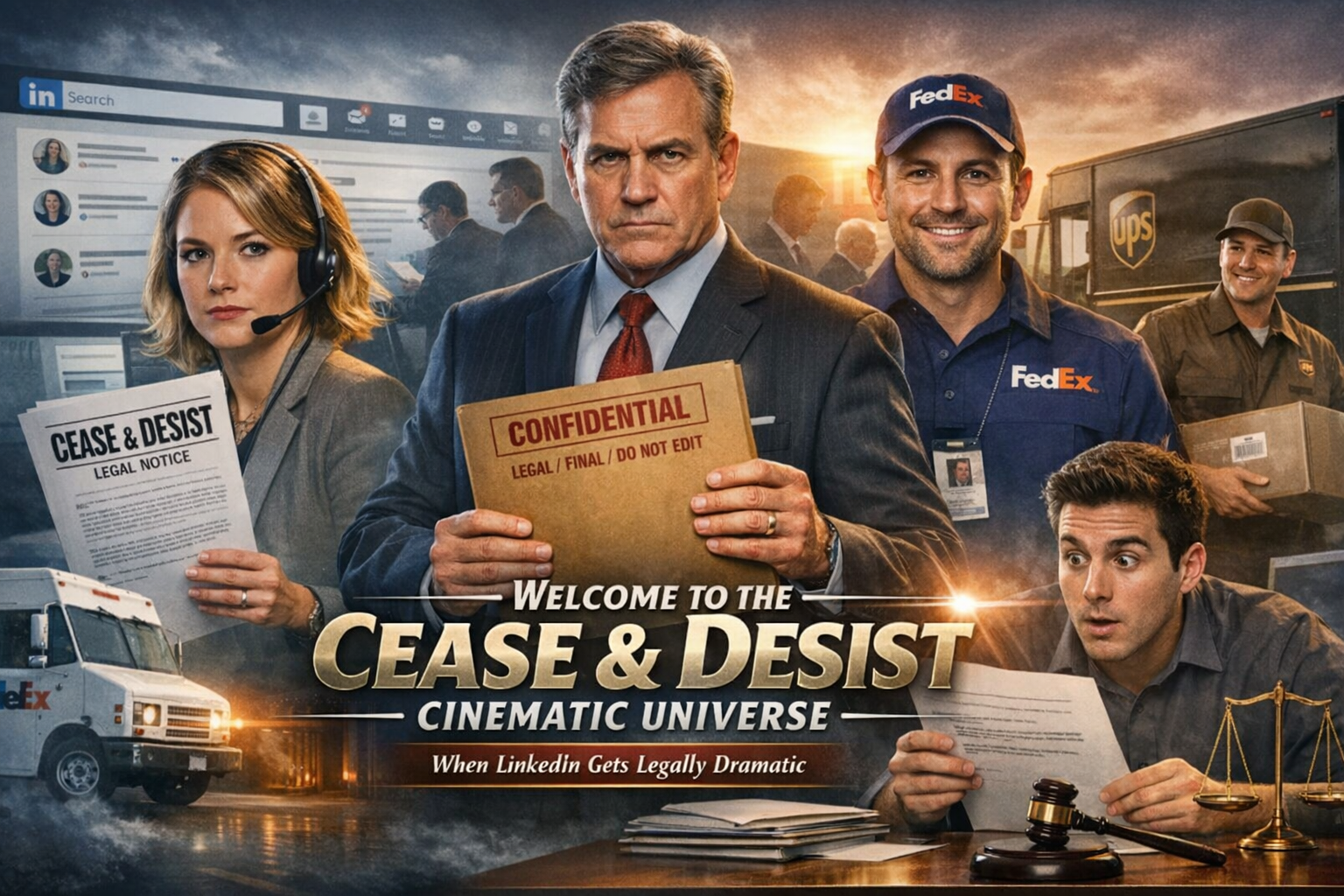
LinkedIn is supposed to be a polite little aquarium where professionals float around in carefully curated poses, smiling through fluorescent lighting and speaking in that gentle dialect of corporate optimism where everything is “exciting,” every setback is “a lesson,” every resignation is “a new chapter,” and every promotion announcement reads like a vow renewal. It’s a place where people say “thrilled” the way Victorian doctors said “hysteria”—with absolute confidence, zero proof, and a strong desire for everyone else to nod along.
It is not, historically, a place where you expect to be served.
Yet every once in a while, the algorithm takes a sharp left turn and drops you into a different genre entirely. You’re scrolling past someone announcing they’ve joined a company you’ve never heard of as “Director of Narrative Excellence,” you’re watching a stranger post a selfie with a ring light and a caption about “choosing joy,” you’re witnessing a man in a vest explain how “leaders don’t complain, they calibrate,” and then—like a door slamming in a quiet hallway—your inbox lights up with a message that is not a message so much as a performance of authority.
It begins with the kind of phrase you don’t hear in real life unless you’re in a courtroom drama or a hostage negotiation:
“Please allow this message to serve as a formal demand.”
A formal demand. On LinkedIn. Floating there like a shark in a kiddie pool, wearing a tie, holding a binder, and pretending this platform isn’t eighty percent humblebrags and twenty percent people pretending they love “cross-functional collaboration.”
That’s the first moment you realize you’re not talking to a person. You’re talking to a template. A template that has lived its entire life in a shared drive folder labeled LEGAL / FINAL / DO NOT EDIT, quietly waiting for its one opportunity to feel powerful. It has never laughed. It has never experienced sunlight. It has never read the room. It has only known revision history and the sweet, intoxicating scent of toner.
And the tone—my god, the tone. Not “Can we talk?” Not “We saw your post and would like to discuss it.” Not even “We’re concerned.” No. We’ve skipped directly to Act Three of Corporate Theater, where everyone suddenly speaks in proclamations, as if a LinkedIn post is not a post but a destabilizing international incident. Somewhere, you can practically hear the orchestra warm up. Somewhere, a projector turns itself on. Somewhere, a compliance officer appears like a cryptid, clutching a PDF and whispering, “It’s time.”
The message will mention “disparagement,” because nothing says “we are stable” like pausing your day to explain how emotionally affected you are. It will reference a “non-disparagement agreement,” because corporate culture loves nothing more than a document you signed while your brain was trying to memorize a new password and your soul was trying to decide whether “we’re a family” was heartfelt or a warning label. It will promise that a “formal cease and desist letter will follow,” because why resolve conflict when you can release a sequel?
And “will follow” is an incredible phrase. “Will follow” is not information. It is a trailer. It is a cliffhanger. It is the corporate version of a horror movie ending where the villain’s hand twitches in the last frame to remind you that the franchise is not done with you.
The funniest part is the implied magnitude. The suggestion that somewhere, in a boardroom full of chairs no one asked for, a group of adults stopped what they were doing and declared, with solemn urgency, “We must act. A LinkedIn post has occurred.” Alarms. Screens flicker. A paralegal sprints. A printer clears its throat and rises to the occasion like a warhorse.
Meanwhile, on the rest of the platform, people are still congratulating themselves. Someone is posting a photo of a notebook and calling it “strategy.” Someone is writing a breakup letter to their job and signing it “with gratitude.” Someone is reminding us that “closed mouths don’t get fed” while selling a course about speaking.
And here you are, holding the opening credits to an entirely different show—one where the stakes are inflated, the language is ceremonial, and the main character is an envelope that desperately wants to be feared.
Welcome to the Cease and Desist Cinematic Universe, where the font is bold, the intent is vague, and the shipping is expedited like the company is trying to win an Emmy for Logistics.
LinkedIn Tries on a Suit and Forgets It’s a Networking App
There’s a special kind of corporate confidence that only appears when someone thinks the word “formal” automatically makes them right. It’s the confidence of a person—or more accurately, a corporate organism—who believes authority can be conjured by tone alone, like summoning a demon by reciting the employee handbook three times in a bathroom mirror.
That’s what a “formal demand” is. It’s not a request. It’s not a conversation. It’s a posture. It’s corporate America standing on tiptoe in dress shoes, trying to look taller.
Because what does a normal human do when they have a concern? They speak plainly. They ask a question. They request a change. They explain why. They attempt to communicate like a creature that has eaten food with other people at a table.
Corporate culture, however, has a different instinct. Its instinct is to inflate. To turn “please remove that” into “please allow this message to serve as a formal demand,” because if you say it like that, it sounds less like you’re bothered and more like you’re the sheriff.
The word “allow” is the funniest part. Please allow. Like you have a choice. Like you are being granted the honor of receiving their seriousness. It’s the politeness of a villain who says “with all due respect” right before they set your day on fire.
And the thing about LinkedIn is that it is not built for this energy. LinkedIn is a networking site that dresses itself up as a professional temple, but it’s still a place where people post photos of themselves shaking hands like they just signed a peace treaty. It’s a place where people announce “I’m humbled” by awards they nominated themselves for. It’s a place where a person can write twelve paragraphs about leadership because their flight was delayed and the airline offered them a voucher.
So when legal cosplay shows up in your inbox, it hits wrong. It’s like someone brought a fog machine to a salad bar.
And the more you read, the clearer it becomes: the point isn’t to resolve anything. The point is to dominate the tone. The point is to move the interaction out of the realm of human conversation and into the realm of ceremonial seriousness, because ceremonies make people hesitate. Ceremonies make people feel like they’re not allowed to speak. Ceremonies make people think, “Oh… maybe I should be scared.”
It’s also why the message will often be vague. Vague is a feature, not a bug. Vague keeps the sender flexible. Vague allows them to sound powerful without committing to specifics. Vague is how you threaten without being pinned down. Vague is the corporate equivalent of saying, “You’ll be hearing from my lawyer,” while still Googling what your lawyer actually does.
The message will imply that you violated something. It will imply that you “know” you did. It will imply that consequences are already in motion. It will imply that a “letter will follow,” as if the existence of paper is itself an enforcement mechanism.
But here’s the problem: confident institutions don’t respond to criticism with cliffhangers. They respond with clarity. If they’re truly secure, they don’t need to intimidate. They can simply communicate.
Fragile institutions, though? Fragile institutions treat a single LinkedIn post like a breach in the hull. They react like the ship is taking on water, not because the post is actually that dangerous, but because the institution has built itself out of vibes and fear and the belief that silence equals safety.
A formal demand is not power. It’s panic wearing a blazer.
And once you see that, the whole thing becomes less intimidating and more… theatrical.
The Font That Clears Its Throat Before Speaking
If the first message is the trailer, the printed letter is the full theatrical release. This is where corporate seriousness stops being a vibe and becomes a physical object you can hold, because nothing says “we’re calm” like spending money to mail your feelings.
Somewhere, someone decided the digital message wasn’t enough. Digital is too casual. Digital is too modern. Digital is where people send memes and birthday wishes and “just circling back” emails. Digital lacks gravitas. Digital doesn’t make your heart race the way a thick envelope does. Digital doesn’t create that moment where you stare at your mailbox like it’s about to deliver a verdict.
So they print.
And when they print, they don’t print quietly. They print with ceremony. They print with a header that screams.
CEASE AND DESIST — LEGAL NOTICE
It’s not a title, it’s a trumpet blast. It’s the font equivalent of a man clearing his throat in a silent room just to remind everyone he exists. It is the kind of header that wants you to sit up straighter, not because it contains anything inherently persuasive, but because it is bold enough to intimidate a lesser soul.
Corporate America loves a big header because it believes big letters create big authority. It believes typography can replace leadership. It believes that if the words are tall enough, you’ll stop questioning them. It’s an ancient ritual, like wax seals and courtroom benches, except now it’s printed on standard office paper next to a faint smell of desperation and printer ink.
And the language inside is always written like someone is trying to sound professional while also making sure you understand you are being threatened. It’s the weirdest balance: polite sentences carrying sharp edges. “Please see the attached correspondence.” “A physical copy is being sent.” “Contact me at your earliest convenience.” It reads like a duel invitation written by someone who also uses Outlook categories.
“Earliest convenience” is my favorite phrase in this genre because it pretends you have agency. It suggests you can choose a time. But the entire point of sending a cease and desist is to steal your comfort. It’s to insert urgency into your day. It’s to make you feel like your time no longer belongs to you—it belongs to their manufactured seriousness.
And that’s what this is: manufactured seriousness. Because if the institution truly had confidence, it wouldn’t need to inflate. It would simply state facts, clarify expectations, and move forward.
But insecurity loves ceremony. Insecurity loves formality. Insecurity loves legal-sounding phrases, because legal-sounding phrases can make ordinary people doubt themselves. They can make you think, “Wait… am I in trouble?” even when what you did was speak.
The letter wants to feel like a gavel.
But it’s still just a piece of paper.
A dramatic piece of paper, yes. A paper that arrived with the energy of a season finale. A paper whose header is doing the emotional labor of an entire legal department. A paper that would absolutely demand a standing ovation if paper could clap.
And this is where the universe starts laughing, because the paper doesn’t arrive alone.
It arrives with shipping.
It arrives with tracking numbers.
It arrives with a supporting cast of delivery companies who did not consent to being part of your corporate drama.
Overnight Shipping as a Personality Trait
There is no better proof that corporate America mistakes logistics for authority than the moment they tell you, proudly, that your threat is being delivered overnight.
Overnight shipping is a fascinating choice because it’s never necessary. It’s symbolic. It’s not about efficiency; it’s about theater. It’s the corporate version of slamming a door—not because the door needs slamming, but because you want the sound to echo.
“A physical copy is being sent via FedEx.”
First of all, the carrier name drop is adorable. Like FedEx is going to kick down your door. Like the truck itself is part of the enforcement mechanism. Like the driver will arrive, scan the package, and whisper, “This is the one,” before handing it to you with a solemn nod.
But the real comedy is what overnight shipping reveals: someone internally decided this was important enough to spend money on speed. Someone said, “This must arrive fast,” as if the letter loses potency if it doesn’t arrive within 24 hours. As if intimidation has an expiration date.
And then, in the most cinematic versions of this saga, you get the crossover episode: another carrier. Maybe UPS. Maybe a second envelope. Maybe the implication that multiple documents are in transit like reinforcements. Because nothing says “we are stable” like diversifying your delivery strategy to ensure your threat hits its target.
Think about what had to happen for this. Drafting. Reviewing. Approving. Printing. Enveloping. Labeling. Tracking-number generating. Shipping-cost approving. Then, the final act: dispatching it into the world like a messenger pigeon carrying corporate anxiety.
All of this takes people. It takes time. It takes budget. It takes effort. It takes an entire chain of operations that could have been used for something else—like improving culture, addressing complaints, or learning the ancient forgotten art of “talking.”
But no. They chose the move corporate culture loves most: escalation disguised as professionalism.
And here’s the twist: the more effort they put into shipping, the less powerful they look. Because confident institutions don’t need to rush paper to your home. Confident institutions don’t panic over posts. Confident institutions don’t treat criticism like a fire alarm.
Overnight shipping is not a flex. It’s a confession. It says, “This got under our skin so fast we needed you to feel it immediately.”
It’s also self-defeating. Because threats amplify attention. “Cease and desist” is marketing with a law degree. It triggers curiosity the way a “DO NOT PRESS” button triggers toddlers. The minute you say it, you’ve essentially placed a neon sign over the situation that reads: There is something here we desperately want you not to look at.
You wanted silence and accidentally ordered curiosity with signature confirmation.
Which is why this entire saga eventually turns into the same lesson: the organization isn’t fighting a post. It’s fighting the reality that someone spoke.
And when the only response is paper and speed, you’re not watching strength.
You’re watching fear with a tracking number.
The Only Adult in the Story Is the Delivery Driver
By the time you reach the end of this saga, you realize something quietly devastating: the most professional person involved is the delivery driver.
The driver arrives. The driver is polite. The driver does not monologue. The driver does not invoke ancient covenants. The driver does not say “formal demand.” The driver simply hands you the envelope like it’s what it is: a package. A thing. An object. Not an event, not a prophecy, not a courtroom summons disguised as stationery.
They have no idea they’re participating in Corporate Theater. They don’t know the envelope contains a header that thinks it’s a judge. They don’t know the sender wrote “will follow” like they were writing the teaser for season two.
The driver is simply doing their job—ironically, with more actual professionalism than the institution that sent the letter.
And then you’re standing there holding paper that is trying to manufacture authority.
And you see the mechanism clearly: corporate power, when insecure, does not communicate. It controls. It does not clarify. It intimidates. It does not address the substance. It addresses the optics.
Because the point of a cease and desist, in this context, is not to solve a problem. It’s to shift the emotional balance. It’s to make you feel isolated. It’s to make you feel like you are alone against “official documentation.” It’s to make you think their seriousness is proof of their correctness.
But seriousness is not truth. Urgency is not morality. Bold font is not a valid argument.
If an organization can’t handle criticism without deploying threats, the problem isn’t the person speaking.
It’s the culture that thinks silence is the same thing as safety.
A strong organization doesn’t need to intimidate. It can respond with facts. It can explain. It can apologize if needed. It can stand on substance.
A fragile one sends a letter and calls it leadership.
And the most telling part is the effort: the institution mobilized paperwork, shipping, and ceremonial language because it didn’t know how to do the thing that would have been simplest and strongest—talk.
The letter is not proof of power.
It’s proof they felt powerless.
Final Thoughts: If You Need a Tracking Number to Win an Argument, You Already Lost
The cease and desist genre is one of corporate America’s favorite illusions. It’s the illusion that if you can make something sound official enough, it becomes official. If you can make it sound legal enough, it becomes right. If you can mail it fast enough, it becomes unstoppable.
But the truth is simpler and funnier: most of this is theater. It’s corporate cosplay. It’s intimidation wearing business casual. It’s an institution trying to reclaim control not by being better, but by being louder in writing.
Because the real purpose of this kind of letter isn’t “resolution.” It’s emotional leverage. It’s the attempt to make you doubt yourself. It’s the attempt to make you feel like your voice is risky, like your perspective is dangerous, like speaking is a violation.
And that’s why it always arrives with so much ceremony. That’s why the header is shouting. That’s why the phrasing is theatrical. That’s why the letter “will follow” like an ominous sequel. That’s why they name drop FedEx like the truck is the cavalry. That’s why they wrap the whole thing in professionalism—because professionalism, in corporate culture, is often used the way stage lighting is used in theater: not to illuminate truth, but to direct attention.
If you’ve ever wondered what insecurity looks like when it has a budget, this is it. A packet of paper, mailed quickly, designed to make you flinch.
And yet, the irony is that it often does the opposite. It doesn’t silence. It spotlights. It doesn’t diminish your voice. It validates that your voice landed. It doesn’t make the organization look strong. It makes it look like it has a hair-trigger nervous system and a deep dependence on templates.
Because strong institutions don’t panic over posts. They outgrow them. They respond like adults. They communicate. They clarify. They fix what needs fixing. They understand that reputations are built through behavior, not through threats.
Fragile ones, however, treat criticism like contamination. They rush to control the narrative like it’s leaking out of a cracked jar. They don’t ask, “Is there truth here?” They ask, “How do we make it stop?”
And the saddest, funniest part is this: the paper is never as powerful as the institution wants it to be. The paper can arrive overnight, but it can’t deliver respect. It can’t deliver trust. It can’t deliver credibility. It can’t deliver the one thing they’re trying to buy with shipping and tone—authority.
Authority is earned. It is not printed.
So if you ever receive a “formal demand” on LinkedIn, remember what it really is: a networking app briefly pretending it’s a courtroom because someone got their feelings hurt in a professional font.
You don’t have to be scared of paper.
Paper is just paper.
The only thing it truly proves is this: you spoke loudly enough that someone, somewhere, stopped what they were doing, opened a template folder, and said, “Send the trucks.”
And honestly?
That’s not intimidation.
That’s impact.