
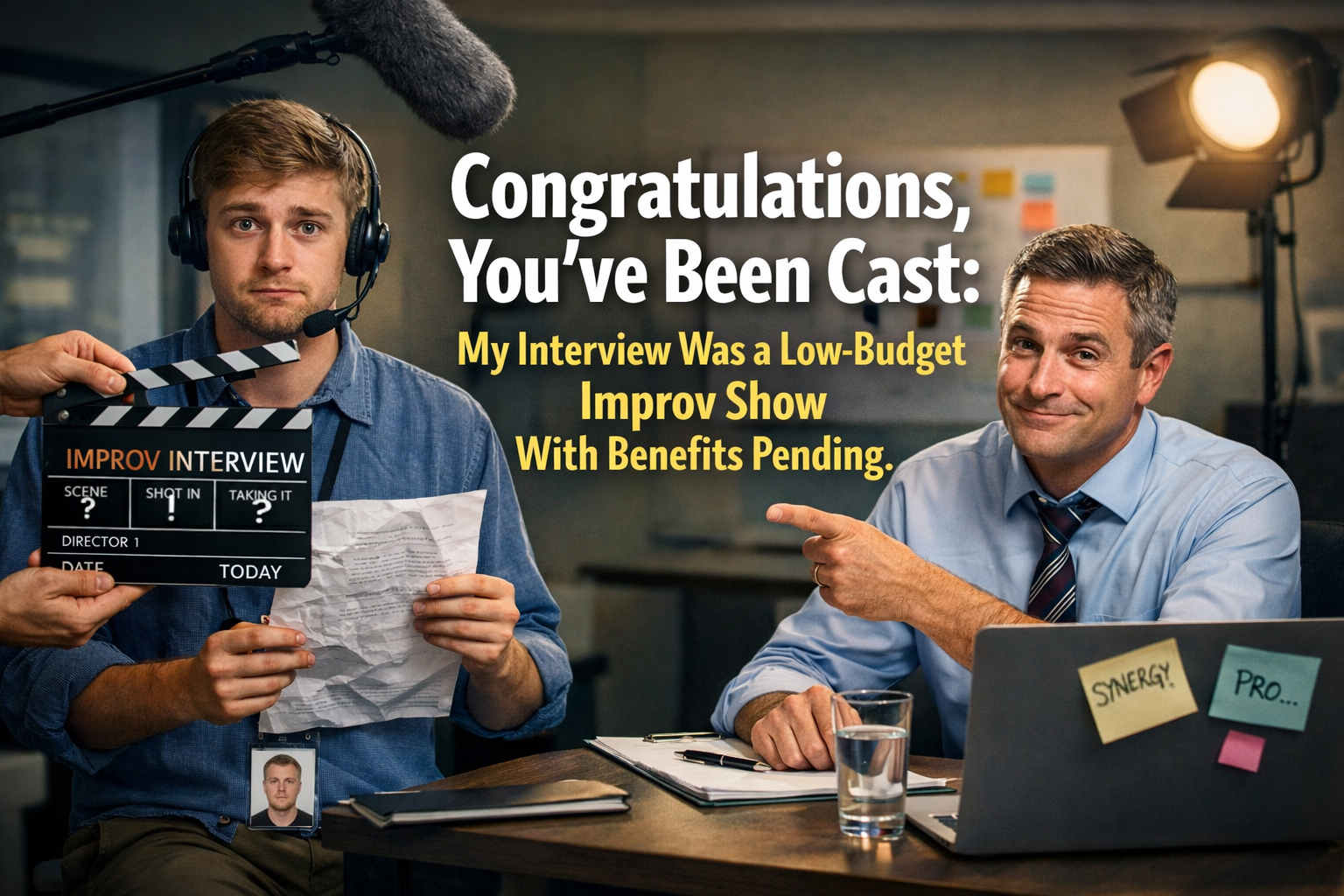
I’ve learned there are two kinds of interviews in corporate life, and the tragedy is that the calendar invite never tells you which genre you’re walking into.
There’s the respectable kind, the normal kind, the kind our parents still believe exists: a room (physical or digital) where competent adults ask thoughtful questions, you answer them like a competent adult, everyone nods like a committee of serious owls, and afterward you leave with the familiar combination of hope, dread, and the faint smell of printer toner that always lingers around HR departments like they’re actively printing anxiety in duplex.
And then there’s the other kind, the one that has quietly become the default experience for anyone applying to a job in the modern era: the interview that is not an interview, but a performance, a surprise audition, a corporate escape room disguised as “a quick chat,” an unpaid speaking role in a production titled Please Don’t Make This Awkward, where the objective is not to evaluate your ability to do the job but to see how gracefully you can maintain eye contact with absurdity while it throws chairs at your self-esteem.
This second type is always introduced with cheerful language. “We’re excited to meet you!” they say, which is corporate for: We have not met you, we have not read your resume, and if we did read it, we absorbed it the way a goldfish absorbs a TED Talk, but we are excited to do something adjacent to meeting you, as a concept, in the abstract. The invite includes a Zoom link, a meeting title that looks like it was generated by a microwave (“Interview – Round 2 – Candidate Review – Final_v3”), and a list of attendees that feels like a social experiment: one person with the job title you applied for, one person from HR, one person who is “joining for five minutes,” and one mysterious entity named “Recruiting Team” who either never appears or appears only as a silent black square labeled “iPad.”
This is how you end up in situations like mine, where I logged in expecting a real interview and instead found myself in a digital community theater production where the lead actor was an intern holding a piece of paper like it was a sacred text, and I, the candidate, was about to learn that my role was not “Experienced Professional,” not “Future Team Member,” not even “Human Being With Questions,” but “Helpful Substitute Teacher Who Must Pretend This Is Fine.”
It’s a special flavor of modern corporate life, the kind you can’t explain to someone who hasn’t lived it because it sounds like satire, and yet here we are, all of us, adding new chapters to the same shared anthology titled We Are Definitely Not Okay, But Please Proceed To The Next Round.
So let me walk you through it, not as a complaint, but as a documentary, a field guide, a cautionary tale, and a love letter to every candidate who has ever realized mid-interview that the company isn’t assessing their skills as much as it’s assessing their ability to politely carry an adult conversation for everyone in the room.
The Casting Call, Or How I Met My Interviewer (And He Met The English Language)
The intern appeared on screen with the wide-eyed intensity of someone who had been told, moments before, that they were about to perform brain surgery and the only tool available was a laminated FAQ page. His badge, if it had been on camera, would have still had the factory scent, that fresh-plastic optimism that hasn’t yet been crushed by the weekly recurring meeting titled “Alignment.” He was holding a piece of paper at chest level like a courtroom clerk reading the charges, eyes flicking between the questions and the camera like he was trying to keep both the script and reality from escaping.
He cleared his throat with the ceremonial gravity of a man about to read the will. “Question… one.”
Now, the paper did not merely exist; it crinkled with purpose, announcing itself like a character in the scene. The paper had stage presence. The paper was not a tool; it was the star. I could hear it shifting, folding, gripping the air with that brittle sound that says: I have been printed, I have been distributed, and no one has prepared anyone for what comes next.
He began reading the first question with the confidence of someone attempting to defuse a bomb using a YouTube tutorial filmed in 2009, and the first line came out fine because the first line always comes out fine. Corporate questions are designed to lure you into a false sense of normalcy with familiar phrases like “Tell me about yourself,” which is human language, and “Walk me through your experience,” which is still human language, and then they abruptly turn into corporate spellcasting: “Describe a time you leveraged cross-functional synergies to optimize stakeholder enablement.”
And that’s where we met the villain of the story: a word he couldn’t pronounce.
Now, I want to be compassionate. We have all been betrayed by language. We have all encountered a word that looks like it was assembled by committee. But there is a unique kind of tension when someone is actively interviewing you while losing a wrestling match with the alphabet. He tried once, stumbled, tried again, and produced a sound that can only be described as a sneeze trying to access the internet through dial-up.
At this moment, my brain presented me with two choices.
Choice one: sit silently and watch him struggle, letting the discomfort fill the room until we both dissolve into awkward dust and Zoom automatically ends the meeting out of pity.
Choice two: become the co-host.
And because I am a seasoned candidate, a professional, a person who has survived corporate life long enough to understand that sometimes your job is simply to keep the group project moving, I chose option two. “Oh, that word is ‘synergy,’” I said gently, the way you teach a toddler to say “spaghetti” while maintaining the illusion that you are not actively parenting an interview.
He nodded, relief flooding his face like I had just restored oxygen to the room, and continued reading as if nothing unusual had occurred, which is a very corporate thing to do: a small crisis happens, someone quietly saves it, and everyone pretends it was always part of the process.
In a normal world, this would have ended the interview because everyone would have agreed, in human language, that the interview had become a different thing entirely. But corporate life does not operate on human language. Corporate life operates on momentum. As long as the meeting is still happening, it is considered productive, even if the meeting has become a live demonstration of why training matters.
So we proceeded.
And with each question, the paper crinkled like applause, the intern stared at it like it contained the secrets of the universe, and I realized I wasn’t being interviewed so much as I was serving as the stabilizing adult presence in a scene that was rapidly becoming an educational film titled Leadership: When You Have To Do The Thing While Someone Else Reads The Thing.
The Reading Circle, Or How I Became The Supportive Stage Partner In My Own Evaluation
The rest of the interview transformed into a collaborative reading circle, which sounds wholesome until you realize that one of the participants is trying to decide whether you should be trusted with payroll access.
He would begin: “Tell me about a time you demonstrated… uh… pro-ac… proac…” and then he would look up with the quiet panic of someone who has reached a cliff edge and is hoping the candidate will politely build a bridge.
And I would jump in like a supportive improv partner, because at that point it wasn’t just about the word; it was about the vibe. “Proactivity,” I offered.
“YES,” he said, with the gratitude of someone who has been rescued from drowning by a stranger who was only trying to ask about team dynamics.
There’s a special kind of corporate comedy that happens when you’re the one doing the work of keeping the interview functional while being evaluated for whether you can do work, because the answer is clearly yes, I can do work, I am actively doing work, I am doing work for you right now, in real time, during the interview you are supposedly conducting, and if you would like a reference, I can provide it, because I am currently referencing myself.
Somewhere, I am convinced, a recruiting manager was watching this unfold and mistaking it for a leadership demonstration. Look at him, they probably thought, stepping up, coaching talent, providing clarity, elevating performance. This is the kind of person we need. He’s already managing our talent pipeline in real time.
Which sounds flattering until you remember that I was coaching the talent pipeline because the talent pipeline was holding a paper like it was an ancient tablet and asking me to decode it.
As the questions continued, I entered a bizarre professional state I can only describe as “polite survival.” I answered everything with the appropriate corporate seasoning: strategy, impact, growth, cross-functional collaboration, stakeholder alignment, customer-centric outcomes, scalable solutions, and the kind of confident delivery that says I have been in rooms where decisions were made and I lived to tell the tale.
And the intern responded the same way to every answer: “Okay.”
Not “great answer.” Not “tell me more.” Not “that’s interesting, can you expand.” Just “okay,” like my entire career was a captcha he clicked through while trying to prove he wasn’t a robot, even though the situation itself felt suspiciously robotic.
At one point, he asked where I saw myself in five years, and my soul briefly tried to escape my body and type, “Holding the paper while you take the interview,” into the chat. But I stayed professional, because professionalism is essentially the art of experiencing a thought and then swallowing it like a live grenade.
So I delivered the answer we all deliver, the answer that has been recited by candidates since the dawn of PowerPoint: I see myself growing, contributing, leading initiatives, driving meaningful outcomes, building strong partnerships, delivering value, and doing work that matters.
He looked down at his paper, and the paper looked back, and he said, “Okay.”
This is when I began to understand the real challenge of modern interviewing: it’s not answering questions, it’s maintaining dignity in a situation where the structure has collapsed but everyone is still pretending the building is standing because the meeting is on the calendar and the calendar is sacred.
And if you can do that, if you can keep your tone steady and your posture upright while the interview quietly turns into a group exercise in improvisation, you begin to realize that the interview isn’t measuring your capability. It’s measuring your composure.
Not “Can you do the job?” but “Can you remain calm while the process does the job poorly?”
Not “Do you have experience?” but “Do you have the emotional stamina to treat this as normal?”
Not “Are you a culture fit?” but “Will you play along with the performance, even when the script is missing pages?”
Which is a fascinating thing to test in candidates, and also deeply terrifying, because it suggests the job itself might feel exactly like this, except instead of one intern with a paper, it’s an entire organization holding policies they don’t understand and asking you to pronounce them with confidence.
The Questions Portion, Or When He Admitted The Script Ends Before The Plot Does
Then came the grand finale, the moment every interview eventually reaches, the moment where the candidate gets to ask questions, which is corporate tradition’s way of pretending this is a two-way conversation and not a ritual.
“Do you have any questions for me?” he asked, and for a brief second I considered asking whether he wanted help with the next word on the sheet, because at that point, we were a team. We had been through things together. We had survived pronunciation. We had built trust. We had created a bond forged in the shared understanding that nobody in this call had been properly set up for success.
But I stayed polite, because I am the kind of person who will hold the door open for chaos as long as it is wearing a badge.
So I asked the questions candidates ask when they’re trying to appear employed by dignity: What does success look like in this role? What are the priorities in the first 90 days? How does the team measure performance? What does a strong partnership across functions look like in practice? What are the biggest challenges the team is facing right now? How would you describe the culture beyond the buzzwords?
He blinked twice, looked down, and said the sentence that should be engraved on a plaque above every recruiting department in the country: “I don’t have that part.”
Now, on one hand, I appreciated the honesty. He didn’t try to improvise. He didn’t pretend. He didn’t throw out random corporate words like “agility” and “transparency” like he was sprinkling seasoning on a dish he had never tasted. He simply admitted the truth: the script ended before the plot did.
On the other hand, the situation became almost spiritually comedic, because this is the part of the interview that reveals whether the company is organized, whether the role is clear, whether anyone knows what they’re hiring for, whether success is defined, whether priorities exist, whether the job is real or just a concept floating around in someone’s head like a motivational quote.
And the representative of the company, the person assigned to be the face of this process, was telling me that his paper did not include the part where they explain the job.
It’s like going to a restaurant, ordering a meal, and the waiter saying, “We have the menu for the first course, but the rest is vibes.”
It’s like being on a plane, hearing the pilot say, “I know how to take off, but the landing instructions weren’t printed, so we’ll just see what happens.”
It’s like signing a lease and being told, “We have the keys, but we don’t have the part where we tell you where the building is.”
And still, you must nod politely, because you are the candidate, and the candidate must always behave like the process makes sense, even when the process is openly admitting that it does not.
I thanked him. I told him I appreciated the time. I smiled in the way candidates smile when they’re trying not to scream. He said “okay” one last time, like punctuation, and the call ended.
And when the screen went dark, I sat there for a moment, staring at my own reflection, and realized what had actually happened: I had not been interviewed. I had endured something.
Some interviews aren’t interviews. They are endurance tests. They are corporate escape rooms. They are improv comedy where the only rule is that you must pretend the script is real, even when the intern can’t pronounce the premise.
If this was culture fit, the culture is community theater with Wi-Fi.
Final Thoughts: Offer Letter Pending, Sanity Optional
Here’s the part where I’m supposed to wrap this up with wisdom, like a wholesome LinkedIn parable, and say something uplifting about resilience and growth and how every experience is a stepping stone toward your destiny.
But let’s be honest: sometimes the only lesson is that the process is broken, and your job, as a candidate, is to navigate it without letting it convince you that you are the problem.
Because the modern job hunt will absolutely try to gaslight you.
It will make you feel like you’re failing because you didn’t “sell yourself” enough, even when you literally coached the interviewer through the vocabulary.
It will make you wonder whether you’re behind, even when you’re the only adult in the room.
It will make you question your worth because you didn’t get “great answer” feedback, even when the feedback mechanism is a piece of paper that ends before the questions begin.
It will also do that thing where it turns professionalism into performance, where you’re not rewarded for competence so much as for your ability to make chaos look like a strategy. If you can keep your voice calm while the process free-falls, if you can smile while the script disintegrates, if you can answer questions that aren’t even being understood by the person asking them, you are considered a strong candidate, not because you’re the best fit, but because you are the safest person to hand the mess to.
And maybe that’s the real interview.
Maybe the real assessment is: Are you willing to keep the machine running, even when the machine is clearly missing parts?
Because if the interview looks like that, imagine the onboarding.
Imagine the first day, where the intern hands you another paper and says, “Welcome. I don’t have the part where we tell you what success looks like, but I do have the part where you reset your password.”
Imagine the first week, where you’re asked to “own” something that nobody can define, “lead” something that nobody attends, and “align” with stakeholders who have never heard of the project but strongly feel you should provide an update.
Imagine the first month, where your manager says, “We need you to be proactive,” and you flash back to the moment you taught someone how to pronounce it.
So yes, I think I nailed it. I showed leadership. I demonstrated adaptability. I drove cross-functional pronunciation outcomes. I enabled stakeholder comprehension. I delivered value in the form of syllables.
I’m now expecting an offer letter addressed to “Dear Candidate Who Helped Us Read,” with a compensation package consisting of one salary range they can’t disclose, three benefits they haven’t finalized, and a signing bonus payable in exposure.
And when they ask me for references, I will simply provide the intern’s name, because technically, I managed him for thirty minutes, and if anyone can vouch for my ability to lead under pressure, it’s the person who watched me rescue a corporate process from being defeated by the word synergy.