
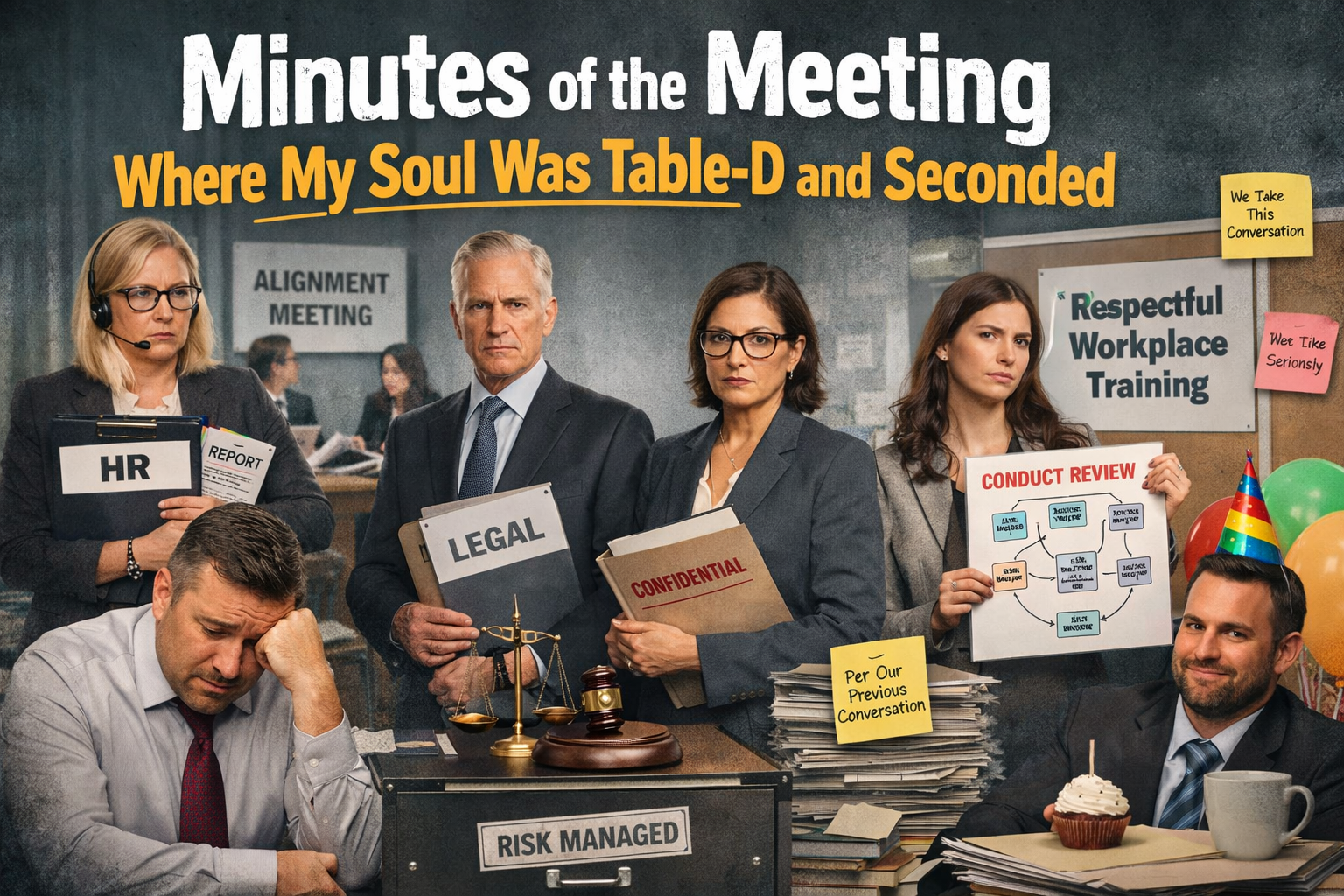
Back when I worked for corporate America, I learned there are three departments that never sleep: HR, Legal, and the tiny internal committee responsible for turning every human conversation into a PDF, stamping it with a version number, and then emailing it back to you as an “FYI” as if it’s helpful to receive your own feelings as an attachment.
Corporate life is fascinating like that. It doesn’t matter what the moment is. It doesn’t matter how small, how harmless, how deeply nonthreatening your sentence feels when it leaves your mouth. The moment you say, “Hey, quick question,” the building changes temperature by two degrees, someone’s eyes narrow like you just admitted to tax fraud, and you can practically hear the office furniture scooting itself into a more defensible formation. Your coworkers don’t respond like coworkers. They respond like people who have been trained—gently, lovingly, with the slow conditioning of a workplace that calls itself “a family”—to treat all casual language as a potential Exhibit A.
Because that’s the secret: corporate America doesn’t hate conversation. It hates unstructured conversation. It hates any exchange that hasn’t been processed through the proper channels, sanitized for tone, drained of personality, and translated into an email that could survive discovery. You might think you’re asking for clarity, but they hear risk. You might think you’re making a joke, but they hear liability. You might think you’re being honest, but they hear someone trying to smuggle a real emotion into a system that only recognizes “professional neutrality” and “action items.”
And this is how it starts. You walk into work a normal person. You leave work a heavily edited document. Somewhere along the way, your laughter gets routed through compliance, your frustration gets rebranded as “concern,” and your perfectly reasonable request becomes a calendar invite titled “Alignment” that includes four people you’ve never met and one person who will take notes as if your nervous system is a project milestone.
This is not an article about hating HR or Legal as individuals. The people are often fine. The system is the monster. The system is the thing with the smile and the handbook and the soothing voice that says, “We take these matters seriously,” while quietly escorting your problem into a drawer labeled “Risk Managed,” never to be opened again unless a VP needs a scapegoat and a timeline.
So if you’ve ever wondered why corporate workers can look calm while dying inside, it’s because we learned the only safe emotion is the kind that can be formatted in 11-point font and approved by a committee. Laugh quietly. Cry in a spreadsheet. And if you must speak, speak like you’re being recorded by someone’s future lawyer.
Welcome to the workplace support group. Attendance is mandatory, but the healing is optional.
HR, or the Department of Feelings With a Barcode Scanner
HR did not want to solve problems. HR wanted documentation. HR wanted the story of your lived experience to arrive in triplicate, signed, dated, witnessed, and expressed in neutral language that makes it sound like you are describing a weather pattern instead of a human event. They were not referees. They were archivists. Their natural habitat was the phrase “per our previous conversation,” which is corporate for “I remember everything you said, and I want you to know I can retrieve it.”
If you came to HR with something messy—something human—something that required discernment, courage, or even the basic act of acknowledging reality, HR would pull out a form so calmly you’d almost admire it. You’d be like, “This person is treating me badly,” and HR would respond, “Thank you for sharing. Before we proceed, can you clarify what you mean by ‘badly’ using measurable verbs and time stamps?” It’s like trying to report a fire and being asked whether the flames are aligned with the company’s values and whether the smoke has completed the correct training module.
And the language. My God, the language. HR does not speak in sentences. HR speaks in protective spells. You could say, “I feel disrespected,” and HR would translate it into something like: “The associate has expressed a perception of misalignment with interpersonal engagement standards.” Your pain gets reclassified as “a perception.” Your reality gets repackaged as “a concern.” Your boundaries get described as “a preference.” Everything becomes soft around the edges so nobody has to touch the sharp part where accountability lives.
Then comes the ritual: they schedule a meeting. Not a meeting to fix anything. A meeting to formally witness the existence of the issue, the way you might take a photograph of a problem and then frame it and hang it in the hallway as proof that at one point, someone noticed. They will nod. They will type. They will say, “I hear you,” in the same tone people use when they are training a dog not to jump on guests. And then—because the system must always protect itself—they will ask for your statement.
Your statement is where you learn that the workplace does not want the truth. It wants a usable version of the truth. It wants the truth in a format that can be filed, forwarded, and summarized in a slide deck without causing anyone’s eyebrows to rise. So you give them the statement. You give them dates. You give them examples. You give them context. You give them your dignity, shrink-wrapped.
And then nothing happens for a while.
This is the part where you stare at your inbox like it’s a slot machine. You keep pulling the lever. You keep getting the same outcome: silence, followed by a vague email that says, “We are reviewing,” which is corporate for “We are deciding whether this is worth the inconvenience.” Sometimes you get the sacred phrase, the one that means you should stop expecting anything: “We take these matters seriously.”
Of course they do. They take them seriously the way a librarian takes overdue books seriously. The seriousness is procedural, not personal. It’s not about protecting you. It’s about protecting the building. HR is not your ally. HR is the company’s emotional support animal. Friendly, present, trained to soothe the room, but ultimately loyal to the person holding the leash.
And if you ever make the mistake of thinking HR is on your side, you will eventually experience that magical moment where you report something and somehow become the problem. Your complaint gets processed like a boomerang. It returns to you with your name on it and a brand-new label that says “needs coaching.”
Legal, or the Place Where Sentences Go to Lose Their Personality
Legal was worse. Legal was the part of the building where language goes to die quietly under fluorescent lights. Legal doesn’t read your words for meaning. Legal reads your words for risk. Legal is what happens when a company looks at a human being and thinks, yes, but what is the exposure.
You might write an email like, “Can we please stop scheduling meetings at six?”—a reasonable request from a person who wants a life—and Legal will translate it into: “This communication shall not be construed as a request, suggestion, or indication of dissatisfaction, implied or otherwise, and is submitted without prejudice to any rights held by the company in perpetuity.” You’ll read the final version and wonder if you just tried to unionize by accident.
Legal removes personality like it’s an infection. They strip away tone, humor, softness, and any hint that you were once a human who laughed freely in sunlight. They take your sentence and replace it with something that sounds like it was written by a cautious robot who got promoted for never taking a clear stance. You don’t “ask.” You “inquire.” You don’t “disagree.” You “seek alignment.” You don’t “need.” You “request clarification.” You don’t “feel.” You “observe.”
And you know what? In their world, it makes sense. Legal is the company’s bouncer. Legal is there to decide who gets in, who gets out, and who needs to be escorted away from the dance floor because they are moving their arms in a way that could become a lawsuit.
But here is the part that breaks your spirit in the most beautifully corporate way: Legal doesn’t just rewrite your emails. Legal rewrites your ability to speak. You start editing yourself before you even open your mouth. You begin living in the pre-draft stage of your own thoughts. You hear yourself forming a sentence and you stop midway, like your internal Legal department just ran a risk assessment on your feelings and found them noncompliant.
You become a person who says things like, “Just flagging this,” and “Wanted to bubble up,” and “Not sure if this is the right forum,” even when you are literally sitting in a meeting called “Open Forum.” You learn to communicate in fog. You learn to say nothing in many words. You learn that clarity is suspicious.
And if you ever try to be direct—if you ever choose plain language over corporate incantation—the system reacts like you brought outside food into the cafeteria. Someone will respond with, “Let’s take this offline,” which is corporate for “Please stop speaking in front of witnesses.”
Because corporate America does not fear conflict. It fears recordable conflict. It fears any moment that might later be explained to someone outside the building who still remembers what words mean.
Humor, or the Unapproved Software Install That Triggers an Audit
And heaven help you if you were funny.
Humor in corporate America is treated like an unapproved software install. First someone asks, “Is this appropriate?” Then HR pulls out the sacred flowchart: intent, impact, context, and whether your joke has been pre-cleared by the Department of Vibes. If you laugh too loudly, you are one Slack message away from a mandatory training called “Respectful Workplace: Part Seven, The Reckoning,” where the main learning objective is “Be less alive in public.”
The irony is that corporate America loves to brand itself as fun. They put “fun” in slide decks. They put “fun” in job descriptions. They put “fun” in the list of values right next to “integrity,” as if fun is something you can measure quarterly. They will host a pizza party and call it culture. They will add balloons to a meeting and call it morale. They will use the word “family” and then lay people off in an email sent at 4:58 p.m.
But genuine humor—the kind that happens naturally between humans, the kind that relieves tension and makes the day feel survivable—genuine humor is dangerous. Genuine humor implies truth. It implies shared understanding. It implies that someone noticed the absurdity. And the system cannot allow too much noticing.
So you learn to do comedy the way you learn to do everything in corporate life: carefully, quietly, with plausible deniability. You tell jokes that are so bland they could be used as office air freshener. You laugh with restraint, like you’re borrowing laughter from the company and don’t want to get charged for it. You make sure your humor can be interpreted as “team building,” because if it can’t be rebranded as productivity, it will be treated as a threat.
And when HR and Legal team up—when the archivist and the bouncer collaborate—it becomes a magic show where accountability disappears in real time. You will report something real and receive a response so vague it feels like it was generated by a machine trained on apology templates. You will watch your messy human situation get translated into a corporate lullaby: “We have addressed the matter.” Addressed how. With what. To whom. In what universe. The answer is never the point. The appearance of process is the point.
By the time you get closure, the original issue has already retired and moved to Florida. The person who caused the problem has been promoted, re-titled, or relocated to a new department where they can continue their legacy uninterrupted. And you—if you’re still there—are expected to carry on with professional neutrality, the only emotion the system can safely archive.
Final Thoughts: Professional Neutrality and the Art of Dying Quietly in a Calendar Invite
Eventually I realized the system was not built to protect people. It was built to protect the company from people. The company does not want humans; it wants predictable inputs and quiet outputs. It wants you to be productive, polite, and emotionally flat enough to function as a dependable part of the machine. It wants your work, your loyalty, your availability, and your weekends if the meeting “runs long,” but it does not want your honest reactions to any of it.
That’s why corporate workers look calm while dying inside. We have learned to survive in a landscape where every sentence is a potential liability and every emotion needs a disclaimer. We have learned to compress our personalities into acceptable formats. We have learned that the safest thing you can be is vague. Vague is untraceable. Vague is unprovable. Vague is how you make it to Friday without being called into a meeting that starts with, “This is a safe space,” and ends with, “We’ll follow up.”
And yet, somehow, we keep showing up. We keep performing professionalism like it’s a stage role we were cast in without auditioning. We keep joining meetings titled “Alignment” where the goal is never alignment, it’s containment. We keep writing emails that say “circling back” because saying “you ignored me” is considered aggressive. We keep pretending the system makes sense because admitting it doesn’t would mean admitting we have spent years living inside an absurd theater production where the props are real and the consequences are worse.
If this gave you flashbacks, share it with the coworker who still says “circling back” like it is a personality trait and not a symptom. Let us start a support group where the only rule is that we speak in normal human language, and nobody is allowed to summarize your trauma into bullet points.
Bonus points if you forward it to HR. They will file it as “Culture,” tag it “Feedback,” and schedule a meeting to discuss whether you could have expressed your existential despair in a more solutions-oriented tone.
And somewhere, in the quiet glow of a monitor at 6:02 p.m., the tiny internal committee responsible for turning every human conversation into a PDF will smile, click “Save As,” and whisper softly to itself: version final_FINAL_reallythisone.pdf.