
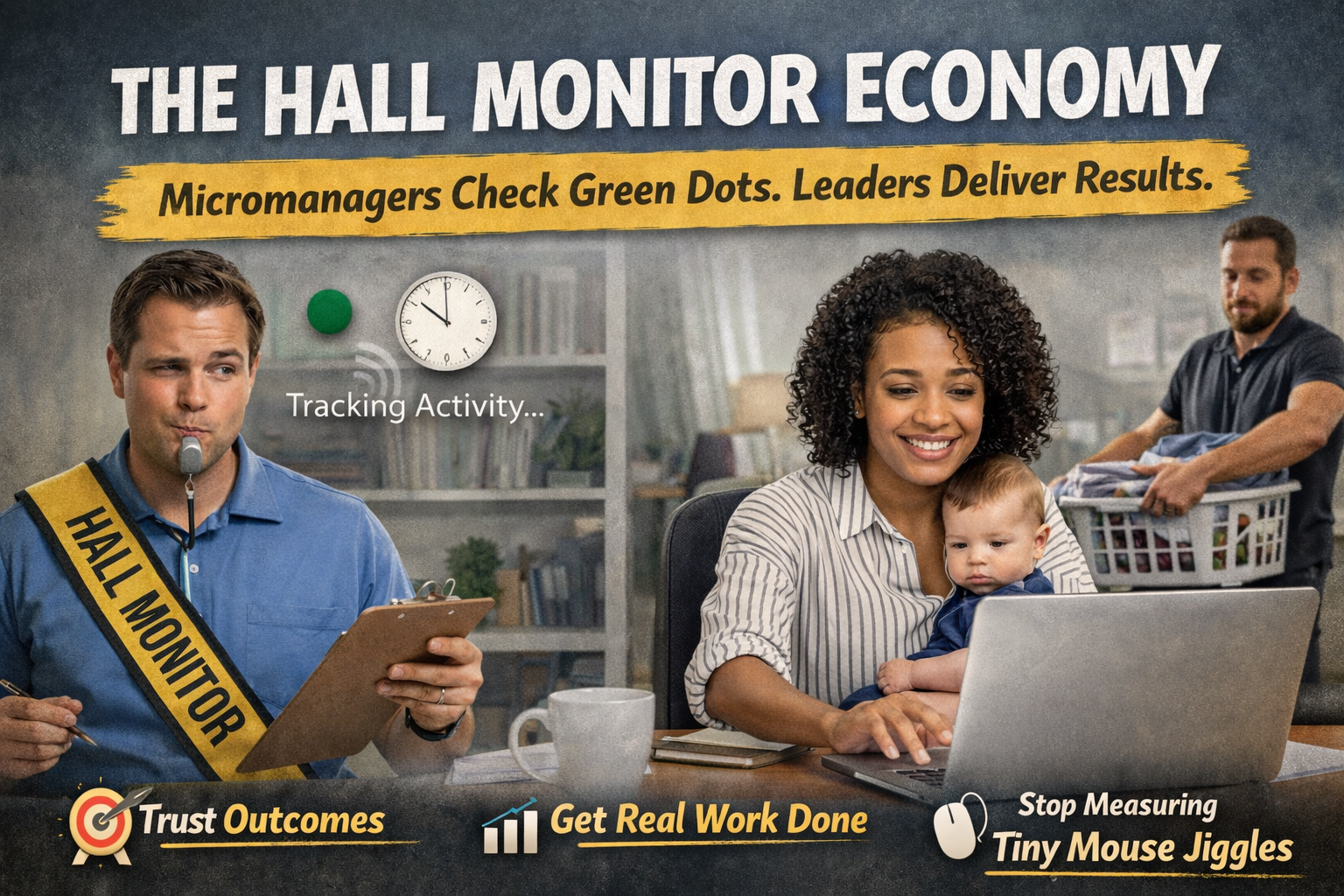
There are two kinds of leaders in the world, and you can usually tell which one you have within the first five minutes of a remote work conversation, right around the moment someone says the phrase “time theft” with a straight face, as if the greatest threat to modern capitalism is a grown adult putting their laundry in the dryer between meetings, not the fact that we’ve built entire business models on pointless status updates, calendar Tetris, and the ritual sacrifice of focus at the altar of “quick syncs.”
Some people hear “remote work” and picture flexibility, autonomy, and a sane adult life where you can knock out real work without having to perform productivity like it’s a Broadway show. Other people hear “remote work” and immediately spiral into a cold sweat because they can’t physically see you sitting in a chair, which—according to their personal philosophy of management—means you must be doing crimes.
These are the managers who treat Slack like a polygraph test. They stare at the green dot the way ancient civilizations stared at the sky, searching for meaning, signs, prophecies, and whether Karen from Ops is “really working” or just “being suspiciously away for twelve minutes,” which is obviously how long it takes to execute a full betrayal of the company mission.
And here’s the thing: the original post you replied to wasn’t controversial in any sane universe. It was a simple, beautiful statement of adult leadership: if the work is getting done, I don’t care if you ran an errand, did a school pickup, took a nap, got a haircut, or temporarily left your desk to participate in being a human.
That’s not “time theft.”
That’s life—coexisting with work the way it always has, except now you’re not forced to pretend you’re a robot who never needs to eat, stretch, or refill your coffee. Remote work didn’t invent errands. It just removed the theater where everyone pretended they weren’t doing them.
Because people have always taken breaks.
In offices, those breaks were just rebranded as “collaboration.”
We didn’t stop doing laundry. We just stopped pretending the only acceptable time to exist was before 9 a.m., after 5 p.m., or during a lunch break you were never really allowed to take.
So yes: micromanagers measure mouse jiggles. Leaders measure impact.
And if that sentence makes someone angry, it’s usually because they just realized their entire management identity is built on monitoring activity logs and sending messages like “Hey, saw you were away—everything okay?” with the warm, supportive energy of a parking enforcement officer.
Let’s talk about why.
The Mouse Jiggle Industrial Complex
Micromanagement is not leadership. It’s anxiety wearing a lanyard.
It’s the belief that if you cannot witness someone suffering in real time, they are not contributing. It’s the emotional need to see bodies in chairs, fingers on keyboards, and a steady flow of performative busyness so you can feel like the ship is being captained, even if you’re steering directly into a fog bank labeled “low trust culture.”
The green dot has become a substitute for actual management skill.
Not coaching. Not clarity. Not priorities. Not removing blockers. Not setting outcomes. Not building a team that can operate without constant surveillance.
Just… dot watching.
And I understand why it’s tempting. Mouse movement is easy to measure. Outcomes require thought. Outcomes require you to define what success looks like, communicate expectations, and evaluate work based on results rather than vibes. That’s harder than refreshing Slack like it’s the stock market.
But when a manager’s greatest fear is that someone might take a 14-minute break and still get their work done, we’re not dealing with a “productivity concern.” We’re dealing with a control hobby.
This is why some workplaces have quietly turned into digital detention centers. Time trackers. Activity monitoring software. Keyboard metrics. Random “are you there?” pings that read like a needy text from someone who definitely should not be in a relationship, let alone in charge of a team.
And the funniest part is that this surveillance rarely targets people who actually underperform. It targets everyone. Which is the management equivalent of saying: “I don’t know how to manage, so I’m going to watch all of you equally until I feel better.”
Meanwhile, the people who know how to work will still work. They’ll just do it with one eye on their tasks and the other on the absurd need to look busy, which is how you end up with entire teams doing “visibility work” instead of real work.
You can practically hear the productivity draining out of the room:
- “I should be writing this proposal, but I need to keep my status active.”
- “I should be deep in analysis, but I should probably send a few Slack messages so it looks like I’m alive.”
- “I finished my work early, but now I need to pace around my laptop like a prisoner so nobody thinks I’m ‘disengaged.’”
Congratulations. You have invented a culture where efficiency is punished and performance is replaced by pageantry.
The office used to be the theater. Now it’s just a streaming service.
Adults Don’t Need Permission Slips (But Some Bosses Really Want to Hand Them Out)
Your reply nailed the core truth that micromanagers hate: adults don’t need permission slips to function.
But some managers? They crave the permission slip economy. They want to be the gatekeeper of your humanity. They want to be the person who decides whether you deserve to run an errand or take a break or exist outside of work hours without feeling like you’re sneaking around.
This is why “flexibility” is often offered with invisible strings attached.
Sure, you can take your kid to school… as long as you respond to Slack instantly. Sure, you can take a break… as long as your status never changes. Sure, you can go to the doctor… as long as you “make up the time,” as if you stole it out of a safe.
It’s not flexibility. It’s parole.
And it creates a workforce of people who are technically free but psychologically trapped, constantly scanning for signs of disapproval, constantly proving they’re “on,” constantly performing devotion like they’re auditioning for a role called “Employee Who Never Blinks.”
Here’s the reality the hall monitors don’t want to admit:
If someone wants to slack off, they can slack off in an office, too.
They can do it while:
- “printing something” for 20 minutes,
- taking a “quick lap” around the building that becomes an expedition,
- having an hour-long conversation about weekend plans that somehow counts as “culture,”
- attending meetings where nobody says anything but everyone leaves feeling exhausted.
Offices are not productivity monasteries. They’re just places where slacking is socially camouflaged.
Remote work removed the camouflage. Now the same managers who never questioned two hours of office small talk suddenly treat a 15-minute laundry swap like a felony.
Because the issue was never time.
It was visibility.
And visibility is a control drug. Once you’ve relied on it, you don’t know how to lead without it.
That’s why your reply hits: micromanagers audit minutes. Leaders trust outcomes.
One is trying to manage people. The other is trying to manage feelings.
And when you manage feelings, you end up with policies designed to soothe management anxiety instead of improve performance. You build a workplace around the fear that someone might be comfortable while employed, which—according to certain leadership philosophies—should be illegal.
Measuring Impact Is a Skill (Measuring Mouse Movement Is a Hobby)
There’s a reason your reply lands so hard with people who’ve been through it: because real leadership is not a surveillance strategy. It’s an outcomes strategy.
Leaders who measure impact do a few “radical” things:
They set clear expectations. They define success. They give people autonomy. They coach when someone struggles. They hold people accountable when outcomes aren’t met. They don’t confuse presence with performance.
They understand something deeply inconvenient: work is not a place you go. It’s a thing you do.
If the work is getting done—and getting done well—then the method matters far less than the result. That’s not softness. That’s competence.
Because when you lead by impact, you’re forced to focus on what actually drives business results:
- quality,
- speed,
- customer outcomes,
- collaboration that produces something,
- clarity of priorities,
- removing blockers,
- building a team that doesn’t need babysitting.
It’s harder. It requires actual leadership muscles.
And yes, it requires trust. Not blind trust—grown-up trust with accountability.
Trust doesn’t mean “do whatever you want.” Trust means: “I hired you because I believe you can deliver. Here’s what delivery looks like. Let’s build the conditions where you can do your best work.”
The hall monitor model is the opposite. It says: “I don’t believe you’re working unless I can see evidence of movement.”
Which is hilarious, because movement is the easiest thing to fake.
If we’re going to play that game, we can all win. There are literal devices designed to jiggle a mouse. There are apps that simulate activity. There are people who could write a full novel while their status remains “Active.”
So the hall monitor strategy doesn’t even catch slackers. It catches honest people.
It doesn’t improve performance. It increases resentment.
It doesn’t build culture. It builds compliance.
And compliance is not engagement. Compliance is what you get right before someone updates their resume in silence and then quits with the calm demeanor of someone leaving a party that stopped being fun hours ago.
Your line about “the problem isn’t remote work, it’s imagination” is dead accurate. Because a manager who can only lead when they can physically see people is not leading. They’re supervising. They’re monitoring. They’re policing.
They’re not building outcomes. They’re building a digital panopticon with a calendar invite.
Final Thoughts
Remote work didn’t create the question of trust. It exposed it.
It revealed which leaders actually know how to lead, and which ones were relying on proximity as a substitute for management. It revealed who measures results—and who measures anxiety.
If you’re delivering outcomes, solving problems, communicating clearly, and doing the work, you shouldn’t have to prove you’re “at your desk” like you’re serving a sentence. You’re not in remote work to be watched. You’re in remote work to work.
And if someone’s management style collapses the moment they can’t monitor your mouse movement, that’s not a remote-work problem.
That’s a leadership problem—one wearing a whistle, carrying a clipboard, and begging for someone to please, for the love of productivity theater, return to the imaginary hallway for hall monitor duty.
Clipboard provided. Green dot required. Results optional.