I miss the old LinkedIn, the simpler LinkedIn, the LinkedIn that only asked one thing of you: pretend you were thriving in fluorescent lighting while quietly updating your resume like it was a classified document. The old feed was predictable in the way a chain restaurant is predictable. You knew what you were getting. You’d log on, sip coffee, and be greeted by a familiar parade of badly cropped headshots, suspiciously enthusiastic promotions, and the timeless announcement that someone was “thrilled to begin a new chapter,” which is corporate code for “I am smiling through a grief process and my new laptop hasn’t arrived yet.”
It was cringe, yes. But it was honest cringe. It was the kind of cringe you could tolerate before 9 a.m. because it stayed in its lane. It was professional theater: short monologues about resilience, occasional humblebrags with the emotional depth of a toaster, and that one person who posted a selfie with a microphone headset to remind everyone they “love connecting with people,” which is a sentence that has never been said by someone who truly loves connecting with people.
But now LinkedIn has evolved. Or, depending on your stress levels, metastasized.
Somewhere along the way, LinkedIn decided it wasn’t enough to be a platform for careers. It needed to be a courtroom, a podcast, and a moral philosophy seminar all at once. It needed to be a place where everyone has a take, and every take arrives with the confidence of someone who believes an internet connection grants them tenure at the University of Public Discourse. And for reasons no one can adequately explain, Epstein has become required reading, like there’s a pop quiz coming and your employability depends on the correct tone of your take.
In the old days, you worried about keywords. Now you worry about vibes. You used to optimize for ATS. Now you optimize for whether a stranger with “People Leader” in their bio thinks your moral calibration is “a culture add.” It’s no longer enough to be qualified. You must also be socially fluent in the ever changing dialect of LinkedIn Ethics: a language where nuance is suspicious, certainty is performative, and any sentence longer than two lines is interpreted as either leadership or a red flag.
And somehow this energy escaped the feed.
It’s in interviews now.
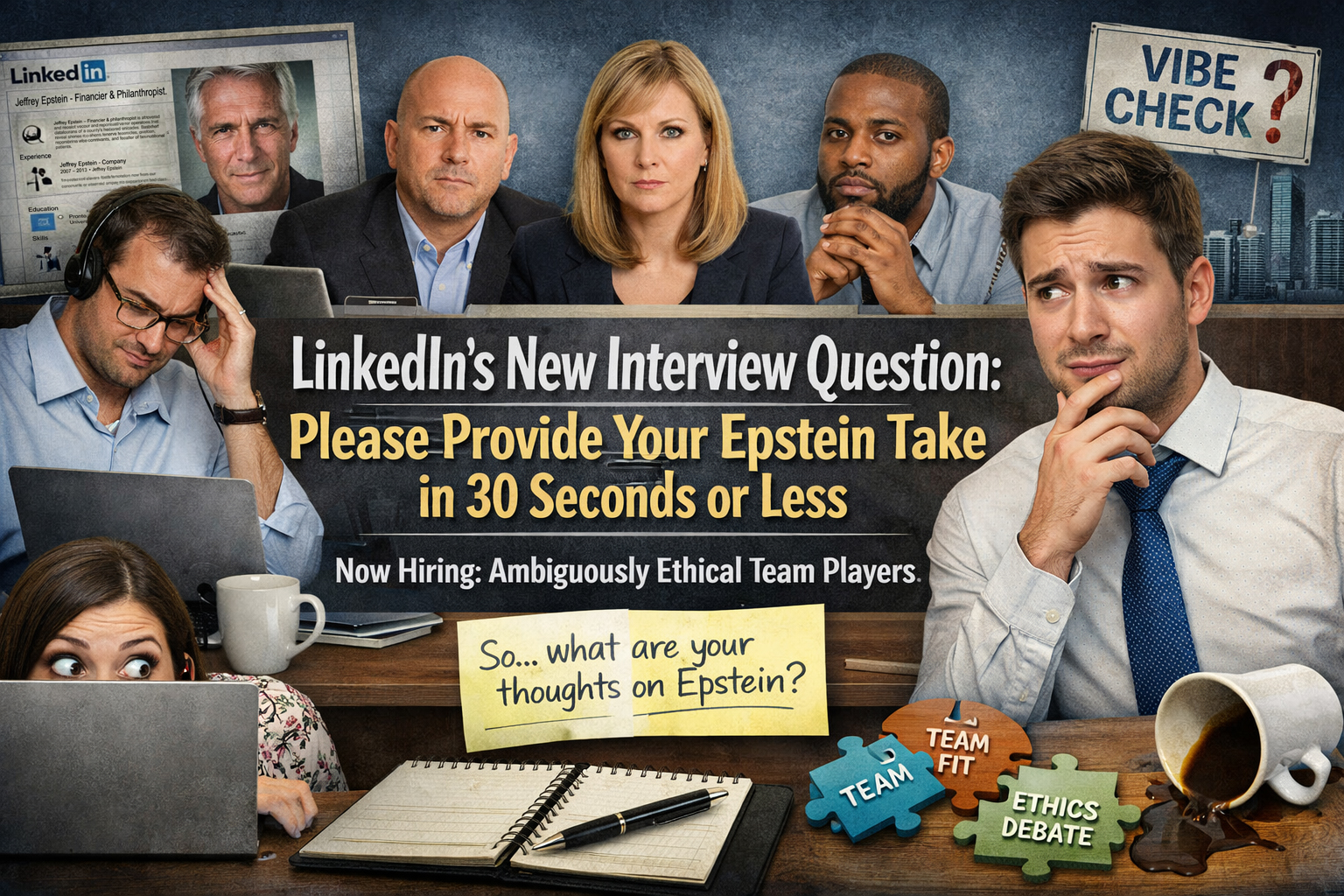
Real interviews. Zoom interviews. Panel interviews where you’ve ironed your shirt, tested your mic, rehearsed your stories, and reminded yourself not to sound desperate, bitter, or unemployed in a historic job market collapse. You show up ready to discuss strategy, stakeholder management, cross-functional alignment, impact. You smile just enough to appear pleasant without seeming like you’re trying to sell them a timeshare. You do the little nod that says “I am listening” and not “I have been awake since 4 a.m. thinking about rent.”
Then, without warning, somebody asks:
“So… what are your thoughts on Epstein?”
Not framed as ethics. Not framed as leadership. Just dropped into the conversation like this is a reasonable metric to evaluate alongside your ability to manage projects.
And that’s when you realize you are not in a job interview.
You are in a live vibe assessment.
Welcome to the modern hiring process, where the job description is vague, the budget is pending, the reporting structure is flexible, the timeline is “we’re moving quickly,” and the only thing that must be locked in immediately is your exact moral thermostat setting.
The Feed Used to Be About Careers, Not Character Witness Statements
There was a time when LinkedIn’s biggest crime was being relentlessly optimistic in a world that clearly did not deserve it. It was a digital lobby filled with people handing out business cards made of motivational quotes. The drama was petty and manageable: a passive-aggressive post about “leaders who don’t value loyalty,” a celebratory “I’m honored” paragraph that read like a hostage note, a carousel of “5 Tips to Be More Confident” that somehow included “believe in yourself” twice.
You could scroll it like a menu. You could predict it. You could survive it.
Now, every third post is a multi-paragraph moral dissertation. People who were scheduling screening calls last week are suddenly posting think pieces with the solemnity of a Supreme Court opinion. The same accounts that once shared “Top 3 interview tips” are now hosting unsolicited ethics panels in the comments, like they’ve been personally appointed to oversee the spiritual development of the workforce.
And the format is always the same:
A dramatic hook. A story you cannot verify. A lesson you did not ask for. A call to action that implies if you disagree, you are the problem with society.
You scroll past it, but it doesn’t leave you. It follows you. It sits in the back of your mind like a pop-up ad you can’t close. It makes you question whether you’re behind on the required reading. It makes you wonder if the new professional standard is “be excellent at your job and also be prepared to deliver a morally acceptable monologue at any moment, even if you’re just applying for a role that involves spreadsheets.”
The most exhausting part is that nobody is actually doing anything with this moral energy. It’s not policy. It’s not action. It’s content. It’s performance. It’s the corporate version of lighting a candle and then immediately posting a photo of the candle to prove you care.
LinkedIn has turned outrage into a networking skill. It’s not enough to have boundaries. You must have a publicly acceptable set of beliefs, expressed in a tone that is firm but not inflammatory, empathetic but not emotional, educated but not “too much,” and always, always formatted with line breaks for maximum engagement.
This is the new professional brand: not your work, not your results, but your ability to sound correct in a public forum that rewards certainty and punishes complexity.
And if you’re thinking, “Surely this stays online,” you have not been paying attention.
The Interview Isn’t About the Job, It’s About Whether Your Soul Has Teamwork Experience
The modern interview process has always been a little surreal. You sit in front of a camera and try to convincingly explain that your greatest weakness is “caring too much” without immediately disintegrating into sarcasm. You describe a time you “handled conflict” which means you once politely asked a grown adult to stop derailing meetings with conspiracy theories about printer ink.
But lately, interviews have leveled up from surreal to experimental theater.
Because somewhere along the way, companies decided that assessing your ability to do the job was not enough. They needed to assess your ability to exist in their culture without causing emotional turbulence. Not actual turbulence, mind you, but the kind of turbulence that happens when someone says something that makes people think too hard during lunch.
So now the interview includes secret bonus rounds.
You think you’re here to discuss scope and outcomes. Surprise. You’re here to demonstrate moral agility. You’re here to prove you can navigate conversational tripwires while four people stare at you silently, taking notes, as if your answer will reveal whether you are safe to invite to the Slack channel.
The question arrives without context, because context would imply responsibility.
“So what are your thoughts on Epstein?”
And immediately your brain starts triaging like an ER nurse.
What is the goal of this question? What answer are they hoping I say? Is there a correct answer or just a correct vibe? Do they want outrage, or composure? Do they want empathy, or distance? Am I being tested for ethics, or for compliance? Is this about values, or about whether I’m going to be annoying in meetings?
Because there is no safe answer. Too passionate and you’re intense. Too cautious and you’re evasive. Try to redirect and suddenly you “lack transparency.” Attempt nuance and now you’re “overthinking it,” which is a fascinating criticism to receive during an interview for a role that literally involves thinking.
Meanwhile, the job itself remains a mystery wrapped in a KPI.
“What does success look like in the first 90 days?” “Well, we’re still defining that.”
“What are the priorities?” “It depends.”
“What’s the budget?” “We’re flexible.”
“Who does this role report to?” “It’s evolving.”
But your worldview? That needs to be crystal clear right now, on camera, in a way that makes everyone feel comfortable, and also preferably earns a few internal head nods that say, “Yes, this person’s moral settings match ours.”
It becomes obvious you are not being interviewed for competence.
You are being interviewed for compatibility.
Not with the team’s workflow. With the team’s preferred emotional temperature. With the organization’s preferred public posture. With the unwritten rules of what you are allowed to say out loud.
And the irony is thick enough to spread on toast: you’re expected to “bring your whole self to work,” but only the parts of yourself that won’t make anyone ask questions.
Performative Professionalism and the Art of Saying Nothing While Sounding Meaningful
By the time you hit your third interview round, you are no longer a candidate. You are a trained actor. You have learned the sacred language. You speak in controlled sincerity. You smile on cue. You have a story for everything, including adversity, which you present as a neatly packaged anecdote with a beginning, middle, and lesson, like trauma but with deliverables.
And now, you also need to master the hardest skill in corporate America: saying absolutely nothing in a way that sounds deeply thoughtful.
Because the “Epstein take” question is not a question. It’s a trap disguised as curiosity. It’s a vibe checkpoint. It’s an invitation to either align publicly or reveal yourself as an unpredictable element.
So you do what every modern professional does when confronted with a loaded question in a high-stakes setting:
You build a sentence so vague it could be used in any conversation at any time and still receive polite nods.
Something like:
“I think it’s important to approach complex issues with care, prioritize accountability, and stay grounded in values.”
Congratulations. You have said words. You have signaled seriousness. You have committed to nothing. You have created the verbal equivalent of a corporate mission statement: emotionally reassuring, functionally useless, universally agreeable, and impossible to disagree with unless someone is actively rooting for conflict.
This is the skill hiring now rewards: the ability to remain employable under pressure.
Not the ability to solve problems. Not the ability to lead teams. Not the ability to deliver outcomes.
The ability to speak in safe shapes.
It’s like the job market has become a televised debate, except you don’t get notes, you don’t get prep, and the prize for “winning” is a salary range they refuse to disclose.
And if you’re a candidate, this becomes exhausting in a way that is hard to explain to people who aren’t in it. You are already carrying the weight of rejection, uncertainty, and constant self-marketing. You are already performing optimism while your bank account does the opposite. You are already navigating processes so long you forget which version of yourself you pitched in round two.
Now you also have to be a public relations specialist for your own humanity.
You have to be interesting but not controversial. Intelligent but not intimidating. Honest but not inconvenient. Human but not messy.
You are expected to show depth, but only the kind that doesn’t disturb the pool.
And if you hesitate, it’s not because you don’t have values. It’s because you are doing math. You are calculating which version of yourself is safest to present to strangers who control your access to rent money.
That’s not nervousness.
That’s strategy.
Final Thoughts: I’m Not Applying to Be a Talking Head, I’m Applying to Pay My Bills
Somewhere along the way, we confused “having values” with “performing values on demand for an audience.” We confused leadership with commentary. We confused professionalism with the ability to speak fluently in HR-approved ambiguity while being evaluated by people who refuse to define the role they’re hiring for.
And I get it. Companies want alignment. Teams want trust. People want to work with colleagues who aren’t going to turn every Monday into a personal manifesto.
But there is something uniquely exhausting about watching the hiring process become a morality audition while the actual job remains a foggy concept that may or may not exist next quarter.
If you want to talk about ethics, build ethical systems. Make policies. Protect people. Enforce standards. Stop outsourcing accountability to candidates in a Zoom room like the interview is a lie detector test for “Will you embarrass us on the internet?”
Because here’s the truth candidates are living inside right now:
We are not refusing to “bring our whole selves.” We are protecting ourselves.
We are trying to get hired in a market where roles vanish without warning, feedback is optional, and being “a great candidate” is apparently a compliment you receive right before someone ghosts you for three weeks and then posts about “transparent communication” on LinkedIn.
So when you ask a candidate for their take on Epstein in a job interview, understand what you’re really doing. You’re not measuring ethics. You’re measuring how well they can survive a conversational landmine while still appearing calm, agreeable, and safe to place in a meeting.
You’re not hiring a project manager.
You’re hiring a performer.
And the performer is tired.
I’m not applying to be a talking head. I’m not auditioning for corporate group therapy. I’m not here to deliver an on-camera monologue that perfectly matches the emotional temperature of a company that can’t even tell me who I report to.
I just want a job.
Apparently, that’s controversial now.