
The other day, someone told me a story that caused my soul to briefly leave my body, float above my laptop like a Windows screensaver, and file a formal complaint with the Department of Common Sense, which—based on the current hiring landscape—has clearly been defunded and converted into a “Culture Committee” that meets twice a month to brainstorm new ways to make simple things feel like a hostage negotiation.
Here’s the setup. A person applied for an assistant manager position at Jewel-Osco, a place where the daily heroics include turning a key, making a schedule, and explaining—politely, repeatedly, with the patience of a saint—that yes, the aisle was reorganized and no, it was not a personal attack on the customer’s childhood memories. It’s a job built on real work, real feet, real weekends, and real moments where someone says, “Excuse me, this coupon expired in 2016, but I FEEL like it should still work.”
The pay was $20 an hour, which is not an insult, but it is also not the kind of pay that typically comes with a four-part interview saga, a ceremonial robe, and a panel of elders gathered to decide if you are worthy to stand near the deli slicer with leadership in your heart. Because the interview process was not a normal conversation. It was a four-person panel interview.
Four.
People.
Four people is not “we just want to meet you.” Four people is “we are forming a council.” Four people is “welcome to the tribunal.” Four people is the number of individuals it takes to run a group project that will still somehow fail, and yet here it was, being used to determine whether someone can responsibly close the store and survive the emotional turbulence of a Sunday afternoon when the rotisserie chickens are running low and the crowd starts looking…organized.
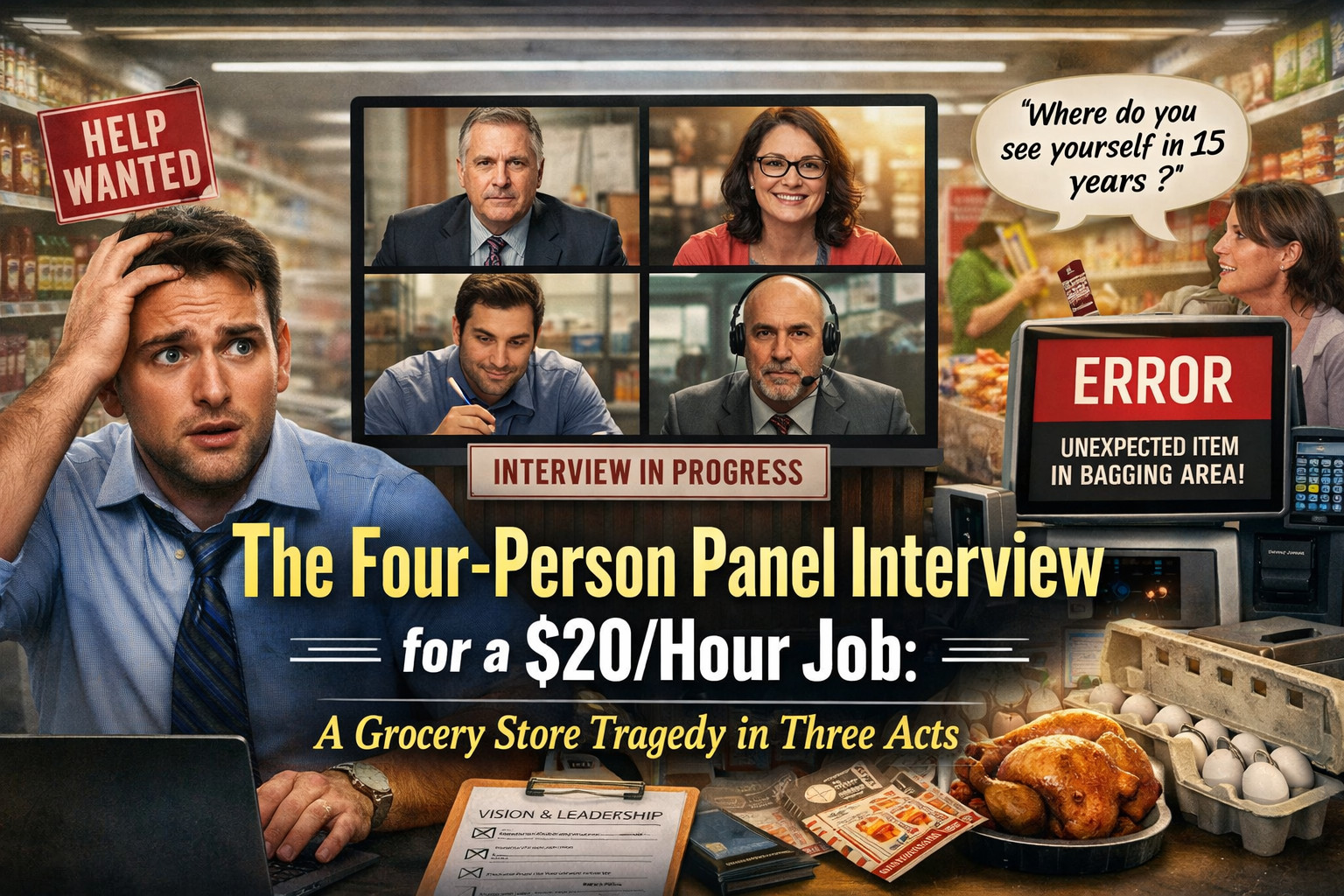
I imagine the candidate logged in expecting something reasonable—one person, a few questions, maybe a quick discussion about availability and experience—and instead got the full Brady Bunch grid of faces staring back like, “Hello. We have reviewed your resume. Please tell us about a time you demonstrated leadership under pressure…in aisle seven…during a price discrepancy…while a toddler screamed in the background and a customer insisted the sign said ‘free.’”
And the thing is, it’s not even the panel itself that’s wild. It’s the commitment to the theater. It’s the belief that hourly work must be filtered through the same corporate rituals we use for roles that involve budgets, strategy, and the power to ruin lives via a single spreadsheet mistake. Because somewhere along the way, we stopped interviewing humans and started staging performances.
Which brings me to the part where my soul returned to my body only long enough to say, out loud, to nobody in particular: We have fully lost the plot.
The Council of Four and the Deli of Destiny
Let’s picture the scene. The candidate enters the Zoom call. They are prepared. They have their best shirt on. They have their notes. They have practiced answers to basic questions like, “Tell me about yourself,” and “Why are you interested in this role,” and “Are you available nights and weekends,” which is really just the grocery store version of signing a waiver that says you accept the concept of time not belonging to you anymore.
Then the screen populates. One face. Two. Three. Four.
It’s not an interview. It’s a jury selection.
One panelist immediately gives the vibe of “I have been assigned this, I do not want to be here, and I will punish you by asking questions that sound like they were generated by a leadership podcast.” Another panelist is smiling too hard, which usually means they will say the words “culture” and “family” and “fast-paced environment” as if those are gifts and not warnings. The third panelist is taking notes with the intensity of someone writing the next Constitution. The fourth is on mute the entire time, but you can feel them judging you through the pixels like a ghost who haunts break rooms.
And the questions begin, as they always do, with the sacred corporate incantations that have somehow been recycled into every job on Earth, no matter how practical the work actually is.
“Tell us about a time you dealt with conflict.”
Absolutely. Let me tell you about the time a grown man attempted to fight the self-checkout machine because it asked him to place the item in the bagging area and he took that personally, like it was accusing him of something. Let me tell you about the time two customers reached a near-violent disagreement over who was “next” in line at the deli, as if we were distributing passports and not sliced turkey.
“Where do you see yourself in five years?”
In five years, I see myself still explaining why eggs are locked up, apologizing for prices I did not set, and managing the emotional fallout of someone discovering self-checkout is not, in fact, self-aware, and cannot “just fix itself,” no matter how loudly you speak to it like it’s a disobedient teenager.
But in the panel’s mind, you’re not applying to manage a store. You’re applying to become a symbol. A brand ambassador. A visionary. A champion of “operational excellence,” which is a phrase that sounds important until you realize it means “make sure the shelves are stocked and nobody steals the Tide.”
And somehow, while they’re asking you about leadership, one panelist is nodding like you’re auditioning to run the entire state of Illinois.
This is where the absurdity really blooms. Because if the job is real work—and it is—then why is the interview pretending it’s something else? Why are we dressing up hourly roles in executive rituals like we’re trying to prove seriousness through unnecessary complexity?
Four people sat down and said, “Yes. This is the appropriate amount of scrutiny for twenty dollars an hour.”
At that point, it’s not an interview. It’s pageantry.
Corporate Theater Comes to the Produce Aisle
Here is the part that makes my brain itch: we have taken simple employment and turned it into performance art, like the job market is a Broadway show and the only way to get hired is to deliver a monologue with proper posture, confident eye contact, and a compelling narrative arc in which your greatest weakness is that you care too much about inventory management.
Somewhere in the last decade, a group of people decided hiring should feel like a talent competition, as if we’re all competing for a golden buzzer that unlocks the right to afford groceries at the grocery store we’re applying to work at.
We’ve added panels. We’ve added “culture fit.” We’ve added rounds. We’ve added assessments. We’ve added personality quizzes that ask if you’d rather be “a bold eagle” or “a collaborative dolphin,” when the reality is you are simply trying to survive in an economy where everything costs more and dignity has a processing fee.
And here’s what’s really happening: companies want to appear rigorous. They want to look thoughtful. They want to signal that they do things “the right way,” which often means doing things in the most complicated way possible and calling it professionalism. They don’t want to hire someone. They want to “select” someone, like they’re choosing a successor in a royal bloodline, not staffing a schedule so the closing shift doesn’t collapse into chaos.
Meanwhile, the candidates are tired. Not “a little tired,” but the kind of tired where you can feel your spirit gently detaching from your body every time you hear, “We’ll be moving forward with other candidates,” after you just performed an emotional TED Talk about teamwork and integrity while trying to look calm in a chair you’ve been sitting in for two hours.
Job searching has become a slow-motion insult, because the more complicated the hiring process gets, the more it communicates one simple message: we do not trust you until you have proven yourself through unnecessary suffering.
For $20 an hour, you don’t need a panel. You need a conversation. You need to confirm someone is responsible, competent, and not going to disappear during a rush because they “don’t really do stress.” You need to confirm they can manage people without turning the break room into a reality show. You need to confirm they can handle customers who treat expired coupons like sacred scrolls. That’s it.
Instead, we’re out here building interview rituals that require four schedules to align, which means the candidate is waiting weeks just to be evaluated by people who will later say, “We moved slowly because we’re very intentional,” when the truth is you moved slowly because the fourth panelist was busy and nobody wanted to make a decision without the ceremonial presence of the Mute One.
This is how we end up in a world where job searching feels less like opportunity and more like auditioning for a role in a system that already plans to underpay you and overwork you.
And then we act surprised when people stop applying.
If It Takes Four Interviewers to Close a Store, What Does It Take to Bag Groceries?
Here’s the most dangerous part of this entire story: it sets a precedent.
Because once a company normalizes a four-person panel for a $20/hour job, what’s next? A three-round process for bagging groceries? A case study for cart collection? A behavioral assessment for stocking cereal that asks you to “walk us through your thought process as you align the Frosted Flakes with the brand standards”?
I can see it now.
“Welcome to round two. Today you’ll complete a timed exercise: place these items in a bag while narrating your leadership philosophy.”
Then round three: “We’d like you to present a 10-minute vision deck on the future of paper versus plastic, with a focus on stakeholder engagement and sustainability.”
And the final round is just you in a fluorescent-lit room, facing a single interviewer in a suit who asks, softly, “Why do you want to work here,” while a self-checkout machine in the corner screams, UNEXPECTED ITEM IN BAGGING AREA, like an oracle warning you to turn back.
The logic behind all this is always the same. “We want to make sure we hire the right person.” And sure. Nobody wants to hire chaos. Nobody wants to hire someone who treats schedules like suggestions and keys like souvenirs. But at some point, the process becomes less about choosing the right person and more about protecting the company from the terrifying possibility of being slightly inconvenienced.
The irony is that the people who can actually do these jobs—the ones who can handle customers, staff issues, inventory problems, and closing responsibilities—are often the same people who don’t have the time, energy, or patience to endure a hiring circus. They have kids. They have bills. They have a life. They don’t want to prepare for a panel interview like they’re applying to run a Fortune 500 supply chain.
So the process filters out the very humans who would be most capable, and instead rewards the people who are best at interviews, which is not the same thing as being good at the job. It’s just being good at performing competence in a controlled environment where nobody is yelling about coupons.
And the more this becomes normal, the more we all collectively accept a world where employment requires hoop-jumping that is wildly disproportionate to the pay, the role, and the reality of the work.
It’s not that the job is beneath dignity. It’s that the process is detached from reality.
Final Thoughts: May Your Hiring Process Remember It’s Hiring
I wish everyone involved well. And by well, I mean: may your interviews be shorter than the lunch break, may your panels be replaced with common sense, and may someone someday remember that $20 an hour does not require a jury, a vision statement, or a dramatic pause before the final question like you’re about to reveal whether the candidate has been accepted into the elite society of people who know where the extra receipt paper is kept.
Because if managing a grocery store requires four interviewers, I am afraid to ask what it takes to bag groceries.
Probably a panel of six, a personality assessment, a simulated conflict scenario involving a bruised avocado, and a final interview with the self-checkout machine, which will reject your answers three times and then ask you to wait for assistance, even though nobody is coming.
And honestly? That’s still more communication than most hiring processes.