
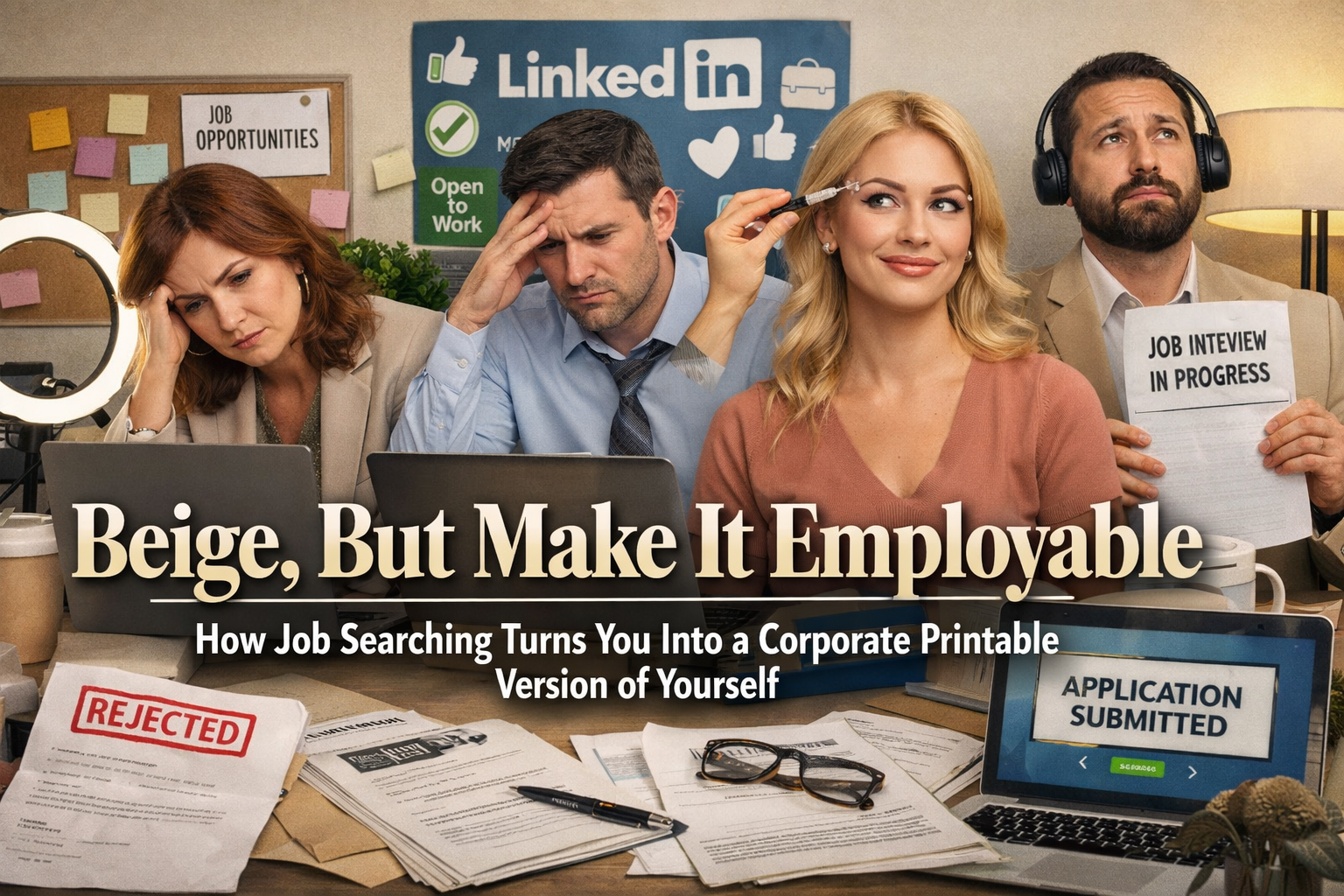
There’s a moment in modern job searching that nobody prepares you for, and it’s not the rejection, or the ghosting, or the seventh “quick call” that turns into a sixty-minute interrogation about your “why” as if you’re applying to become the next Pope of Operations.
It’s the slow, almost polite disappearance of you.
Not your ability to work. Not your competence. Not your bills. Those remain aggressively present. I’m talking about the parts of you that used to make you recognizable to yourself: the humor, the weirdness, the unpolished texture, the specific little opinions and quirks that made you a person instead of a carefully arranged stack of transferable skills wearing a neutral blazer and holding a coffee mug that says “Rise and Grind” like it’s an inspirational warning label.
Because job searching in the era of LinkedIn optimism and beige professionalism doesn’t just ask you to present your best self. It asks you to present your safest self. Your least controversial self. Your most printable self. The version of you that could be photocopied in black and white and still look “aligned with company values,” which is corporate for “doesn’t make anyone in leadership feel complicated feelings.”
It starts innocently, the way all identity theft starts: with “just a few tweaks.”
You trim the résumé a little. You remove the hobby that could be misinterpreted. You swap “built” for “spearheaded.” You replace “I led a team through chaos” with “I navigated ambiguity,” because chaos is honest and honesty is risky, whereas ambiguity sounds like you were raised by a management consultant and trained to thrive in vague suffering.
Then you begin pruning words that used to mean something, words like creative and passionate and human, because somewhere in the last few years we decided those words are suspicious. We replaced them with strategic, cross-functional, and results-driven, even though none of those words have ever driven anything except mild confusion and an HR person’s urge to schedule a meeting about tone.
Meanwhile, the platform tells you to show up authentically while rewarding the exact opposite. And so, on LinkedIn, we all perform the same routine like we’re part of a traveling troupe of motivational speakers trapped in an airport Marriott ballroom. We rewrite posts three times to sound inspiring but not desperate, confident but not threatening, authentic but not too authentic, because God forbid someone discovers we’re funny, tired, self-aware, or emotionally sentient.
Behind the scenes, of course, it’s chaos.
We’re out here doing emotional headstands in business casual. Adjusting lighting, angles, and headshots like we’re auditioning for a reboot of ourselves that looks fifteen years younger and significantly more employable. Botox for some. Ring lights for others. A silent agreement that we will all pretend this is normal and call it personal branding, not a collective mid-career identity crisis happening under fluorescent lighting with a neutral background and a hopeful smile.
Then we apply. And apply. And apply.
We tailor résumés until they no longer resemble our actual lives. We paste our work history into a form that asks us to retype it anyway like it’s a loyalty test. And then we wait. And wait. And wait some more. No response. No rejection. Just silence. A digital void where your application goes to rest beside everyone else’s hopes and carefully chosen bullet points, while an algorithm decides whether your life is properly keyworded.
And the irony, the part that makes you laugh because the alternative is to scream into a throw pillow, is that the same world that tells us to “bring our whole selves to work” is the one where we’re afraid to comment honestly because it might reveal we have a personality. So instead we react with a tasteful clap and move on, guarding our real thoughts like trade secrets.
That’s why humor matters here. Because laughing about it doesn’t make us less professional. It makes us sane. It reminds us we’re not broken, lazy, or failing. We’re just navigating a system that asks us to be invisible and exceptional at the same time, polished but desperate, confident yet silent, human enough to inspire and robotic enough to never inconvenience anyone who spends six seconds scanning our name.
So if you’re reading this while questioning your identity, refreshing your inbox, or wondering when job searching became an endurance sport, just know this: you’re not alone, you’re not imagining the absurdity, and yes, it’s okay to laugh at the process while you survive it.
We’ll figure out who we are again.
Probably right after someone finally emails back.
The Resume Exorcism (Or, “Tell Us About Yourself” Without Telling Us About Yourself)
A résumé used to be a summary of your professional life. Now it’s a carefully engineered document designed to survive an automated hunger games arena where only the most keyword-compliant applicants make it to human eyes, and even then, they arrive dehydrated, personality-free, and wearing the emotional equivalent of a company polo.
This is where the transformation begins.
You don’t start by lying. You start by sanitizing. And sanitizing feels responsible. Mature. “Strategic.” Sanitizing is what you do when you want to be taken seriously, because we’ve collectively agreed that seriousness is measured by how thoroughly you can erase evidence that you have ever laughed in public.
So you take a red pen to your own history.
You cut the fun job title because it sounds unserious, even though you did serious work. You remove the side project that proves you’re resourceful because it might look “unfocused.” You delete the line about mentoring because you can’t quantify kindness. You strip away context, nuance, and the actual story of your career until what’s left is a series of bullet points that read like they were written by a robot who majored in Corporate Synonyms and minored in Fear of Being Misunderstood.
And the worst part is that everyone tells you this is the right thing to do.
Keep it to one page, they say, as if your life is a brochure. Avoid fluff, they say, while insisting you add metrics for everything, including the time you prevented an entire department from imploding with a single well-timed joke and a spreadsheet that didn’t crash.
Quantify impact, they say, and you try, truly you do, but some jobs are 40 percent outcomes and 60 percent emotional triage. Some achievements cannot be measured because the metric is “the number of times I stopped a grown adult from starting a meeting by yelling.”
So you do what you can.
You turn “fixed a broken process” into “optimized workflows.” You turn “calmed down angry stakeholders” into “managed cross-functional relationships.” You turn “kept this place afloat” into “drove operational resilience,” which sounds impressive and means nothing, but nothing is the preferred tone.
And then comes the greatest insult of the modern job search: after you compress your entire career into a sterile rectangle of bullet points, a hiring process will still ask, “Tell me about yourself.”
Tell you about myself.
Which version would you like? The one where I am a living person with stories, quirks, and a humor-based coping strategy? Or the one where I am a perfectly formatted list of action verbs held together by desperation and Arial 11?
Because I can tell you about myself in three ways now:
- The actual version, which is complicated, honest, and full of human texture.
- The résumé version, which is clean, optimized, and sounds like I was manufactured in a leadership factory.
- The interview version, which is the résumé version but spoken with warm eye contact and a faint tremor that says, “Please accept me into your system.”
By the time you reach your fifth tailored application of the day, you start forgetting which version is real.
Not because you’re fake, but because the process rewards you for being safely generic, and after enough repetition, “safely generic” begins to feel like a personality trait.
LinkedIn Theater and the Cult of Professional Niceness
LinkedIn, in theory, is a networking platform.
In practice, it is a stage where we all perform the same play, and the play is called “Everything Is Fine and I Am Thrilled to Be Here,” even when we are actively losing our minds in the comments section of our own lives.
The aesthetic is always the same: hopeful. polished. beige. If LinkedIn were a color palette, it would be oatmeal. If LinkedIn were a candle scent, it would be “Ambition with Notes of Mild Panic.”
We post wins. We post lessons. We post inspirational reflections that begin with “I’m humbled” and end with “If you’re struggling, you’ve got this,” and we mean it, we truly do, but it’s hard to ignore that the algorithm has trained us like golden retrievers with a ring light.
Say something uplifting. Receive engagement.
Say something honest. Risk being perceived.
And in this economy, being perceived is dangerous.
So we flatten ourselves into acceptable shapes.
We celebrate layoffs with gratitude. We turn burnout into resilience. We take genuinely painful experiences and package them as “growth opportunities” because the social contract of LinkedIn is that you can be vulnerable, but only in a way that makes other people comfortable. The moment your honesty feels even slightly inconvenient, people start reacting like you’ve brought a raccoon into a conference room.
And comments, oh the comments.
We want to say so much. We want to talk about the absurdity. We want to say, “This is broken,” or “I’m exhausted,” or “Why are we doing six interviews for a job that pays the emotional equivalent of a half-eaten granola bar.”
But we don’t.
Because we’re scared.
We’re scared an employer will scroll three years back and discover we once made a joke about recruitment or admitted that being ghosted feels humiliating. We’re scared that someone in a position of power will mistake honesty for instability, humor for attitude, humanity for a lack of professionalism, because professionalism has been redefined as “how well you can pretend you never have problems.”
So instead we clap.
Tastefully. Safely. Beige-ly.
And while we’re doing all of this, we are also curating our own faces.
New headshot. New tagline. New bio. New “open to work” banner, but not too open to work because open to work is a little desperate, and desperation is only allowed if you disguise it as motivation.
We’re out here adjusting angles and lighting like we’re applying for a job and also auditioning for the role of “person who is not affected by job searching.”
And the most surreal part is how quickly it becomes normal.
The self-optimization. The constant scanning of your own image like you’re a brand instead of a person. The quiet pressure to always seem like you are “thriving,” even when you are applying for roles at 2 a.m. while whispering affirmations to your laptop like it’s a sick pet.
This isn’t networking anymore.
This is theater.
And the saddest thing about theater is that when you perform long enough, you start to forget you’re performing. You start speaking in taglines. You start thinking in bullet points. You start using phrases like “I’m excited about the opportunity” even when you are mostly excited about having health insurance again.
The Waiting Room Economy and the Ghosting Olympics
After the résumé exorcism and the LinkedIn theater comes the part that breaks people quietly: the waiting.
Not the kind of waiting where you know an answer is coming. That’s manageable. That’s civilized.
I’m talking about the modern job search waiting, the kind that feels like shouting into an empty parking garage and hearing your own echo come back with a notification that says, “Your application has been received.”
Received by whom, exactly?
Because it certainly doesn’t feel like a human.
You apply. You see the little confirmation screen. You get the email that says, “We’ll be in touch,” which is corporate for “we have now placed your hopes into a file cabinet that may or may not exist.”
Then nothing.
Days pass. Weeks pass. You start inventing stories about the hiring manager’s life just to explain the silence, because your brain cannot tolerate ambiguity, and yet ambiguity is the main product of the modern job market.
Maybe they’re busy. Maybe the role is on hold. Maybe they had a reorg. Maybe the recruiter got swallowed by the same algorithm that rejected your last application for lacking a keyword you didn’t know existed.
Or maybe, and this is the fun one, the job was never real.
Yes, that’s a thing now too, because why should your dignity be the only thing that’s fully employed?
Some postings are stale, some are duplicated, some are placeholders, some are internal hires disguised as open roles, and some are simply corporate mood boards: “We might want someone like this someday, so let’s see if the market delivers a unicorn.”
Meanwhile, you are supposed to remain optimistic.
You are supposed to “keep applying,” as if applying is not a full-time job in itself, one that pays in rejection emails and occasional emotional whiplash. You are supposed to maintain confidence, as if confidence is not slowly drained by every unanswered application, every interview that goes nowhere, every enthusiastic “we loved meeting you” that leads directly to silence.
And yet, the system keeps demanding enthusiasm.
You must be eager but not desperate, persistent but not annoying, grateful for the opportunity to audition, and thrilled to be placed in a pipeline like you’re a product on a shelf.
This is where humor becomes more than a joke.
It becomes oxygen.
Because when you cannot control the outcome, the only thing you can control is your sanity, and sanity is difficult to maintain when your worth is being assessed by strangers, software, and a timeline that treats your life like content.
Humor is how you reclaim the truth without letting it swallow you.
It’s how you say, “This is absurd,” without letting the absurdity convince you that you are the problem.
It’s how you remember you were a person before you became a candidate.
Final Thoughts: You Were Someone Before You Were “A Strong Fit”
If you’ve been job searching for any length of time, you’ve probably had that eerie moment where you look at your own résumé and think, “Who is that.”
Not because you lied, but because the process trained you to speak about yourself like a product description.
And if you’ve spent enough time on LinkedIn, you’ve probably felt that strange pressure to be inspirational at all times, as if your struggles must come with a moral and your exhaustion must end in a lesson, because being human without a take-away is apparently unprofessional now.
But here’s what I want you to remember, even if you can’t feel it today:
You are not your lack of responses.
You are not your rejection emails.
You are not the silence.
You are not the version of yourself you built to survive a hiring process that treats people like interchangeable puzzle pieces.
You are a person, not a pipeline.
And if humor is the thing that helps you breathe in the middle of all this, if it’s the thing that helps you see the absurdity without letting it define you, then lean into it. Laughing doesn’t make you less serious. It makes you resilient in a way that doesn’t require you to become numb.
One day, someone will email back. Someone will say yes. Someone will see you through the beige fog and the keyword circus and the performance of professional niceness, and you will remember what it feels like to be chosen for more than your ability to sound like a corporate template.
Until then, if you’ve lost track of who you are, it doesn’t mean you’re gone.
It just means you’ve been adapting.
And you can always come back to yourself, one honest sentence at a time, one laugh at a time, one small refusal to let a broken system convince you that your humanity is the liability.
We’ll figure out who we are again.
Probably right after someone finally emails back.