
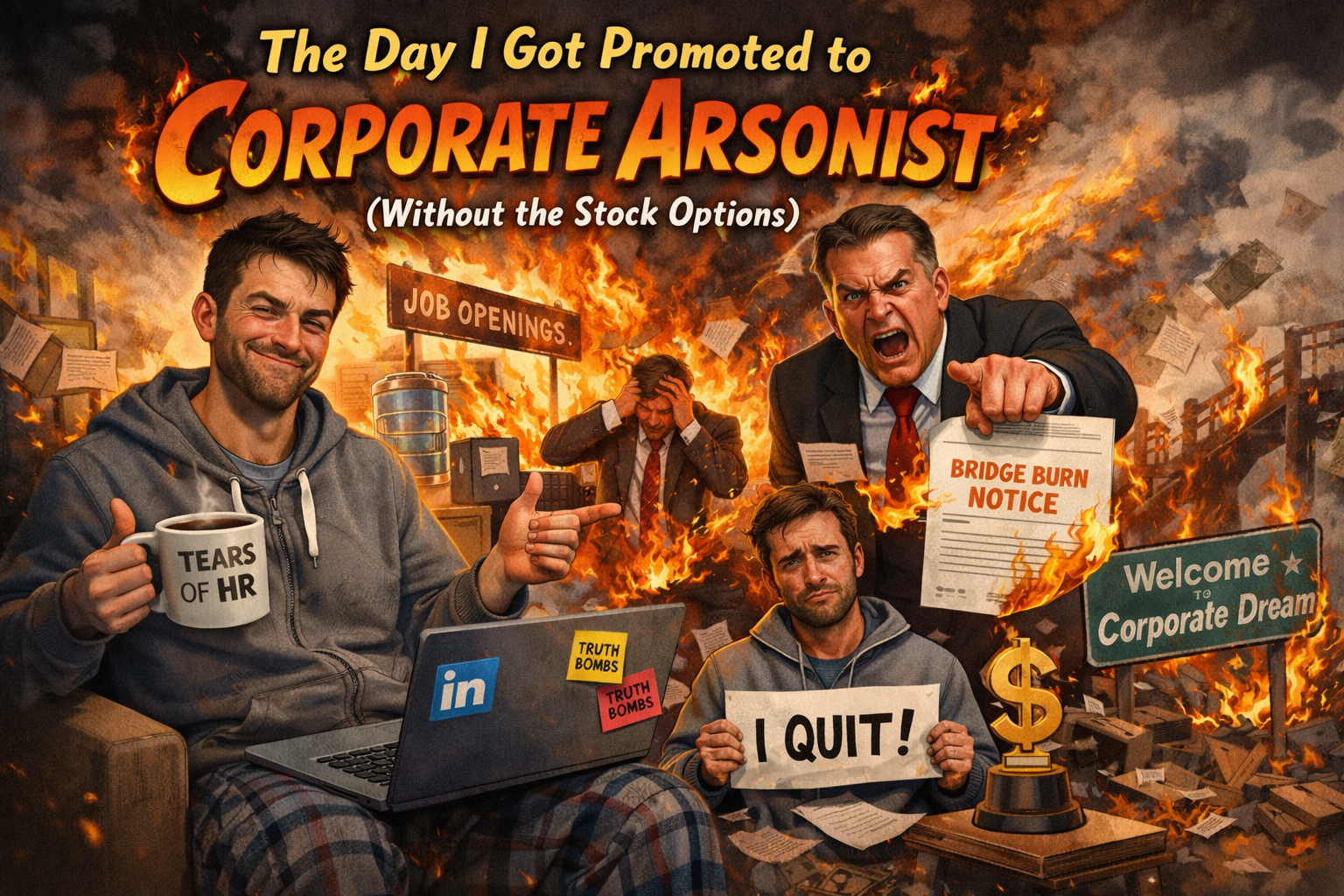
The other day, I received one of those messages that doesn’t just land in your inbox—it kicks the door in, looks around your living room, judges your throw blanket, and announces, with the confidence of a middle manager holding a clipboard, that you have officially become A Problem.
Not a job offer. Not a collaboration. Not even the classic “Hope you’re doing well” that always reads like a threat in a nice font.
No.
A Fortune 500 senior leader reached out to personally inform me that my job-hunting rants have burned my chances with certain companies and, somehow, single-handedly caused a $100,000 manager to quit after reading my posts.
First of all, I’d like to thank the Academy, the algorithm, and whatever cursed Wi-Fi signal allowed this message to find me. Because for years, I couldn’t even get a recruiter to acknowledge my existence. I applied. I followed up. I manifested. I refreshed my inbox like it owed me money.
Nothing.
But now? Now I’m apparently influential enough to collapse leadership pipelines with a sarcastic paragraph and a caffeine problem.
This is the part where you realize the corporate world is basically a haunted house run by spreadsheets. It’s all bravado and KPI dashboards until someone says, “Hey, this feels broken,” and suddenly executives are clutching their pearls like you just dragged a printer into the ocean.
And the funniest part is the framing—because it’s never, “Our systems might be chewing up human beings.” It’s always, “You… you said it out loud.”
Like the Titanic didn’t hit an iceberg. The Titanic read a LinkedIn post about icebergs and decided to explore its feelings.
So here we are. Me, sitting in sweatpants, being told I’m the reason a six-figure professional stared into the abyss and the abyss blinked first.
If that’s true, I deserve a title. Something elegant. Something terrifying.
“Senior Vice President of Sudden Self-Awareness.”
Or at least a badge: Warning: May Cause Resignations.
The Myth of the Unshakable $100K Professional
Let’s talk about the manager who allegedly quit because of a post.
Not because their workload doubled while their staff got cut in half. Not because their calendar looked like a Tetris game designed by anxiety. Not because they were asked to “do more with less” so many times they began to suspect “less” was their actual job title.
No.
They quit because they read something honest and it made their brain do that dangerous little thing brains do when they aren’t being actively suppressed by Outlook notifications: think.
Imagine earning $100,000 a year and feeling stable right up until you scroll past a sentence like, “The hiring process is broken.” And then suddenly you whisper, “Oh my God… it is broken,” and your body immediately begins the resignation process like it’s muscle memory.
That isn’t sabotage. That’s a fire alarm.
And the funniest part is the implication that money inoculates you against reality. Like once you cross a certain salary threshold, you’re legally required to stop feeling anything besides “grateful” and “aligned.”
But burnout doesn’t check your compensation package first. It doesn’t walk in politely, glance at your W-2, and say, “Ah, never mind, you can afford this misery.”
Burnout shows up like a repo man for your personality. It takes your sleep, your patience, your ability to make small talk without wanting to throw your laptop into the nearest body of water, and it leaves you with one emotion: a blank stare that says, “If one more person schedules a ‘quick sync,’ I will be forced to become a forest.”
So if a manager read my post and quit, the post wasn’t the reason.
The post was the last toothpick on a Jenga tower made of ignored boundaries, silent dread, and “just push through this quarter” repeated for six straight years.
Corporate Logic, Starring Me as the Villain
Now, let’s address the senior leader who messaged me like they were delivering a weather report.
“Just letting you know… you’re burning bridges.”
Okay.
First of all, what a sentence. That’s not advice—that’s a line you say right before you reveal you’ve been watching someone through a conference room window.
Second, I love the cinematic confidence of it, as if my LinkedIn posts are a controlled substance and they are the concerned doctor warning me about side effects.
“May cause: discomfort in leadership, dizziness in HR, and spontaneous resignations in middle management.”
But here’s what kills me: the system is always presented as flawless. The hiring process is a sacred machine. The company culture is a pristine ecosystem. The leadership team is a stable, rational unit of adults who definitely don’t make decisions based on ego, optics, and whatever book they half-read on an airport layover.
And then I show up like, “Hey, ghosting candidates is weird,” and suddenly I’m the unstable element.
Not the job posting that’s been recycled since 2021 like it’s a family heirloom. Not the role that’s “urgent” but somehow still interviewing in the year 2049. Not the six-round interview process for a job paying in vibes, exposure, and a “competitive benefits package” that includes a granola bar and the privilege of being stressed.
No.
The danger is me using decent grammar to describe what everyone already knows.
It’s almost adorable how quickly “transparency” becomes “toxicity” the moment it applies to them.
Companies will say they value authenticity, but only the kind that sounds like this:
“I’m passionate about synergy and I love challenges.”
Anything more honest than that and suddenly someone is emailing you like you leaked state secrets.
And please understand: I am not powerful enough to destroy your brand.
Your brand is being destroyed by the fact that your hiring process treats human beings like suspicious packages that must be scanned, labeled, and forgotten in a warehouse.
I’m not burning bridges.
I’m pointing at bridges that are already on fire while someone in a company polo insists, “This is fine,” and hands you a branded water bottle as your eyebrows singe.
Permission Slips, Not Resignations
If someone quit because of a post, here’s what likely happened:
They didn’t read my words and suddenly get possessed by rebellion.
They read my words and recognized themselves.
That’s it. That’s the crime. That’s the scandal. That’s what leadership fears most: not negativity—recognition.
Because recognition is contagious.
One person reads something honest and thinks, “Wait… I’m not lazy. I’m exhausted.”
Another person reads it and thinks, “Wait… I’m not ungrateful. I’m depleted.”
Another reads it and realizes the “culture” isn’t culture. It’s a coping mechanism with a logo.
My posts don’t make people quit.
They make people stop gaslighting themselves.
They make people stop calling misery “ambition.”
They make people stop acting like suffering is a rite of passage and not a warning sign.
And that’s why it rattles executives—because the most dangerous thing in corporate America isn’t a competitor.
It’s an employee who realizes their life is allowed to feel better than this.
So if that manager quit, maybe they didn’t leave because they were weak.
Maybe they left because they were finally honest.
And maybe, just maybe, the real issue isn’t that someone wrote about the smoke.
It’s that there’s so much smoke the entire building has started normalizing the smell.
Final Thoughts: If Truth Has a Body Count, It Didn’t Pull the Trigger
So yes, apparently my chances are burned. Yes, someone important is mad. And yes, I’ll keep writing.
Because if telling the truth disrupts things, the truth isn’t the problem—it’s the diagnosis.
If bridges burn when someone speaks plainly about the hiring process, those bridges were built out of dry wood and corporate denial.
If a senior leader can’t tolerate a joke about ghosting candidates, it’s not because the joke was too harsh.
It’s because it was accurate.
And if a $100,000 manager read a post and quit, that wasn’t sabotage.
That was permission—the kind people don’t realize they’ve been waiting for until they finally hear their own thoughts said out loud, in a world that’s been telling them to “push through” and “be grateful” and “circle back” until their soul starts auto-replying.
So no, I’m not sorry I said it.
I’m only sorry it took me this long to realize how fragile the illusion is.
Because if my words can shake a Fortune 500 ecosystem…
Then that ecosystem wasn’t stable.
It was just quiet.
And quiet was never the same thing as okay.