
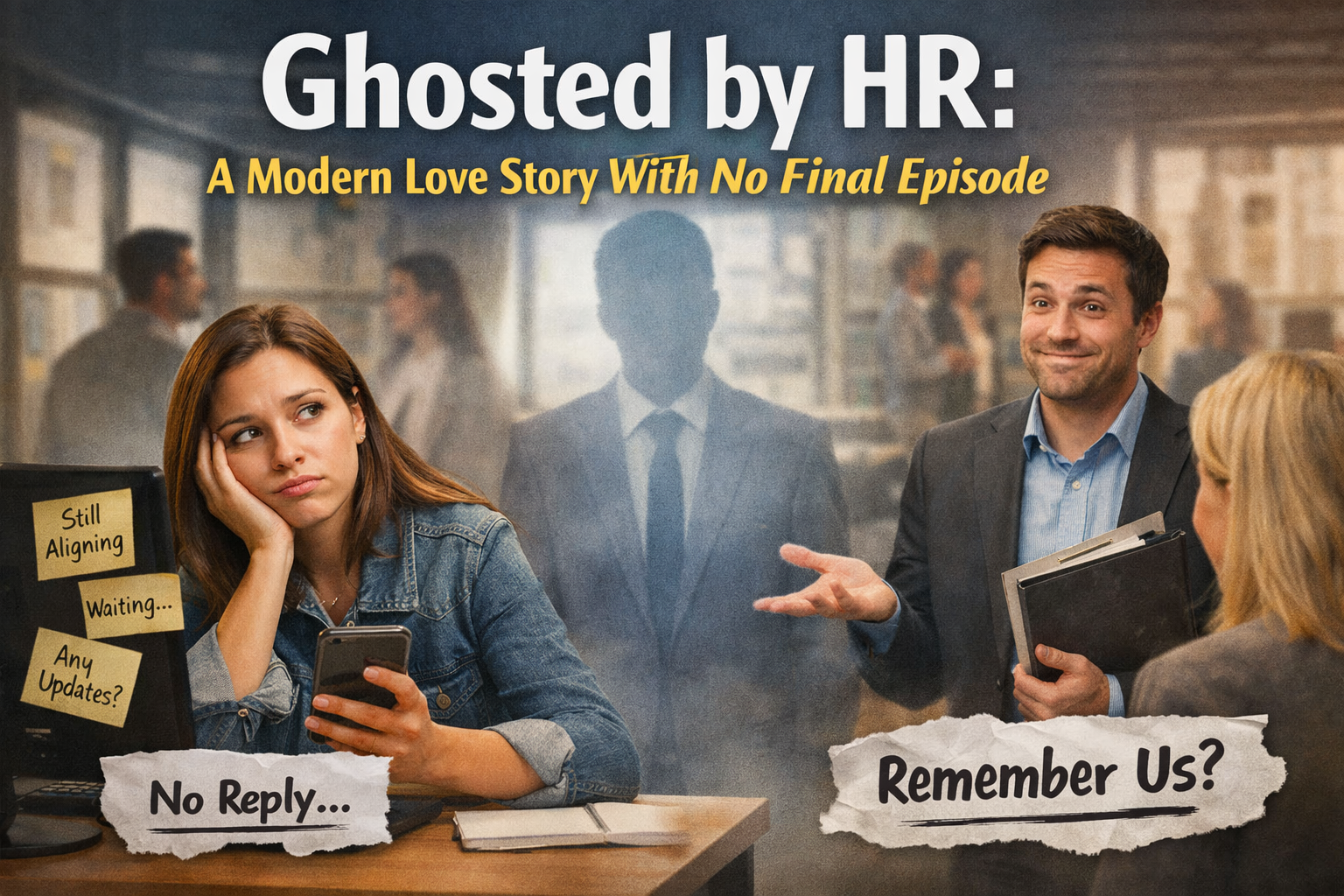
There’s a special kind of corporate confidence it takes to ghost a candidate after three rounds of interviews, because what you’re really saying is, “We believe you are a full adult human with a job, a calendar, a nervous system, and possibly a family… and we’re comfortable treating your time like a free sample at Costco.”
And the funniest part is how normalized it’s become.
Not the rejection. Rejection is fine. Rejection is honest. Rejection is at least a complete sentence. What’s wild is the way ghosting gets dressed up as “process,” like silence is a legitimate stage in the recruiting funnel, right between “Great conversation!” and “We’re aligning internally,” which is corporate for “We are auditioning other people while keeping you emotionally marinating in hope.”
Because that’s the real crime here. It isn’t that you chose someone else. It’s that you chose someone else and still kept me on the line like a polite hostage, with little status-update crumbs tossed my way to make sure I didn’t start applying to competitors too enthusiastically.
“We’re still aligning internally.”
Translation: We held a meeting about holding a meeting, and the only decision we made was that we hate decisions.
“We just need a little more time.”
Translation: We’re waiting to see if the person we actually want accepts, and if they don’t, we plan to crawl back to you like a raccoon returning to a dumpster it swore it was done with.
And then, eventually, the most honest message arrives: nothing.
No follow-up.
No closure.
No “thank you.”
Just the dead air of an inbox that suddenly develops “technical issues” every time your name shows up.
Here’s what hiring teams don’t understand, though: candidates might move on, but they do not forget. Ghosting doesn’t disappear. It doesn’t evaporate. It fossilizes. It turns into a story someone tells at dinner parties, in group chats, and one day—when your company circles back like a boomerang with a branding budget—it turns into consequences.
Because you might forget them.
They won’t forget you.
“We’re Still Aligning Internally” — The Sacred Hymn of Cowardice
The phrase “we’re still aligning internally” is fascinating, because it’s presented as neutral information, like weather, when in reality it’s an emotional smoke bomb used to escape accountability.
What are you aligning, exactly?
The stars?
Your chakras?
The CFO’s sense of self?
The hiring manager’s ego with the recruiter’s calendar and the CEO’s need to feel involved in everything?
Because here’s what it usually means in practice: you’re keeping a candidate warm.
And “keeping a candidate warm” is one of those phrases that should make everyone pause for a second, because it sounds like something you’d say about soup, not a human being with a mortgage and blood pressure.
Keeping someone warm is when you text them just enough to keep them hopeful, like a relationship where the other person doesn’t want you, but also doesn’t want anyone else to have you, so they toss you a “hey stranger” every three weeks and call it connection.
And the recruiter—who is often a decent person trapped in the middle of an organization that treats communication like a liability—gets handed the task of being the friendly face of dysfunction.
“Just keep them warm.”
Meaning: don’t tell them the truth, don’t end it cleanly, don’t let them move on emotionally, because we might need them later if our first choice ghosts us.
So the candidate waits.
They reread the interview notes in their head.
They replay the moment the hiring manager said, “Honestly, I can really see you thriving here,” which is the kind of sentence that should come with a warning label: May contain traces of corporate fiction.
They keep their schedule oddly flexible.
They stop applying to other roles as aggressively because they don’t want to jinx it.
They become emotionally invested in a job that doesn’t exist yet, because the company has turned hiring into an unofficial reality show called So You Think You Can Be Ignored.
And then the silence begins, and it doesn’t arrive dramatically like a breakup—it arrives like a slow leak, where you wake up one day and realize you’ve been refreshing your inbox the way people check hospital waiting room updates.
That’s what ghosting does. It turns professional adults into anxious detectives, searching for clues in timestamps and read receipts and the tone of a previous email that now feels suspiciously final.
The Auditioning Phase — Where You Become the Backup Plan With Feelings
Companies love to pretend the candidate experience is a journey, like it’s a carefully designed path meant to build trust and clarity and mutual excitement, when in reality it’s often a chaotic hallway where you’re told to stand in the corner while people run around behind the scenes making decisions they won’t explain.
The candidate thinks they’re in a hiring process.
The company thinks they’re shopping.
And shopping is fine, by the way. Interview multiple people. Compare strengths. Be thoughtful. Make a good decision. Nobody is asking you to marry the first person you meet.
But here’s the line you cross when you ghost: you stop treating candidates like people and start treating them like inventory.
You start mentally labeling them:
“Strong, but expensive.”
“Great culture fit.” (Which, 70% of the time, is code for “feels familiar.”)
“Potentially annoying in meetings.” (Which usually means “will ask why we do dumb things.”)
“Excellent backup if our first choice doesn’t accept.”
And once someone becomes “backup,” something strange happens in the corporate brain: you feel entitled to their continued availability, as if they should remain suspended in time like an extra in your production, standing in wardrobe, waiting for the director to call them back on set.
So you stall.
You delay.
You “circle back.”
You “revisit next week.”
You “connect after the holidays.”
You “align internally.”
Meanwhile, the candidate is still living an entire life. They’re still working. They’re still parenting. They’re still applying. They’re still trying to keep their confidence intact while being treated like a link someone forgot to click.
And the most insulting part is that the company often convinces itself it’s being kind.
“We didn’t want to reject them too early.”
Translation: We didn’t want to close the door in case we needed them, because we don’t see communication as respect—we see it as risk.
But in trying to avoid discomfort, you create a bigger problem: you train people not to trust you.
Because candidates don’t need certainty that they got the job.
They need certainty that they’re not being played.
They don’t need you to hire them.
They need you to treat them like a human being whose time and dignity matters.
The Sequel Nobody Asked For — “Hey! We Have Another Role!”
And then comes the moment that makes ghosting truly comedic in a dark way: the return.
A year later.
Eighteen months later.
Two layoffs and a reorg later.
A new role opens up, and suddenly your company remembers how to type.
“Hi! I hope you’re doing well!”
Which is an insane sentence to receive from someone who previously vanished like a magician mid-trick, leaving you staring at an empty stage wondering if you hallucinated the entire conversation.
They’re excited.
They love your background.
They think you’d be a great fit.
They want to reconnect.
And sometimes—and this is my favorite part—they don’t even realize they’re talking to the same person they ghosted, because the corporate memory is a goldfish with a LinkedIn license.
So you get to do something rare in modern hiring: you get leverage.
You get to respond with calm, professional honesty.
You get to say: “I remember you.”
Not in a petty way.
Not in a dramatic way.
In a simple, factual way, the way you’d remind someone that yes, they did in fact leave you on read after you reorganized your life around their timeline.
Because ghosting doesn’t just end a hiring process.
It ends trust.
And trust is one of those things that doesn’t come back because you have a new job opening and a better recruiter this time. Trust comes back when you demonstrate, over time, that you can be counted on to do the basic adult thing: communicate.
The hiring team might think your decline is about ego, or spite, or holding a grudge, but it’s not. It’s about pattern recognition. It’s about knowing that if they disappeared when you were trying to join, they’ll disappear again when you need something as an employee—support, clarity, growth, fairness, a decision.
Because recruiting isn’t separate from culture.
Recruiting is culture, with better lighting and more slogans.
Final Thoughts: Silence Is a Decision, and Candidates Remember Who Made It
If you’re hiring, I need you to understand something that should be obvious but apparently requires a reminder in the year of our Lord 2025: candidates are not disposable.
They are future employees.
They are future customers.
They are future referrals.
They are future people who might be sitting across from your CEO at an industry event one day, smiling politely while remembering the exact moment your “people-first” company turned into a vanishing act.
And you don’t need a perfect process to avoid this.
You don’t need a complex automation system.
You don’t need a 12-step candidate nurture journey.
You need the courage to send a message that contains a conclusion.
Even if the conclusion is disappointing.
Even if the conclusion is awkward.
Even if the conclusion is “We went another direction.”
Because closure is respectful, and silence is lazy, and “keeping someone warm” is just emotional manipulation with a corporate email signature.
Ghosting tells candidates one thing, loudly, without words: “Your time doesn’t matter here.”
And once you teach someone that, don’t be shocked when they believe you the second time you reach out—when you suddenly want them, when you’re suddenly hiring, when you’re suddenly ready to communicate like an adult.
They’ll decline.
Without hesitation.
Not because they’re bitter.
Because they listened the first time you showed them who you are.