
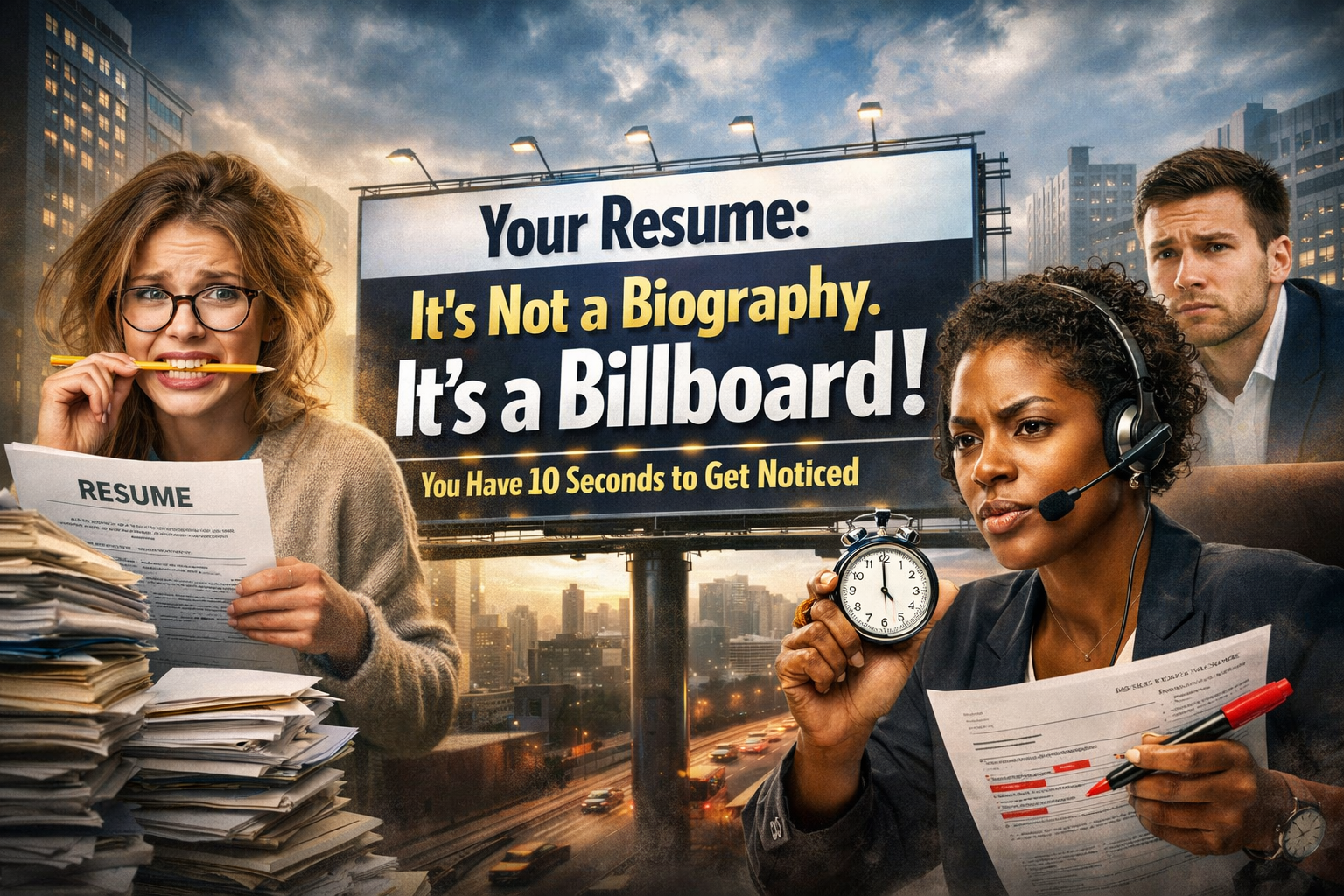
There’s a special kind of optimism that only exists inside the human brain right before we upload a résumé, and it sounds like this: Surely they will appreciate the full arc of my professional identity, the nuance of my growth, the emotional resilience it took to survive Outlook calendar invites, and the fact that I once saved Q4 by bribing the printer with gentle affirmations.
They will not.
Because your résumé isn’t being read like a novel. It’s being scanned like an airport security tray: quickly, suspiciously, and with the strong assumption that at least one thing you packed is unnecessary and possibly dangerous. Recruiters aren’t sitting there with tea and a blanket whispering, “Tell me about your journey.” They’re triaging. They’re sorting. They’re speed-dating your career while Slack pings, hiring managers panic, and a candidate named Jordan has already submitted a résumé that says “Revenue +18%” in the first 12 words.
And this is why most résumés fail for one brutally simple reason: they try to tell everything instead of selling the right thing.
A résumé that tries to contain your full life story becomes a documentary. A résumé that sells the right thing becomes a billboard. One gets politely ignored. The other gets pulled off the highway and asked, “Okay, wait—who are you?”
As we close out the year, let’s stop writing résumés like we’re applying for sainthood, and start writing them like we’re applying for money.
The Resume Biography Trap (AKA: “Here’s Every Job I’ve Ever Had, Enjoy Your Eye Strain”)
Most people build their résumé the way they pack for a trip: they throw everything they own into the suitcase because what if they need it—what if, in the middle of an interview, someone asks about that one volunteer role from 2014 where you coordinated a charity bake sale and therefore possess elite stakeholder management skills, flour-based conflict resolution, and a deep understanding of oven preheat cycles.
So the résumé expands. It becomes a museum exhibit. It includes tasks, tools, committee memberships, software you touched once, and bullet points that read like a detailed witness statement.
And it feels responsible, because you’re thinking, If I include more, they’ll see I’m capable.
But “more” doesn’t read as capable. “More” reads as unclear.
Because the résumé isn’t judged on how much you did. It’s judged on how fast someone understands what you do now, what you’re great at now, and what problem you solve now. Not “responsibilities.” Not “supported.” Not “assisted.” Not “participated in.” Those are the résumé equivalent of telling someone you went to the gym by showing them a photo of the parking lot.
The people who win aren’t the people with the most content. They’re the people with the cleanest signal.
Your goal isn’t to prove you’ve been busy. Your goal is to prove you’ve been useful in measurable ways.
Recruiters Scan Like They’re Defusing a Bomb (So Stop Hiding the Wire They Need)
Recruiters are not villains. They are not trying to ruin your life. They’re just operating in an environment where time is a myth and every open role attracts a small population. They’re scanning because they have to. They’re scanning because the hiring manager is asking for “someone with 8 years experience” and then immediately rejecting anyone with 9 because “they might be too senior.” They’re scanning because the ATS is basically a raccoon in a suit sorting keywords into piles like, “This one smells like leadership. This one smells like Excel. This one smells like lies.”
So when you give them a résumé that starts with a paragraph-long objective statement about your passion for growth, collaboration, and excellence, what you’re doing is forcing a busy person to dig through fog to find the one thing they’re actually looking for.
Instead, give them the wire. Put it right on top. Make it obvious.
If I opened your résumé and gave myself ten seconds, could I answer these questions without squinting?
- What are you? (Role / lane / level)
- What do you do best? (1–2 strengths)
- What results do you produce? (proof, not vibes)
Because “strategic, detail-oriented professional” is not a hook. That’s the corporate horoscope everyone thinks is unique.
A real hook looks like outcomes. Numbers. Clear wins. Short phrases that scream this person moves the needle.
And yes, your bullets can still have personality. But the kind of personality that gets interviews is called precision.
Stop Listing Effort. Start Selling Impact (And Make Every Word Pay Rent)
A lot of résumés read like someone is trying to earn credit for trying.
- “Responsible for managing…”
- “Assisted with…”
- “Worked on…”
- “Helped support…”
- “Participated in…”
That’s not impact. That’s attendance.
You can work hard and still be invisible on paper if your bullets don’t translate effort into outcomes. Because companies don’t hire effort. They hire results. They hire reduced costs, increased revenue, faster processes, smoother operations, less chaos, fewer fires, happier customers, and fewer meetings that could have been emails.
So instead of writing what you did, write what changed because you did it.
Not:
- “Managed the onboarding process for new hires.”
But:
- “Redesigned onboarding workflow, cutting time-to-productivity by 30% and reducing first-week escalations.”
Not:
- “Handled client communication.”
But:
- “Owned client communications for 40+ accounts, improving retention by strengthening response SLAs and reducing escalations.”
Not:
- “Led cross-functional meetings.”
But:
- “Led cross-functional launches across Product and Ops, keeping delivery on schedule while unblocking stakeholder bottlenecks.”
Your résumé should read like a highlight reel, not like a job description you copied out of fear.
Because when you say “responsible for,” you’re basically telling the reader: Please imagine I did something valuable here.
Don’t make them imagine. Show them.
Final Thoughts: Clarity Beats Quantity, Every Time
As we close out the year, consider this your friendly reminder that your résumé is not a scrapbook. It’s not a confession booth. It’s not a comprehensive encyclopedia of every time you touched a spreadsheet and lived to tell the tale.
It’s a billboard.
A billboard does not list the ingredients. A billboard sells the craving.
So tighten the message. Lead with what you want to be hired for. Make your headline stop someone mid-scroll. Replace responsibilities with outcomes. Replace effort with impact. Remove anything that doesn’t serve the role you want next, even if it’s technically impressive, because the résumé isn’t about proving you can do many things—it’s about proving you can do the right thing.
Make every word earn its place.
Because you don’t get minutes. You get seconds.
And the résumé that wins is the one that makes someone look up and think, Oh. This is exactly who we need.