
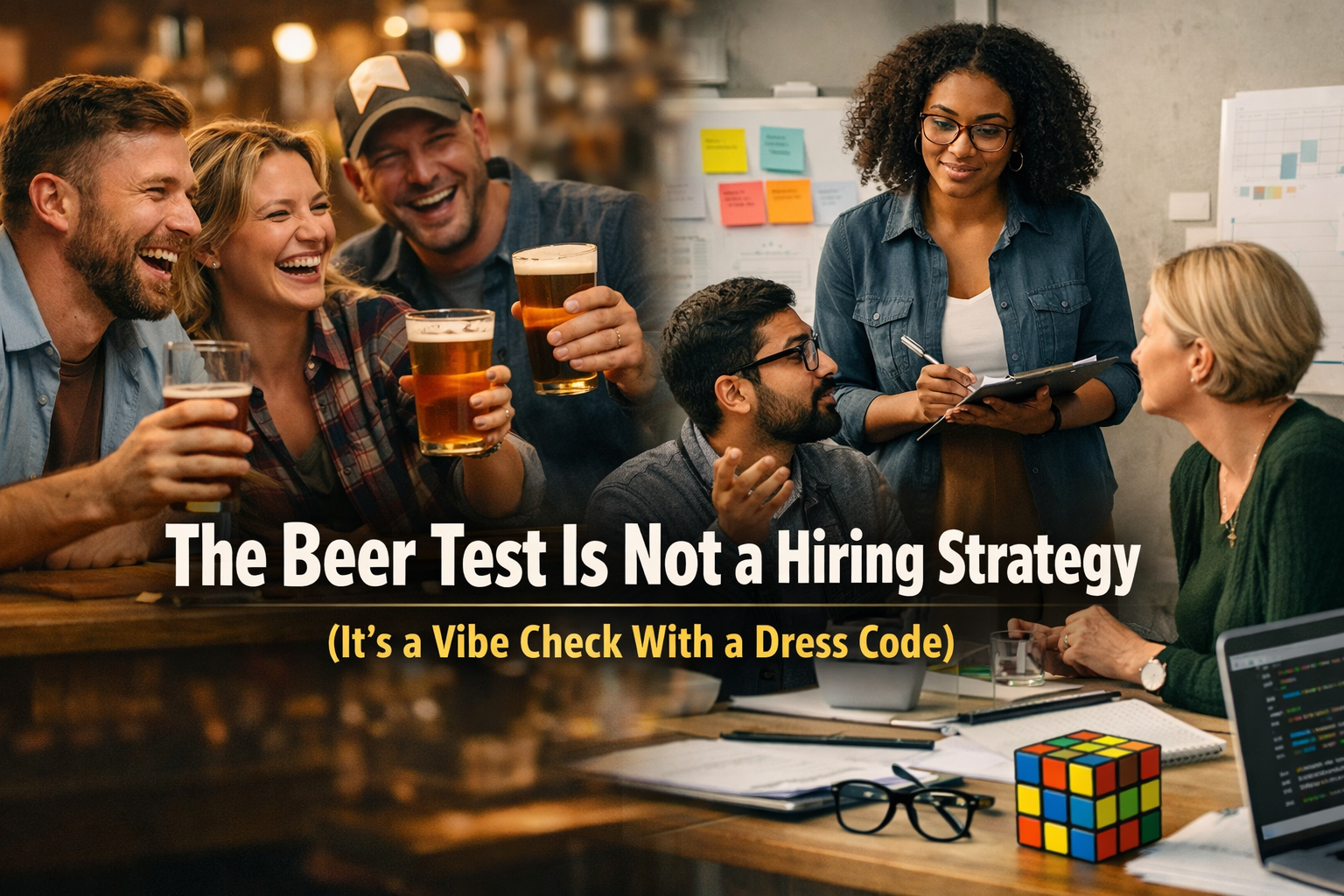
There’s a very specific kind of sentence that only shows up in hiring conversations when the room has gone quiet, the interview notes are suspiciously thin, and everyone is trying to explain a gut feeling without admitting the gut feeling is mostly just a playlist of personal preferences wearing a blazer, and it sounds like this: “They just didn’t pass the beer test.”
And every time someone says it, I can feel an entire HR department somewhere gently placing their head onto a desk like it’s a pillow made of legal risk.
Because here’s the thing: you are not staffing a fraternity reunion. You are not casting “Best Friend #3” in an office sitcom. You are not hiring a co-pilot for your weekend patio routine where you talk about golf swings and pretend you’re “not really checking email.” You are hiring someone to build, scale, fix, secure, analyze, sell, lead, ship, and sustain actual work that has consequences—work that impacts customers, revenue, compliance, uptime, and the fragile emotional stability of everyone who will be paged at 2:17 a.m. when the database decides it’s tired of being perceived.
But “culture fit” sounds warm. It sounds safe. It sounds like you care about people. It sounds like you are building something intentional instead of accidentally recreating your high school friend group inside a conference room with fluorescent lighting.
And that’s why it’s so dangerous.
“Culture fit” is often just bias with better branding. It’s the corporate equivalent of saying, “I don’t know what it is, I just don’t like them,” but then adding a PowerPoint slide so it feels professional.
So yes, the person who didn’t laugh at your joke about “circle back” might be the exact person who would have prevented your next product meltdown. The person who didn’t mirror your energy might be the one who would have challenged the assumptions your entire team has been recycling for years like it’s sustainability.
But we don’t say that. We say “culture fit.” Because “culture fit” is a soft pillow you can put over the face of discomfort.
And discomfort, inconveniently, is where growth tends to live.
The “Beer Test” Is Just a Social Compatibility Quiz With a LinkedIn Profile
The “beer test” is one of those hiring myths that refuses to die because it is unbelievably convenient, which is how most bad workplace traditions survive.
On paper, it sounds reasonable: “Would I want to grab a beer with this person after work?” The problem is that it instantly prioritizes social familiarity over professional capability, and social familiarity is a magnet for sameness. People don’t usually want to grab a beer with someone who challenges them, interrupts their assumptions, or communicates differently than they do. They want comfort. They want rhythm. They want someone who speaks their dialect of small talk and laughs at the same harmless little jokes that make the workday feel less like a spreadsheet treadmill.
But the job is not “Beer Companion.” The job is not “Vibes Curator.” The job is not “Makes Meetings Feel Less Like Meetings.”
The job is the job.
And when you reduce hiring decisions to a social hang test, you quietly screen out anyone who doesn’t match the dominant style in the room. Not maliciously, not even consciously, but consistently. The introvert who isn’t going to perform extroversion on command. The neurodivergent candidate who communicates directly and doesn’t decorate every sentence with a smile. The person from a different culture who doesn’t do the exact same humor cadence. The woman who has learned that “after work drinks” can be a career trap depending on who’s watching. The candidate who’s sober. The candidate who’s a parent. The candidate who simply doesn’t want their job to require a personality audition on top of already doing the work.
And then everyone wonders why the team “doesn’t have diverse perspectives,” like diversity is something you can order after you’ve already hired twelve variations of the same person with slightly different haircuts and identical opinions about what “professionalism” looks like.
The beer test doesn’t find the best hire. It finds the easiest hire for the people already in power. It rewards familiarity, and familiarity is a lazy substitute for assessment.
If the role is to scale a database, you should be asking questions that reveal how they think about scaling a database—tradeoffs, architecture, incident response, collaboration under pressure, communication when something breaks, integrity when the numbers look ugly, humility when they’re wrong, curiosity when they don’t know.
Not whether they would laugh politely at your story about that one time at the company retreat.
“Culture Fit” Builds a Fragile Monoculture With Zero Blind Spot Detection
When hiring teams optimize for “culture fit,” what they usually mean—without realizing it—is “cultural similarity.” Same communication style. Same energy. Same humor. Same assumptions. Same comfort with ambiguity. Same tolerance for conflict. Same definition of “direct.” Same definition of “respect.” Same definition of “leadership.” Same definition of what a “good candidate” looks like when they walk into a room.
And the result is a team that feels smooth. Meetings are efficient because nobody interrupts the groupthink. Decisions happen quickly because dissent has been gently filtered out at the door. Everything feels aligned because alignment has been engineered through selection, not earned through clarity.
It is comfortable.
It is also brittle.
Because monocultures don’t notice their own blind spots. They normalize them. They make them tradition. They reward them. They build processes around them. They promote the people who repeat them with confidence.
And then, one day, reality shows up—customer behavior shifts, a competitor ships faster, a security incident exposes weak assumptions, a market turns, a product fails, a regulatory change hits, a recession makes “nice-to-have” features look like expensive hobbies—and suddenly the team that always agreed realizes it has no muscle for disagreement, no framework for challenge, no language for conflict that doesn’t feel like personal betrayal.
That’s the hidden cost of “culture fit”: it trains teams to confuse harmony with health.
Innovation doesn’t usually happen in rooms full of people who think the same way. Innovation happens when someone asks the question nobody wants to answer. When someone says, “Why are we doing it this way?” and doesn’t accept “because we always have” as a valid technical reason. When someone points out that the roadmap is basically a hope strategy and the metrics are more decorative than diagnostic. When someone says, politely but firmly, “This will break,” and then explains how, and then helps you fix it before it becomes a public incident and a private panic.
But “culture fit” teams often interpret that person as “not a team player,” which is corporate code for “they are ruining our vibe by noticing the risk.”
And that’s how you end up with fragile monocultures: teams that feel good right up until they fail in predictable ways, because nobody was hired to be the person who sees what everyone else is missing.
Hire for “Culture Add” — The Person Who Makes You Slightly Uncomfortable for the Right Reasons
“Hire for culture add” doesn’t mean “hire someone who is difficult,” like some sort of professional chaos gremlin who takes pride in friction. It means hire someone who expands the team’s thinking, strengthens the team’s decision-making, and improves the team’s ability to detect its own blind spots.
It means you hire the person who makes you pause, not because they’re wrong, but because they’re not predictable.
The person who asks better questions than the rest of the room. The person who doesn’t accept vague answers. The person who wants definitions. The person who wants success metrics. The person who wants to know what failure looks like, and what happens when it arrives. The person who challenges the “we’re a family” narrative by asking what you do when a family member has boundaries. The person who says, “What does ‘fast-paced’ mean here?” and waits for something more specific than “we move quickly,” because they know “fast-paced” is often a euphemism for “we are under-resourced and emotionally improvising.”
Culture add means you intentionally hire people who bring in missing strengths: someone more structured than your chaos. Someone more skeptical than your optimism. Someone more customer-obsessed than your internal politics. Someone more analytical than your storytelling. Someone more direct than your passive-aggressive meeting dance. Someone who will say, “We can do that, but here’s the tradeoff,” because they respect the work more than they respect the fantasy.
And yes, sometimes culture add annoys you slightly.
Because culture add will ask the question you wanted to skip.
Culture add will notice that your onboarding is basically “Here’s a laptop, good luck.”
Culture add will point out that your hiring rubric is vibes with extra steps.
Culture add will insist on clarity, and clarity is uncomfortable when you’ve been getting by on charisma and institutional memory.
But that discomfort is not a threat. It’s information. It’s the signal that you are hiring beyond your own reflection.
If you only hire people you instantly like, you are not building a team—you are building an echo chamber with benefits.
Final Thoughts: The Goal Isn’t Comfort. It’s Capability.
“Culture fit” is seductive because it feels like cohesion. It feels like fewer conflicts. It feels like hiring is easier. It feels like you can trust your gut.
But your gut is not a neutral hiring instrument. Your gut is a scrapbook of experiences, preferences, biases, and comfort triggers that were never designed to build equitable, resilient teams in a complex world.
If you want a team that scales, you need people who can disagree without detonating. People who can challenge without contempt. People who can bring a different lens without being punished for not matching the room.
So retire the beer test. Replace it with something boring and effective: a clear rubric tied to the work, structured interviews, skills assessments that reflect real job tasks, and a deliberate commitment to hiring people who make the team stronger, not just smoother.
Because the best teams are not the ones where everyone gets along instantly.
They’re the ones where different thinkers can build something together—without mistaking comfort for excellence, and without calling bias “culture” just because it sounds nicer in a meeting.