
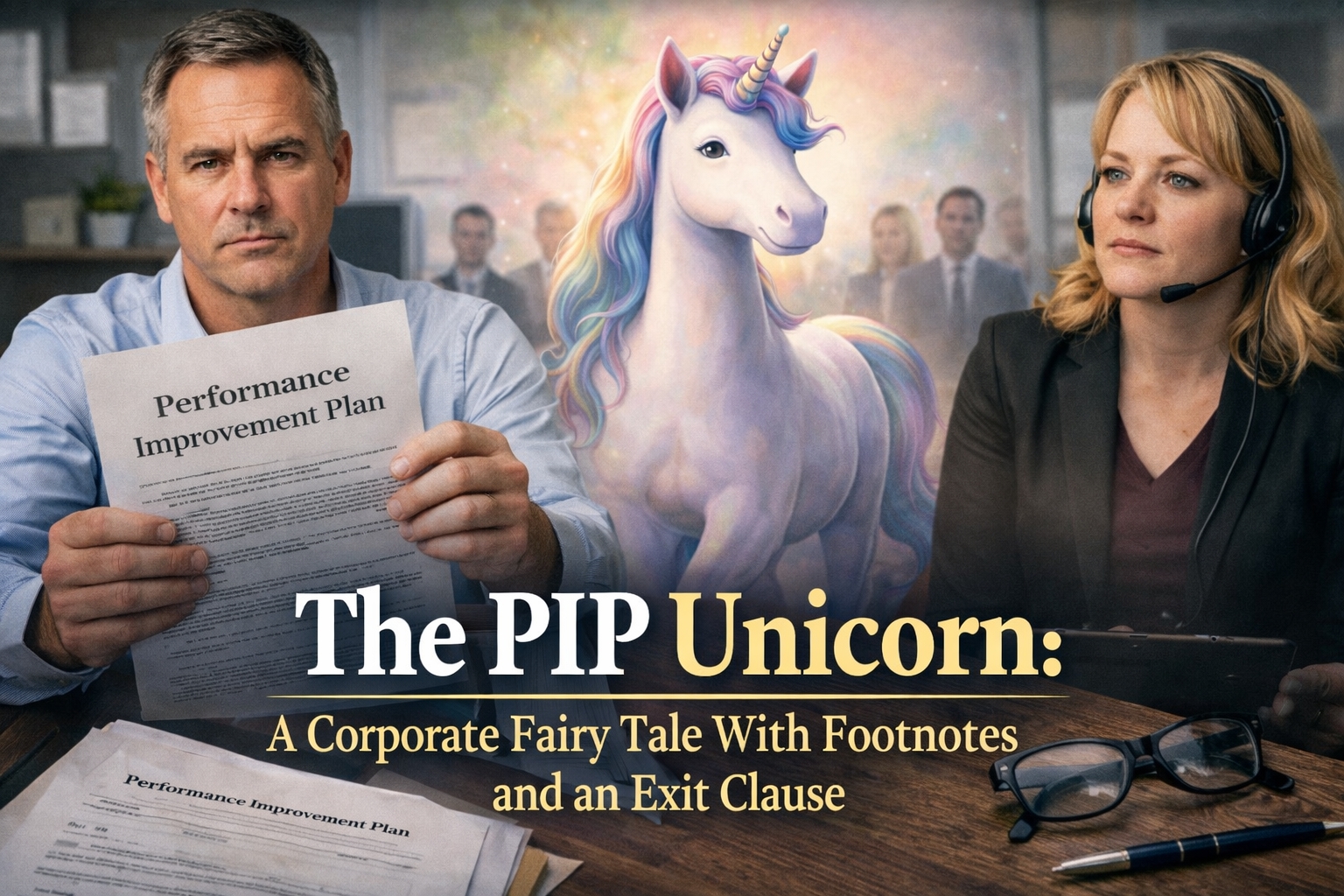
A Performance Improvement Plan is not a phrase. It’s a season. It has its own barometric pressure. You don’t hear it coming—you feel it in the air, like the office suddenly got colder even though Facilities insists the thermostat is “working as designed.” It arrives the way all modern calamities arrive: as a calendar invite with a friendly subject line, a polite time block, and an attachment that somehow manages to smell like HR templates, legal alignment, and the faint cologne of someone saying, “This is for your benefit,” while quietly opening a folder labeled Documentation.
And the truly unnerving part is the tone. Always the tone.
It’s never dramatic. It’s never angry. It’s never, “You’re failing.” It’s supportive. It’s measured. It’s the corporate version of a nurse smiling while tightening a tourniquet. Everyone is calm. Everyone is empathetic. Everyone is “rooting for you.” Meanwhile your nervous system is already on LinkedIn, updating your headline to something brave like Strategic Leader | Results Driven | Currently Experiencing a Character Arc.
But then the stories begin.
Because according to a certain breed of executives—usually the ones who speak exclusively in metaphors, dashboards, and “win-win” energy—a PIP is not what you think it is. It’s not a formalized stress test. It’s not a controlled demolition with a PR strategy. It’s not a paper trail built to outlive you like an ancient ruin.
No.
A PIP is a gift. A growth portal. A thoughtfully designed opportunity to become the best version of yourself, like a wellness retreat, except instead of yoga you get milestones, and instead of aromatherapy you get a timeline that reads like a countdown to the season finale.
And this is where the unicorn enters the chat.
Because somewhere, allegedly, there exists a unicorn who was placed on a PIP and reacted the way corporate training videos insist people react: with gratitude, clarity, and improved posture. A unicorn who did not spiral. Did not quietly Google, “Does a PIP mean they’re trying to fire you,” at 1:47 a.m. while eating shredded cheese out of a bag. A unicorn who didn’t start screenshotting compliments from six months ago like evidence in an upcoming trial.
This unicorn embraced effort. Effort—the mystical force it had been casually avoiding during the entire “months of prior coaching” era, which is corporate language for “we told you a bunch of times and you smiled a bunch of times and nothing changed.”
But once the PIP arrived—once the goals had bullet points, and the consequences had a timeline—our unicorn awakened. The seriousness caused a shift. The horn shimmered. The KPI dashboards parted like the Red Sea. And suddenly, transformation.
They showed up differently.
And everyone clapped.
Not loudly, of course. Respectfully. In Outlook.
The Gentle Calendar Invite That Triggers the Apocalypse
A PIP does not announce itself like a villain. It doesn’t slam the door and yell, “I’M HERE TO RUIN YOUR WEEK.” It glides into your inbox in a tone that suggests you should bring a notebook and a positive attitude, like you’re about to attend a lunch-and-learn titled Thriving Through Feedback.
Subject line: Touch Base Location: Zoom Attendees: You, your manager, HR, and sometimes “Optional: Someone with Legal Eyes.”
And even if Legal isn’t on the invite, you can feel it. Legal is always there spiritually, like a ghost that haunts conference rooms and feeds on ambiguous phrases.
The meeting begins exactly the same way every time:
“We want to set you up for success.”
Which is corporate for: We want to be able to say we tried.
You’ll hear things like:
- “This is supportive.”
- “This is a tool.”
- “This is an opportunity.”
And none of these phrases will prevent your stomach from dropping into your shoes like it’s trying to leave the organization before you do.
Because here’s what a PIP really does: it transforms your job from a role into a performance.
Not performance like excellence. Performance like theater. Every interaction becomes evidence. Every email becomes part of the record. Every sentence you write now has the energy of someone trying not to be misquoted in court.
You begin living in a world where “good morning” feels like it needs a time stamp.
And yet, everyone acts like this is a healthy process. A mentorship arc. A glow-up document.
Which brings us back to the unicorn.
The Unicorn Who Discovered “Effort” and Became a Legend
According to corporate folklore, the unicorn was coached. Coached extensively. Coached with care. Coached with “frequent touchpoints” and “clear expectations” and probably a Google Doc titled Roadmap to Excellence.
But coaching didn’t work.
Not because coaching is vague. Not because leaders are inconsistent. Not because expectations move like the goalposts are on wheels.
No.
Coaching didn’t work because the unicorn hadn’t yet accessed the sacred realm of effort.
Effort, in this story, is treated like a spiritual awakening. Like a chakra alignment. Like the unicorn was simply waiting for the right formal document to activate the part of its brain that understands “deadline.”
And once the PIP arrived? Boom. Effort unlocked. The unicorn began to:
- Make eye contact with metrics.
- Respect the calendar like it was scripture.
- Treat feedback not as commentary but as prophecy.
- Stop “missing details” and start “owning outcomes.”
- Show up differently, which is the corporate way of saying, “We like you better when you’re afraid.”
And you know what’s truly magical about the unicorn story?
The PIP was never held against them.
Never.
It didn’t follow them. It didn’t resurface later. It didn’t become a permanent eyebrow raise in future promotion conversations. It didn’t return every year like a seasonal allergy.
It disappeared like it had never existed—leaving only admiration and the kind of respect normally reserved for people who survive bear attacks or tax audits.
Because in the corporate ecosystem, nothing earns reverence quite like thriving under consequences.
The unicorn did not improve. The unicorn redeemed itself.
And now, whenever anyone questions PIPs, the legend is invoked.
“Remember the unicorn.”
Of course. How could we forget. The one employee who treated the PIP like a motivational poster instead of what it feels like for most people: a formally scheduled farewell tour with deliverables.
When “Support” Becomes a PDF and Accountability Gets Laminated
Let’s talk about the part no one puts in the unicorn story.
The part where “support” changes shape.
Before a PIP, support is verbal. Vague. Warm. It’s all, “Let’s keep an eye on that,” and “Just be mindful,” and “We want to see more leadership,” which is a sentence that means everything and nothing, depending on the weather and your manager’s mood.
After a PIP, support becomes:
- Written
- Time-bound
- Trackable
- Designed to survive scrutiny
Support turns into a document with sections. A timeline. Milestones. Check-ins. An ending.
And once it’s in writing, the real purpose becomes visible: this isn’t just about helping you improve. It’s about ensuring that if you don’t, the company can point to Exhibit A, B, and C and say, “We were fair.”
Which is why so many people don’t experience a PIP as a gift.
They experience it as a polite off-ramp with a smile.
Because while the unicorn story insists the PIP is a growth portal, reality suggests it’s often a process that starts with “opportunity” and ends with “alignment,” and somewhere in the middle you begin to understand that the plan is not designed to make you great—it’s designed to make the paperwork bulletproof.
And that’s the part that makes the unicorn story feel like a bedtime tale told by someone who has never been the one trying to sleep.
Final Thoughts: In Search of the Unicorn, In the Silence of the Barn
I don’t deny that unicorns exist. I don’t deny that some people get a PIP and rise. Some people do respond well to structure. Some managers genuinely want to salvage the relationship. Some companies actually mean it when they say “support.”
But the reason the unicorn story gets told so often is because it’s comforting—for leadership.
It suggests the system is kind. The process is pure. The outcomes are earned. It frames fear as motivation and consequences as character development. It turns survival into a virtue and calls it “respect.”
And for everyone else—the regular horses in the barn, the ones doing their best while the workload grows and the goalposts migrate and the feedback arrives like fog—the unicorn story can feel less like inspiration and more like a warning wrapped in pastel colors.
“See?” it says. “If you don’t succeed, it’s not the process. It’s you. You just didn’t embrace growth hard enough.”
So yes. I’ll keep listening to the folklore. I’ll nod politely. I’ll even smile when someone calls a PIP a “win win.”
But I’ll also be over here, scanning the horizon for the unicorn, horn shining, KPI-aligned, emotionally regulated, thriving under formal documentation… wondering how rare it is, why it’s always used as proof, and why, when the story ends, the barn always gets so quiet.