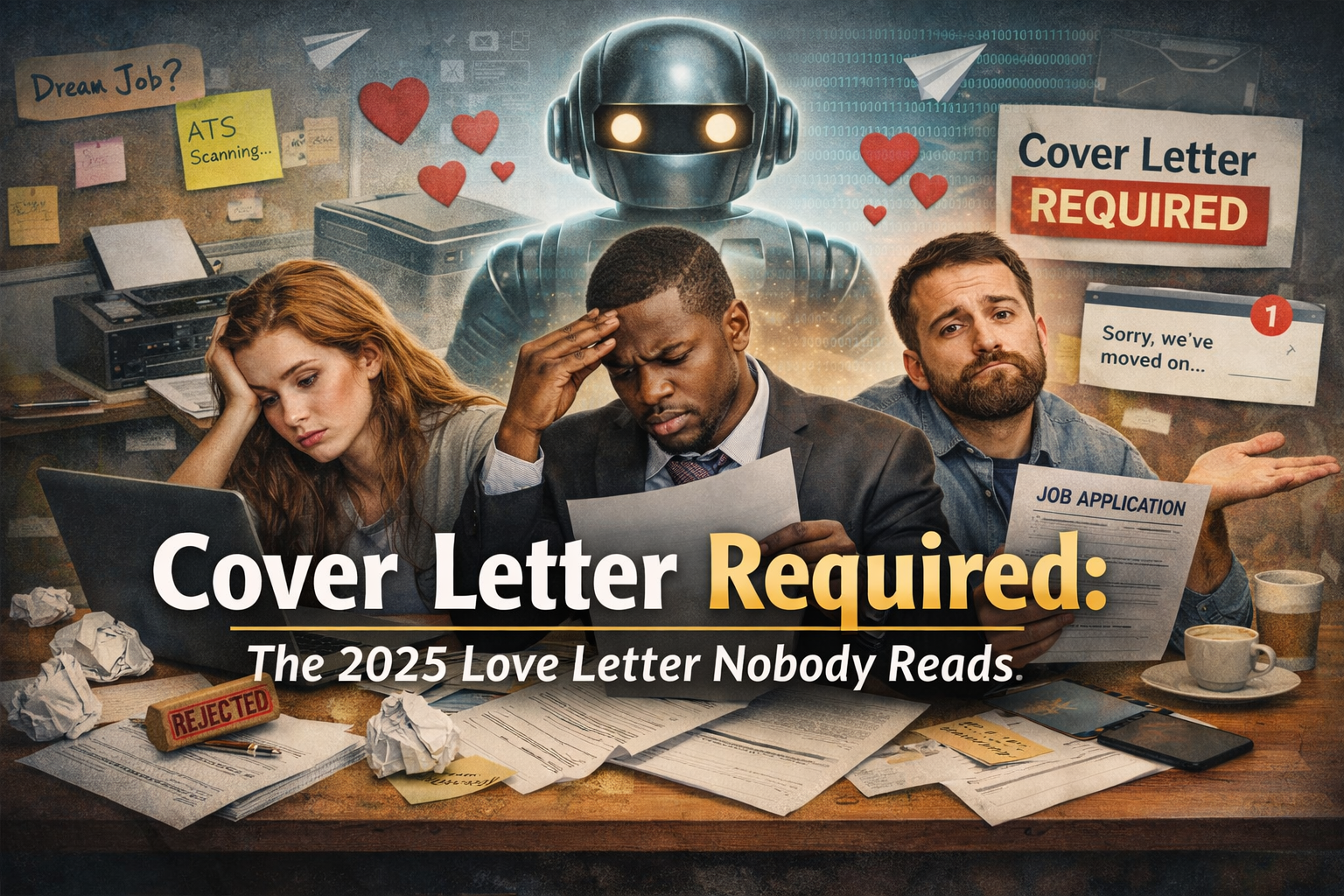
The other day I was scrolling LinkedIn the way we all do now: with one hand on the mouse, the other hand clutching our last shred of dignity like a fragile houseplant we keep forgetting to water, just trying to avoid emotionally bonding with job postings that were clearly written by a committee of stressed-out managers and one haunted HR generalist who still thinks “fast-paced environment” is a personality trait.
And then I saw it.
A job posting that didn’t just suggest a cover letter. It didn’t politely whisper, “If you have time.” It didn’t pretend it was optional in the same way office snacks are “optional” until you’re crying in the break room eating pretzels for dinner.
No. It said the cover letter was required. Not “nice to have.” Not “recommended.” Required, or your application would not be accepted.
Immediately, my spine straightened. My coffee tasted bitter. Somewhere, a printer from 2009 whirred ominously like it had sensed weakness in the workforce.
Because nothing in 2025 says “innovative workplace” like demanding a document that exists solely to prove you can politely beg in paragraph form while pretending you’re not begging. It’s the professional version of writing a heartfelt caption under a photo and hoping your ex notices you “thriving,” except your ex is a company that refuses to list salary and thinks “competitive” is a number.
So I sighed. Rolled my shoulders. Opened a blank document. And began the ritual, the ancient ceremony, the sacred dance of rearranging the same twelve words in different orders until it looks like enthusiasm instead of survival.
Draft one: too eager. Draft two: too robotic. Draft three: accidentally sounded like I was writing to a Victorian factory owner asking for an apprenticeship and promising I could operate the loom with only minor tears. Draft four: confident but humble, which is an impossible emotional state invented by recruiters to see how well you can lie with charm.
And every sentence became a moral dilemma.
“I’m excited about this opportunity” felt desperate. “I’m interested in this role” felt lukewarm. “I believe I’d be a strong fit” felt arrogant. “I bring value” felt like a hostage negotiation with bullet points.
At one point I realized I’d spent forty-five minutes explaining why I wanted a job that hadn’t even bothered to list the salary. I was crafting a bespoke love letter to a company whose name I would forget immediately after clicking “submit,” assuming the system even let it through. And that’s when it hit me: I wasn’t job hunting anymore. I was auditioning for the role of Person Who Wants This Enough.
So yes—this is a story about a cover letter. But it’s also a story about modern work culture asking people to perform devotion before they’ve even been treated like a human being. It’s about being asked to write a tiny novella proving you’re passionate, strategic, and results-driven, when the actual truth is: you are a person with bills, and you would like to exchange skills for money without doing unpaid creative writing as the entry fee.
Which brings us to Chapter One, also known as: Why are we doing this again?
The Cover Letter as Corporate Astrology
A cover letter in 2025 is not a document. It’s a vibe check. It’s a loyalty test. It’s corporate astrology where your fate depends on whether you used the correct alignment of keywords under a waxing gibbous moon.
It’s also the only piece of writing in America that asks you to be simultaneously:
- unique but aligned
- confident but humble
- eager but not desperate
- professional but “authentic”
- experienced but still “hungry”
- human, but not too human
You are expected to sound like you’ve dreamed of joining this company since childhood, which is wild because the company was founded in 2017 and primarily sells software that helps other software track software.
And yet you must write as if you’ve always admired their mission. Their values. Their culture. Their strong commitment to synergy and community and “people-first,” which is always the phrase used right before a layoff email starts with, “This was not an easy decision.”
Cover letters ask you to do the emotional labor of romance in a relationship that hasn’t even agreed to dinner.
You’re expected to write, “I’m drawn to your mission,” while the job posting says, “Must lift 50 pounds,” “Must thrive under ambiguity,” and “Must be okay with occasional nights and weekends,” which is an elegant way of saying, “We will call your personal life a boundary issue.”
And here’s the best part: the cover letter isn’t even for a person. It’s for a system. A robot. A hungry digital filing cabinet that reads at the speed of disrespect.
So you write your heartfelt paragraphs, and the ATS skims it for six seconds, misreads your name, and quietly escorts your application into the digital abyss, where it will live forever alongside unanswered follow-ups and automated “we’ve moved forward” emails that sound like they were written by a toaster trying to be kind.
Drafting the Perfect Tone, aka Rearranging Anxiety
Cover letters don’t get written. They get wrestled into existence.
Because you start with sincerity, and then you remember sincerity is risky. Sincerity can be interpreted as “too emotional,” and in professional environments we only allow emotions that increase productivity—like urgency, panic, and the special anger that comes from a calendar invite titled “Quick Sync.”
So you edit.
Then you edit again.
Then you edit until the letter becomes less about you and more about constructing the hologram of a candidate who has:
- the ambition of a startup founder
- the stability of a Swiss savings account
- the energy of someone who sleeps eight hours
- and the humility of a medieval monk
Every line is a balancing act.
If you say you’re excited, you sound desperate. If you say you’re capable, you sound cocky. If you say you’re adaptable, you sound like you’re willing to be exploited with a smile. If you ask about salary, you sound “transactional,” which is hilarious because a job is literally a transaction.
You start deleting words like “passionate” because you can’t be passionate about everything. No one is passionate about “stakeholder alignment.” No one wakes up at dawn whispering, “I cannot wait to cross-functional this quarter.”
But you still have to pretend you do.
And the longer you stare at the page, the more you realize the cover letter isn’t asking, “Can you do the job?” It’s asking, “Can you perform the correct personality long enough to get past our first gate?”
At some point you’re no longer writing a letter. You’re rearranging anxiety into polite formatting.
And that’s when you hit the stage where you’re not improving it anymore—you’re just moving commas around like they’re tiny emotional sandbags holding back a flood of exhaustion.
Opting Out, aka Choosing Peace Over Homework
Eventually, I closed the document and looked at the posting again, and a deep calm settled over me—not rage, not bitterness, not even sarcasm—just the clear and simple realization that I did not have the energy to audition for basic respect.
I didn’t withdraw in anger. I didn’t rage apply elsewhere. I simply opted out of a process that required unpaid creative writing before we’d even met.
Because here’s the truth: if your first interaction with candidates is, “Please prove your worth in essay form,” that’s not a hiring process. That’s homework.
And I’m sorry, but I graduated already.
A cover letter requirement tells me a lot, and none of it is the kind of “culture” you put on a careers page with a smiling stock-photo team holding coffee cups like they’re united by joy instead of shared deadlines.
It tells me:
- they value performance over clarity
- they’re comfortable asking for extra labor without providing extra information
- they think access to employment should be gated by how well you can write a polite brochure about yourself
- and they still believe devotion is something candidates owe them up front
Meanwhile, the posting still didn’t list salary. Still didn’t list the actual day-to-day. Still didn’t show evidence of a hiring process that respects time.
But it wanted a letter.
A letter that would almost certainly be skimmed, ignored, or used to disqualify someone for not sounding enthusiastic enough about being underpaid in a “fast-paced environment.”
So I chose peace. And honestly? That felt like the most professional decision I made all day.
Final Thoughts: The Most Radical Thing You Can Do is Stop Performing
Somewhere out there, that role is still waiting for a perfectly formatted paragraph explaining why someone has dreamed of joining the team since childhood. I wish them well. Truly. I hope they find a candidate whose spirit animal is a cover letter and whose favorite hobby is “tailoring my enthusiasm.”
But the rest of us? We’re tired.
Not tired of working. Not tired of contributing. Not tired of building things and solving problems and doing meaningful work.
We’re tired of the audition.
Tired of the performative gratitude. Tired of the hoops. Tired of being asked to write a love letter to a company that won’t even tell us what the job pays, then acting shocked when candidates stop showing up for the pageant.
So if you’re out there staring at a “cover letter required” checkbox and feeling your soul leave your body in real time, just know: opting out is not laziness. It’s discernment. It’s boundaries. It’s you refusing to do unpaid emotional theater for the privilege of being ignored.
And in 2025, that might be the healthiest career move anyone can make.