Some interviews feel like conversations. Some feel like auditions. And some feel like you accidentally wandered into a corporate escape room where the clues are emotional, the lighting is flattering in a way that feels suspicious, and the only exit is convincing two strangers that you are both a visionary leader and a compliant, low-maintenance houseplant who thrives under “fast paced ambiguity.”
This one started off deceptively simple.
Two person panel. Just two. Which sounds easier on paper until you realize it’s the interview equivalent of being asked to perform open heart surgery while two people stand three feet away, holding clipboards, blinking slowly, and making tiny notes like: candidate breathes with confidence.
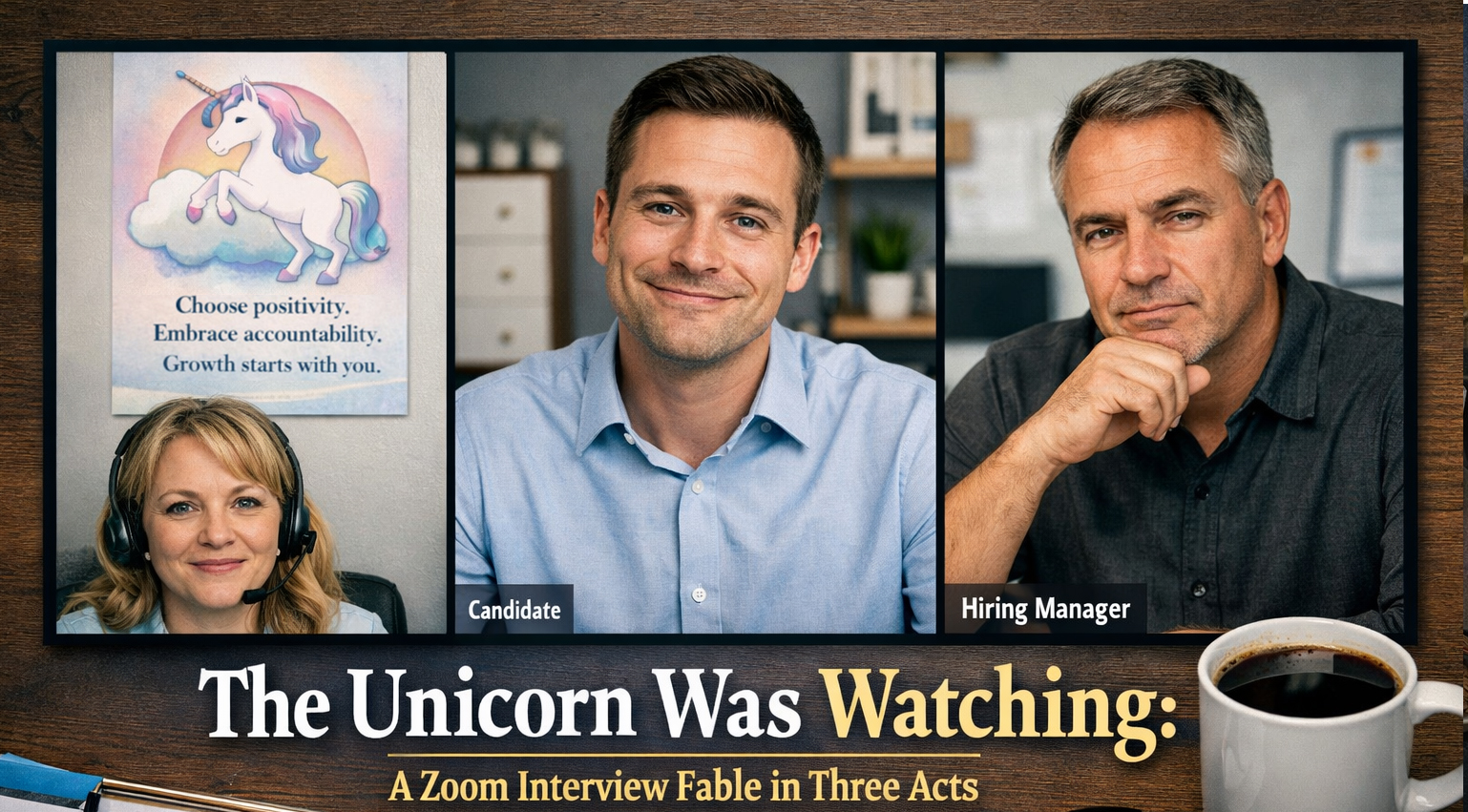
I was centered. Well lit. Smiling the way adults smile when they’re trying to look employable and not like someone who has ever been emotionally harmed by Outlook Calendar. HR Manager Sally occupied one square, Hiring Manager on the other. Everything was calm. Professional. Courteous.
And then my eyes landed on it.
Behind Sally, perfectly framed like the universe had been hired as a set designer, was a poster.
A unicorn.
Not a fun unicorn. Not the “I will ruin your life at a Renaissance festival” unicorn. Not the chaotic glitter unicorn who drinks cold brew and starts office rumors for sport.
This was an HR approved unicorn.
Soft pastel colors. Calm font. The kind of unicorn that looks like it has never raised its voice, never missed a deadline, and definitely has a color coded spreadsheet for feelings. The kind of unicorn who doesn’t “push back,” it “seeks alignment.” The kind of unicorn who doesn’t have boundaries, it has “availability.”
Underneath it was one of those phrases that sounds uplifting until you say it out loud in a performance review and suddenly it becomes a threat with serifs:
“Choose positivity. Embrace accountability. Growth starts with you.”
And right then, my brain stopped listening to Sally and began having a private conversation with the unicorn, because nothing says “safe space” like being evaluated while a mythical creature silently reminds you that your continued employment is apparently a mindset choice.
Sally talked. I nodded. The unicorn watched.
And I realized: this interview wasn’t just an interview.
It was a fable.
A corporate fable.
And I was about to learn a lesson I never asked for.
The Candidate and the Unicorn of Personal Responsibility
Sally asked normal questions. The kind that sound friendly but are actually little psychological traps wrapped in professionalism.
“Tell me about a time you received feedback.”
I gave a polished story. Something tasteful. Something where I took ownership, made improvements, and didn’t mention that most corporate feedback is delivered like a fortune cookie: vague, crunchy, and somehow still judgmental.
The unicorn beamed.
“How do you handle accountability?”
I said words like “clarity,” “ownership,” and “continuous improvement,” because those are the correct incantations. I said them in the correct order. I said them like I wasn’t being watched by a laminated horse with a horn that clearly had opinions about my maturity.
The unicorn looked proud, like it had personally mentored me.
And the thing about an HR approved unicorn is that it doesn’t judge you loudly. It judges you softly. It doesn’t accuse you of failure. It invites you to discover that you chose it. It’s the spiritual cousin of “per my last email.”
Because the unicorn isn’t there to inspire you.
It’s there to pre-blame you.
If you get hired, the unicorn will congratulate you for embracing growth.
If you don’t, the unicorn will calmly accept it, because you obviously didn’t choose positivity hard enough.
The market could be on fire. Budgets could have shifted. The role could have been posted just to make internal candidates feel desired.
Doesn’t matter.
The unicorn has spoken.
Culture Fit, But Make It Mythical
At some point Sally began describing “company culture,” which is always fascinating because culture is the only thing companies can’t define without accidentally confessing something.
“We’re collaborative.”
Meaning: you will be in meetings you don’t need, because we fear silence.
“We’re fast paced.”
Meaning: we do not plan well, and we will make that your personality.
“We value transparency.”
Meaning: we will tell you the bad news with a smile so it counts as leadership.
And hovering behind her, that unicorn—calm, pastel, unbothered—was basically co-hosting the interview. It was giving silent commentary.
Sally said, “We really value accountability here.”
And I glanced at the unicorn like, Yes. I see. The horse with the horn has already told me.
I could feel it. The unicorn wasn’t décor. It was policy. It was the unofficial third panelist. It was the spiritual head of HR. It was the mascot of “we’re a family,” but the kind of family where love is conditional and the conditions are documented.
Because here’s the thing: corporate unicorns don’t show up when everything is going well.
They appear during onboarding, when you’re still hopeful and slightly dehydrated from pretending you’re excited about mandatory trainings.
They appear in conference rooms where someone is about to say “This isn’t disciplinary.”
They appear right before accountability becomes documentation.
Right before support becomes a PDF.
Right before “we’re here for you” becomes “this is your opportunity.”
And the unicorn, in its serene pastel confidence, looked like it had seen this story a thousand times.
And it always ends the same way.
When Positivity Becomes a Performance Metric
Somewhere near the end, when the interview begins to drift into polite wrap-up mode, you get that moment where everyone’s smiling but the outcome is already being processed in the background like an HR printer warming up.
Sally said, “This was a great conversation.”
The hiring manager nodded the way hiring managers nod when they’ve already decided whether your vibe is “team fit” or “future problem.”
And I smiled back, professional and pleasant, while the unicorn watched me like it was preparing to deliver the moral.
Because corporate life has evolved. It’s no longer enough to perform competence. You now have to perform optimism.
You can do great work, but if you don’t do it with the correct emotional tone, you’re suddenly “not aligning.”
You can hit goals, but if you aren’t enthusiastic about the goals, you’re “not engaged.”
You can be exhausted, but if you don’t mask it with positivity, you’re “not resilient.”
Positivity has become the world’s cutest weapon.
It’s not joy. It’s compliance in a cardigan.
It’s accountability with glitter.
It’s “growth starts with you” translated into corporate language, which means: if we fail you, it’s still your responsibility to interpret it as a personal development opportunity.
That unicorn wasn’t there to motivate anyone.
It was there to teach the most important corporate lesson:
If things don’t work out, the system is still innocent.
The process is still pure.
The unicorn is still smiling.
And you, my friend, simply did not show up differently.
Final Thoughts: The Unicorn Always Wins
I left the Zoom interview the way everyone leaves Zoom interviews: politely, hopefully, and with a slight sense that my soul had been evaluated by a committee that includes both humans and office décor.
Maybe I’ll get the job. Maybe I won’t. Maybe they’ll “move forward with other candidates whose qualifications more closely align,” which is corporate for: we liked you but not enough to commit.
But the unicorn did teach me something.
Not about culture. Not about growth. Not about positivity.
About the way corporate life turns everything—even mythical creatures—into laminated messaging designed to make outcomes feel personal.
Because in the end, that unicorn doesn’t exist to remind companies to support people.
It exists to remind people to blame themselves politely when they aren’t supported.
And that’s the real magic trick.
Not that a unicorn exists.
But that it’s smiling while the accountability is quietly being loaded into a PDF.