
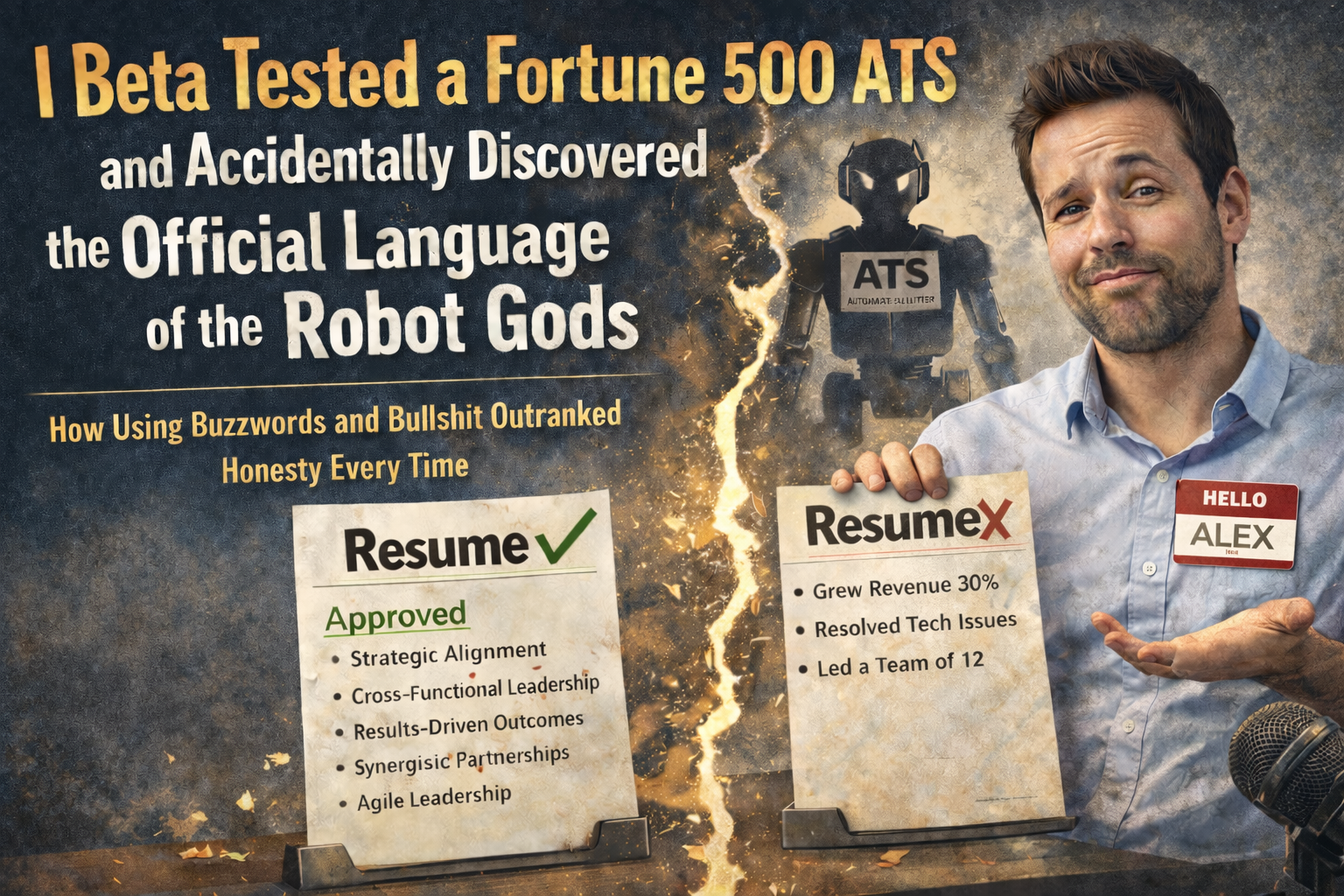
The other day I received one of those corporate invitations that arrives dressed like a compliment but feels, the longer you stare at it, like an unpaid internship for your soul.
They called it a “beta test.” They said it was for a Fortune 500 company, which is corporate for: we have enormous resources, endless meetings, and a spiritual commitment to outsourcing responsibility to a system we will later pretend we cannot control. They framed it as an honor, a privilege, a chance to “help improve hiring,” which is a sentence that sounds inspiring until you remember that most hiring processes cannot be improved until someone admits they are broken on purpose.
Naturally, I assumed the assignment involved thoughtful evaluation, nuance, and an actual attempt to build technology that could recognize human competence without needing it to be wrapped in glittery, buzzword-shaped camouflage. I assumed the system would reward clarity, experience, specificity, and the kind of grounded language used by adults who have actually done the work, led the teams, and lived through enough reorganizations to know exactly which “transformation initiative” is just layoffs wearing a trench coat.
That optimism lasted roughly twelve seconds.
Because I uploaded a résumé that was normal. Clean. Honest. Clear. Full sentences. Real accomplishments. Straightforward ownership. The kind of résumé that says, “I have done this,” instead of, “I have leveraged synergies to reimagine deliverables through a scalable paradigm of stakeholder-forward excellence.”
I hit submit.
Denied.
Not “we’ll review it.” Not “we’ll be in touch.” Just an immediate rejection that arrived so quickly I did not feel evaluated so much as swatted away, like the system had taken one glance at sincerity and flinched. It was the ATS equivalent of recoiling from sunlight.
And that is when I realized the beta test was not going to reveal how hiring works.
It was going to reveal what hiring has become.
The Immediate Rejection, or, When Honesty Becomes a Disqualifier
There is something uniquely insulting about a rejection that arrives at the speed of automation, because it does not just say “no,” it says “you were never even a person in this process.”
A human rejection has friction. It has delay. It has the faint illusion that someone read something, considered something, had a thought, then decided you were not the chosen sacrifice for this particular corporate ritual. An ATS rejection that arrives instantly is not a decision; it is a reflex. It is a motion sensor. It is a trap door triggered by the sound of a real sentence.
And the most impressive part is that it manages to be both impersonal and deeply personal at the same time, because what it is really rejecting is not your background, but your refusal to speak in the approved dialect.
My résumé had actual clarity. It had context. It had outcomes described in human language, the kind of language that suggests accountability, which is not always a welcome vibe in organizations where responsibility is passed around like an unwanted plate at a potluck.
It had specifics, which are dangerous, because specifics imply traceability. Specifics can be measured. Specifics can be questioned. Specifics can expose whether the role itself is real, or if it is just a patch on a broken process with a title slapped on it like a bandage on a leaking pipe.
The ATS did not want my details. It wanted something else.
It wanted comfort.
It wanted the soothing hum of familiar corporate noise, the verbal equivalent of elevator music, where nothing is sharp, nothing is direct, and nothing suggests that the candidate might someday ask a question like, “What does success look like here, and who is accountable when it does not happen?”
Because here is the quiet truth: many systems are not built to find the best candidate.
They are built to eliminate the most inconvenient one.
And inconvenience often looks like competence expressed plainly.
So when my normal résumé hit the machine, the machine did what it was designed to do.
It protected the process from reality.
Keyword Cosplay, or, How I Became a Corporate Ouija Board
After the second instant rejection, I did what any modern job seeker eventually learns to do, not because it feels good, but because survival has a way of turning dignity into a flexible concept.
I rewrote the résumé.
Not with lies, exactly. I kept the same experiences, the same roles, the same accomplishments. But I translated them. I stopped speaking like a person and started speaking like a brochure that had been through three committees and emerged with no soul but excellent formatting.
I fed it buzzwords the way ancient civilizations fed offerings to gods they feared.
Strategic alignment. Cross-functional partnerships. Synergistic collaboration. Data-driven outcomes. Scalable solutions. Transformation. Optimization. Stakeholder engagement. Agile leadership.
I removed clarity and replaced it with confidence-shaped noise.
I turned myself into a walking job description echo, a mirror held up to the posting, reflecting it back with the same vocabulary, the same rhythm, the same sanitized corporate perfume that makes everything smell like “initiative” and nothing smell like responsibility.
And then I uploaded that version.
Approved instantly.
Not a pause. Not a moment of confusion. Not even a flicker of hesitation, despite the fact that the résumé now read like a corporate Mad Libs fever dream written by someone who had never met a verb they could not turn into a “strategic lever.”
The system loved it.
Welcomed it.
Recognized me.
And that was the moment something inside me did not break in a cinematic way, but in a quiet, practical way, like a tiny shelf snapping under the weight of one more absurd truth.
Because the ATS did not reward honesty.
It rewarded performance.
It did not care whether I had done the work.
It cared whether I could recite the right incantations without accidentally sounding human.
This was not screening for talent.
This was screening for fluency in corporate spellcasting.
And the most haunting part is how many people already know this, not intellectually, but in their bodies, because they have felt the humiliation of realizing their entire career can be denied by a system that prefers the word “leveraged” to a real accomplishment described clearly.
Safe Candidates, Predictable Language, and the Algorithmic Vibe Check
Once you realize the system prefers buzzwords to truth, the rest of the modern hiring landscape starts to make painful sense.
This is why companies complain they “cannot find good talent” while posting roles that demand unicorns, pay in coupons, and then run every applicant through a machine that rejects anyone who writes like a human being with actual skills.
This is why qualified people feel invisible.
This is why job searching feels less like being evaluated and more like trying to sneak past a security system by wearing the correct keywords as camouflage, like leaves taped to your chest.
Because the ATS is not designed to find the best candidate.
It is designed to find the safest one.
Safe does not mean capable. Safe means familiar. Safe means compliant. Safe means you already understand the performance required to live inside corporate systems without asking them to evolve.
A safe candidate knows how to sound like the company wants them to sound. A safe candidate mirrors. A safe candidate uses the sacred words in the sacred order. A safe candidate does not introduce unexpected vocabulary like “accountability,” “ownership,” or “why.”
And to be fair, this makes sense if your organization is not actually hiring for excellence.
It makes perfect sense if your organization is hiring for preservation.
Preservation of existing leadership.
Preservation of existing habits.
Preservation of processes that are failing, but failing in familiar ways, which is the only kind of failure corporate culture can tolerate without holding a meeting about it.
The ATS did not fail.
It did exactly what it was built to do.
It filtered out clarity, complexity, and human nuance in favor of standardized language that makes every candidate sound like they were assembled by the same consultant factory, stamped with the same phrases, and shipped in the same box marked “high potential, low disruption.”
And when you step back and look at that system, you realize the problem is not that it rejects good people by accident.
The problem is that it rejects them as a feature.
Final Thought: Congratulations, You Passed—Now Please Stop Being a Person
The most depressing part of the beta test was not that the ATS rejected an honest résumé and approved a buzzword-stuffed one.
The most depressing part was how quickly the result felt familiar, because it explained so much of what people have been experiencing for years while being told it is their fault.
It is not that good candidates disappeared.
It is that the process stopped recognizing them.
It is not that people became unqualified.
It is that qualification became a formatting exercise and a vocabulary test, where the prize goes to whoever can lie politely enough to pass an algorithmic vibe check.
And yes, there is a dark comedy in realizing the machine does not want truth, it wants comfort. It wants familiarity. It wants the soothing corporate hum of approved language arranged in the right order, like a lullaby sung by middle management.
But the deeper problem is what it teaches people to do.
It teaches them to sand down their experience until it becomes vague.
It teaches them to replace real work with buzzword fog.
It teaches them that the less honest they are, the more employable they become.
Which means we are not hiring people.
We are hiring whoever is best at performing employability for robots.
The ATS passed the test perfectly.
And somehow, that is the most damning result of all.