
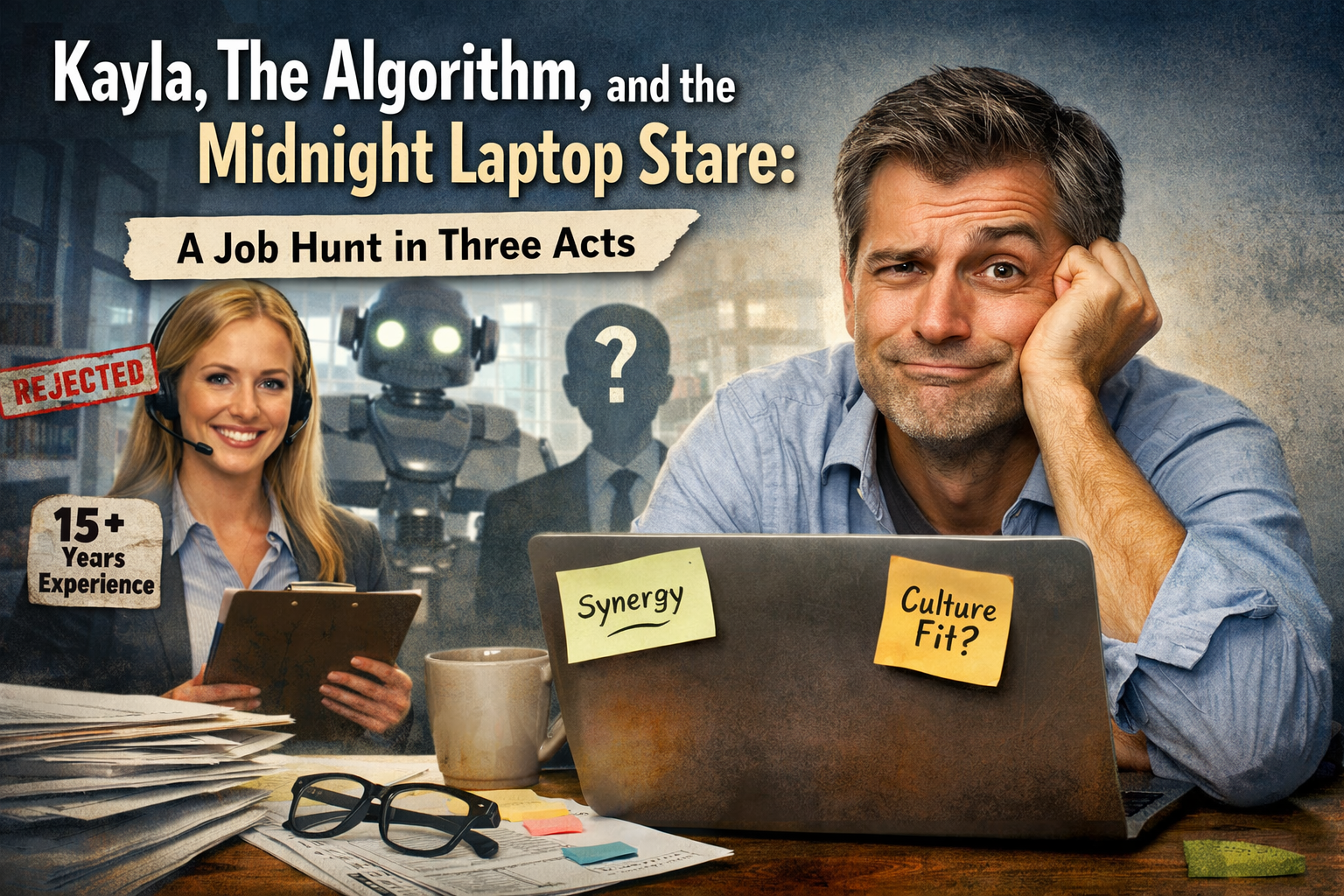
There is a special kind of quiet that happens at midnight when you are alone with your laptop, your dignity, and the soft glow of yet another portal that wants you to retype your resume like it is a sacred text that must be recopied by hand to prove you are worthy of being ignored.
It is not a dramatic moment, not in the way movies understand drama, where rain slaps the window and violins announce your heartbreak, but it is dramatic in the way modern adulthood is dramatic, which is to say it is fluorescent, procedural, and powered by passwords you cannot remember, with a faint underlying sense that your entire future is being evaluated by a dropdown menu that does not include the option that best describes you.
You are not crying. You are not even angry. You are just staring, wide-eyed, at a system that claims to value experience, leadership, and strategic thinking, while simultaneously behaving like it is allergic to people who have actually done the work long enough to recognize when something is broken.
You have become familiar with the language of corporate reassurance, the gentle phrases designed to sound like respect while doing the emotional equivalent of sliding your resume into a paper shredder with a smile. You know the difference between “moving fast” and “we will never speak again.” You know “culture fit” is sometimes code for “you might ask a follow-up question.” You know “overqualified” does not mean “impressive,” it means “potentially inconvenient,” the way a functioning smoke detector is inconvenient if the building is on fire and everyone is committed to pretending it is merely warm.
And then there is Kayla.
Not Kayla as a person. Kayla as a symbol. Kayla as an archetype. Kayla as the freshly graduated Senior Talent Acquisition Partner who was handed a checklist, a template, and the sacred responsibility of filtering out seasoned professionals so the organization can continue its proud tradition of learning lessons the hard way, repeatedly, with confidence.
Kayla is thriving. Kayla is not malicious. Kayla is simply doing what the process trained her to do: protect the system from complexity, protect the hiring manager from accountability, and protect the company from the terrifying possibility that they might accidentally hire someone who knows what they are doing.
So you laugh.
Not because it is funny, exactly, but because it is absurd, and absurdity has a way of demanding a response, and if you do not respond with humor you will respond with something less socially acceptable, like screaming into the void or writing a strongly worded cover letter addressed to “Dear Algorithm” that ends in a legal disclaimer and a prayer.
This is the story of how the job hunt in 2025 turns competence into a threat, turns experience into a liability, and turns one human being’s career into a series of searchable keywords meant to impress a machine that does not technically believe you exist.
The Portal of Eternal Re-Entry
The first chapter of every job hunt begins with you finding a role that looks like it was written specifically for you, which is how the universe tests your optimism before it crushes it into a fine powder and stirs it into your coffee like a creamer of despair.
You read the description. Fifteen years of experience required. Strategic leadership. Cross-functional collaboration. Change management. Stakeholder alignment. The ability to be both a visionary and a doer, which is corporate for “we want a wizard who also answers emails instantly.”
You nod, because you have lived all of this. You have led teams through reorganizations that were pitched as “exciting new opportunities” while everyone quietly updated their LinkedIn. You have migrated systems that were promised to be seamless and ended up being a three-month scavenger hunt for missing data. You have built processes, fixed processes, survived processes, and watched processes get destroyed by someone’s “new idea” that was just your old idea with a different font.
You apply.
The portal greets you with the warmth of a bank’s fraud department.
You upload your resume, and then, as a ritual, you are required to type the exact same information into tiny boxes, as if the machine wants to watch you prove you can suffer. You paste your job titles, and it strips the formatting like it is offended by your professionalism. You enter dates, and it rejects them because your employment history is too long for its imagination. You submit a cover letter, and it offers a cheerful suggestion that you also attach a cover letter, as if it did not just watch you do it.
Then you hit submit, and the confirmation message appears: “Thank you for your interest.”
This is not gratitude. This is a receipt.
You know what happens next. The algorithm will scan your resume not as a story of capability, but as a puzzle of keywords, and it will decide whether you are real based on whether you used the exact phrase “synergize stakeholder value streams” instead of “led the team and delivered results.”
It will not ask what you built. It will ask whether you called it by the right name.
It will not consider that experience often comes with nuance. It will consider whether your bullet points contain the approved incantations. It will do this in seconds, because it is efficient, and efficiency is what you get when you remove the human part of human resources.
And if you are rejected quickly enough, you start to suspect the job was never open, only posted, like a decorative wreath hung on a corporate door to show the world they are hiring while inside they quietly select someone’s cousin’s neighbor’s former roommate who is “a great culture fit” and “already familiar with how we do things,” meaning they will not ask why the process is broken.
This is where you begin to understand that the portal is not designed to find the best candidate. It is designed to sort, to filter, to reduce, to protect the organization from the chaos of choice, which is why it feels less like applying for a job and more like approaching a bouncer at a nightclub where the music is mediocrity and the dress code is compliance.
Still, you try again.
Because you are a professional, and professionals endure.
The Interview With Kayla, Keeper of the Checklist
When Kayla appears on the screen, she smiles brightly, and you can tell she has been trained well, because she has mastered the tone of friendly authority that says, “I am here to guide this conversation,” while also implying, “I have been instructed not to deviate from the script.”
Kayla thanks you for your time, which feels a little like someone thanking you for donating blood while they actively drain it.
She asks you to walk her through your resume.
This is always a moment, because your resume is a document you wrote, carefully, with intention, and Kayla is asking you to narrate it aloud as if it is a bedtime story and she is trying to see if you can pronounce your own job titles without confusion.
You comply. You always comply. You have learned that the job hunt rewards compliance the way kindergarten rewards children who sit quietly with their hands folded, even if the quiet child is building a rocket ship in their mind and the loud child is eating glue with confidence.
Kayla nods and types. She types with intensity, like the fate of the company depends on her capturing your sentences in the correct format.
Then come the questions.
“Can you tell me about a time you showed leadership?”
You pause, because you have showed leadership in so many different ways across so many different contexts that choosing one feels like being asked to pick a favorite breath.
You choose carefully. You tell a story. You describe a challenge, a team, a constraint, an outcome. You mention accountability. You mention growth. You mention what you learned, because you have learned things, and your career is essentially a museum of lessons you did not want but acquired anyway.
Kayla nods, then gently interrupts to ask how you leveraged cross-functional synergy, because the template demands it, and the template is the true hiring manager.
So you translate your lived experience into corporate dialect. You take your story of people and pressure and decisions and you repackage it into phrases that sound like they belong in a quarterly earnings call. You do this not because it is who you are, but because you understand the rules of the game, and the rules say the box must be fed the correct words.
Then Kayla asks if you are comfortable with change.
This question always lands with a particular absurdity when asked of someone who has survived multiple economic collapses, restructures, mergers, “digital transformations,” and at least one executive who tried to replace a pay increase with a laminated quote about grit.
You assure her that you are adaptable.
You do not mention that you once learned a brand-new software system in a weekend because someone decided the old one was “not scalable.” You do not mention that you once held a department together with process improvements and caffeine. You do not mention the time you had to explain to leadership why removing the only experienced person from a team might result in problems, because in 2025 “comfortable with change” often means “comfortable with chaos as long as you pretend it is strategy.”
Kayla asks about energy level.
This is the moment you realize the interview is not fully about competence. It is about containment. It is about making sure you are not too much, which is another way of saying, not too experienced, not too aware, not too capable of noticing the gap between what the company says and what the company does.
So you soften yourself. You smile. You say the safe things. You present a version of competence that is not threatening, like you are wrapping your expertise in bubble wrap so it does not scratch anyone’s comfort.
The interview ends warmly. Kayla says they are moving fast.
You know what that means.
You thank her. You log off.
And you wait, because waiting is now a full-time part of the job hunt, a quiet unpaid internship in uncertainty.
The Rejection Letter, Written by Nobody, Sent to Everyone
The rejection email arrives with the emotional warmth of an automatic thermostat.
“Thank you for your interest.”
“We enjoyed learning more about you.”
“After careful consideration…”
This is always my favorite part, because “careful consideration” in 2025 can mean a human glanced at your application for four seconds before selecting “decline” while taking a sip of water and thinking about lunch.
Then comes the line that always makes you blink.
“We decided to move forward with candidates whose experience more closely aligns with our needs.”
Which is impressive, given the job description demanded fifteen years of experience, mastery of tools invented last week, and the enthusiasm of someone who still finds Slack notifications thrilling, which means the needs were either wildly different than what they posted or the selection process is essentially astrology with a corporate logo.
Sometimes the rejection is immediate, so immediate you suspect the system rejected you before you even hit submit, like it sensed your competence approaching and locked the door.
Sometimes it takes weeks, which is worse, because weeks creates the illusion that a person might have been involved, and you start to imagine your resume being discussed in a conference room, when in reality it was probably sitting in a digital holding pen next to five thousand other resumes, waiting for someone to search a keyword that you did not include because you used a synonym like a fool.
Sometimes you never hear anything at all, which is the purest form of modern rejection, because it does not even have the courtesy of closure. It is not a no. It is a disappearance. It is being ghosted by an organization that claims to value communication.
And after enough cycles of this, you begin to realize that the job hunt is not just a process. It is a performance. It is theater staged by systems that want to feel efficient, staffed by people who are overworked, and governed by metrics that measure speed instead of wisdom.
Kayla is still there, doing her best, dutifully collecting your stories and feeding them into the machine. The algorithm is still there, scanning for the approved words like a truffle pig trained in corporate jargon. The hiring manager is still there, wanting a unicorn, a bargain, and zero risk, while also wondering why they cannot find good people.
And you are still there, staring into the midnight glow, wondering how we built a world where experience is demanded in the posting but punished in the selection.
So you laugh.
Because the alternative is to take it personally, and that is how the job hunt wins, by convincing you that a broken system is a reflection of your worth instead of a reflection of its design.
Final Thoughts: Sarcasm as a Survival Skill
Sarcasm is often misunderstood as bitterness, but in the job hunt it is frequently the last remaining form of honesty that does not get you flagged as “not a team player.”
It is commentary, not cruelty. It is a pressure valve. It is a way to say, “This is strange, right?” without collapsing into despair or writing a twelve-page manifesto titled “Dear Hiring Process, Please Stop.”
Because when a system is built to reward keyword cosplay over actual competence, to prioritize comfort over capability, and to let a checklist decide the fate of people who have spent decades building real things, humor becomes a rational response.
In 2025, the job hunt can feel like you are auditioning for a role in a play where the audience is invisible, the judges are automated, and the director is a spreadsheet. You do the dance, you say the words, you smile on cue, and then you receive a rejection written by nobody and signed by the void.
So yes, you tell the truth wrapped in humor. You write the sarcasm. You name the absurdity. You let Kayla keep the checklist, because Kayla did not invent the game, she just inherited it.
And you keep going, not because it makes sense, but because you are still here, still capable, still awake at midnight, still laughing just enough to survive the surreal.
Because in a job hunt this ridiculous, laughter is not a distraction.
It is strategy.






Thanks for sharing. I read many of your blog posts, cool, your blog is very good.
Thank you for your sharing. I am worried that I lack creative ideas. It is your article that makes me full of hope. Thank you. But, I have a question, can you help me?