
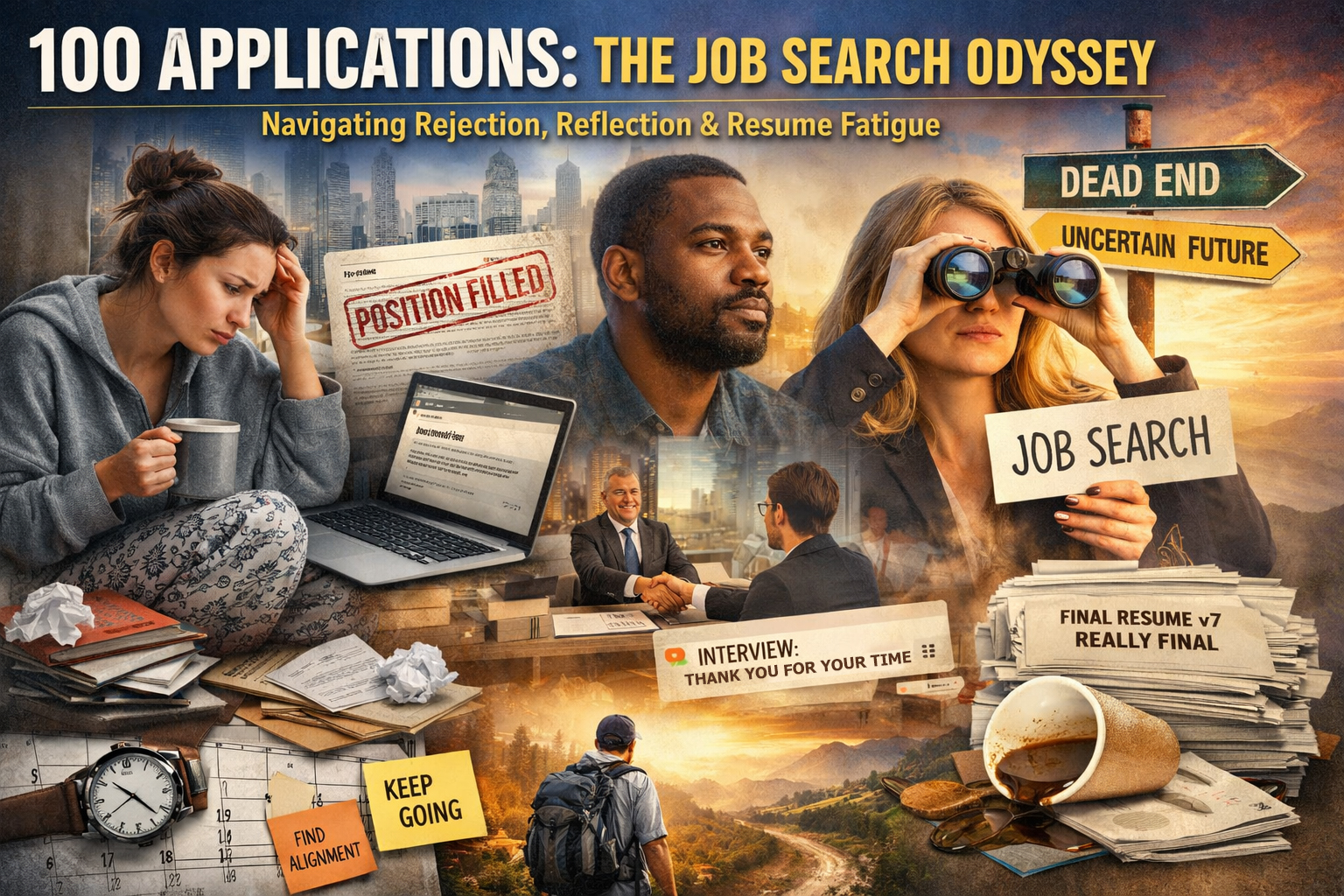
There’s a particular kind of milestone that doesn’t come with balloons, applause, or a surprise office cake that tastes like printer paper and expired optimism. It’s not “I ran a marathon” or “I bought a house” or “I finally learned how to fold a fitted sheet without screaming.” No. This is a quieter, more modern achievement, the kind you reach alone, usually in sweatpants, with fifteen tabs open, two versions of your resume named “FINAL_v7_REALLY_FINAL,” and a browser history that looks like a cry for help.
One hundred job applications.
A number so clean and round it feels ceremonial, like a corporate anniversary pin, except instead of being rewarded with a plaque you’re rewarded with… silence. Possibly a “we went with other candidates” email that arrives three months later like a ghost dragging chains through your inbox, reminding you that at one point you were hopeful and now you’re just organized about disappointment.
And yet, the post is steady. Calm. Grounded. Almost annoyingly emotionally mature. It’s not “I’m spiraling,” it’s “I’m discerning.” Not “I’m desperate,” it’s “I’m intentional.” Not “I’ve been rejected 99 times,” it’s “I’m learning alignment, boundaries, and sustainable work.” Which is the job search equivalent of walking through a thunderstorm while holding a candle and telling people, very politely, that you are actually enjoying the moisture.
Because that’s what this milestone really is: proof you’ve stayed in motion without panic, which is basically the highest form of enlightenment in a market that’s slow, noisy, and opaque—three words that also perfectly describe most corporate meeting agendas.
So yes, let’s celebrate the 100. Not because it’s fun. Not because it’s glamorous. But because it’s a modern epic, and you didn’t turn into a feral LinkedIn goblin along the way.
The Application Era — Where Hope Goes to Get a Tracking Number
The first ten applications are charming. You’re optimistic. You’re curated. You’re still writing cover letters like someone is going to cradle them tenderly, whisper “finally,” and forward them to the hiring manager with tears in their eyes.
You still believe phrases like “competitive salary,” which, when translated from Corporate, means: We will pay you in vibes, exposure, and a number that would’ve been strong in 2009.
You still read the job description like it’s scripture. You highlight words. You tailor your resume. You stare at “3–5 years required” and think, I have 7 years. I am the chosen one.
Then reality arrives. Quietly. Consistently. Like a cat walking across your keyboard.
Because by application #23, you’ve learned the job description is less a list of responsibilities and more a mood board made by five people who don’t agree on what the role is. It’s one part unicorn wish list, one part therapy session, and one part “other duties as assigned,” which is Corporate’s way of saying: You will eventually be doing someone else’s job and they will call it a growth opportunity.
This is also when you discover the first truth of the modern job search: applying is not the same as being considered. Applying is the act of placing your resume into a digital canyon and listening for the echo.
Sometimes you get an automated response immediately, which is oddly insulting, like the system didn’t even wait for you to leave the room before forgetting you existed.
Sometimes you get no response at all, which is the corporate version of being left on read by someone who posted a motivational quote about “communication is everything” that same morning.
And still—still—you keep going. You keep showing up thoughtfully. Which is incredible, because the easiest thing in this process is not quitting the job search entirely; it’s quitting your personality.
By application #50, many people become a shell. They become a function. They become a resume cannon. They stop believing in fit and start believing in volume. They start applying to roles that don’t match, industries they don’t understand, jobs located in cities they’ve never heard of, and one suspicious posting that turns out to be for a “CEO mindset mentor” who definitely owns at least one fedora.
But you didn’t. You stayed steady. You kept your brain switched on. Which, in this economy, is basically a superpower.
Discernment — The Art of Politely Declining Chaos Wearing a Blazer
Somewhere between application #60 and #80, you stop getting seduced by jobs that “look fine on paper.” Because paper can lie. Paper is easily impressed. Paper has never been in a meeting where someone says, “We’re like a family here,” and your soul physically tries to exit through your left shoulder.
Discernment is what happens when you’ve been in enough interviews to recognize the red flags before they unfold into full-length Netflix documentaries.
You start hearing certain phrases differently:
- “We move fast.”
Translation: We don’t plan, we react, and then we praise ourselves for being resilient. - “We need someone who can wear a lot of hats.”
Translation: We have not hired enough humans, and now we’re hoping you have the nervous system of a small appliance. - “This role is evolving.”
Translation: Nobody knows what you’ll do, including us. Surprise. - “We’re looking for a self-starter.”
Translation: We will not train you and we will be confused when you ask questions, because questions are weakness here.
Discernment is also learning that “alignment” is not some fluffy concept you talk about at a retreat while holding a ceramic mug that says Rise & Grind. Alignment is the very practical ability to look at a role and know, deep in your bones, whether it will add to your life or quietly drain you until you start Googling “how to disappear into the woods and become a person who makes artisanal jam.”
It’s choosing not to walk into the same trap, even when it’s wearing a new logo.
It’s realizing that boundaries aren’t just personal—they’re professional infrastructure. They keep you from saying yes to jobs that will consume your evenings, your weekends, and eventually your sense of self, all while the company posts a “mental health matters” banner in May and calls it culture.
So when you say those 100 applications represent discernment, what you’re really saying is: I have grown. I now recognize the difference between an opportunity and an expensive lesson with dental coverage.
And that is not small.
The Reset — When Life Hits Refresh and You Have to Re-Login as Yourself
An “unexpected reset” is such a gentle phrase for what is essentially life grabbing your carefully planned storyline, crumpling it into a ball, and tossing it into a bin labeled “character development.”
Resets come with grief, even when they lead to something better. They come with anger. Confusion. A weird amount of time staring into the middle distance like you’re buffering.
And then they come with learning.
The kind of learning you don’t choose, but you keep anyway, like a souvenir from a trip you didn’t want to take.
You learn what you actually need to do good work sustainably, which is a phrase that sounds calm but is secretly radical in a world that rewards burnout like it’s a badge of honor. You learn that being “busy” is not the same as being effective. You learn that a role that demands constant urgency will eventually make your nervous system think peace is suspicious.
You learn you can be steady without being stagnant.
You learn you can be in motion without panic.
That’s the difference between flailing and forward progress. Flailing is applying to anything that breathes and calling it hustle. Forward progress is staying thoughtful in a market that wants you to become frantic, because frantic people will accept less, tolerate more, and mistake anxiety for ambition.
And here’s the strangest part: somewhere during this reset, you become clearer. Not louder. Not more performative. Clearer.
You stop chasing titles and start chasing conditions. You start noticing whether people can answer simple questions without doing verbal gymnastics. You start paying attention to how you feel after conversations—energized, respected, curious—or slightly nauseous with the creeping realization that you’d be reporting to someone who thinks “feedback” is a sport.
You stop trying to “win” the job search and start trying to choose the right next chapter. Which is harder, because winning is an event. Choosing is a practice.
So you keep practicing.
Final Thoughts: 100 Applications and a Nervous System That Still Knows Its Name
Here’s what I love about this milestone: it isn’t just a tally. It’s a record of steadiness.
It’s proof you didn’t collapse into panic, even though the market is slow, noisy, and opaque, and sometimes feels like you’re shouting your qualifications into a fog while someone on the other side quietly decides they “went in a different direction” toward a candidate who is inexplicably the hiring manager’s former roommate.
It’s proof you learned boundaries without turning bitter.
It’s proof you stayed in motion without losing your discernment.
And maybe most importantly, it’s proof you’re closing out the year with clarity instead of chaos. Not because everything is resolved, but because you are steadier, and that matters more than pretending you have a perfect map.
A hundred applications doesn’t mean you’re behind.
It means you’re still moving.
And in this market, with this much noise, that kind of quiet forward motion is not just resilience—it’s strategy.