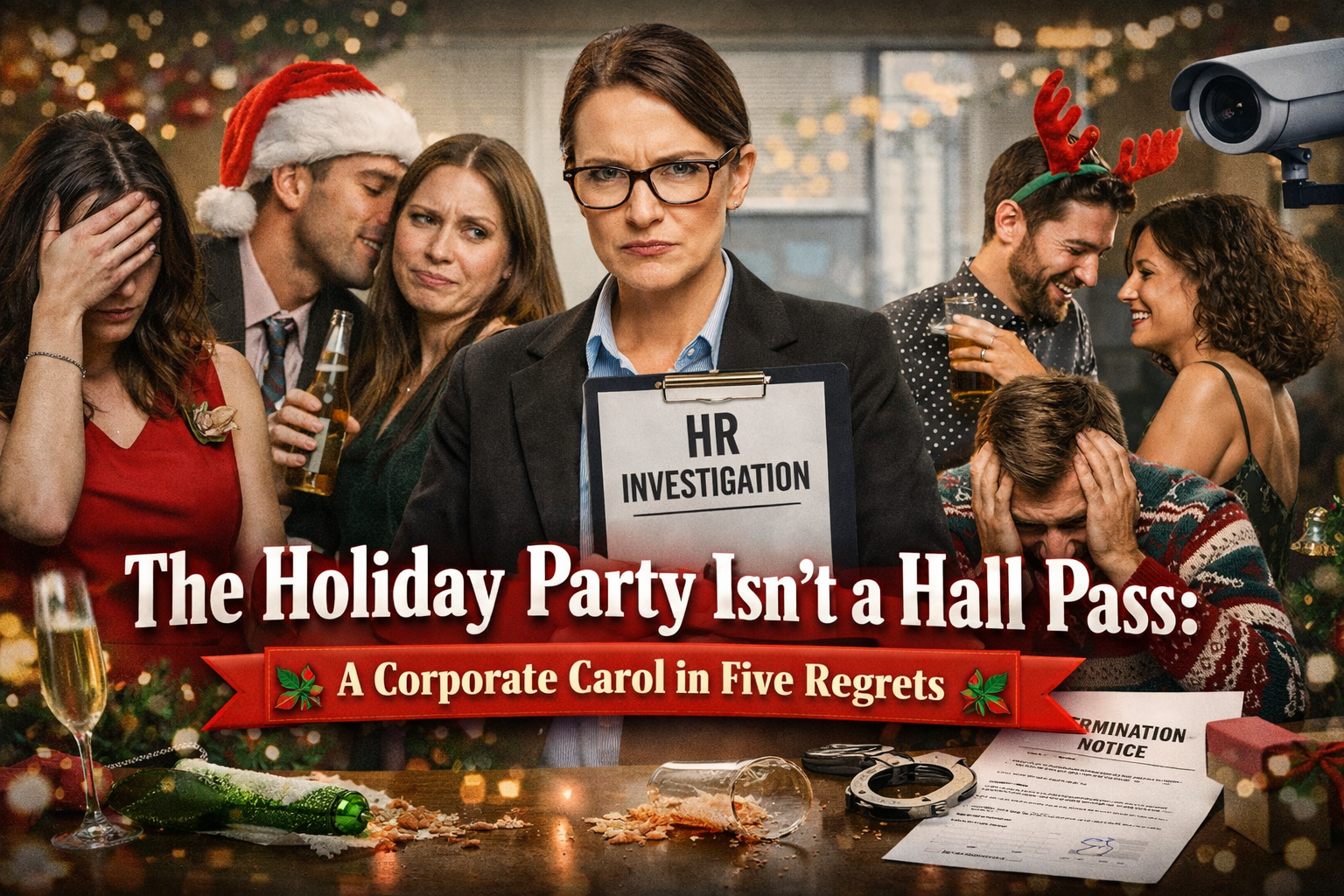
There’s a specific kind of confidence that only appears when three things happen at once: the lighting gets dim, the DJ plays a song that has never improved anyone’s decision-making, and your company provides free alcohol like it’s running a nonprofit whose mission is “test the limits of workplace policy in real time.”
It starts innocently. Someone from Finance who normally communicates exclusively in spreadsheets suddenly becomes conversational. A quiet manager who usually ends meetings with “Thanks, everyone” now ends sentences with “Woooo.” The office introvert discovers they can, in fact, dance—if the standard is “moving in the general direction of music while holding a plastic cup like it’s emotional support.”
And then, somewhere between the first “You know what we should do?” and the fifth “I just want to say something…” a handful of people forget the most inconvenient truth in corporate America:
The holiday party is not a vacation from consequences.
It’s just your workplace with glitter.
This is the part no one wants to hear because it ruins the vibe, and the vibe is the only thing keeping the party from feeling like a mandatory networking event sponsored by regret. But the holiday party isn’t a magical loophole where policies dissolve and HR turns into a mythological creature that hibernates until January.
HR does not hibernate.
HR eats.
So let’s talk about what really happens when someone treats the Christmas party like a personal redemption arc, a reality show audition, or a misunderstood “comedy set,” and then wakes up shocked—shocked—that actions still have outcomes.
The Office Party Is Still the Office—It Just Has a Disco Ball Now
Here’s the simplest way to understand a work holiday party:
If your boss is there, it’s a work event.
If your coworkers are there, it’s a work event.
If someone from Payroll is there, it’s a work event and also a reminder that your direct deposit is being processed by people who have eyes.
It doesn’t matter if it’s at a fancy restaurant. It doesn’t matter if the invitations used cursive. It doesn’t matter if the bartender calls you “my friend” like you’ve known each other since kindergarten. It doesn’t matter if you’re wearing sequins and the CFO is wearing something that looks suspiciously like personality.
It’s still work.
This is where people get confused, because the brain sees “open bar” and thinks, “Ah yes, freedom.” But workplace policy sees “open bar” and thinks, “Ah yes, the annual performance review—live.”
The danger is not that people drink. The danger is what people start believing after they drink.
They believe the party is a safe zone.
They believe they’re funnier than they are.
They believe this is the moment to “clear the air.”
They believe their crush at work is “basically mutual” because the person laughed politely at a joke about printer ink.
And then the holiday party becomes what it has always been: a professional environment where everyone is temporarily dressed like they’re in a rom-com, but still quietly logging memories for later.
Because Monday is coming.
And Monday does not care that you were “just having fun.”
The 10 AM Test—If It’s Weird in a Meeting, It’s Weird on the Dancefloor
There’s a sacred corporate rule that could save careers, marriages, and several HR inboxes a year:
If you wouldn’t say it at 10 AM in a meeting, don’t say it at 10 PM next to the DJ.
That’s it. That’s the rule.
But the holiday party creates a specific delusion: people start confusing “social setting” with “social permission.” They interpret laughter as encouragement, proximity as interest, and the fact that someone is standing near them as a sign from the universe that it’s time to “shoot their shot.”
And here’s the problem with “shooting your shot” at a work event:
Sometimes it’s not a shot.
Sometimes it’s a felony in festive packaging.
It begins with the classics:
- The inappropriate compliment that’s framed as a joke but lands like a wet sock.
- The “playful” comment that’s actually a workplace policy violation wearing a Santa hat.
- The unsolicited touching that someone convinces themselves is “friendly,” right up until it becomes the reason someone else is googling “how to report harassment” while hiding in a bathroom stall.
And then the person who crossed the line wakes up the next morning with a hangover and a story they think is “funny,” only to discover it’s actually a witness statement.
This is where the phrase “It was a joke” arrives, dragging its tiny suitcase of denial through the lobby of reality.
“It was a joke” is what people say when they’re trying to turn a harmful moment into a misunderstanding.
But the workplace doesn’t measure intent the way your buddies do.
The workplace measures impact.
The workplace measures safety.
The workplace measures liability, and liability is humorless by design.
And that’s before we even talk about the phrase that has ended more careers than layoffs:
“I don’t remember.”
Which is never the defense people think it is. It’s not a reset button. It’s not a loophole. It’s just you announcing you were too impaired to control your behavior at an event where controlling your behavior was always the job.
HR Isn’t Ruining Your Life—You Did That With Eggnog and Confidence
There are few things more predictable than what happens next.
Monday arrives.
Someone tells someone.
Someone else confirms it.
An email is sent that begins with “Hi,” and ends with “Can you hop on a quick call?”
And suddenly the person who treated the Christmas party like a personal episode of “Flirt Island” is sitting across from HR experiencing the most sobering moment of their adult life.
This is where the shock sets in.
“Can they really do this?”
Yes. Yes they can.
Because your workplace policies didn’t take the night off. Your code of conduct didn’t get replaced by a candy cane. The company didn’t say, “For one magical evening, consent is optional and professionalism is a suggestion.”
They said, “We are providing food and drinks.”
That’s it.
That was the whole deal.
And here’s the part people really hate: once you cross a serious line, what you do next can make it worse.
Some people minimize.
Some people blame the alcohol.
Some people try to “explain.”
Some people text the person involved to “smooth things over,” which is often just harassment with better punctuation.
Some people go on apology tours like they’re running for office in a small town called Accountability.
But a situation like this isn’t fixed by vibes. It’s fixed by taking it seriously, shutting up long enough to stop digging, and getting real advice before you turn one bad decision into a whole documentary series.
Because reputations don’t usually implode from one mistake alone.
They implode from the mistake… plus the refusal to respect how serious it was… plus the follow-up behavior where someone tries to talk their way out of a reality that is already documented by five witnesses and a security camera that does not care how “out of character” it was for you.
Final Thoughts: Celebrate Like an Adult Who Wants to Keep Their Paycheck
The holiday party can be fun. It should be fun. People should laugh, connect, and enjoy themselves without treating the event like a loophole in the moral universe.
But if you need a guiding principle that works every single time, here it is:
Act like Monday matters—because it does.
Drink like you have a job you’d like to keep.
Flirt like consent is a real thing (because it is).
Joke like policies exist (because they do).
Dance like the soundtrack isn’t going to testify.
And if you feel yourself slipping into that dangerous holiday-party mindset—the one that whispers, “This is my moment”—
Please remember:
This is not your moment.
This is your workplace… wearing tinsel.
If you want to go fully feral and make choices that require a lawyer, do it somewhere that doesn’t have your boss’s boss watching you attempt a split you can’t afford physically or professionally.
Because the Christmas party doesn’t ruin careers.
People do.
And HR just writes it down.