
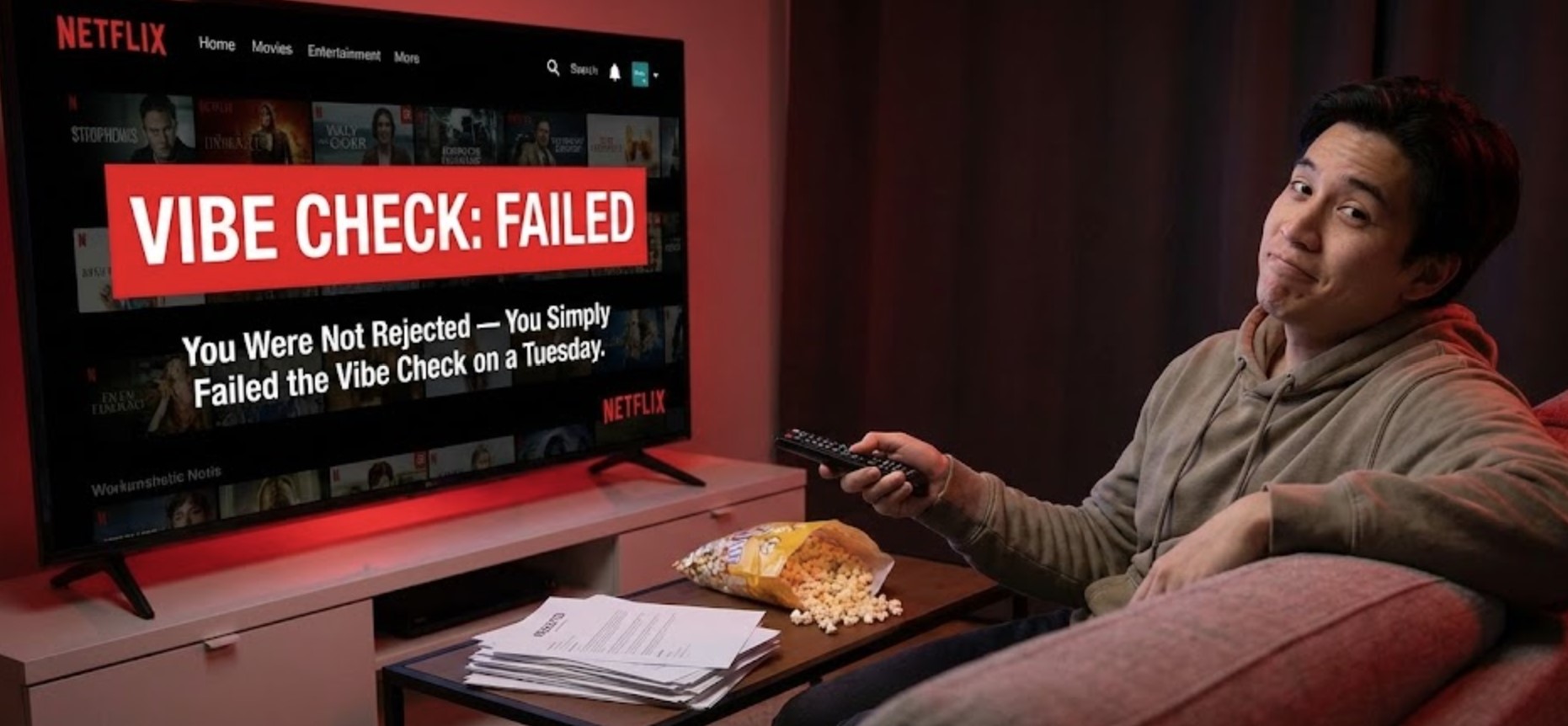
There is a very specific emotional temperature that exists only in the narrow window immediately after you apply to Netflix, a fleeting state of professional optimism where your entire career suddenly feels intentional, narratively coherent, and far more impressive than it has ever felt while living inside it.
In that moment, the chaos of your résumé rearranges itself into a clean three-act structure. The lateral moves become strategic pivots. The burnout becomes resilience. The jobs that quietly aged you a decade are rebranded as “high growth environments,” and for a brief, intoxicating stretch of time, you are convinced that this role did not just appear on your screen by accident, but arrived because the universe, the algorithm, and your LinkedIn keyword optimization finally aligned.
This is not delusion. This is how prestige works.
Netflix is not perceived as a place you work so much as a place you arrive, a cultural destination that carries enough narrative weight to turn even rejection into a credential, something you mention softly in conversations like people reference almost attending an Ivy League school or nearly making it to the Olympics before an injury, timing issue, or mysterious decision-maker intervened.
You do not say, “I applied to Netflix.” You say, “I went through the process.”
Because what you imagine that process to be — a rational, structured evaluation of experience, leadership, results, and impact — is actually something far more abstract, far more interpretive, and far more psychologically demanding: a prestige endurance ritual where competence is assumed, humanity is negotiated, and your entire professional identity is quietly distilled down to whether you feel right to a room full of highly intelligent people who have learned to trust their instincts over explanations.
This is not cynicism. This is field reporting.
The Application — When Hope Puts on Business Casual and Lies Convincingly
It begins, as all modern illusions do, with an application form.
You upload a résumé so carefully tailored to the role that it temporarily replaces your actual personality, shaving off nuance, compressing complexity, and presenting your life as a sequence of decisive, upward-moving choices made by someone who has never hesitated, doubted, or stared at a laptop at midnight wondering how things escalated this far. Entire years of learning are reduced to verbs. Entire jobs are flattened into metrics. Your hobbies, if they survive at all, are reframed as “strategic curiosities” and stripped of anything resembling joy.
Netflix thanks you for your interest and reminds you they only hire “stunning colleagues,” which initially feels affirming until you realize it is corporate shorthand for we admire excellence deeply, but we will not bond with you emotionally or provide reassurance at any point in this journey.
Then the silence arrives.
Not the polite, ambiguous quiet you expect from most companies, but Netflix silence — the kind that stretches time just enough to make you wonder whether your résumé was reviewed by a human being, filtered by an algorithm, or ceremonially archived in a digital folder labeled Impressive, But Not Urgent. Days pass. Then weeks. Then the kind of time where you detach emotionally as a survival tactic, telling yourself you were never that invested anyway, even as you quietly replay every line of your résumé for potential missteps.
Eventually, you let go. You move on. You convince yourself it was aspirational, not realistic.
That is precisely when the recruiter appears, like a surprise limited-series drop you did not know was coming but immediately binge anyway, expressing enthusiasm, admiration, and a desire for a “quick call,” which is never quick and always marks the beginning of something that will consume far more mental bandwidth than you planned.
The Interviews — Previously On You, Now With Higher Stakes
The first conversation is warm in a way that feels intentional, calibrated, almost engineered, as they speak fluently about freedom and responsibility in the same sentence, referencing the culture deck with the quiet confidence of people who assume you have read it, reread it, internalized it, and reshaped your internal compass around it.
They explain that there are no rules, only context, while carefully observing whether you instinctively follow rules that have not been articulated, because autonomy at Netflix does not mean the absence of expectations — it means the expectation that you will intuit them flawlessly, without needing guardrails, clarification, or permission.
Somewhere inside the ATS, a raccoon pauses, adjusts its glasses, and takes notes.
Then the interviews begin to multiply, gently at first and then persistently, until you find yourself speaking to more people than appear in most Netflix end credits, each of them intelligent, composed, and asking variations of the same questions in slightly different packaging to see whether your personality remains stable under repetition, pressure, and subtle reframing.
You recount your accomplishments again and again, not because they doubt your competence, but because they are watching how you hold it — whether confidence drifts into arrogance, whether humility collapses into self-erasure, whether you can describe success without sounding like you need validation or credit. You become acutely aware of your tone, your pacing, your facial expressions, your word choices, all while pretending to be relaxed.
This is not a skills assessment. Skills are table stakes.
This is a vibe audit, where you must demonstrate leadership without gravity, ambition without appetite, decisiveness without rigidity, and authenticity without unpredictability, all while avoiding phrases that suggest you are a human being with limits, needs, or a nervous system that occasionally requires rest.
Eventually, someone asks about your greatest weakness, which is not a question but a ritualized offering, prompting you to present a flaw that is actually a strength in soft lighting — something relatable yet resolved, vulnerable but already healed, human enough to signal self-awareness but polished enough to survive legal review. Notes are taken. Heads nod. Somewhere, a spreadsheet experiences deep emotional fulfillment.
You will never see it.
The Decision — When Alignment Quietly Outranks Evidence
By the time the process reaches its later stages, you have already begun reorganizing your future around it in small, responsible ways, imagining the conversations you will have, the subtle identity shift, the way people will react when you casually mention where you work, all while reminding yourself not to get attached even as attachment has clearly already occurred.
When the recruiter finally calls, the tone is warm, respectful, and carefully empathetic, as they explain that you were exceptional, genuinely impressive, and one of the strongest candidates they have seen in a long time — which you believe, because nothing in their voice suggests otherwise, and because at this point you know you performed well.
Unfortunately, they are moving forward with someone who is slightly more Netflix.
This explanation lands softly and somehow answers nothing.
It does not mean better. It does not mean more qualified. It does not mean you failed.
It means that on that particular day, in that particular room, with that particular combination of personalities, priorities, and algorithmic instincts, someone else matched the internal mood board more precisely than you did, and that alignment — however ineffable — carried more weight than evidence.
You hang up politely, open Netflix almost instinctively, and are immediately recommended a show by the same algorithm that has now rejected you professionally and, it feels, personally.
It is unsettlingly accurate.
Final Thoughts: You Were Not Inadequate — Just Temporarily Incompatible
If you walk away from this process feeling respected, exhausted, and inexplicably unemployed, understand this clearly: you did not fall short. You participated in a system that prioritizes chemistry over clarity, alignment over explanation, and feeling over proof, all while presenting itself as radically rational and data-informed.
That does not erase your value. It contextualizes the outcome.
Somewhere, there is a team that will want your experience without requiring you to sand down your humanity until it fits inside a brand-approved silhouette, and until you find them, remember this:
If an algorithm can autoplay a show you did not ask for and still call it personalization, then being passed over does not mean you lacked substance.
It simply means that today — you were not Netflix enough.