
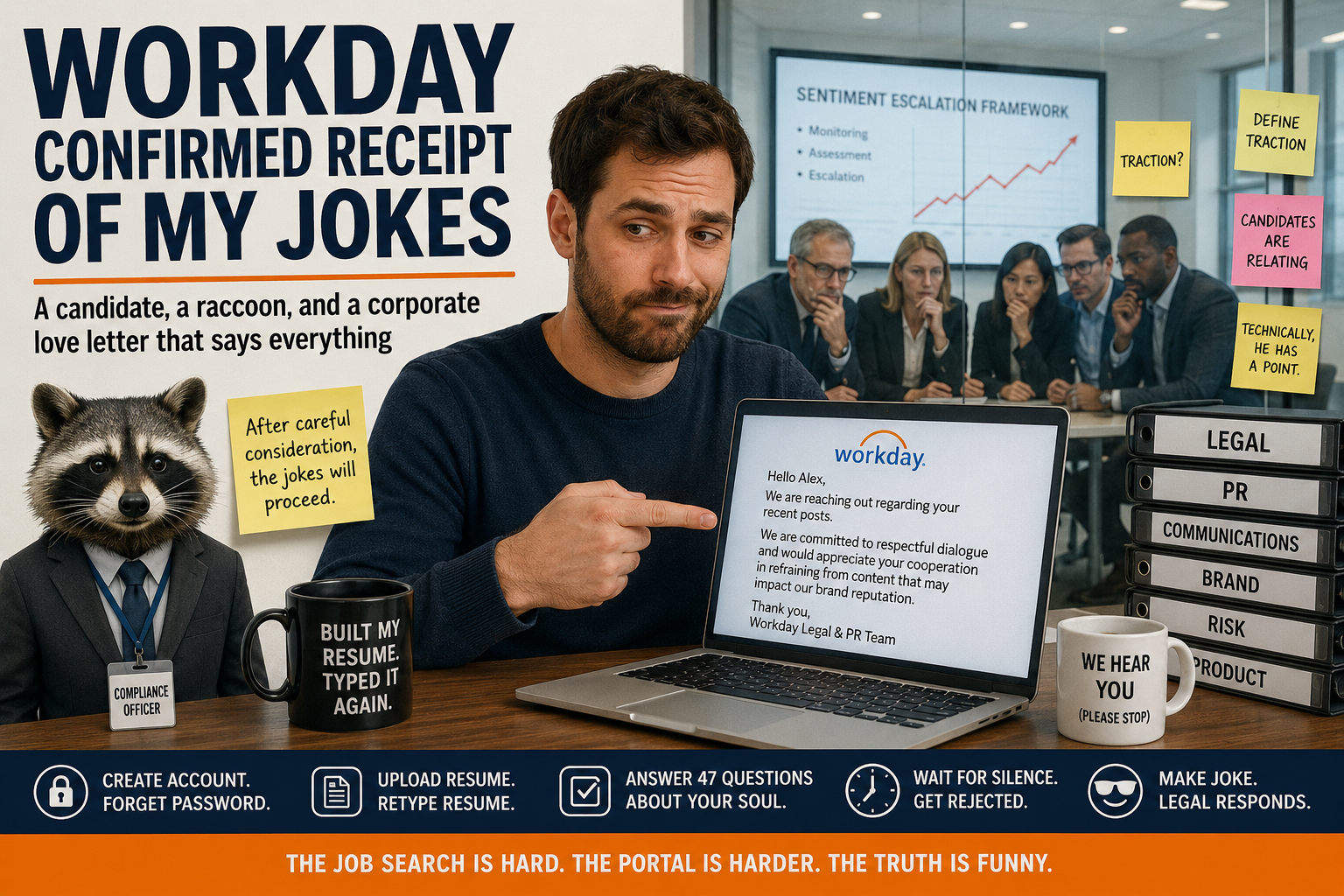
You ever tag a company in your posts so many times that eventually Legal and PR stop pretending they are simply “monitoring brand sentiment” and start behaving like you have been pacing outside headquarters with a folding chair, a battery powered speaker, three unpaid opinions, and a raccoon wearing a tiny compliance badge?
Because today, I received what can only be described as corporate affection.
A love letter.
Not the emotional kind. Not the kind where someone stands in the rain holding a boombox outside your window and says, “Alex, your application status has changed from submitted to emotionally unavailable.” This was not romance. This was enterprise software romance. This was the kind of message written by six departments, reviewed by someone named Brad in Risk, softened by Communications, disinfected by Legal, and then sent with the temperature of a conference room where nobody knows who owns the agenda.
The message had that beautiful corporate tone where every sentence smiles politely while wearing steel-toed shoes.
They were not angry. Corporations are never angry. They are “concerned.” They are “seeking clarity.” They are “committed to respectful dialogue.” That is corporate for, “We saw the post, the comments are laughing, Legal has questions, and someone in PR has been blinking at a dashboard since breakfast.”
And honestly, I respect it.
There is something deeply American about making jokes online about a hiring platform, watching thousands of candidates crawl out of the bushes like veterans of the same haunted war, and then receiving a professionally worded message that says, without technically saying, “Could you please stop turning our user experience into community theater?”
I imagine the meeting was beautiful.
Someone walked into a glass conference room and said, “We have a situation.” Another person dimmed the lights like they were about to brief national security. My post appeared on a screen. There it was, glowing in corporate blue, probably between a slide about market perception and another slide titled “Sentiment Escalation Framework.” A senior leader adjusted their glasses and read the line, “Workday remembered nothing and demanded everything.”
Silence.
Then someone from PR whispered, “Is this gaining traction?”
Someone from Legal said, “Define traction.”
Someone from HR said, “Candidates are relating to it.”
And one brave intern, who had recently applied to seventeen jobs and retyped his resume into twelve portals while questioning the meaning of civilization, leaned forward and whispered, “Technically, he has a point.”
That intern was never seen again. They were reassigned to password recovery.
The Portal That Raised Us
Let’s be honest about Workday for a second. Workday is not just an application system. Workday is a rite of passage. It is the digital equivalent of being handed a candle, pushed into a basement, and told, “Somewhere down there is a career opportunity, but first you must create an account using one uppercase letter, one lowercase letter, one number, one symbol, one ancient family secret, and the name of a cereal mascot discontinued in 1998.”
Every candidate knows the feeling. You find a job that looks promising, which is already dangerous because hope should require a warning label. The title sounds real. The salary is either missing or described as “competitive,” which usually means it is competing with your ability to pay rent. The responsibilities are vague but fancy. The company says it values people, innovation, collaboration, inclusion, and other words that have been in a corporate hostage situation since 2014.
Then you click Apply.
That is when the floor opens.
Suddenly, you are no longer a candidate. You are an unpaid data entry specialist for your own life. You upload your resume, which contains your name, contact information, job history, education, skills, dates, responsibilities, achievements, and the emotional residue of every manager who ever said, “Let’s circle back.”
Workday looks at that resume.
Workday processes that resume.
Workday accepts that resume.
Then Workday turns around and says, “Great. Now type it all again.”
That is not technology. That is a trust exercise designed by a raccoon with an HR certification.
And we do it. We sit there like fools with broadband and dreams, carefully entering every position we have ever held into boxes that look like they were designed during a team-building exercise nobody survived. Job title. Company name. Start date. End date. Responsibilities. Reason for leaving. Manager’s shoe size. Emotional weather during employment. Did you ever operate a copier while spiritually unwell?
By the time you finish, you are no longer applying for the job. You are filing a museum exhibit about your own professional existence.
And then, after all that, the system asks if you want to upload a resume.
That is when something leaves your body.
Not your soul exactly. More like your remaining respect for civilization.
Legal Has Entered the Comment Section
So when a company like Workday eventually sends a message, I have to admire the journey. Because for years, candidates have been screaming into the portal void. We have been uploading resumes, retyping resumes, creating accounts for every company like we are joining small nations, answering knockout questions written by people who appear to have never spoken to another human in person, and receiving rejection emails at 2:14 a.m. from automated systems that somehow sound disappointed in us.
But nobody responded then.
The portal did not care when we forgot our password for the ninth time. The portal did not care when it locked us out because we used a password we had already used for another company’s Workday account, even though every Workday account seems to live in a different universe with its own laws, customs, moon phases, and emotional tax code.
The portal did not care when the application froze on step seven of nine after we had already entered our employment history, education, certifications, references, voluntary demographic information, and the exact moment optimism became medically questionable.
But make some jokes?
Now we have movement.
Now people are “aware.”
Now the brand has feelings.
That is the funniest part about corporate America. A thousand candidates can say, “This process is broken,” and the response is silence so complete you can hear a recruiter ghosting someone in another state. But one post goes viral, one joke lands too close to the executive dashboard, one raccoon with a compliance badge starts trending in the comments, and suddenly the building has discovered urgency.
I picture Legal reading my post like it was found at a crime scene.
“Your honor, Exhibit A: the defendant referred to our platform as a haunted mansion of hiring.”
PR leans forward. “Was the mansion language necessary?”
Legal sighs. “Unfortunately, the comments suggest the public finds it relatable.”
Someone from Product says, “Could we improve the application experience?”
Everyone stares.
Then someone from Communications says, “What if we send a message about respectful dialogue instead?”
Perfect. Beautiful. Corporate ballet.
Because nothing says “we hear candidates” like carefully avoiding the part where candidates have been saying the same thing for years with the desperation of people trapped inside a dropdown menu that does not include their actual answer.
After Careful Consideration, The Jokes Will Proceed
I want to be clear. I do not hate Workday.
Hate requires energy, and Workday has already taken enough of mine during various application processes, password resets, profile creations, document uploads, duplicate work history entries, and those beautiful moments where you click Next and the page reloads like it has decided your career needs character development.
I do not hate Workday. I respect Workday as one respects a haunted house, a jury summons, or a printer that jams only when you are already late. It is not personal. It is historical.
Workday is part of the modern job search mythology now. Every generation gets its monster. Sailors had sea creatures. Villagers had dragons. Candidates have Workday asking them to manually enter information already visible on page one of the resume they uploaded four minutes ago.
And somehow, we all know the choreography.
You create the account. You verify the email. You forget the password. You reset the password. You answer security questions you do not remember creating. You upload the resume. You retype the resume. You select your country. You select your state. You agree to terms and conditions you did not read because your willpower is already bleeding. You answer whether you are authorized to work in the United States. You answer whether you will now or in the future require sponsorship. You answer whether you are willing to relocate. You answer whether you have ever been personally victimized by an applicant tracking system.
Then you submit.
And for a moment, there is peace.
A beautiful little message appears.
“Application submitted.”
That message should come with a warm towel and a small cup of soup.
Instead, you receive silence. Days pass. Weeks pass. You begin to wonder if the application was sent to the company or placed inside a decorative bottle and thrown into the ocean. Then, one random morning at 2:14 a.m., while you are asleep and emotionally defenseless, an email arrives.
“After careful consideration…”
There it is.
The phrase that has ended more dreams than bad Wi-Fi.
After careful consideration, they have decided to move forward with other candidates. Not better candidates. Not more qualified candidates. Just “other candidates,” a mysterious population of people who apparently emerged from the mist carrying perfect resumes, internal referrals, and the ability to influence cross-functional stakeholders without asking what that means.
And we accept it.
We move on.
We apply again.
Because hope is not a strategy. It is a medical condition with a LinkedIn profile.
Final Thoughts: Workday Confirmed Receipt
So yes, receiving a message from Workday felt meaningful in the strangest possible way.
Not because I think anything dramatic will happen. I do not expect a board meeting, a public apology, or a new button that says, “We noticed you already uploaded your resume, so we will not ask you to manually rebuild your entire life like you are assembling IKEA furniture during a thunderstorm.”
But I do think it proves something.
The jokes are reaching the room.
That matters.
Because humor has a way of sneaking into places honesty gets denied entry. A serious complaint can be dismissed as negativity. A candidate sharing frustration can be labeled bitter. A laid-off worker telling the truth can be told to remain professional. But a joke? A joke walks through the front door wearing sunglasses, steals a bagel from the leadership breakfast, and sits down at the table before anyone realizes it has evidence.
That is why satire works.
It says the thing everyone has been thinking, but it says it wearing a party hat and carrying a raccoon in a blazer, so people laugh before they realize they just agreed.
Candidates are tired. Not lazy. Not entitled. Tired. Tired of broken systems. Tired of fake personalization. Tired of being asked to perform gratitude while being filtered by software. Tired of hiring processes that treat people like data packets with shoes. Tired of companies saying people are their greatest asset while making those same people wrestle a portal built like a tax form that developed self-esteem issues.
And if that makes Legal uncomfortable, welcome to the candidate experience.
We have been uncomfortable for years.
We have been uncomfortable in password reset loops. We have been uncomfortable in one-way video interviews. We have been uncomfortable in panel interviews where five people join late and ask questions already answered on the resume. We have been uncomfortable waiting for recruiters who promised updates by Friday, only to discover Friday is apparently a metaphor. We have been uncomfortable reading rejection emails that thank us for our interest while offering the emotional closure of a vending machine refusing a dollar.
So to Workday, Legal, PR, Communications, Brand, Risk, Product, and whoever else had the misfortune of reading my post in a meeting where someone said “sentiment” more than twice, thank you.
Truly.
Thank you for confirming receipt.
Thank you for taking the jokes seriously, even if the candidate experience often feels like it was designed by a committee of haunted fax machines. Thank you for proving that comedy can climb the corporate ladder faster than most applicants. Thank you for reading the comments, even the ones where people describe your system like it is a cursed escape room with health insurance implications.
After careful consideration, I have reviewed your concerns, evaluated the available options, consulted with the raccoon compliance department, and decided to move forward with other jokes.
Please know this decision was not easy.
I was impressed by your legal tone, your polished phrasing, and your commitment to sounding calm while holding a fire extinguisher next to brand sentiment. I encourage you to keep my profile on file for future opportunities to improve the candidate experience.
Unfortunately, due to the high volume of absurdity in the current job market, I am unable to provide individualized silence at this time.
Best of luck in your future monitoring.