
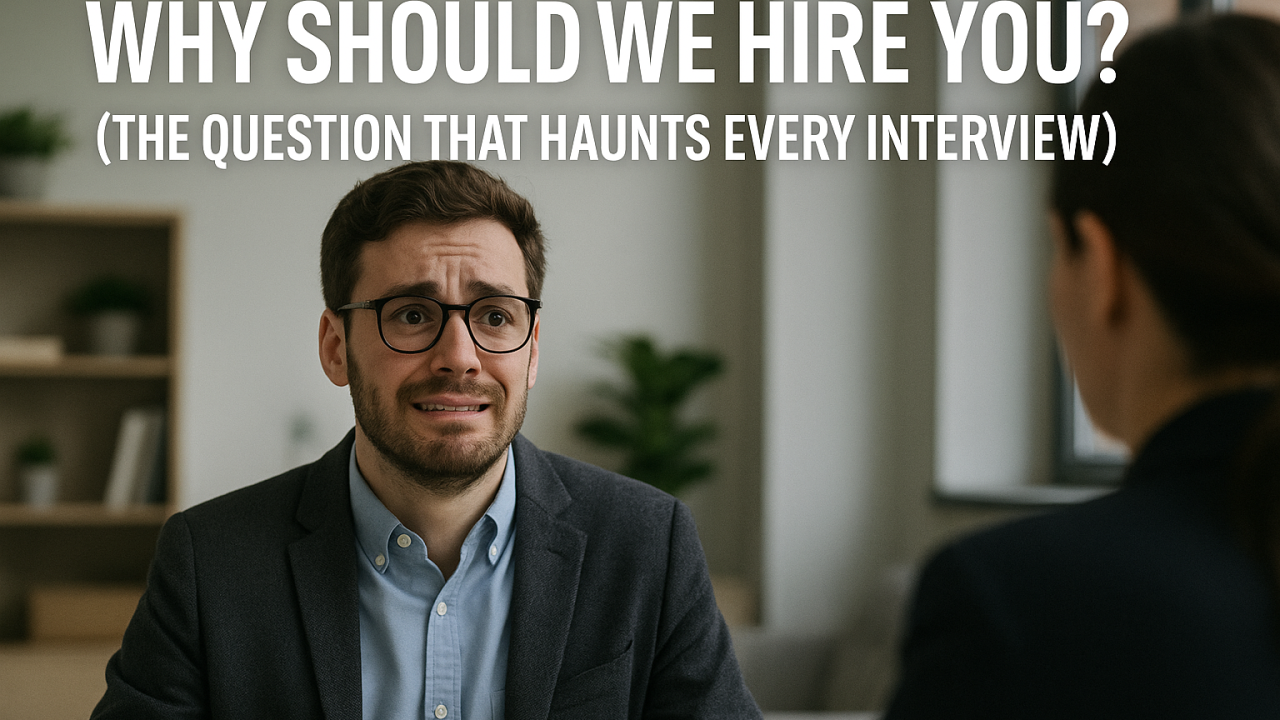
Some questions in life come easy. “What’s your favorite pizza topping?” Easy—pepperoni, extra cheese, maybe a splash of hot honey if you’re feeling trendy. “Do you want fries with that?” Of course you do. “Is Netflix still asking if you’re watching?” Yes, Netflix. Always yes.
But then there’s the heavyweight, the undisputed champion of awkward interview land: “Why should we hire you?”
The room goes silent. You feel every molecule of oxygen vanish. Suddenly, your palms sweat like you’re sitting in front of Judge Judy, and your brain decides to pull a fire drill. Every clever, rehearsed line you practiced in the mirror evaporates. Instead, your mind offers up gems like: “Because I really like money.” Or “Because I’m here, aren’t I?” Or my personal favorite: “Because my mom said I’m special.”
This is the interview world’s version of a pop quiz. You could’ve prepared for hours, studied the company history like it was a final exam, even memorized their mission statement word for word. But the moment they lob this grenade across the table, you’re reduced to either panicked silence or a TED Talk nobody asked for.
And let’s be honest, the question itself is flawed. Imagine you’re buying a car, and instead of the salesperson convincing you, the car itself is expected to say: “Well, I have four wheels, decent mileage, and I won’t break down on the highway, so you should totally pick me.” That’s essentially what job seekers are asked to do: transform into a talking commercial for themselves, live and unscripted, under fluorescent lights.
The Responses We All Cycle Through
Of course, we’ve all tried our versions of the “perfect answer.”
- The Overachiever Script: “I have ten years of experience, I’ve led multiple teams, and I once survived a three hour Zoom meeting without turning into a meme.”
- The Flattery Angle: “I’ve always admired your company. In fact, I have your logo set as my phone wallpaper.”
- The Brutal Honesty: “Because I can’t afford not to work, and my landlord doesn’t accept exposure as rent.”
- The Chaos Option: “Because if you don’t hire me, I’ll go to your competitor and make them millions.”
And the worst part? Sometimes none of it matters. You can give the most flawless, rehearsed, Oscar worthy response, and still boom you’re ghosted.
What They’re Really Asking
Here’s the trick: when an interviewer says “Why should we hire you?”, what they’re really saying is, “Please make my decision easier. Please give me a reason to bet on you without risking my reputation.”
They want reassurance that you’re more than just a resume with carefully inflated bullet points. They want to know that when the deadlines loom, the Wi-Fi crashes, and Brenda from accounting hits “Reply All” for the seventeenth time this week, you’ll be the one who doesn’t crumble.
Because skills can be trained. Software can be taught. Processes can be explained. But grit? Humor? The ability to keep a straight face while corporate chaos explodes around you? That’s gold.
The Real Answer
So, why should they hire you?
Because you’re the full package. You’re experienced, sure—but you’re also resilient. You know how to take rejection and still show up the next day. You know how to laugh in the middle of disaster. You know that work isn’t just about doing the tasks, it’s about keeping the circus running even when half the clowns call in sick.
You’re the person who will find a way to fix the printer when it jams, calm the customer when they panic, and still crack a joke that keeps the whole team from melting down. You’re not just qualified, you’re human. And being human beats being perfect every single time.
The Long Goodbye (Because This Answer Deserves a Standing Ovation)
So the next time you hear those five terrifying words, “Why should we hire you?” don’t freeze. Don’t panic. Don’t recite a robotic script you found on page three of a career blog from 2014.
Smile. Take a breath. And remind yourself that the whole point of this exercise isn’t just to prove you can do the job, it’s to remind them you’re the kind of person they actually want around when things inevitably fall apart.
Because when the power goes out during a presentation, when the client emails a twelve page list of last minute changes, when half the office calls in sick the morning of a deadline, your boss won’t remember how many certifications you rattled off. They’ll remember that you looked them in the eye and said, with steady conviction:
“Because when everything hits the fan, I’m the one who knows how to keep the lights on.”
And that’s the truth. That’s the laugh. That’s the mic drop.






Your article helped me a lot, is there any more related content? Thanks!