
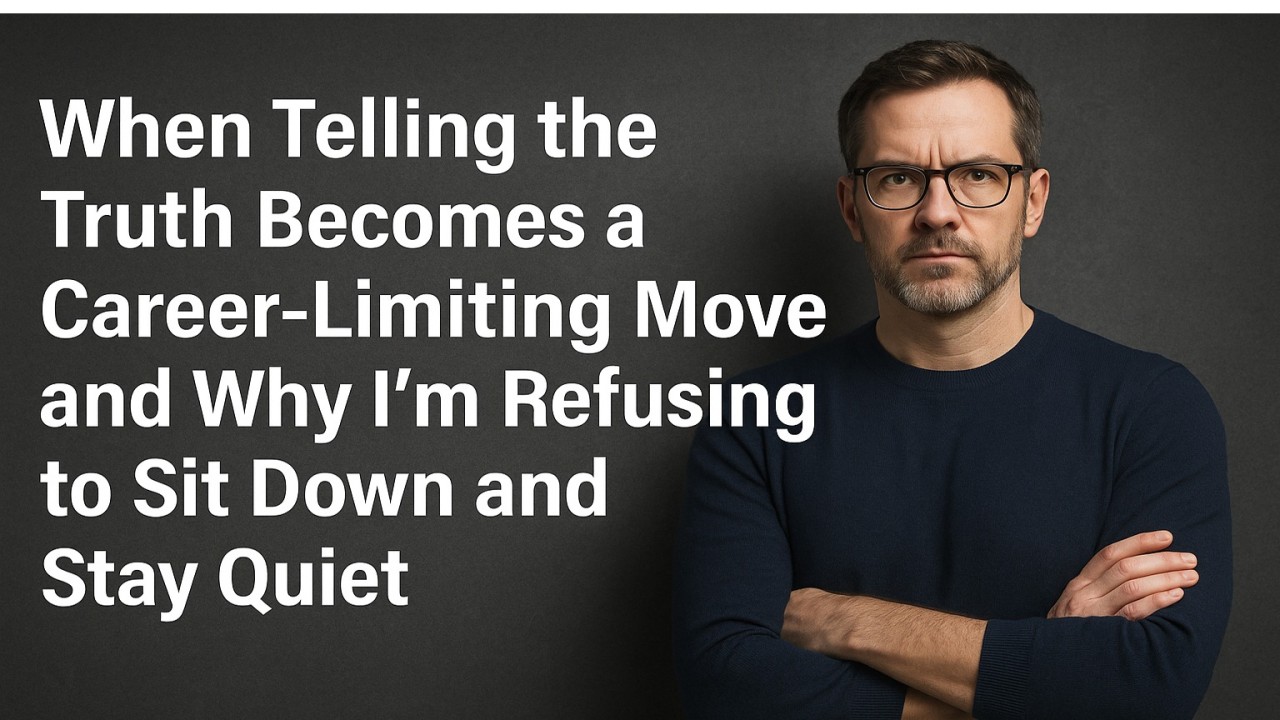
Step into today’s job market and you’ll feel it before you can name it, an invisible etiquette, a quiet choreography everyone seems to know but no one ever says out loud. It hums beneath the glossy “we value experience” career pages and the upbeat webinars about authenticity and resilience. At first, it’s just a whisper: be honest, but not too honest. Share your layoff story, but sand it down until it sounds like a personal growth retreat. Admit frustration only if it’s wrapped in enough polite optimism to soothe whoever’s reading. Keep the hope high, the pain low, and never, under any circumstances, hint that the system itself might be broken.
It’s a clever trap disguised as wisdom. We’re coached to smooth our edges, polish the resume until it glows, tuck away the anger until it’s invisible, smile just enough to look resilient but never bitter. Follow the formula and, we’re promised, a recruiter will appear like some corporate fairy godmother, rewarding our restraint with safety and opportunity.
But that fairy tale collapses fast. Politeness hasn’t saved anyone from the empty “we’re still reviewing candidates” silence. It hasn’t stopped ghost postings meant to fill databases, not desks. It hasn’t protected seasoned professionals from being labeled “overqualified” by an algorithm that can’t read nuance. It hasn’t kept interviews from dying the moment actual experience sounds expensive.
The truth is simpler and harder. Playing small doesn’t work. Being quiet doesn’t keep you safe. It only keeps you unseen.
The Well-Meaning but Dangerous Message That Landed in My Inbox
This week, a message landed in my inbox that read like it had been lifted word for word from the secret playbook, the one no one admits exists but everyone seems to quote when they want you to sit down and behave:
“Hi Alex. While you regularly speak the truth and capture the angst of being an older adult looking for work, I hope you understand you are killing your chances of finding employment with every post. No employer wants their dirty laundry posted on social media, and recruiters will avoid individuals who are controversial and cynical. You speak eloquently and truthfully, but you are scaring potential employers. Save it for a book! Please think about how else you can express your frustration — for your sake.”
It’s packaged as concern, maybe even kindness — the professional equivalent of “I’m just looking out for you.” But read between the lines and you see it for what it really is: a warning label designed to keep people small. Don’t rock the boat. Don’t make hiring managers nervous. Don’t call out the broken pieces because acknowledging them is riskier than enduring them.
It’s the same script job seekers have been handed for years. Be grateful for scraps. Be cheerful about rejection. Pretend the process isn’t dehumanizing. Smile while you explain the layoff that gutted your career. Frame every setback as “resilience” so no one has to feel awkward about what’s actually happening. The subtext is clear: survival means silence. Honesty might help others, but it won’t help you.
And yet, that “protection” has a cost no one talks about. You swallow frustration until it curdles into shame. You edit yourself down until you barely recognize the person left on the page. You spend so much energy trying to look safe that you forget you were supposed to look valuable.
The Myth of Safety and the Trap of Staying Polite
Here’s what I know after years of surviving layoffs, pivots, and a job market that eats people alive: politeness is not a parachute. It doesn’t stop companies from cutting roles in the middle of a profitable quarter. It doesn’t stop younger, cheaper hires from sliding into jobs you could run blindfolded, while you get labeled “overqualified” or “too experienced.” It doesn’t stop resume bots from discarding decades of expertise because you dared to graduate before the internet had color or list skills older than last year’s tech trend.
We were told that if we stayed safe, we’d stay employed, that if we packaged our setbacks as “learning opportunities,” if we smiled and said “open to work” but not too loudly, if we swallowed anger and radiated gratitude, the system would eventually reward us. But safe has delivered nothing but silence. Safe has made talented people invisible. Safe has handed us a creeping suspicion that maybe the problem is us, that our experience somehow expired, that our worth vanished the moment a layoff happened.
It hasn’t. The problem isn’t the people adjusting, surviving, and showing up anyway. The problem is a hiring machine built to be efficient at rejecting, not at seeing. A market obsessed with cheap speed over lasting skill. A process so fragile that one honest post can “scare” employers away.
Why Telling the Truth Terrifies the Wrong Companies (and That’s Good)
If a company gets nervous because a candidate publicly names what’s broken, age bias, mass layoffs, broken hiring funnels, the quiet cruelty of algorithms, then it’s probably a company where truth goes to die. That’s not a safe culture; that’s a fragile one. Environments built on silence and fear don’t just avoid hard conversations; they punish them. They’re the places where bad managers hide behind process, where dissent gets labeled as “not a culture fit,” and where real feedback never makes it past the conference room door.
The right teams don’t fear candor. They hire it. They need people who’ve weathered storms and are still standing, people who can look at messy reality and still solve problems. They want professionals who will raise a hand when something’s broken rather than quietly watch it fail.
So when someone warns me that honesty will “scare away” employers, I hear something entirely different: good. Let it. I don’t want to work somewhere allergic to reality, where survival means playing small and telling safe half-truths. The companies that run from honesty were never going to offer stability; they were going to ask for silence in exchange for a paycheck. I’m not interested in cashing that check.
Books Don’t Start in Secret — They Start in Conversations Like These
Yes, I’m writing books. But books don’t just happen; they don’t spring fully formed out of tidy optimism and quiet suffering. They grow from friction, from voices colliding, raw and unedited. They begin as a single honest post thrown into the void, a few unguarded lines that make someone whisper “me too” in the dark. They build a bridge before they build chapters. They build community before they build anything else. And silence? Silence kills that.
If I had waited until my rage felt polished and my scars looked poetic, I would still be alone. And so would the hundreds of people who have messaged me in the last months saying, “Your words kept me going,” “I thought it was just me,” “I needed to know someone else was furious and still fighting.” Those voices aren’t statistics; they’re proof that connection is oxygen when the system makes you feel invisible.
It’s easy for someone on the outside to say, “Just keep it to yourself, save it for a book.” But what they miss is that the book, the real one, the one worth writing, doesn’t exist without the messy middle. The power is in the in between: in the public reckoning, the small rebellions against the pressure to shut up and smile. Those conversations turn isolation into solidarity. They give people enough air to stand back up and try again.
If I’d kept everything locked away until it was safe, no one would know that it’s possible to survive a career implosion and still build something new. No one would know that the layoff isn’t the end of your worth. No one would know there’s life after being labeled “too seasoned,” “too expensive,” “too much.”
And that’s the heart of it, this isn’t just venting. It’s resistance. It’s making noise so someone else doesn’t sink quietly. It’s refusing to let a broken system also steal our stories. A single honest sentence can be the rope someone else grabs when the current pulls hard. That’s not recklessness. That’s survival strategy disguised as storytelling.
Who I’m Actually Talking To (Hint: Not Recruiters)
People assume every post is bait for employers, as if each word is some clever personal ad crafted to make me look irresistible to hiring managers. It’s not. My words are for the person staring at the ceiling at 2 a.m., replaying every polite rejection, wondering if maybe the market has quietly decided they’re finished. For the midlife professional who built twenty or thirty years of skill only to watch it dissolve the moment a layoff arrived. For the ones sitting in parked cars after another silent interview, trying to swallow panic and tell themselves they’re still valuable.
I write for the ones who keep refreshing inboxes that never refill. For the seasoned specialists rebranding themselves as “adaptable” because experience suddenly reads as expensive. For the people quietly deleting half their work history just to squeeze through an algorithm, knowing each deleted line cost them something, identity, pride, proof of how far they’ve come.
These posts are for the job seekers scrolling in the dark not just looking for a lead but looking for oxygen. They’re searching for a sign that the brokenness isn’t their fault; that they’re not lazy or obsolete; that the system, not their worth, is the thing failing. They’re hoping to bump into a sentence that says, “You’re not alone in this absurd, dehumanizing maze.”
If that frightens a recruiter somewhere, if the honesty in those sentences makes someone behind a corporate firewall nervous, fine. Let them pass by. The companies I want to work with aren’t hunting for the safest, quietest candidates. They’re looking for people who can speak plainly, who can navigate chaos, who know how to survive hard things and still keep going.
My real audience isn’t the risk averse gatekeeper scanning for red flags; it’s the exhausted, talented humans who need to know they’re not invisible. They’re the ones sending late night messages like “I thought I was alone until I read this.” They’re the reason I keep writing. Not because I’m trying to prove I’m hireable, but because no one should feel they’re the only one fighting to stay relevant.
And if being a lifeline to them means losing a few squeamish recruiters along the way, that’s a trade I’ll make every time.
Honesty Is Not Self-Sabotage — It’s a Filtering System
Every time I write openly about ageism, rejection, and the slow erosion of dignity baked into the modern hiring process, the wrong companies quietly cross me off their list. Good. That’s not failure, that’s free sorting. I’m not auditioning for organizations that want silence and compliance. I’m not trying to squeeze myself into a culture so brittle that one honest LinkedIn post sends them running.
What I am doing, intentionally is making it easier to find the rare employers who actually mean it when they say they value experience and diversity of thought. The ones who understand that resilience isn’t bitterness, and candor isn’t chaos. The ones who know that someone who’s weathered storms can also lead teams through new ones.
That’s not career suicide; it’s career filtration. It’s building a shield instead of a mask. Every company that decides my voice is “too risky” is a company that would have required silence as the price of belonging. Better to know that now, before I hand over my time, energy, and trust.
Filtration clears the path. It strips away the places where you’d be tolerated but never valued. It saves you from months of trying to fit into a culture that would punish the same honesty they once called “refreshing.” And it makes room for the work and people who actually want what you bring, scars, candor, and all.
That’s the secret they don’t teach in the polite playbook: speaking up doesn’t just risk opportunity; it refines it. It shrinks the field to the ones worth playing on.
Silence Was the Real Career Killer All Along
We’ve been taught to disappear to survive, taught that shrinking ourselves, editing our stories, and smoothing every edge is the safest way to stay employable. But disappearing isn’t survival; it’s surrender. It’s handing over the most valuable thing you own — your voice — in exchange for the faint hope that someone, somewhere, might reward your quiet. And what’s the reward? Usually more silence. More rejection. More feeling like you don’t exist.
If telling the truth costs me a seat in a fragile culture, I’ll take that loss as a win. Better to know upfront than to discover later that belonging there means constant self erasure. The right place, the one where candor is strength, not danger — won’t flinch when they see someone who names what’s broken and still shows up willing to build something better. Those are the teams worth trusting, the leaders worth following.
So no, I won’t stop. Not because I’m reckless or angry for sport, but because staying quiet has already proven it doesn’t protect anyone. I’m not out to burn every bridge; I’m trying to find the bridges worth crossing, the ones that can hold the full weight of experience, honesty, and humanity without cracking.
And because somewhere out there, right now, someone else is scrolling through this broken market, looking for any proof that it’s still safe to try. They’re wondering if showing up again tomorrow is worth it, if resilience matters when the system seems to reward only the safe and the silent. They deserve to know they’re not crazy for feeling what they feel. They deserve to know that truth still belongs here, that it can be said out loud, shared, and met with recognition instead of exile.
And so do we. We deserve not to vanish just to earn another interview. We deserve careers built on real strength, not careful performance. We deserve to stop surrendering our voices in hopes of being seen, and instead let our voices be the very thing that draws the right people toward us.