
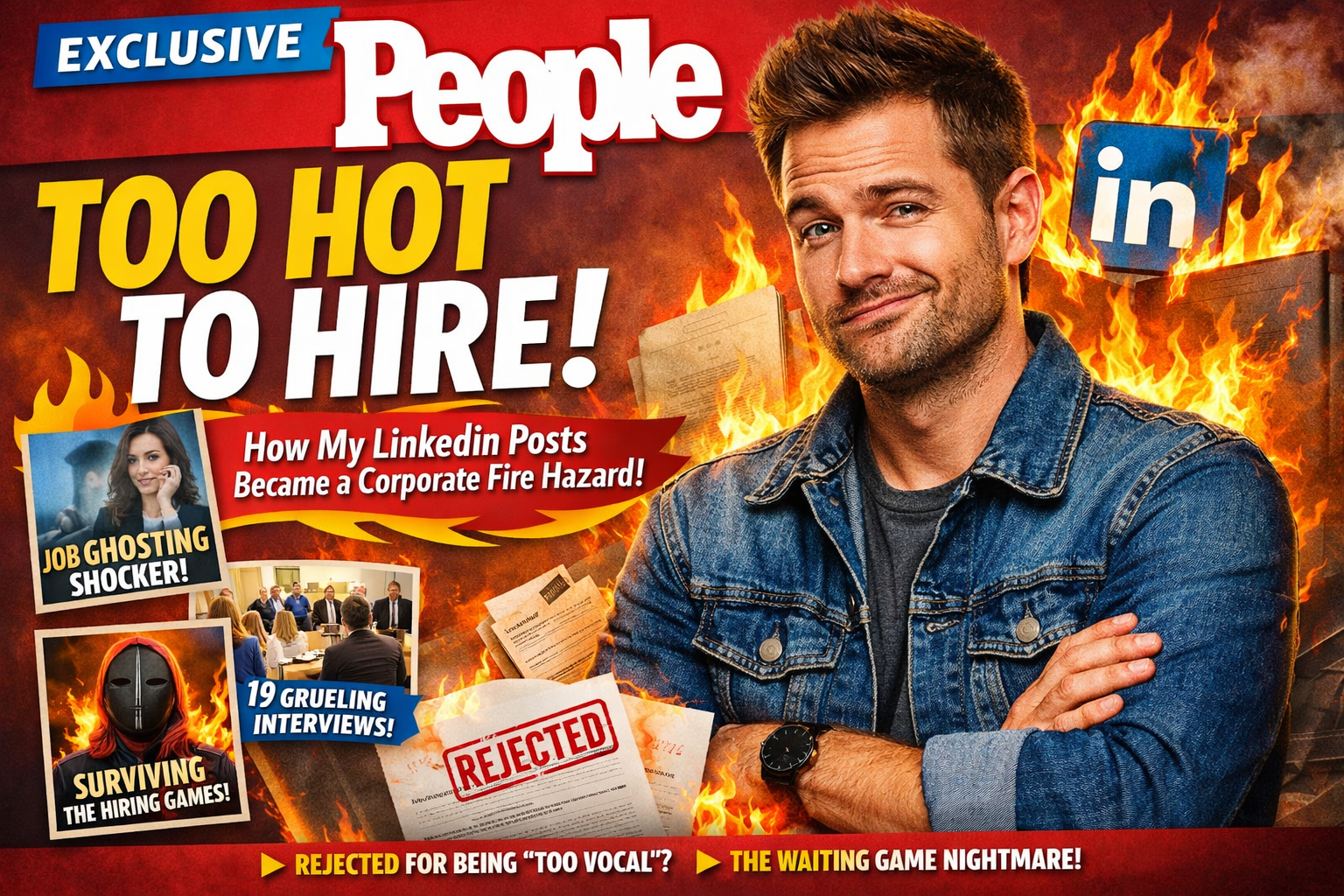
Some people get rejected for lacking experience. Some people get rejected for asking about salary. Some people get rejected because they dared to breathe with confidence in the third interview.
Me?
I apparently didn’t get the job because I’m “too hot on LinkedIn.”
Not “hot” like I’m in demand. Not “hot” like I’m an industry thought leader. No—“hot” like a slightly defective laptop battery that leadership would rather not keep on their desk, because it might swell up, make a sound, and remind everyone that the system is held together by duct tape and vibes.
That was the recruiter’s actual phrasing. “We really like you,” she said, as if “liking” candidates has ever paid anyone’s rent, “but your posts are… a little too passionate. Too direct. It might make leadership uncomfortable.”
Leadership. Uncomfortable.
Ma’am, leadership has annual retreats dedicated to “embracing discomfort,” with matching t-shirts and a keynote speaker who overcame an obstacle by journaling. Leadership can survive a LinkedIn post that says, “Hey, it’s weird to ghost someone after six interviews.”
But no. Apparently the hiring process is less about matching skills and more about selecting a candidate who will politely accept emotional chaos, thank everyone for it, and then post online about how “grateful” they are for the opportunity to be ignored.
So if you’ve ever wondered what the hiring process looks like when it’s run by people who fear honesty the way toddlers fear haircuts, let me take you behind the curtain. Bring snacks. The show is long. The plot is messy. And the audience is mostly candidates trying to stay hydrated while being tested for patience, compliance, and willingness to pretend the whole thing is normal.
Because the truth is: companies don’t want your passion. They want your passion in a soundproof room, with a non-disclosure agreement, expressed only through approved emojis in the team chat.
And the moment you use your voice in public?
Suddenly you’re “a culture risk.”
The Application — Where Hope Goes to Be Retyped
It always starts the same way. You find a job posting that reads like it was written specifically for you.
“Seeking a strategic, resilient self-starter who thrives in ambiguity.”
Translation: We have no plan, but we’d like you to be cheerful about it.
You get excited. You sit up straighter. You tell yourself, “Okay. This is the one. This makes sense.” You click Apply like you’re placing a bet, because in 2026 the job market is basically a casino with better lighting and worse odds.
You upload your resume.
Then the system immediately says, in a tone that can only be described as smug:
“Great! Now please retype everything you just uploaded.”
And not in a helpful way. No. In a “prove you want it” way.
It’s not enough that your resume is polished. It’s not enough that it contains your entire professional history, your accomplishments, and the emotional scars of your last three restructures. The system needs you to demonstrate loyalty by manually entering your job title, company name, dates, responsibilities, and the names of your childhood pets.
It’s a ritual. A sacrifice. A test.
You are not applying for a job. You are auditioning for a role in a corporate escape room where the first puzzle is: How much dignity can you lose before you stop trying?
And the worst part is: you do it.
Because you’re told to be resilient. Because you’re told to be adaptable. Because you’re told the job market rewards perseverance.
So you retype your resume like a medieval scribe.
Then you answer the questions:
- “Why do you want to work here?”
Because I enjoy eating food. - “Describe a time you overcame adversity.”
You mean like this application? - “What makes you unique?”
I can survive 47 required fields without throwing my laptop.
Then you submit.
And the second you hit that button, you feel it. That tiny shift in your nervous system. That subtle realization that you have just sent your story into a digital canyon where it will either be reviewed by a human… or fed to an algorithm that thinks “experienced” is another word for “expensive.”
The application vanishes.
Your hope remains.
And the waiting begins.
The Waiting Room of Doom — Where Time Moves Differently Than In Reality
The waiting phase is where your brain starts doing interpretive dance.
Day 1: Confident. Optimistic. Professional.
Day 7: Casual curiosity.
Day 14: Mild concern.
Day 21: Full documentary narrator voice.
“It was at this point Alex began to wonder… was the role ever real?”
Because nothing happens. No email. No update. No “we received your application.” No “we’re reviewing candidates.” No “we accidentally posted this while half asleep.”
Just silence.
And silence is not neutral in the job hunt. Silence is loud. Silence is personal. Silence is your brain filling in the gaps with worst-case scenarios while you try to act normal in public like you’re not refreshing your inbox like a raccoon checking the same trash can every hour hoping the universe has finally thrown out a decent opportunity.
You start reading meaning into everything.
The job posting is still up. That’s either good or terrible.
A recruiter viewed your profile. That’s either promising or they were looking for someone else and clicked the wrong Alex.
You get an automated email that says, “We value your time.” That’s how you know they don’t.
Then you follow up, because you’re a professional adult who communicates. You write a kind message. A respectful message. The type of message that practically curtsies.
“Hi there! Just checking in on the status of my application. I remain very interested. Thank you!”
And you hit send, and your email disappears into the same void where socks go when they vanish in the dryer.
Now you’re stuck in the waiting room, except it’s not a waiting room with chairs and magazines. It’s a waiting room with no clock, no receptionist, and a sign that says:
“Please be patient. The hiring manager is currently aligning stakeholders.”
Aligning stakeholders.
What are they, planets?
At this stage you learn the first rule of modern hiring:
They are not hiring. They are considering the concept of hiring.
And you are simply a supporting character in their internal drama titled Budget vs Headcount: The Reckoning.
The Interview Gauntlet — The Netflix Series Nobody Asked For
When they finally reach out, it’s always sudden, like they remembered you exist mid-meeting and panicked.
“Hi Alex! We’d love to schedule a quick chat!”
Quick chat is never quick. Quick chat is a trap.
First interview: recruiter screen.
You answer polite questions. You smile. You prove you are human and not a scammer from the year 2009.
Second interview: hiring manager.
They ask you to walk through your background, which you do, even though they have your resume, even though you already retyped it, even though your work history is now living in four separate systems like it’s being hunted.
Third interview: someone adjacent to the team.
You say the same story again. Your personality starts to feel like a PowerPoint.
Then it expands.
“Can you meet with the director?”
“Can you meet with the VP?”
“Can you meet with the team?”
“Can you meet with Gary from another department who just wants to vibe check your aura?”
At some point you’re on interview five and you realize you’ve explained your strengths so many times you no longer believe you have any. You’re just a person repeating the phrase “cross-functional collaboration” like it’s a prayer.
Then comes the panel.
Six faces. No one blinking. Everyone asking the same question in a slightly different font.
“Tell me about a time you handled conflict.”
“Tell me about a time you influenced without authority.”
“Tell me about a time you had to deal with ambiguity.”
I am currently dealing with ambiguity. It is this interview process. It has been ambiguous since the application phase. It is a lifestyle at this point.
And then you get that magical sentence:
“You’re a top finalist.”
Top finalist.
An elite category of candidates who are close enough to taste the offer but still far enough away to be ghosted without consequences.
Then the silence returns.
So you follow up again, kindly.
Then again, politely.
Then you write a LinkedIn post because you’re a human being with a voice and a pulse and you are trying to process the absurdity of a system that asks for authenticity while punishing anyone who displays it in public.
And that’s when it happens.
You get the rejection email.
Not just any rejection email. The kind that contains the hidden subtext of corporate America:
“We decided to go in a different direction.”
And then, as the cherry on top of the professionalism sundae, the unspoken addition:
Also, we saw your posts.
You’re a little too… vocal.
Translation: We love authentic people, as long as they are authentically quiet.
Final Thoughts: If I’m Too Hot, Then You Were Never Built for Fire
Here’s the thing. Being “too hot on LinkedIn” is the funniest reason I’ve ever been rejected, because it reveals the truth companies try desperately to hide behind values posters and leadership webinars.
They don’t want honesty. They want comfort.
They don’t want candidates who advocate. They want candidates who absorb.
They don’t want passion. They want passion that whispers. Passion that doesn’t disrupt. Passion that doesn’t remind anyone that the hiring process is often disrespectful, inefficient, and emotionally reckless for the people living inside it.
And I refuse to pretend that’s normal.
I’m not going to water myself down so leadership can stay cozy. I’m not going to shrink my voice so someone with “executive presence” can avoid the discomfort of reading a sentence that sounds like reality.
Because I’ve watched too many talented people break quietly behind the scenes. I’ve watched friends do everything right—tailor the resume, practice the interviews, send the thank-yous—and still get ghosted like they were never human in the first place.
So yes. I post.
I post for the people who don’t have energy to be inspiring anymore.
I post for the people who are surviving on savings and stubbornness.
I post for the people who keep getting told to “stay positive” while their inbox stays empty.
And if a company can’t handle that?
Good.
Because I don’t want to work somewhere that calls honesty “a risk” and calls silence “professionalism.” I don’t want to join a culture that mistakes comfort for leadership and treats public accountability like a threat.
If being real makes me “too hot” for them…
Then consider me fully on fire.
And consider it a blessing that I didn’t get hired into a place that only values authenticity when it’s safely hidden behind closed doors.