
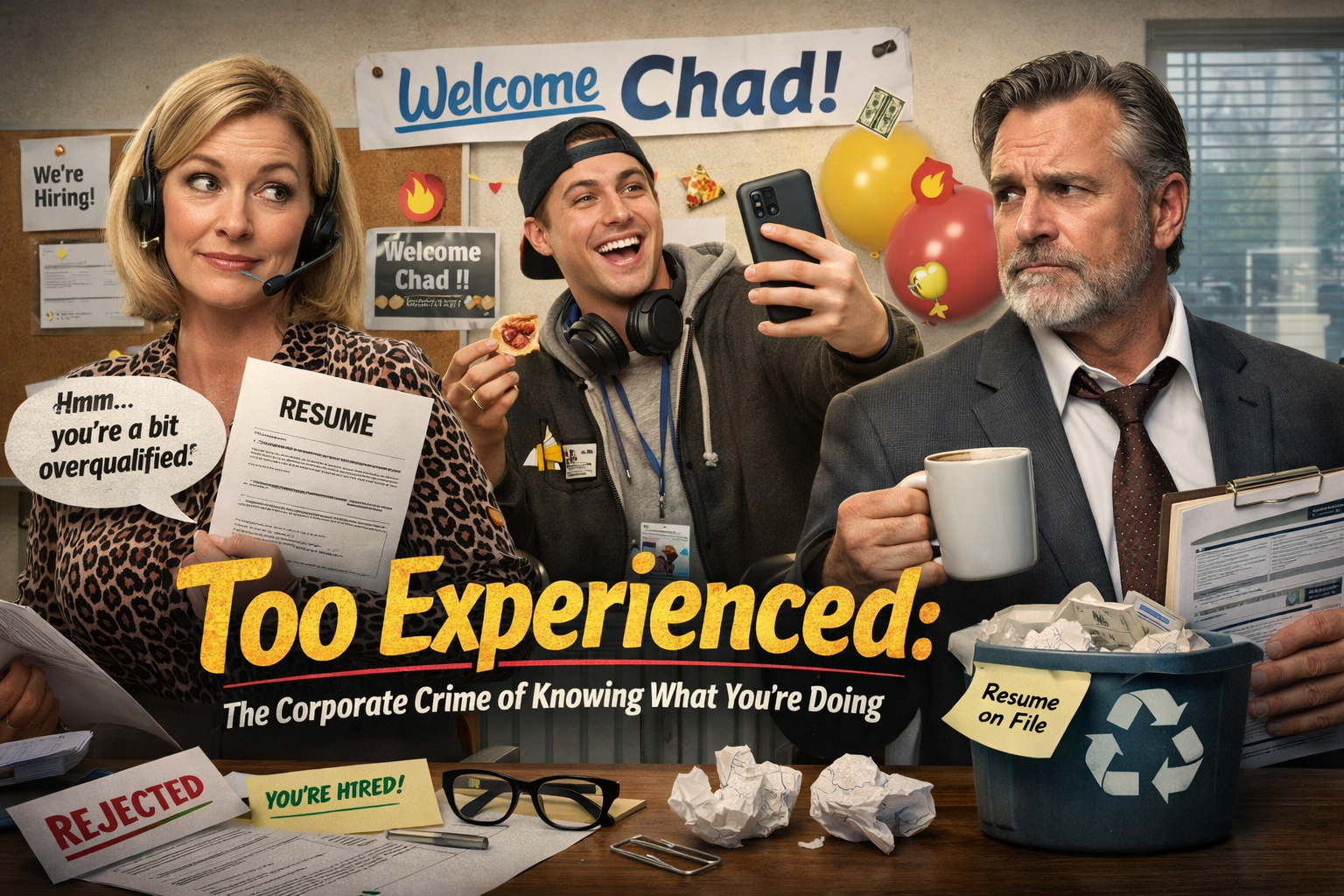
There’s a special kind of optimism required to apply for a job in 2026 when you have actual experience, a working nervous system, and the audacity to believe that competency is still considered a feature instead of a liability.
You upload your resume. You tailor it. You remove the words “managed,” “led,” and “prevented disaster” because apparently that comes off as “intense.” You paste your entire work history into 47 tiny boxes like you’re hand-copying scripture for an ancient monastery that hates PDFs. You take the little personality quiz where they ask whether you prefer “structure” or “vibes,” and you choose the answer that feels the least likely to get you sent to HR prison.
And then you wait.
You wait like a person who has survived budgets, board meetings, and the era when office printers were powered by spite. You wait like someone who has earned their confidence the hard way—through late nights, hard conversations, leadership decisions that didn’t come with applause, and the quiet competence of keeping the whole machine from catching fire.
That’s when Karen the Recruiter appears, not as a person, but as a corporate weather pattern. Karen doesn’t introduce herself so much as she materializes in your inbox with a subject line like: “Quick Question :)” and the energy of someone who has never once been personally betrayed by a “circle back” that never circled back.
Karen has reviewed your resume and she has concerns.
Not about the gaps. Not about the skills. Not about the fact that you’ve clearly done the job you’re applying for plus five other jobs that were “temporarily” added to your plate during reorg season.
No, Karen’s concern is that you might be too experienced.
Which is corporate code for: you’re going to notice things.
You’re going to notice when “fast-paced” means “we don’t plan.” You’re going to notice when “lean team” means “we laid off three people and gave their workload to one brave soul named Tyler.” You’re going to notice when “unlimited PTO” means “unlimited guilt.”
And the worst part?
You’re going to say it out loud.
So Karen does what corporate systems always do when presented with someone seasoned, stable, and fully capable: she panics, and she goes hunting for a cheaper model with fewer questions and more enthusiasm per square inch.
Enter Chad.
Chad is 23. Chad has a brand new title on LinkedIn that includes the words “visionary,” “strategist,” and “disruptor,” which is fascinating because Chad has never disrupted anything except maybe the office microwave by putting metal in it “as a test.” Chad completed a six-week online bootcamp that promised he’d be a Business Ninja, which sounds impressive until you realize the curriculum was mostly motivational quotes and a capstone project called “Synergy: A Vibe.”
Chad is excited. Chad is available. Chad’s salary expectations are a paycheck, some exposure, and a pizza party so long as the pizza includes gluten-free options and a TikTok-worthy unboxing moment.
Karen hires Chad instantly, because Karen loves two things: a low number on an offer letter and the feeling of having “moved quickly.”
And you?
You get the email.
The one that always begins with warmth and ends with emotional damage.
“We’ve decided to move forward with other candidates.”
“We’ll keep your resume on file.”
Yes, Karen. Please keep it on file. Right next to your office ficus and your stack of outdated employee engagement posters that say “Hustle!” while your staff cries softly in the bathroom.
Now let’s talk about what happens next, because it’s never the end. In corporate America, it’s never the end. It’s just intermission.
The Great Experience Paradox (Or: When Competence Becomes Suspicious)
In a logical world, experience is the point. It’s the reason you’re applying for roles that require leadership, judgment, emotional intelligence, and the ability to survive a meeting called “Quick Sync” that turns into a two-hour argument about fonts.
Experience means you’ve learned things the hard way, which is the only way corporate lessons actually stick.
You’ve learned that “we’re like a family here” is often said by people who will absolutely disown you the second you ask for a cost-of-living adjustment.
You’ve learned that the person who says “I just want transparency” is usually the person hiding a reorg PowerPoint in their desk drawer.
You’ve learned that the real skill is not doing the work—it’s doing the work while someone else takes credit for it and then asks you to train them.
So when you walk into a hiring process with 15+ years of experience, you’re not just bringing skills. You’re bringing pattern recognition. You’re bringing a finely tuned internal alarm system that goes off the second someone says, “We don’t really do job descriptions, we’re more collaborative.”
You can smell a mess from three departments away. You can feel a toxic culture before the first Zoom call ends. You can hear a manager say “ownership” and immediately translate it into “we will blame you for everything.”
And that’s the paradox: experience isn’t just competence—it’s awareness.
A less experienced hire might see chaos and call it “opportunity.” You see chaos and call it “unpaid labor with a side of burnout.”
A less experienced hire hears “startup energy” and imagines innovation. You hear “startup energy” and imagine a Slack channel named #wins where everyone is quietly begging for mercy.
A less experienced hire hears “we need someone who can wear many hats” and thinks, “Fun!” You hear it and think, “I’m about to become the entire wardrobe.”
So Karen, tasked with finding the “right fit,” scans your resume and realizes you’ve lived too much life for this role to fool you. You have boundaries. You have standards. You have the terrifying habit of asking clarifying questions, like:
“What does success look like in the first 90 days?”
“What’s the team’s turnover been like?”
“Why is this role open again?”
Questions that, in any sane environment, would be considered responsible. But in a hiring process built on vibes and denial, those are dangerous questions. Those are questions that could expose reality.
And corporate reality is a fragile thing. It must be protected. Ideally with Chad.
Chad Gets the Job (And Immediately Becomes a Leadership Case Study)
Here’s what you need to understand about Chad: Chad is not a villain. Chad is a human golden retriever in business casual. Chad is doing what everyone told him to do—be confident, be coachable, be “hungry.” He is proof that the job market doesn’t reward readiness. It rewards performance.
Chad interviews like a dream because Chad has never been burned by the system.
Chad says things like, “I’m excited to grow!” and “I thrive in ambiguity!” and “Feedback is my love language!” and Karen writes it all down like she’s witnessing prophecy.
Chad doesn’t ask about salary because Chad still believes salary is based on effort.
Chad doesn’t ask about culture because Chad thinks culture is when they have snacks.
Chad doesn’t ask about work-life balance because Chad has never had his life eaten by work yet.
So Chad gets hired, and everyone claps because they love a fresh start. They love “new energy.” They love the illusion that youth equals adaptability and that experience equals cost.
On day one, Chad is introduced to the team. He posts a selfie with his badge and captioned: “New chapter. New beginnings. Let’s goooo.” He doesn’t know what he’s doing yet, but he’s excited to do it loudly.
By week two, Chad is asked to “take ownership of Q4 ops strategy,” which he interprets as:
- scheduling recurring meetings
- creating a new spreadsheet
- renaming the spreadsheet “Q4 Strategy FINAL FINAL v7”
- adding emojis to the column headers because “it helps people engage”
By week three, Chad has discovered two things:
- The job is not what he thought it was.
- Nobody is coming to help him.
The role requires decision-making. It requires cross-functional influence. It requires walking into tense conversations and leaving with alignment instead of chaos. It requires knowing when to push, when to negotiate, and when to stop a bad idea before it becomes a catastrophe.
Chad, unfortunately, has been trained by modern corporate culture to believe that confidence is the same thing as competence, and that “ownership” means you’re in charge, not that you’re about to be held accountable for a mess you didn’t create.
So Chad tries. He really does.
He opens Slack. He posts, “Hey team! Quick pulse check :)” and nobody answers.
He schedules a meeting called “Alignment” and three people decline because they’ve already been to six meetings called “Alignment” and none of them aligned anything.
He sends an email asking for updates and gets replies like, “Per my last email,” which is corporate for “I already told you this and now I hate you.”
Chad starts to sweat.
Then the first real crisis hits—something breaks, a client escalates, a deadline collapses, and leadership says, “Can you handle this?”
Chad says yes, because Chad always says yes.
And that’s when Chad discovers the truth: the job isn’t hard because of the tasks. It’s hard because of the people, the politics, the pressure, and the fact that everyone is pretending the system works when it doesn’t.
Within 90 days, Chad isn’t thriving in ambiguity anymore. Chad is dissolving in it. He rage-quits during a Slack standup, his camera off, his mic on, and his soul visibly leaving his body in real time.
And just like that, the job is open again.
The Karen Comeback Tour (Now Featuring “Circling Back”)
This is my favorite part, because it happens so predictably it should come with its own calendar invite:
Subject: Checking In 🙂
Body: “Hi! Hope you’ve been well! Just wanted to see if you’re still open to opportunities…”
Ah yes. The classic.
Karen returns like a polite ghost, pretending she didn’t just pass on you because you were “too experienced.” Karen now says the role has “evolved,” which is recruiter language for “we tried something and it went badly.”
Karen wants to “revisit” your candidacy because now, suddenly, experience looks less like a threat and more like an emergency service.
Because here’s what companies always learn the expensive way: the cost of inexperience is not the salary you saved. It’s the turnover, the mistakes, the lost time, the damaged trust, the constant re-training, and the quiet chaos that spreads when the wrong person is placed in the wrong role and everyone else has to compensate.
Experience is expensive because it saves you from paying for disasters.
Experience costs more because it prevents you from reinventing the wheel every quarter and calling it innovation.
Experience costs more because experienced people don’t just do the job—they stabilize it. They create structure. They mentor others. They spot problems early. They keep the ship steady when leadership is busy “visioning.”
And most importantly?
Experienced people don’t need to be taught what matters.
They already know.
They know that culture isn’t snacks. It’s behavior.
They know that “fast-paced” should still include planning.
They know that “we’re a family” should not include emotional manipulation.
They know that your processes don’t magically improve because someone made a new deck.
They know that people don’t quit jobs—they quit exhaustion, disrespect, and leaders who confuse “high standards” with “constant stress.”
So Karen comes back, hoping you’ll be flattered.
And maybe you are, for a moment. Because it feels good to be remembered. To be wanted. To be seen.
But then you remember: you were always qualified.
You weren’t too experienced. You were too aware.
And the question becomes: do you really want to go back to the place that rejected you because you had the audacity to know what you’re worth?
Final Thoughts: Experience Isn’t a Red Flag—It’s a Survival Skill
Here’s the part no one says loudly enough: being “too experienced” is not a problem. It’s just inconvenient for people who want cheap labor wrapped in optimism and silence.
Experience means you’ve earned discernment. It means you can tell the difference between a growth opportunity and a slow-motion burnout ritual. It means you’re not impressed by buzzwords, and you’re not seduced by titles that come without support.
And yes, it means you’ll ask for things.
Like clarity.
Like boundaries.
Like resources.
Like pay that matches the expectations.
Like PTO that isn’t treated as a personal betrayal.
So if Karen tells you you’re too experienced, don’t take it as an insult.
Take it as confirmation.
You’ve become the kind of professional who can’t be easily manipulated by corporate theater, and that makes the wrong jobs uncomfortable—and the right jobs grateful.
Because eventually, every company learns the same lesson, usually the hard way:
You can hire Chad for enthusiasm.
But when things get real, you’re going to want the person who didn’t just read the manual…
They wrote it.
And they know exactly where the exits are.