There’s a certain poetry in chaos, and lately, I’ve realized that every great modern story doesn’t start in a castle, or on a mountain, or even at a dramatic airport gate. It starts at a Starbucks drive-thru.
Forget the hero’s journey—this is the caffeine quest. A saga of half-conscious adults in traffic, clutching steering wheels like lifelines, searching not for meaning, but for caffeine that doesn’t taste like regret and adulthood that doesn’t feel like a subscription service.
You roll up to that glowing green mermaid logo at 7:42 a.m., eyes half open, playlist on shuffle, and a faint hope that your mobile order didn’t accidentally go to the location across town (again). You’ve done this dance hundreds of times, but every morning feels new—because Starbucks isn’t a coffee stop. It’s a test of emotional endurance.
As you inch closer to the speaker, you start mentally rehearsing your order like you’re auditioning for a caffeinated Broadway play. You clear your throat. You practice your “friendly but efficient” voice. You promise yourself you’ll sound like a functioning adult, not someone negotiating peace with their own exhaustion.
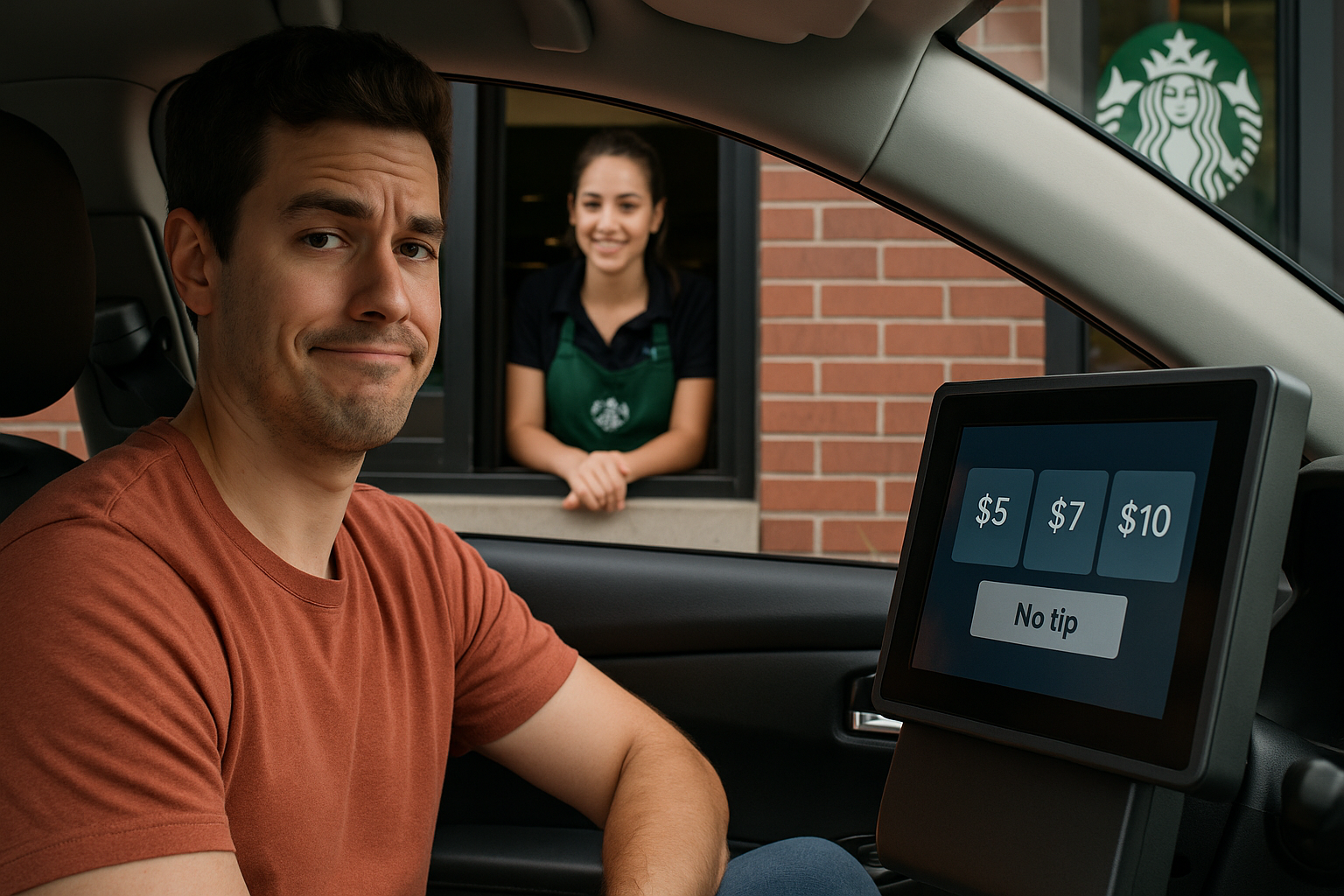
And then you arrive—the touchscreen awaits. That bright, moralistic slab of technology that silently judges your soul before the caffeine even touches your lips. You’re not just paying for coffee; you’re being measured. Assessed. Evaluated on whether your kindness extends past your wallet.
The barista smiles. You smile back, because you’re both pretending this is a normal interaction between humans and not the emotional equivalent of a hostage negotiation involving oat milk. You hand over your card, fully unaware that in five seconds, you’re about to enter an ethical minefield disguised as a payment prompt.
The Morality of Mochas
There’s a moment—tiny, devastating—when the barista flips the screen around and the tip options appear. $5. $7. $10. And your total? $4.99.
That’s not a payment screen; that’s a psychological weapon. Starbucks has turned generosity into a math problem that tests your self-worth. You can feel the universe pause. Somewhere, financial gurus faint. Somewhere else, your checking account cries softly.
You look at those numbers, and a full-blown moral debate begins inside your brain. “Well, they work hard,” you whisper to your conscience. “But also, I pay rent.” You imagine every possible outcome like it’s a choose-your-own-adventure book for guilt:
- Option A: No tip. You save $5 but risk spiritual condemnation.
- Option B: Tip $5. You go broke, but you glow with moral superiority.
- Option C: Press “Custom” and try to split the difference.
You go with “Custom.” It’s the rational middle ground. You type $1—reasonable, humane, polite. But the touchscreen freezes. Reloads. You panic. The person behind you inches forward. The barista waits. And somehow, through a tragic chain of user error and divine punishment, you end up tipping $10.
The barista’s smile widens like she just won a raffle. “Thank you so much!” she says, and you nod as if you meant to do that. Because what are you going to say? “Actually, that was an accident, I didn’t mean to sponsor your 401(k)”? No. You accept your fate.
That’s when it dawns on you—Starbucks isn’t selling coffee. They’re selling catharsis. They’ve weaponized guilt into an art form. Every sip of that overpriced brew isn’t just caffeine—it’s a confession.
You didn’t just buy coffee. You bought redemption.
The Caffeine Casino
Starbucks has cracked the code of human psychology: make people feel morally responsible for how they caffeinate. It’s genius, really. They turned a $5 transaction into a casino for conscience.
Every time you order, you pull the lever on that touchscreen like it’s a slot machine for self-esteem. Maybe today you’ll hit “Custom” in time. Maybe you’ll fumble again and send $7 to a college fund you didn’t intend to support. The suspense is exhilarating. The shame, consistent.
What gets me is how the tip options always start high. Nobody needs three digits of generosity on a latte. But they do it strategically—to make $5 feel like the moral minimum. It’s marketing psychology dressed as virtue.
And it works every time. You’ll tell yourself you’re doing it “because they deserve it.” You’ll rationalize it with the same logic people use to justify buying concert tickets during a recession: “It’s about the experience.” Meanwhile, your debit card’s smoking like a used Honda.
Let’s be real—Starbucks isn’t a coffee shop anymore; it’s an emotional casino. They play soft acoustic music, make the baristas call you by name, and convince you that your tip is part of the ritual. Every transaction feels like both a sin and a sermon. You leave not just caffeinated, but spiritually audited.
And the cruelest part? You love it. You crave it. You’ll come back tomorrow, because nothing else makes you feel quite as alive as surviving the gauntlet of modern-day morality before sunrise.
Latte Lessons in Existential Generosity
By now, I’ve accepted it: Starbucks isn’t just a brand; it’s a teacher. A life coach with better lighting and worse boundaries.
Each visit offers a crash course in personal ethics and emotional resilience. You learn to perform generosity under pressure, to smile while your financial anxiety screams in lowercase italics, and to pretend that tipping half your paycheck was part of your self-care plan.
The barista calls your name. You pick up your drink, cup sleeve proclaiming something wholesome like “You got this!” and you think, “You know what? Maybe I do.” You sip. It’s hot. It’s bitter. It’s perfect. You’re briefly at peace.
Then, inevitably, your phone pings: Bank alert: $10 Starbucks purchase. You wince, but you can’t even be mad. Because deep down, you know you’ll do it again. There’s something addictive about the ritual—the awkward silence, the guilt-fueled tip, the brief dopamine hit of moral superiority. It’s corporate theater at its finest.
You’ll justify it a thousand ways. “They’re working hard,” you’ll say. “It’s about kindness,” you’ll add. But really, it’s about you. It’s about needing to feel like a good person before your first email of the day. Starbucks isn’t just a coffee chain—it’s a mirror that reflects who you are when nobody’s watching. Except, of course, everyone is.
Final Thought: The Gospel According to Grande
So yes, every great story might start at a Starbucks drive-thru. Some people find their calling there; others find caffeine-induced humility. You, however, find both—served in a recyclable cup with your name spelled wrong.
Maybe you didn’t set out to be the hero of a moral fable this morning. You just wanted coffee. But somewhere between the touchscreen guilt trip and the sound of the espresso machine, you evolved. You learned something profound about generosity, impulse control, and the spiritual price of foam.
And tomorrow? You’ll be back. Because despite the financial trauma, the awkwardness, and the emotional hostage situation that is the tip screen, you secretly love it. The chaos. The ritual. The humanity of it all.
In a world that feels increasingly automated and artificial, Starbucks remains one of the last places where you can still feel judged in person. And somehow, that feels… comforting.
So go ahead—tip too much, regret it, laugh about it later. Because if life is a story, the drive-thru is your stage, the barista your audience, and your wallet the hero that never learns.






Can you be more specific about the content of your article? After reading it, I still have some doubts. Hope you can help me.