There is a very specific kind of silence that happens when you join a Zoom interview on time and nobody else is there. It is not peaceful silence. It is not the soft, reflective silence of a Sunday morning or a quiet cup of coffee before the world starts asking you for passwords, availability, and emotional resilience. No, this silence has fluorescent lighting even though you are at home. It has HR paperwork energy. It smells like a calendar invite that was created by someone who used the word “culture” three times and then forgot candidates are human beings with clocks, lives, and a shirt they ironed for no reason.
The other day, I joined a Zoom panel interview exactly on time because, unfortunately, I was raised by people who believed time existed. My family made the terrible mistake of teaching me that if someone says a meeting starts at 2:00, that means human beings should begin appearing around 2:00, not spiritually, not theoretically, not when Mercury leaves retrograde, but actually, visibly, with faces, voices, and some basic proof that the meeting was not invented by a recruiter’s abandoned Outlook folder.
So there I was.
Just me.
My camera.
My nervous little pre-interview smile.
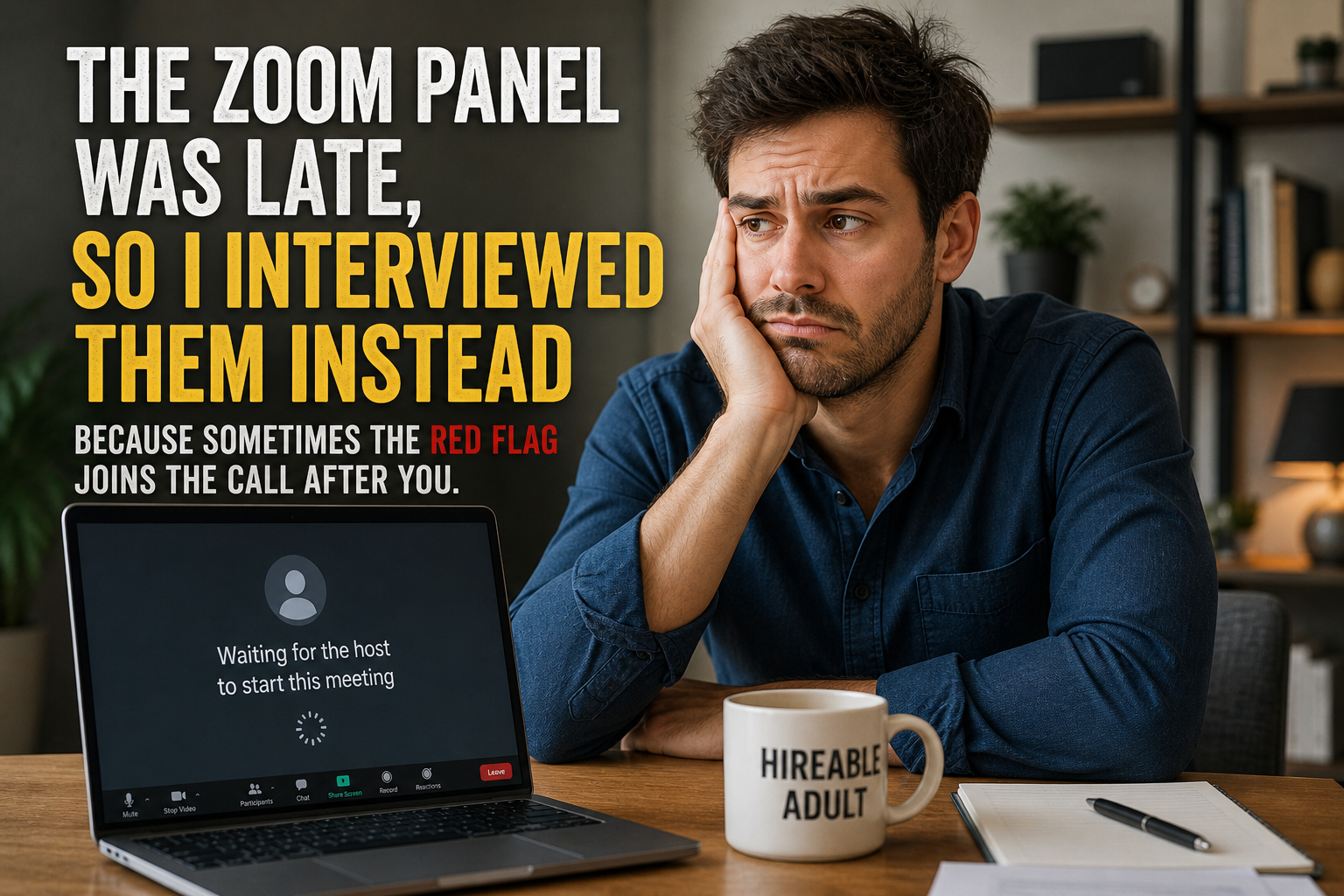
My shirt doing its absolute best to communicate, “hireable adult with leadership potential,” while my soul quietly whispered, “please let these people be normal.”
And then Zoom gave me the message every candidate knows too well:
“Waiting for the host to start this meeting.”
That sentence should be illegal during interviews because it immediately turns you into a corporate ghost standing outside your own evaluation. You are not in a meeting. You are in a digital hallway. You are dressed professionally in your house, sitting perfectly still like a hostage in business casual, wondering whether you should refresh, leave, rejoin, email the recruiter, text your emergency contact, or simply stare into the camera until your face becomes part of the company’s onboarding portal.
Five minutes passed.
Nobody appeared.
Not one hiring manager. Not one HR representative. Not one panelist with a vague title like “Strategic People Enablement Partner.” Just me, alone, waiting for the host like I was trying to get seated at a restaurant where the hostess saw me walk in and immediately decided I looked like I had follow-up questions.
And during those five minutes, something changed in me.
At first, I was patient. Then I was confused. Then I entered the sacred final stage of job seeker enlightenment: sarcastic clarity.
Because after enough interviews, enough ghosting, enough “we really enjoyed speaking with you” emails written by a copy-and-paste goblin in a fleece vest, you begin to notice the pattern. Candidates are expected to perform perfection while companies casually arrive late to their own process carrying a half-empty coffee, a dead camera, and an excuse wearing khakis.
If a candidate is five minutes late, the hiring team starts building a courtroom exhibit.
Concern around professionalism.
Possible time management issue.
May not be aligned with our fast-paced environment.
But when the panel is late?
Suddenly, we are all supposed to understand complexity.
Suddenly, time is fluid.
Suddenly, professionalism has entered witness protection.
And that is when I realized this was no longer an interview.
This was evidence.
The Panel Arrives Like a Group Project Nobody Read
Eventually, they started joining one by one, which is always how chaos enters corporate life: not all at once, but in separate little apologies.
First came the hiring manager, breathing like he had just sprinted through six departments, fought a printer, lost to the printer, and still decided the printer had leadership potential. He appeared on camera with the facial expression of a man who had opened twelve tabs in his brain and all of them were playing different onboarding videos.
“Sorry about that,” he said.
Beautiful.
A classic opener.
No explanation. No ownership. Just “sorry about that,” the corporate napkin placed delicately over the spilled soup of accountability.
Then came HR, smiling with the confidence of someone who knows candidates are judged for blinking too aggressively while panelists can show up late and call it “back-to-back meetings.” HR had that polished, serene expression people get when they have said “we value transparency” in so many meetings that transparency itself has filed a complaint.
Then came another panelist who said, “Sorry, my last meeting ran over.”
Of course it did.
In corporate America, every last meeting runs over. Every calendar is a haunted corn maze. Every professional has somehow become trapped in a chain of meetings so endless that nobody is ever responsible for the meeting they are currently late to because they are still emotionally recovering from the meeting before it.
“My last meeting ran over” is one of those phrases companies use as if candidates are supposed to nod sympathetically and say, “Of course, please, take more of my unpaid time, I brought snacks and a folding chair for the disrespect.”
Then another panelist blamed traffic.
Traffic.
On Zoom.
That one was special.
That excuse had been aging in an oak barrel of nonsense.
I sat there for a second trying to respect the creativity of it because blaming traffic for a virtual meeting requires a level of commitment usually reserved for magicians, toddlers, and executives explaining why they need everyone back in the office to improve collaboration.
Traffic on Zoom.
What happened? Did a Honda Civic crash into your Wi-Fi? Was there construction on the hallway between your desk and your laptop? Did you get stuck behind a slow-moving Outlook reminder with no turn signal?
At that point, the interview was already over for me. I knew two things with complete spiritual certainty.
One, I did not want the job.
Two, I had accidentally entered a leadership assessment, except I was the assessor, and the panel had already failed the warm-up question by arriving late to the meeting they scheduled to evaluate my professionalism.
That is the part hiring teams forget.
Candidates are not furniture.
We are not decorative objects placed inside your process so you can practice behavioral questions between budget meetings. We are watching. We are listening. We are quietly collecting data while you tell us about your amazing culture with the same energy as someone trying to sell a timeshare next to a volcano.
And when a company cannot manage the first five minutes of an interview, candidates notice.
We notice the silence.
We notice the apology quality.
We notice whether anyone takes accountability or just tosses excuses into the room like stale bread at corporate ducks.
We notice whether respect is real or just a value statement trapped on a slide next to stock photos of smiling people in an office nobody works in anymore.
So when they finally settled in, adjusted cameras, muted notifications, and prepared to ask me where I saw myself in five years, I decided to begin.
Not with an answer.
With a question.
I Asked the First Question and HR Saw the Ceiling Open
Before they could launch into the usual ceremony of recycled interview questions, I smiled and said, “So what caused everyone to be late today?”
Silence.
Gorgeous silence.
Expensive silence.
The kind of silence you usually only hear after a candidate asks for the salary range before completing a personality test designed by a haunted vending machine.
Everyone froze in a different emotional tax bracket.
The hiring manager blinked like his soul had briefly left the meeting to check the employee handbook. HR smiled harder, which is how you know panic has entered the chat wearing lip gloss. One panelist looked down, probably typing “candidate asked accountability question” into a secret field marked “culture concern.”
Finally, the hiring manager said, “Great question.”
And that, my friends, is corporate language for, “Please give me a moment while I search my soul and find only calendar invites.”
They began explaining.
Things were busy.
Meetings were stacked.
Priorities shifted.
The day had gotten away from them.
Everyone had a lot going on.
They appreciated my flexibility.
That last part was adorable because I had not offered flexibility. I had not donated my time to the Museum of Disorganized Leadership. I had simply been trapped in a waiting room with my own reflection and the slow collapse of my interest in employment.
There is a difference between being flexible and being held hostage by someone else’s poor planning.
Flexibility is when a meeting moves because something important happened and everyone communicates like adults with access to words.
Disrespect is when a panel arrives late to evaluate your professionalism, then expects you to smile like a golden retriever with a LinkedIn profile.
So I asked the next question.
“If I had joined five minutes late, would that be considered flexibility too, or would we be calling it a concern around professionalism?”
Now everybody’s Wi-Fi got religious.
Frozen faces everywhere.
One screen paused in a position that made it look like the panelist had been personally unplugged by accountability. Another person’s audio suddenly developed the emotional range of a submarine. HR’s smile remained on her face, but her eyes were clearly drafting a policy update.
And I could feel it.
That invisible shift.
The moment a candidate stops acting grateful just to be considered and starts acting like a professional evaluating whether the company deserves access to their labor, experience, brain cells, and Monday mornings.
Because somewhere along the way, companies convinced themselves that interviews are one-way auditions. They sit on one side of the table with their branded water bottles and their mystery salary ranges, while candidates perform humility, enthusiasm, and trauma-friendly optimism for the chance to maybe receive an automated rejection three weeks later that begins with “After careful consideration,” which is impressive because nobody carefully considered anything except maybe lunch.
But interviews are not one-way.
They never were.
Candidates are interviewing the company too.
We are watching whether you respect time.
We are watching whether you communicate clearly.
We are watching whether the people on the panel seem aligned or whether they look like they met each other for the first time when the calendar invite exploded.
We are watching whether the hiring manager can describe the role without sounding like they are reading a ransom note from the department budget.
We are watching whether HR says “family” too early.
We are watching whether your culture sounds like culture or just a collection of words someone found in a leadership book at the airport.
And we are absolutely watching what happens when the company is the one making the mistake.
Because mistakes happen. Life happens. Meetings run over. Computers betray us. Calendars rebel. Printers commit acts of domestic terrorism. Nobody expects perfection.
But there is a massive difference between “I apologize for being late; I should have communicated sooner, and I appreciate you waiting” and “Things are busy, thank you for your flexibility.”
One owns the issue.
The other gently places the issue in the candidate’s lap and asks them to call it teamwork.
Sometimes the Red Flag Joins After You
The rest of the interview became strange because once you ask one honest question, the whole performance loses its costume.
They still tried to continue.
They asked about leadership.
They asked about conflict.
They asked how I manage competing priorities.
That one nearly made me levitate out of my chair.
Because imagine showing up late as a group and then asking the candidate how they manage competing priorities. That is not an interview question. That is performance art. That is like a raccoon asking you to explain kitchen hygiene while holding a stolen sandwich over an open trash can.
I wanted to say, “Apparently better than this panel.”
But I remained professional, which in job search terms means I allowed the circus to continue without naming every clown by department.
They asked me to describe a time I handled a difficult situation.
I almost said, “Right now.”
They asked how I build trust with teams.
I almost said, “By showing up when I say I will.”
They asked what kind of culture I thrive in.
I almost said, “One where traffic does not affect Zoom.”
But the truth is, by then, my interest had left the meeting, packed a small bag, and was waiting outside with the hazard lights on.
Because this was not really about five minutes.
Five minutes by itself is not the crime.
The crime is the pattern.
The crime is the imbalance.
The crime is how candidates are expected to walk into every interview with military-grade preparedness while companies show up with vague apologies, hidden salary ranges, confused panelists, and a hiring process that looks like it was assembled during a fire drill by a committee of raccoons wearing headset microphones.
Candidates are told to research the company, study the role, prepare examples, dress appropriately, test their technology, join early, smile warmly, make eye contact with a camera dot, send thank-you notes, follow up without seeming desperate, and remain enthusiastic after being ghosted by a recruiter whose LinkedIn headline says “People First.”
Meanwhile, the panel can be late, unprepared, distracted, vague, misaligned, and still somehow believe the candidate is the one being evaluated.
No.
Sometimes the red flag joins the Zoom call after you.
Sometimes the warning sign is not in the job description but in the waiting room.
Sometimes “fast-paced environment” means nobody has control over their calendar and your evenings will become a donation center for other people’s emergencies.
Sometimes “collaborative culture” means meetings breed like rabbits and everyone is too polite to say the process is broken.
Sometimes “we treat people like family” means they will be late, undercommunicate, and still expect you to bring emotional snacks.
And sometimes rejection is mutual.
That is a beautiful thing job seekers need to remember.
You are allowed to leave an interview and think, “Absolutely not.”
You are allowed to evaluate them.
You are allowed to notice the energy.
You are allowed to decide that the opportunity is not an opportunity, but a brightly wrapped stress subscription with dental benefits.
You are allowed to say, politely or spiritually, “Thank you for confirming this circus has no ringmaster.”
Because the best interview answer is not always, “I am passionate about this opportunity.”
Sometimes the best interview answer is silence, a smile, and the internal realization that you would rather sell haunted furniture on Facebook Marketplace than report to a team that cannot start its own interview on time.
And honestly, there is freedom in that.
The job search makes people feel powerless because so much of it is built around waiting. Waiting for replies. Waiting for feedback. Waiting for the recruiter to “circle back.” Waiting for a hiring manager to finish reviewing candidates even though the job has been reposted twice and now has 700 applicants, including one golden retriever with project management experience.
But in that Zoom room, while they stumbled through excuses and tried to restart the performance, I remembered something important.
I still get to choose.
Maybe I do not control whether they offer me the role.
But I do control whether I want to hand them my time, energy, talent, sanity, and the good version of myself that still believes work can be meaningful when leadership is not being held together by duct tape and calendar reminders.
And on that day, the answer was no.
A very calm no.
A no wearing a professional shirt.
A no with excellent lighting.
A no that had arrived on time.
Final Thoughts: I Wanted the Job Until the Job Started Talking
By the end of that interview, I did not feel rejected, nervous, or disappointed. I felt informed.
That is the gift of a bad interview. It tells the truth early.
Some companies do not reveal themselves in the job description because the job description was written by a committee, edited by legal, blessed by HR, and sprinkled with words like “dynamic,” “innovative,” and “cross-functional” until nobody can tell whether the role is leadership, operations, customer service, or surviving a corporate escape room with no windows.
But behavior reveals everything.
How people show up reveals everything.
How they apologize reveals everything.
How they respond when the candidate asks a fair question reveals everything.
If the company treats your time casually during the interview, please imagine what happens after onboarding when you are trapped inside their actual systems with a badge, a password reset, and a manager who says, “Can you jump on a quick call?” at 4:57 p.m.
If they cannot respect your calendar when they are trying to impress you, they are not going to magically become organized after you accept the offer.
That is why candidates need to stop treating every interview like the company is doing them a favor by allowing them to breathe near the role.
Yes, we want work.
Yes, we want stability.
Yes, we want benefits, purpose, money, and maybe one job description that does not require twenty years of experience for software invented last Tuesday.
But wanting a job does not mean surrendering your standards at the login screen.
You can be grateful for an opportunity and still notice when the opportunity walks in late wearing a red flag as a cardigan.
You can be professional and still ask why the panel was late.
You can be polite and still decide this is not the room for you.
You can smile, answer questions, close your laptop, and whisper to yourself, “Not today, corporate Jumanji.”
Because candidates are not just being interviewed.
We are observing leadership in the wild.
And sometimes leadership enters five minutes late, blames traffic on Zoom, praises your flexibility, and accidentally tells you everything you needed to know.
I did not want the job.
Honestly, by the end, I did not even want the follow-up email.
I wanted peace.
I wanted coffee.
And yes, I wanted a refund for the shirt.