
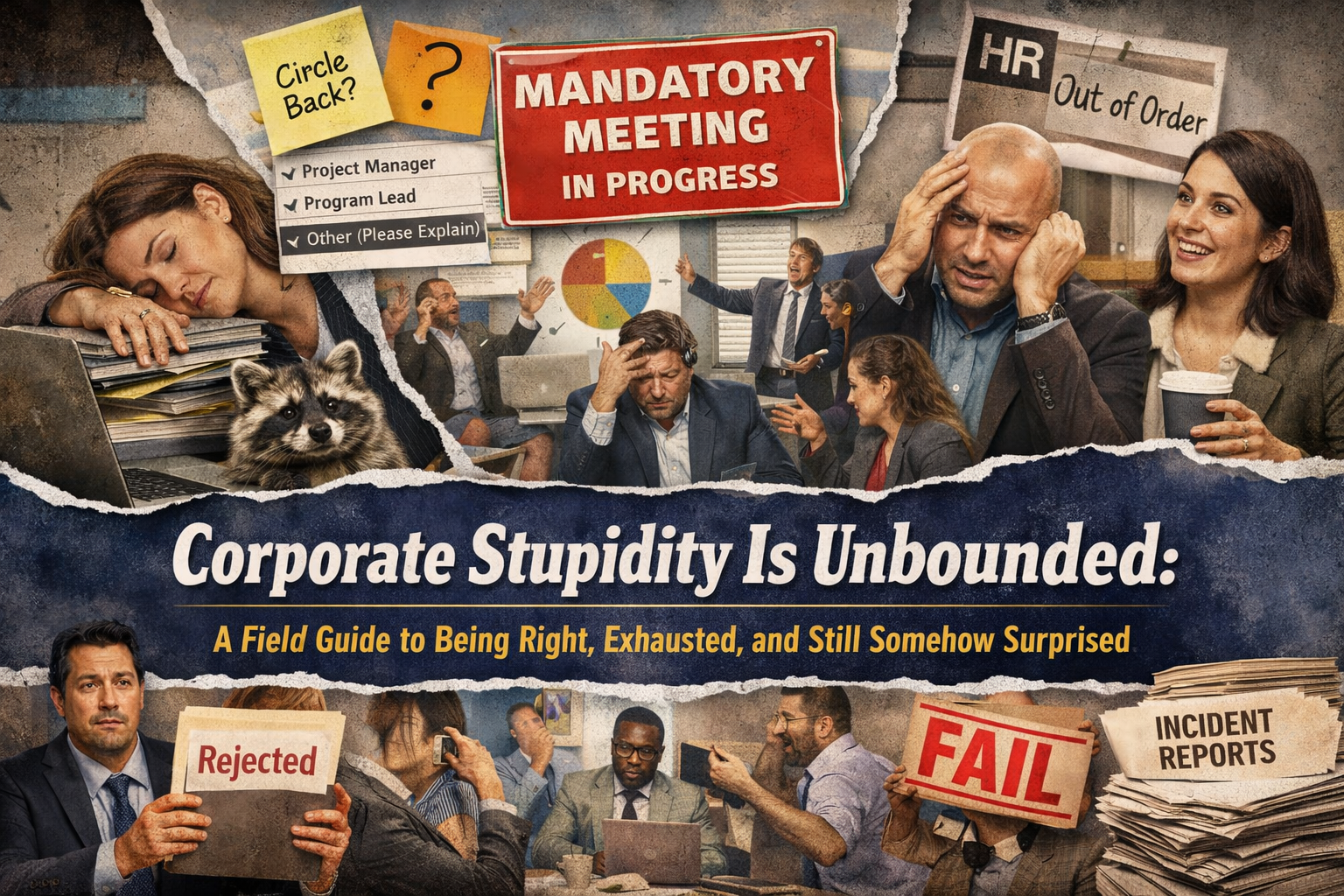
There’s a certain kind of interview moment that doesn’t feel like a red flag so much as a quiet documentary voiceover in your head saying, “And here we see the candidate, unaware they are about to witness the organization’s entire operating system in its natural habitat.” It starts out normal, of course, because interviews always start out normal; that’s the agreement we all silently sign. They ask you about “strengths,” you pretend you weren’t built in a lab specifically to handle chaos, and everyone performs that polite corporate theater where phrases like fast-paced environment and we value collaboration float through the room like scented candles trying to mask the smell of something smoldering behind the drywall.
And you’re doing fine. You’re nodding at the correct intervals. You’re smiling the way adults smile when they’re trying to signal competence without looking like they rehearsed it in the mirror. You’re telling stories that make you sound both results-driven and emotionally safe, like a person who can hit a deadline and also won’t ruin anyone’s weekend by being too honest in a meeting. Everything is smooth. Everything is professional. Everyone is pretending the stakes aren’t high even though the stakes are literally your livelihood and their next six months of staffing decisions.
Then you ask what should be a harmless, reasonable, fully adult question: “How is success measured in this role?”
And suddenly the air changes.
Not dramatically. Not with sirens. Just… quiet. That special kind of quiet where the room doesn’t go silent because someone is thinking, but because everyone is instinctively looking for the safest possible thing to say without accidentally admitting the truth out loud. Eyes move from your face to the table like the table is now the real hiring manager and you are simply a guest speaker at its conference. Nobody wants to be the one who answers first. Nobody wants to be the one who says the wrong thing. Everyone seems to realize, at the exact same time, that describing the measurement of success is a surprisingly vulnerable act, because it reveals what the organization actually rewards when the onboarding slides stop playing and the friendly welcome emails have evaporated into the void.
And then, finally, someone answers, carefully, gently, like they’re approaching a nervous raccoon: “Mostly through feedback from others.”
Now, feedback isn’t evil. Feedback can be useful. Feedback can be part of a real system. But when feedback is the system, when it’s not paired with outcomes, clarity, ownership, and measurable work, it stops being a tool and becomes an atmosphere. It becomes a weather pattern. It becomes a courtroom where everyone is both judge and witness and nobody remembers what the original charge was. It turns the job into a high-stakes popularity contest where the real deliverable is keeping the emotional ecosystem stable while hoping your actual work doesn’t disturb anyone’s sense of comfort.
Because the moment success is primarily “how people feel about you,” the incentives shift quietly, like a building settling. You stop optimizing for impact. You stop optimizing for decisions. You stop optimizing for results. You start optimizing for vibes. You learn to speak in agreeable fog. You master the art of being visible without being accountable. You become fluent in the language of “alignment” so you can spend entire weeks participating in activity that looks like progress from a distance but is actually just motion.
And the wild part is this: the interview didn’t create that reality. It didn’t invent the dynamic. It just accidentally told the truth in a room where truth is usually kept on a short leash.
So let’s talk about what that answer really means, what it costs, and how to spot the difference between a healthy culture that values feedback and a workplace that uses feedback as a stand-in for leadership.
Feedback as a Metric vs Feedback as a Weapon
In a functional organization, feedback is one input. It’s a signal. It’s something you use to improve the work, the communication, the collaboration, the outcomes. It’s paired with real goals, real expectations, and real accountability. It lives alongside metrics that aren’t just feelings wearing a name tag.
But in a vibes-based organization, feedback becomes the metric because it’s the only thing that can be measured without anyone having to commit to anything.
Outcomes are complicated. Results require definitions. Definitions require decisions. Decisions require someone to be responsible. Responsibility requires a spine. And if an organization has built a culture around avoiding discomfort at all costs, it will naturally drift toward the one performance evaluation system that allows everyone to have opinions without anyone needing to explain what “good” actually looks like.
“Feedback from others” sounds collaborative, but it can be a shortcut. It can be a convenient replacement for actual management. Because if success is measured through feedback, then leadership doesn’t have to say what matters. They just have to collect reactions. They can avoid being the bad guy who clarifies priorities, and instead become the neutral librarian of everyone’s feelings.
That’s when feedback stops being guidance and starts being governance.
And governance by feedback is seductive because it gives the appearance of fairness while creating the most unfair game imaginable: one where the rules change depending on who’s speaking, where the goalposts move based on mood, and where “doing the right thing” can be punished if it makes someone feel exposed, challenged, or slightly less comfortable than they were five minutes ago.
This is how you end up in organizations where the most successful people are not the most capable, not the most effective, not the most strategic, but the most emotionally survivable.
The ones who can deliver updates without delivering clarity.
The ones who can agree without committing.
The ones who can appear helpful without becoming responsible for anything that might fail.
Because when feedback is the scoreboard, the objective becomes not “do the work,” but “avoid being the character in someone else’s story.”
And that’s where performance becomes a personality contest and every day turns into a silent audition for “Most Pleasant Person To Be Around While Nothing Changes.”
The Rise of Vibe Optimization and the Death of Ownership
Once you realize you’re being measured primarily by how others perceive you, your brain adapts. Not because you’re weak. Because you’re employed.
You start making subtle choices that have nothing to do with excellence and everything to do with social safety.
You stop taking risks, because risk creates reactions, and reactions create feedback, and feedback becomes your report card. You stop being direct, because directness can be interpreted as “tone,” and tone is apparently a deliverable now. You stop owning problems, because ownership makes you visible to blame, and blame is the only part of accountability that vibes-based cultures enforce consistently.
What does this look like in the wild?
It looks like meetings where everyone speaks but nobody decides.
It looks like “alignment” as a verb, a ritual, a way to keep movement slow enough that no one gets startled.
It looks like people saying “great point” to statements that contain no point.
It looks like “Let’s circle back” used not as a scheduling tool, but as a mild sedative.
And the most dangerous part is that it can feel productive if you’ve never worked in a place where productivity actually has definitions. There are documents. There are check-ins. There are channels. There are threads. There is an entire ecosystem of talk about work, which creates the soothing illusion that work is happening somewhere nearby, like thunder in the distance.
But when success is tied to being liked, clarity becomes risky. Clarity forces people to confront reality. Clarity introduces standards. Standards reveal gaps. Gaps make people feel insecure. Insecurity triggers defensive behavior. Defensive behavior becomes “feedback.” And feedback becomes your problem.
So everyone learns to sand down the edges.
Not because they’re lazy. Because the culture rewards ambiguity and punishes friction. Because the organization has decided, consciously or not, that discomfort is a greater threat than stagnation.
That’s how you end up in a place where:
- Being right is less valuable than being agreeable.
- Shipping work matters only if nobody feels weird about it.
- Decisions are celebrated only when they are unanimous, and unanimity is achieved by making the decision so watered down it can’t offend anyone.
And then people wonder why nothing improves. They hold retrospectives. They schedule “culture conversations.” They hire consultants to tell them, gently, that they have a fear of clarity. Everyone nods. Everyone agrees. Everyone asks for feedback.
Nothing changes.
Because change requires someone to be willing to be temporarily unliked in service of doing something real.
The Interview Moment That Saves You Months of Pretending
Here’s the part that deserves respect, even if it’s horrifying: the interview told the truth.
Most interviews are highlight reels. Everyone is selling. Everyone is performing competence and warmth. The company is showcasing benefits and values. You’re showcasing adaptability and grit. Nobody is talking about how the sausage gets made; they’re just describing how delicious it will be once you’re fully committed and can’t leave without updating your 401(k) paperwork.
But when you ask, “How is success measured?” you’re not asking for a fun fact. You’re asking for the operating manual. You’re asking how reality works after the branding ends.
And if the answer is “feedback from others,” you’ve just been handed a translation key.
It means:
- Success is social approval.
- Safety is consensus.
- Conflict is failure, not information.
- Leadership prefers harmony over progress.
- Your job will include emotional management as an unspoken core responsibility.
It doesn’t mean the place is automatically evil. It doesn’t mean there aren’t good people. It doesn’t mean you can’t succeed there. But it does mean you should walk in with open eyes, because you’re not being hired into a system of metrics and outcomes; you’re being hired into a system of perceptions.
And the question becomes: do you want that job?
Some people do. Sometimes you need stability. Sometimes you want a role where soft skills are actually valued. Sometimes you’re exhausted from high-pressure environments and you want a place where pace is slower and relationships matter.
But there’s a difference between a relationship-driven culture and a vibes-driven culture.
A relationship-driven culture can still say, clearly, what success looks like. It can still define goals. It can still give feedback tied to outcomes. It can still reward ownership. It can still celebrate clarity even when it’s uncomfortable.
A vibes-driven culture can’t do that without feeling threatened by the act of definition itself.
So when an interview reveals that success is measured by feedback alone, you haven’t discovered a quirky HR preference. You’ve discovered the currency. You’ve discovered what people trade in to survive. You’ve discovered the rules of the game before you’ve signed up to play it.
And honestly, that’s a gift.
It saves you months of pretending you don’t notice the scoreboard is imaginary while everyone around you is acting like the numbers are very real and you should be grateful they’re not telling you what they are.
Final Thoughts: Metrics Are Kindness, Even When They’re Uncomfortable
If an organization can’t explain how success is measured without getting weird, it’s not because the question was inappropriate. It’s because the answer forces them to confront something they’ve been avoiding: that accountability requires clarity, and clarity requires someone to be brave enough to define the work.
Feedback is powerful when it’s part of a real system. But feedback as the entire system is just vibes wearing a suit. It’s the illusion of evaluation without the responsibility of standards. It’s a way to keep everything subjective so nobody has to own hard truths.
So if you’re interviewing and you hear, “We measure success through feedback,” don’t panic. Translate it.
You’re being told what’s rewarded. You’re being told what’s punished. You’re being told what kind of person thrives there: not necessarily the best, but the safest. Not necessarily the most effective, but the most pleasant under fluorescent lighting.
And if you decide it’s not for you, that’s not cynicism. That’s wisdom.
Because real success isn’t just being liked. Real success is doing work that matters, in a system that can name what matters, with leadership that doesn’t need a group chat to authorize reality.
And any interview that accidentally admits otherwise just saved you time, energy, and several “quick chats” that require witnesses.