There’s a certain kind of silence that only happens in job interviews, the kind that makes you reevaluate your entire existence. It’s not the peaceful kind, like watching snow fall or hearing lo-fi music in a coffee shop. No, this is the kind of silence that feels like your brain just hit the world’s most inconvenient reboot.
You sit across from a stranger holding your career in a clipboard. You’ve practiced your answers, memorized your resume, even Googled “how to sound confident but not arrogant.” You’ve ironed your shirt, adjusted your lighting, and positioned your camera at the exact angle that hides your exhaustion but shows your ambition. You’re ready. You’re composed. You’re hydrated.
And then it happens.
The interviewer tilts their head, smiles that polite, slightly predatory smile, and says the words that have triggered countless mid-interview identity crises: “Tell me about a time you faced a challenge.”
You freeze. Your mind empties like a browser with too many tabs open. Every professional success you’ve ever had—gone. Every challenge you’ve overcome—erased. Suddenly, your entire career feels like a fever dream, and you’re left wondering if “running out of printer ink” counts as a significant hardship.
That’s when someone, somewhere, inevitably brings up the STAR method.
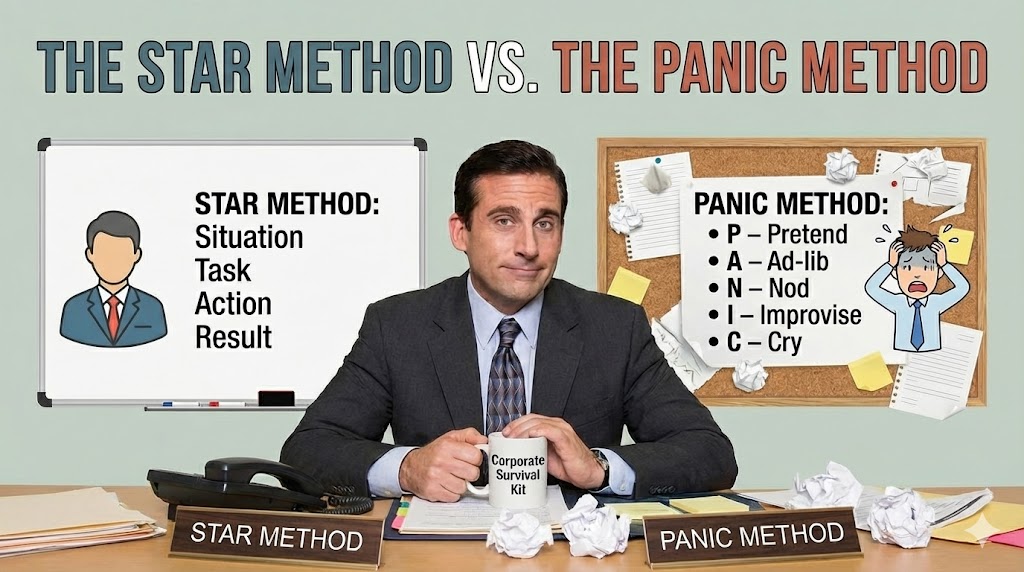
The STAR method, beloved by recruiters, career coaches, and people who use “synergy” unironically. It stands for Situation, Task, Action, Result—a structured way to tell stories that make you sound capable, self-aware, and definitely not like someone who’s one rejection away from becoming a motivational speaker out of spite.
It’s the holy grail of interview techniques. The sacred formula LinkedIn influencers write entire carousels about. The reason half of us spend our Sunday nights whispering to mirrors, practicing stories like:
“There was a time I led a project that taught me resilience, collaboration, and the importance of deep breathing.”
The idea is simple: give your answers structure. Don’t ramble. Sound logical. Be memorable. But here’s the problem, humans don’t naturally speak in bullet points. No one, in the real world, says things like, “The situation was my weekend, the task was to relax, the action was to binge-watch six hours of true crime, and the result was emotional damage.”
And yet, we cling to it. Because interviews aren’t real conversations, they’re performances. Carefully choreographed dances between anxiety and ambition.
The STAR method promises to keep us safe from awkward silences, meandering stories, and the terrifying possibility of sounding like we don’t have our life together. But as I learned firsthand, no amount of structure can save you from the chaos of being human under fluorescent lighting.
The Rehearsed Reality
Let’s be honest, prepping for interviews feels less like professional development and more like method acting. You’re playing “The Competent Adult,” a role that requires emotional stamina, facial control, and the ability to speak in calm, measured tones while your internal monologue screams.
The night before my big interview, I rehearsed the STAR method like a one-person stage show.
“Situation: coworker conflict. Task: find resolution. Action: communicate effectively. Result: harmony and productivity.”
I said it with conviction, timing, and a smile that said I am emotionally stable and hireable. I even added hand gestures, like a motivational speaker who’s read too many leadership books.
When the big day arrived, I was ready to deliver my masterpiece. The question came exactly as expected: “Tell me about a time you resolved a conflict at work.”
I launched into my perfectly structured response like a corporate poet. Every sentence was polished, professional, and blandly impressive. It was textbook STAR. It was, in short, flawless.
Then the interviewer leaned back and said, “Can you give me another example?”
And just like that, I realized something crucial: the STAR method doesn’t protect you from the follow-up question. It only delays the panic by approximately 30 seconds.
Because beneath the structure, we’re all just improvising professionalism. Every “Situation” is a rewrite, every “Action” is embellished, and every “Result” is slightly exaggerated to sound like something that would make a LinkedIn post go viral.
The Theater of Professionalism
Interviews are not conversations. They’re theater.
You walk into a room, or a Zoom and immediately step into character. Your resume is the script. Your confidence is the costume. Your coffee is the only thing keeping you conscious.
The interviewer asks questions designed to assess “behavioral competencies,” but let’s be real, they’re just watching to see if you’ll crack under pressure. You answer with poise, structure, and a tone that suggests you’ve read at least one leadership book in your life. But inside? You’re running on the PANIC method already.
The STAR method is your dialogue coach, it tells you how to stay on track, how to make every story sound like a personal growth montage. But it also drains out all the personality. Every story starts to sound the same. Every answer feels rehearsed. Every genuine human moment gets flattened into a bullet-point performance.
You’re not talking about life anymore—you’re defending your employability.
Meanwhile, your inner voice is screaming things like:
“Did that sound too cocky?” “Am I making enough eye contact?” “Is this tie too much?” “Why does she keep writing? What is she writing?”
By the end, you don’t know if you nailed it or blacked out. You just know that if you ever have to say “team collaboration” again, you might legally combust.
The Rise of the PANIC Method
That’s when the rebels emerge. The ones too tired, too caffeinated, or too self-aware to fake it anymore. They’ve abandoned the STAR method entirely. They’ve embraced something much more honest—much more human.
The PANIC Method.
P – Pretend you know what’s happening.
A – Ad-lib when the question goes off-script.
N – Nod thoughtfully, even if you’re internally buffering.
I – Improvise a success story that may or may not involve emotional trauma.
C – Cry later, preferably in your car, ideally with drive-thru fries.
The PANIC method is raw, chaotic, and surprisingly effective. Because while STAR answers make you sound like a management textbook, PANIC answers make you sound like an actual human being.
You might stumble, you might overshare, you might forget your Result, but you’ll also connect. You’ll make them laugh. You’ll remind them that behind every resume bullet point is a real person trying their best not to sweat through their blazer.
Final Thoughts: Between Stars and Chaos
The truth is, interviews are just socially acceptable anxiety experiments disguised as career opportunities. The STAR method gives structure to that chaos, it’s neat, tidy, and comforting. But life rarely fits into four tidy letters.
The PANIC method, though? That’s real. It’s messy, imperfect, and full of personality. It’s the way we actually survive the madness of modern work. Because at the end of the day, no one hires you for your perfectly rehearsed “Task” section—they hire you for your ability to stay calm when everything’s falling apart.
So go ahead, practice your STARs. But keep your PANIC close. Because when that follow-up question hits, or the Wi-Fi drops mid answer, you’ll need both structure and soul to survive.
And if all else fails? Smile like you meant to pause dramatically. Confidence sells better than coherence.






Your point of view caught my eye and was very interesting. Thanks. I have a question for you.