The other day I walked into an interview already knowing how it would go. Not because I researched the company or stalked LinkedIn for clues. I knew because the hiring manager smiled at me.
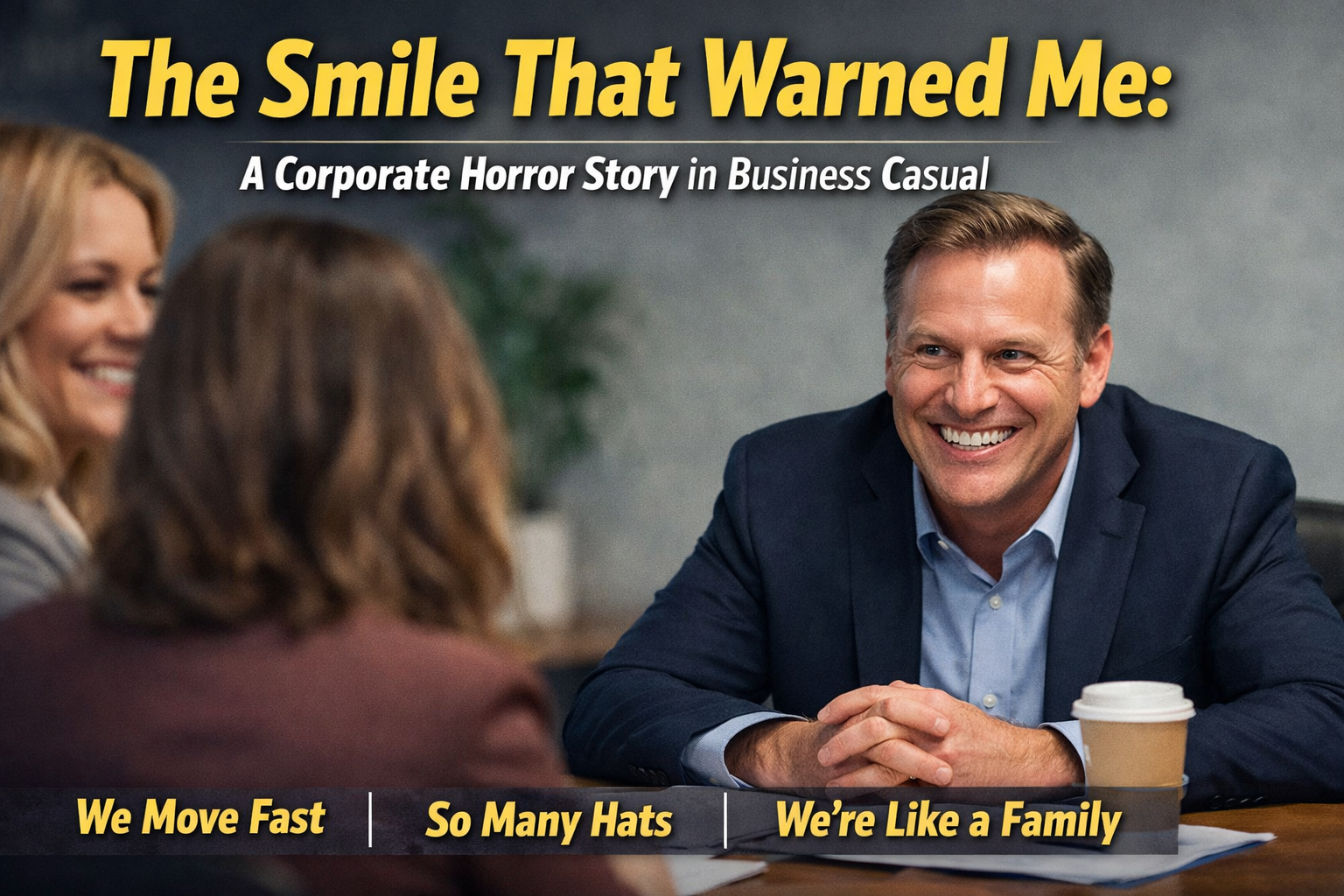
Not a normal smile. Not a “hello, fellow human, I also drink liquids and experience feelings” smile. This was the big one. The teeth-forward smile that doesn’t say welcome. It says buckle up.
It appeared immediately, before I even sat down, which felt less friendly and more like a disclaimer. Normal smiles warm up. This one arrived fully charged, like it had been rehearsing in the mirror. The kind of smile that says this meeting has layers, expectations, and at least one surprise you won’t enjoy discovering later.
And here’s the thing about interviews: we pretend they’re conversations, but they’re really live theater. Everyone shows up in costume. Everyone performs a version of themselves that has never existed for more than forty minutes. Everyone lies politely. And the hiring manager’s smile is the opening monologue. It sets the tone. It tells you whether this is a rom-com, a drama, or a psychological thriller filmed entirely in a conference room with fluorescent lighting that makes hope look like a rash.
They asked how my day was going with the enthusiasm of someone who already knew the answer wouldn’t matter. I said “great” out of reflex, because honesty has no place in interviews. Then came the small talk: weather comments delivered like icebreakers, jokes that landed but explained nothing, and that aggressive positivity that suggests someone just returned from a leadership conference with a tote bag and a new personality.
Then they leaned back, still smiling, and said, “We like to move fast here.”
Which never means efficient. It means someone quit suddenly and took the instructions with them. It means you’ll be trained through observation, vibes, and panic. It means the org chart is a ghost story and your onboarding will include phrases like “You’ll figure it out” and “We’re all wearing a lot of hats right now” said by people who haven’t blinked in weeks.
I nodded professionally while my soul opened a new browser tab.
The Smile, The Small Talk, and the Corporate Ouija Board
The smile never left. It just… hovered. Like a drone. Like it was taking notes. Like it was scanning my answers for weakness, joy, and whether I’d ever once pushed back on an unreasonable request or if I was the kind of person who apologizes when someone else bumps into them.
They started with harmless questions. “How was traffic?” “Did you find the building okay?” “Isn’t it wild how cold it is?” The classics. The emotional warm-up lap. Except it didn’t feel warm. It felt like the pre-show announcement where the voice says, Please locate your nearest exit and note that screaming is discouraged.
Every sentence had the cadence of a corporate TED Talk. Even the laughter was strategic. And I could feel it: the interview wasn’t starting. It had already started. The smile was the starting gun.
Then they said, “We’re very collaborative.”
Which is beautiful, in theory, if collaboration means teamwork. But in Corporate Language, “collaborative” often means you will be included in meetings you don’t need, on projects you didn’t ask for, with stakeholders who will disagree with each other as a sport. You will “align” until you forget your own name. You will “circle back” until your life becomes a shape.
They told me about the culture. The values. The “shared accountability.” I learned everything except what I would actually be doing between Monday and existential dread. Because the job description was clearly written by someone who believes the word “dynamic” counts as a task.
They asked how I handle pressure.
I said, “Well.”
And their smile widened like I’d just confirmed I was willing to be haunted.
Because nobody should be pleased by that answer. A normal person hears “I handle pressure well” and thinks, Great, this person is steady. A hiring manager with that smile hears it and thinks, Perfect. This one won’t scream until at least quarter three.
They asked if I’m comfortable with ambiguity.
I said yes, because that’s what employment requires now. Not skills. Not talent. Not knowledge. The ability to stare into the void and say, “Absolutely, happy to own that.”
They nodded like I’d passed a test I didn’t remember taking.
And the entire time, the smile stayed. Not one crack. Not one flicker. Not even when they talked about “high expectations,” which is corporate for “we will ask you to do the work of three people and then suggest you should be grateful for the growth opportunity.”
That smile wasn’t friendliness.
It was foreshadowing.
We Move Fast Here (Also We Have No Plan)
Then came the hats.
Not literal hats, but the concept. The metaphorical hat store they keep in the back of every company that “moves fast.” The place where roles go to become legends. The place where responsibilities multiply like rabbits, except the rabbits are on fire and also you’re supposed to document them.
“This role wears a lot of hats,” they said.
And in that moment I knew: this role used to belong to three people who are no longer reachable emotionally or legally.
Because “a lot of hats” isn’t a fun quirk. It’s not a cute detail. It’s a warning label. It’s Corporate Morse Code for: We don’t have enough headcount, and we’ve decided your neck looks strong.
They explained the pace. The urgency. The “need for someone who can jump in.” Which is always fascinating, because “jump in” suggests there’s water.
There is no water.
There is only chaos.
And you will jump in anyway.
You will learn the job by watching other people do it badly. You will ask questions and receive answers like, “That’s a good question,” which is Corporate for “We also don’t know.” You will be told there’s documentation, and then you will discover the documentation is one Google Doc titled “Process” with three bullets and a comment thread from 2021 where someone wrote, “We should update this.”
They said, “We like to move quickly.”
And what they meant was: “We make decisions at the speed of anxiety.”
What they meant was: “We’ve mistaken urgency for leadership.”
What they meant was: “You will be rewarded for fixing things that never should’ve been broken and then punished for needing sleep.”
They said, “We’re looking for someone proactive.”
Which is always hilarious, because proactive in an interview means “takes initiative,” but proactive on the job means “predicts problems created by leadership and fixes them before leadership notices they created them.”
They said, “There’s a lot of visibility.”
That’s the one. The sentence that sounds like an opportunity but feels like a spotlight in an interrogation room. Because visibility means your wins will be quietly absorbed into a team slide, but your mistakes will be reenacted in real time in front of people who say things like “Let’s use this as a learning moment” while actively carving your name into a performance spreadsheet.
Visibility means your calendar will become a public resource. Visibility means your work will be discussed by people who do not know you but have opinions about your tone. Visibility means you will accidentally become “the person who owns that,” and “that” will expand until it includes everything.
And the smile stayed.
Like it was enjoying this.
We’re Like a Family (Call a Therapist)
Then they said it.
“We’re kind of like a family.”
And my spirit left my body so cleanly I’m pretty sure it submitted a two-week notice.
Because “family” is the most dangerous word in the corporate dictionary. It sounds warm. It sounds supportive. But in the workplace, “family” usually means boundaries are considered a personal flaw.
It’s the kind of family where nobody communicates directly and everything is discussed later without you. The kind of family where feedback shows up as passive aggression and “quick chats.” The kind of family where someone says, “We’re all just trying our best,” right before assigning you extra work because you “handle things well.”
In a healthy job, professionalism protects you. In a “family,” professionalism is treated like distance. And distance is suspicious. Because family wants access. Family wants loyalty. Family wants you to take it personally when the company makes a decision that impacts your life.
They smiled when they said it, too. Of course they did. Like they were proud. Like they’d built something special. Like the culture was a handcrafted artisanal emotional entanglement.
Then came the hours.
“Long hours from time to time.”
Which sounded suspiciously permanent.
Time to time. Like it’s seasonal. Like it comes and goes. Like it’s a cute little weather pattern. But the tone was telling. The way people say “time to time” when they mean “every time.”
They asked if I had questions.
I considered asking if the smile was included in the benefits package. I considered asking if “family” means I’ll be expected to attend emotional events I didn’t consent to, like Loyalty and Guilt and Unpaid Overtime.
Instead I asked something responsible about growth.
They loved that.
Of course they did.
Because growth is the safest word in the interview world. It means nothing and everything. It’s vague enough to be inspiring and empty enough to avoid accountability. Growth is the shiny distraction you hand to people while you quietly increase their workload.
They said they’d be moving quickly.
Which, in interview language, means I will never hear from them again.
And as I walked out, still wearing my interview face, still nodding like a person who hasn’t been psychologically assessed by a smile, I realized the interview had done exactly what interviews do now: it hadn’t asked if I was right for the job.
It had asked if I could survive the job.
Final Thoughts: The Smile Isn’t Welcome. It’s A Warning.
I left feeling like I’d just exited a ride I didn’t agree to. Slightly dizzy. Mildly evaluated. Emotionally audited. Like I’d been measured for tolerance, compliance, and how quickly I could accept chaos as culture.
Because when the hiring manager smiles that big at the start, it’s not friendliness.
It’s foreshadowing.
That smile doesn’t say welcome.
It says hold on.
And if you’ve interviewed long enough, you don’t even need the job description anymore. You just need the smile.
The big one.
The teeth-forward one.
The one that arrives fully charged.
The one that tells you, before you even sit down, exactly what kind of story this is going to be.