We need to retire the current version of panel interviews the way we retired low-rise jeans: respectfully, permanently, and with a collective agreement to stop pretending this was ever a good idea. Because right now, the modern panel interview isn’t a “holistic candidate evaluation,” it’s a corporate escape room where the only clue is your own resume and the only prize is the privilege of being told, with dead-eyed enthusiasm, that the team is “moving quickly,” which is recruiter for “we will forget you existed the second this call ends.”
It always starts with optimism, too, which is the cruelest part. You log into Zoom with that brave little belief that this might be a normal human conversation—one person, one job, a few questions, maybe a laugh, maybe a moment of chemistry that feels like mutual respect rather than mutual endurance. And then the screen populates. Not with a colleague. Not with a hiring manager. With a Brady Bunch grid of strangers that looks like the opening scene of a documentary titled When Meetings Attack: A Corporate Tragedy.
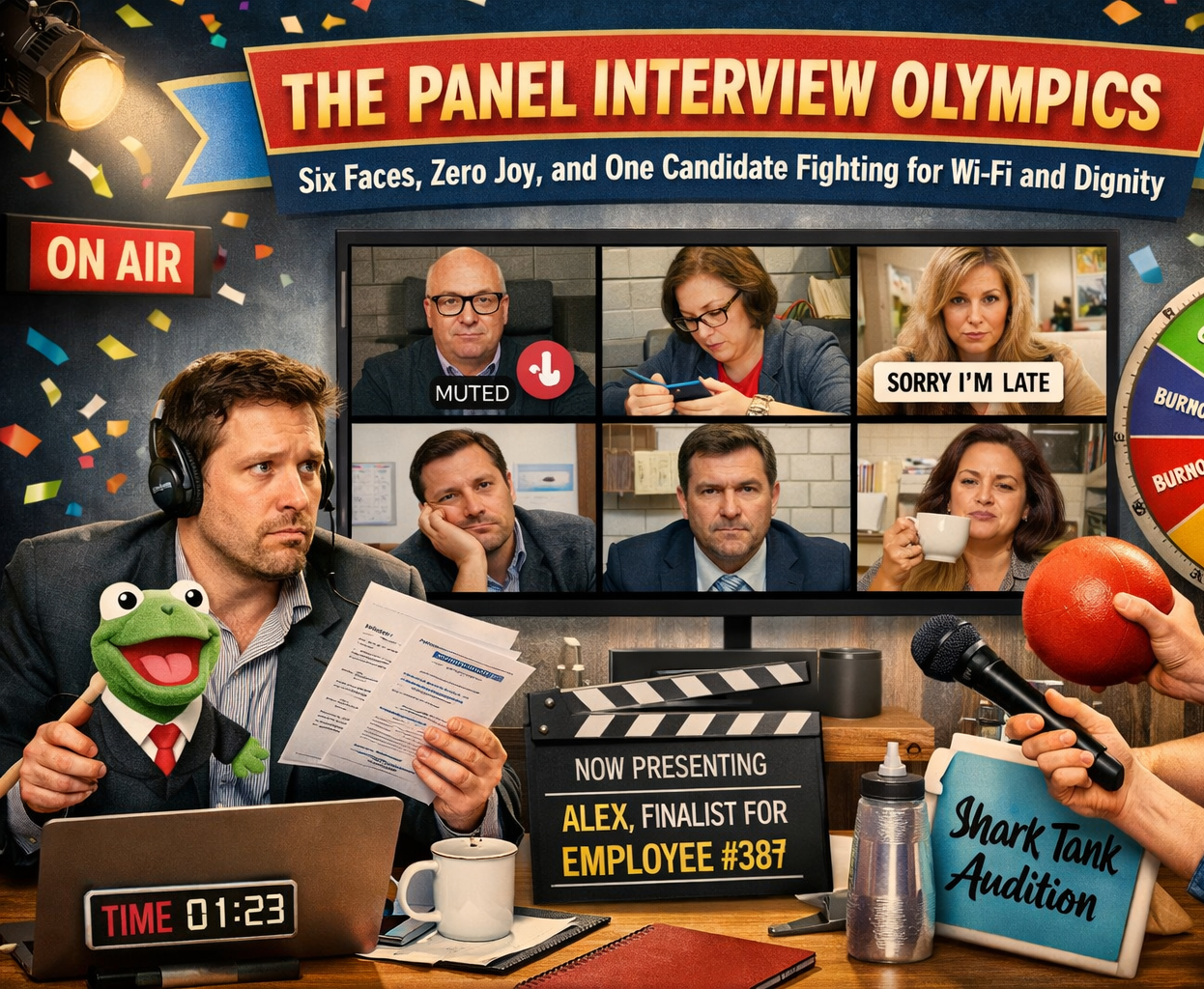
Six faces. Six squares. Six tiny worlds of chaos. One person is frozen mid-blink like a cursed museum exhibit. One person is on mute so long you start wondering if they’re there as a witness. Someone is clearly doing their taxes on a second screen, because their pupils are moving like they’re solving a crime. And someone joins late with the audacity of a person who has never once apologized in their life, just dropping in like, “Hey, sorry, I was on another call,” as if you weren’t already performing your entire personality and competence like it’s a live Broadway audition with no understudy.
And you try to smile. You try to be charming. You try to pretend this is normal. Because that’s the job: not just answering questions, but acting like the questions aren’t being asked by a committee of people who all secretly hate meetings and are now taking that resentment out on you.
Welcome to Hollywood Squares, Please Defend Your Existence
The first question in a panel interview is always the same, like a ritual meant to confirm that nothing in corporate life is ever allowed to evolve. It doesn’t matter if you submitted a resume, a cover letter, a portfolio, a LinkedIn profile, three references, and your childhood report cards. Someone will still clear their throat like they’re about to deliver a verdict and ask, “Can you walk us through your resume?”
Sure. Absolutely. Let me begin in 2012 when I still believed “career path” meant something other than “a series of survival choices made under fluorescent lighting.” Let me narrate my life story to six strangers who are simultaneously checking email, scrolling Slack, and mentally planning dinner. I’ll make it cinematic. I’ll add emotional depth. I’ll include the part where I realized adulthood is just Googling things and hoping nobody notices.
And the weirdest part is that you have to do it with confidence, like it’s not insane to summarize your entire professional identity in five minutes to a group that looks like they’re attending a webinar they forgot they registered for. You have to speak with authority, even while you can feel your soul trying to exit through the USB port.
Meanwhile, Mr. Mute is still on mute. Not even a courtesy nod. Not a blink. Not a single sign of sentient life. At some point you start thinking, maybe he’s not an interviewer at all. Maybe he’s a cautionary tale. Maybe HR put him there to remind you what happens if you stay too long.
Then there’s Tax Lady, who keeps looking down and typing, and you know you’re supposed to interpret this as “engaged,” but the energy is giving “I’m entering deductions and judging you in silence.” And Late Joiner is settling in with the calm of someone who has never experienced consequences, casually sipping something offscreen like they’re watching you audition for their amusement.
So you talk. You perform. You present your resume like it’s a sacred text. You attempt to sound strategic, adaptable, collaborative, results-driven, and also vaguely fun, because apparently you have to be competent and entertaining, like you’re applying to be a Project Manager and a cruise ship comedian at the same time.
And you realize panel interviews aren’t interviews. They’re group projects. And nobody is doing their part.
Ambiguity, Failure, and Other Crimes You Must Confess on Camera
Once the resume recitation ends, they transition into the questions they found on the internet, the ones that were born in the early 2000s and refuse to die because HR keeps feeding them after midnight.
“How do you handle ambiguity?”
Beautiful question, because if you answer honestly—by quietly panicking, making a spreadsheet, and reverse-engineering expectations from passive-aggressive calendar invites—you sound unstable. But if you answer professionally—by talking about frameworks, communication, alignment, stakeholder management—you sound like a robot being interviewed by other robots who hate joy.
So you do the corporate dance. You say you “embrace uncertainty” while your nervous system whispers, We are literally in a six-person Zoom tribunal right now, and three of them are barely conscious.
Then comes the ancient relic: “Where do you see yourself in five years?”
And the real answer is always something like: in a home that I own, with my nervous system no longer reacting to Outlook notifications like they’re bear attacks, in a job where I’m not required to emotionally audition for basic health insurance. But you can’t say that. So you say something about growth and contribution and leadership, like you’re pitching your future as a product they can invest in.
And then—because the universe loves pain—they hit you with, “Tell us about a time you failed.”
This is the moment where every candidate has to decide which version of failure is safe. Not “I failed by trusting a company that said we’re a family and then laid off half the team in a surprise Tuesday meeting,” because that’s too real. Not “I failed by staying somewhere that drained me,” because that sounds emotional. Not “I failed by believing in the process,” because that would be an indictment of the very circus currently happening.
So you pick a failure that’s been sanitized. A failure that’s cute. A failure that comes with a redemption arc and a learning outcome. You tell a story that’s basically a corporate children’s book: Once upon a time, I overcommitted, and then I learned to prioritize, the end.
But the truth is, the failure is happening in real time. The failure is being on Zoom with six people, fighting for a job that might already be filled internally, watching your joke about collaboration land with the grace of a dead battery. You tried to be human—cracked a little line about team collaboration being like group texting with deadlines—and the silence that followed was so absolute it felt like the call itself had stopped believing in you.
That’s the part nobody tells you about panel interviews: they don’t just test your skills. They test your ability to endure awkwardness so thick you could spread it on toast.
“We’ll Be in Touch” and Other Paranormal Phenomena
Then, as all panel interviews do, it reaches the ending that feels less like closure and more like a cliffhanger written by someone who hates the audience.
They smile. They nod. They thank you. Someone says, “Great answers,” even though they looked like they were reading a grocery list for half the call. And then, with the soft professionalism of a magician preparing the final trick, they say: “We’ll be in touch.”
And just like that—poof.
Six squares vanish.
Six faces disappear.
Six people return to their meetings, their emails, their lives.
And you sit there staring at your own reflection like you just survived a social experiment.
You replay everything. Did you talk too much? Too little? Were you too confident? Not confident enough? Did your joke offend someone? Was the mute guy actually the decision-maker and you failed his invisible test? Did Tax Lady hear anything you said or did she just complete a Schedule C while you explained your leadership style?
Then the days pass. Silence. The recruiting void opens up like a black hole with a calendar link. You check your inbox like it owes you money. You refresh LinkedIn like maybe the algorithm will deliver justice. You start negotiating with the universe: if they email by Friday, you’ll become a better person, you’ll drink more water, you’ll stop doomscrolling job boards at midnight like it’s a hobby.
But the message never comes. Or it comes three weeks later with the emotional warmth of an automated car warranty call: “We went with another candidate.”
And you realize the truth: panel interviews don’t make hiring better. They just distribute responsibility so nobody has to own a decision. Everyone gets to say, “We all agreed,” even though half the panel looked like they were being held hostage by their own calendars.
So yes, I support your proposal. Let’s spice it up. Add a live studio audience. Make the candidate and panel switch roles for ten minutes. Introduce a dodgeball round. Let someone narrate like it’s a nature documentary: “And here we see the candidate, calmly answering ‘tell us about yourself’ while internally screaming.”
Because if I have to go through another panel interview where I’m pitching myself like a Shark Tank product while someone silently eats trail mix offscreen, I’m showing up with props, a puppet, and a theme song.
Now presenting: Alex, finalist for the role of Employee #387, featuring a 401K and moderate PTO. Please enjoy the slideshow, the interpretive dance, and the emotional support water bottle.
Final Thoughts
Panel interviews aren’t inherently evil. In theory, they’re about collaboration, fairness, and multiple perspectives. In reality, they’ve become a corporate endurance sport where candidates are expected to be brilliant, charming, resilient, and unbothered while being cross-examined by a committee of people who didn’t want to be there in the first place.
And that’s the part we should stop normalizing: the idea that the process has to be miserable to be “thorough,” that awkwardness is a feature, that turning candidates into performers is somehow the same as evaluating talent. Hiring doesn’t have to feel like a Hunger Games audition with Wi-Fi issues. It can be efficient. It can be respectful. It can be human.
Until then, if you see me joining your next panel interview with a puppet, a fog machine, and a fully choreographed entrance theme, just know I’m not being dramatic.
I’m being prepared.