
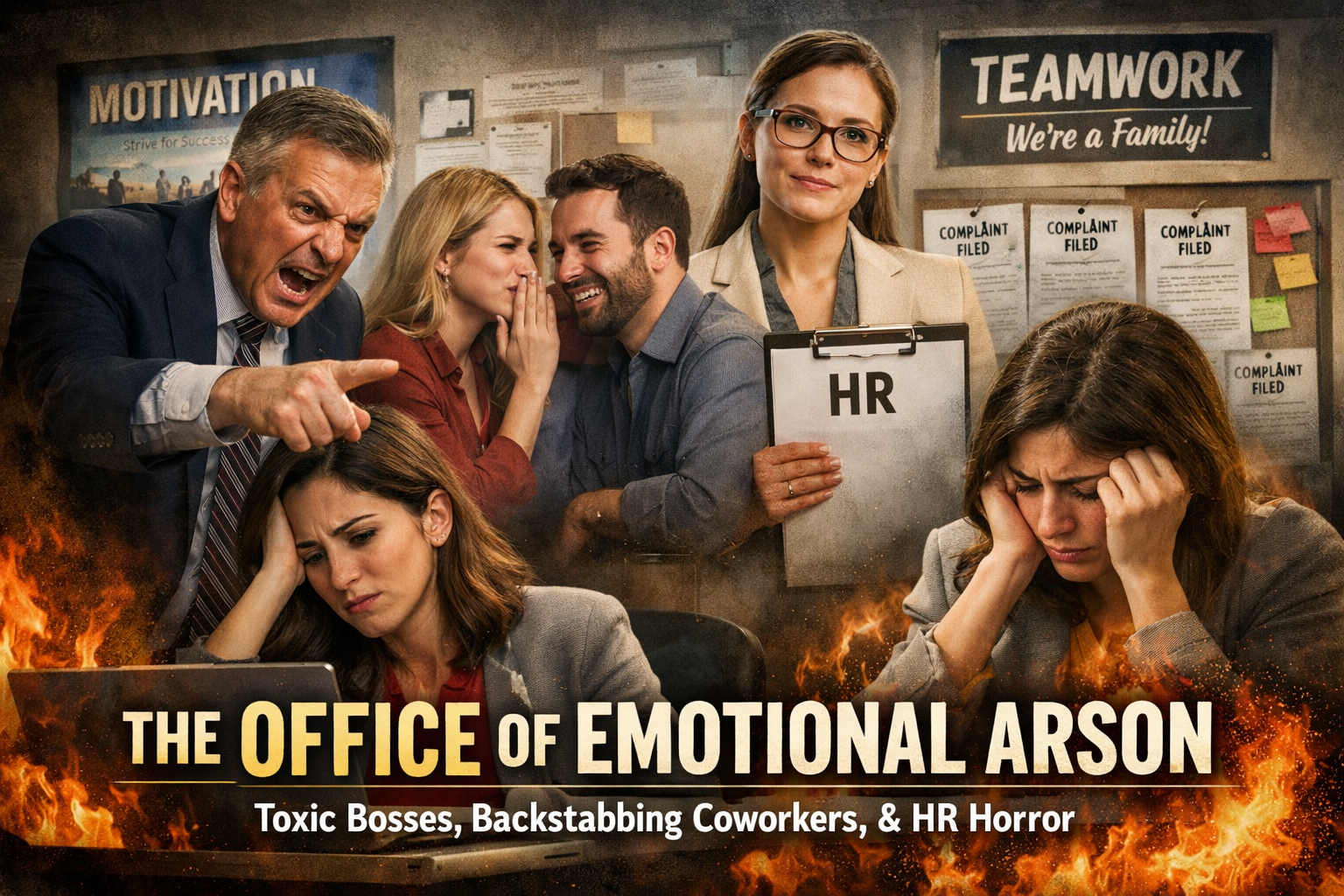
There are bad jobs, and then there are jobs so spiritually corrosive they do not merely pay you to work, they pay you to slowly become a quieter, more tired version of yourself while pretending that this is called professional growth.
You know the kind of workplace I mean.
The kind where the boss speaks in motivational slogans but manages like an insecure camp counselor with a grudge. The kind where one coworker has somehow turned passive aggression into a specialized trade, another treats gossip like a side hustle, and a third has made “per my last email” sound like a threat that should require legal review. The kind where HR smiles with all the warmth of a decorative candle, nods sympathetically, takes notes in a beige notebook, and then somehow concludes that the real issue is the tone you used while describing your experience of being psychologically mugged near the copier.
Toxic workplaces are fascinating because they are never advertised honestly. Nobody posts a job listing that says, “Seeking resilient professional to join rapidly growing department of emotionally underdeveloped adults. Must be comfortable navigating mixed messages, random blame, selective accountability, and a manager who confuses leadership with surveillance. Competitive salary. Free parking. Trauma available after 90 days.”
No. They use words like culture, collaboration, family, fast-paced, high-performance environment, and strong communication skills, which in many offices translates loosely to, “There will be no peace here, and somehow that will be your fault.”
At first, you do not realize what you walked into. That is part of the magic trick. In the beginning, everyone is polished. The boss is charming. HR is upbeat. Coworkers seem helpful. The office has coffee, mission statements, and at least one wall decal urging you to bring your whole self to work, which is deeply funny because the moment your whole self arrives with healthy boundaries and a functioning memory, they act like you smuggled in a live raccoon and released it in payroll.
So you try.
You show up early. You work hard. You stay professional. You learn the personalities, decode the politics, navigate the silences, and convince yourself that maybe the weirdness is temporary. Maybe your manager is just stressed. Maybe that coworker is just going through something. Maybe HR really is here to help. Maybe the confusing expectations will eventually become clear. Maybe the organization is in transition. Maybe the phrase “that’s just how she is” is not actually a warning label but a temporary explanation for why Deborah from operations speaks to people like a Victorian headmistress who lost custody of joy in the divorce.
And then, one day, the pattern reveals itself.
You realize this is not a temporary storm. This is the climate.
The boss is not intense. He is threatened by competence and addicted to control. The coworker is not blunt. She is a full-time manufacturer of friction with a side interest in character assassination. HR is not neutral. HR is a beautifully wrapped corporate air freshener hanging from the rearview mirror of a flaming car, smiling bravely while insisting there is no smell. The meetings are not inefficient. They are ritual reenactments of confusion designed to ensure nobody can ever be held accountable because nobody can prove what was actually decided.
And that is when the exhaustion changes shape.
It is no longer just about work. It becomes the strain of self-translation. The constant editing of your face, your voice, your emails, your reactions, your posture, your timing, your truth. It becomes the effort of surviving people who want your labor, your patience, your emotional regulation, and your silence, all while telling you this is what professionalism looks like.
It is amazing how many organizations want employees with initiative right up until that initiative notices a problem. How many leaders say they want honesty right up until honesty develops nouns and timestamps. How many coworkers preach teamwork while quietly auditioning for the role of saboteur in a low-budget office thriller. How many HR departments say “my door is always open” with the same energy a castle might lower its drawbridge for entertainment purposes only.
And yet, for all the absurdity, the hardest part of toxic work is not always the obvious cruelty. Sometimes it is the slow erosion. The small humiliations. The constant second-guessing. The feeling of being too smart to miss what is happening and too responsible to simply burn the place down in your heart and walk out before lunch. It is the grief of realizing that being good at your job will not save you from people who are bad at being people.
So this is for everyone who has sat through meetings with a fake smile and a clenched soul. For everyone who has drafted seven versions of one email because the wrong punctuation might trigger a departmental opera. For everyone who has been told to be a team player by people who treat the team like a buffet. For everyone who has gone to HR hoping for help and left with the distinct sensation of having accidentally reported a murder to the wallpaper.
Let us talk about toxic bosses, toxic coworkers, toxic HR, and the entire corporate carnival of professionally managed dysfunction, because some workplaces do not run on strategy, talent, or trust.
They run on fear, image, denial, and one emotionally unstable person in a leadership role who learned the word accountability only as a thing to demand from others.
Toxic Bosses, or How Insecurity Put on a Blazer and Started Scheduling Check-Ins
A toxic boss is rarely the movie villain people imagine. They are almost never storming through the office in a cape made of policy violations, laughing as morale collapses behind them. No, the modern toxic boss is usually much more sophisticated than that. They have learned how to wrap dysfunction in management vocabulary.
They do not micromanage, they stay close to the business.
They do not bully, they hold people to a high standard.
They do not play favorites, they invest in top talent.
They do not gaslight, they encourage resilience.
They do not create chaos, they move quickly.
This is how corporate madness survives. It rebrands.
A toxic boss is often just an insecure person with positional authority and access to calendars. A frightened ego with a title. A deeply unsettled adult who cannot regulate the terrifying possibility that someone below them might be smarter, calmer, more respected, or better liked. So they manage that fear the only way they know how: by controlling the environment until nobody remembers what normal feels like.
They change priorities without warning and then judge you for not predicting the update telepathically. They call you into meetings that could have been emails, then criticize you for losing time on execution. They ask for initiative, but only the kind that confirms their brilliance. They say “bring me solutions, not problems,” which sounds wise until you realize it really means, “Do not disturb me with reality unless you have already solved the mess I helped create.”
And let us honor one of their favorite hobbies: ambiguity.
A toxic boss thrives in vague expectations because vagueness is a beautiful weapon. If the goal is never fully clear, then failure can always be assigned later. If the instructions are slippery enough, then your confusion becomes evidence of your weakness instead of their incompetence. Toxic managers love to speak in inspirational fog. They want outcomes to be excellent, visibility to be constant, speed to be immediate, details to be flawless, innovation to be bold, and nobody to ask too many questions because questions feel suspiciously like accountability wearing sensible shoes.
These are the bosses who say things like, “I just need you to own this,” which sounds empowering until you discover ownership in this environment means responsibility without authority, labor without credit, and blame with next-business-day delivery. They hand you a project on fire, remove the extinguisher, call it leadership development, and then stare at you with disappointment when the ashes are not client-ready by Friday.
And then there is mood management, the unofficial second job of every employee under a toxic boss.
You learn the weather patterns. You can tell by the way they say good morning whether today is a normal day, a performative day, a paranoid day, or one of those beautiful disaster days where they have just left a call with their own boss and now need to leak unresolved humiliation onto the nearest available human. Everyone becomes a low-level emotional meteorologist. People stop asking, “What is the priority?” and start asking, “How is he today?” which is not a healthy sign in any institution outside of hostage negotiations and pirate ships.
The worst part is that toxic bosses often mistake fear for respect. They see silence and assume trust. They see caution and assume admiration. They see people editing themselves in real time and think, Ah yes, strong leadership presence. Meanwhile the team is not inspired. The team is simply trying to get through Tuesday without becoming the subject of a weirdly aggressive follow-up email with three people copied for sport.
And for employees who actually care, who want to do good work, who still possess that dangerous combination of competence and conscience, this kind of boss does something particularly cruel: it makes them doubt themselves.
Because if you are thoughtful, you will look inward before you look outward. You will ask whether you are being too sensitive, too difficult, too direct, too quiet, too slow, too ambitious, too human. You will reread your emails. Reconstruct your conversations. Wonder whether your memory is wrong. Maybe they did explain it. Maybe you misunderstood. Maybe the reason you feel dread every Sunday night is not because your boss is an unstable authority goblin with a Teams account, but because you need to work on your mindset.
That is how toxic leadership wins. Not because it is brilliant, but because it is exhausting.
Eventually, you realize the truth. Good leadership creates clarity. Good leadership develops people. Good leadership can correct, challenge, and even demand excellence without making everyone feel like they are participating in a monthly loyalty test sponsored by anxiety. A healthy boss does not need the room to shrink so they can feel big. They do not need confusion to preserve power. They do not need you insecure in order to stay in control.
Toxic bosses, on the other hand, treat management like emotional real estate. They must own every inch. Every idea must pass through them. Every success must reflect them. Every threat must be contained. Every independent thinker must either be domesticated, exhausted, or quietly framed as difficult.
And perhaps the most insulting part is how often these people attend leadership trainings. They love a seminar. Love a keynote. Love a laminated framework. Somewhere, at this very moment, a toxic manager is probably highlighting a workbook called Leading with Empathy while actively ruining two people’s blood pressure through Slack.
Because the problem was never a lack of vocabulary.
The problem was character.
Toxic Coworkers, Gossip Alchemists, Credit Thieves, and Other Office Wildlife
If toxic bosses are the kings and queens of workplace instability, toxic coworkers are the roaming street performers who keep the whole atmosphere humming with low-grade menace.
A bad coworker can turn even an average job into an anthropological experiment. You start each day intending to do your work, answer your emails, and maybe enjoy one peaceful sip of coffee before the meetings begin. Then Cheryl appears near your desk with that look in her eye. Not a kind look. Not an innocent look. The look of a woman who has fresh gossip, selective concern, and just enough free time to become an active threat to organizational progress.
Toxic coworkers come in many forms.
There is the martyr, who is somehow always the hardest-working person in the building despite leaving precisely on time and contributing mostly sighs.
There is the informant, who treats casual conversation like a wiretap operation and can turn “I’m a little overloaded this week” into “Alex has serious concerns about leadership and may be planning a coup.”
There is the spotlight thief, who contributes one mediocre sentence in a meeting and later speaks about the project as though they personally carried it down a mountain while the rest of the team stood below weeping with gratitude.
There is the chaos gremlin, who creates errors, confusion, and avoidable drama, then hovers nearby in the aftermath like a child asking why the toaster is on fire.
There is the professional victim, who leaves tiny emotional land mines all over the department and somehow emerges from every mess as the wounded party despite eyewitnesses, timestamps, and occasionally physics.
And then, of course, there is the passive-aggressive artisan. The Michelangelo of resentment. The person who can take a sentence as harmless as “Just checking in on the file” and respond with something so icy, polished, and formally polite that you feel like you have just been slapped with a silk glove in front of the entire procurement team.
Toxic coworkers are exhausting because they force you to spend energy on nonsense instead of work. Real work is difficult enough. It requires focus, judgment, creativity, discipline, and cooperation. But toxic colleagues introduce a second layer of labor no one includes in the job description: interpersonal hazard navigation.
You must now assess whether sharing information will result in collaboration or future betrayal. You must decide whether asking for help will produce support or become tomorrow’s gossip appetizer. You must determine whether giving credit will be returned in good faith or quietly harvested like wheat by someone who refers to your idea as “something we were already discussing.”
And yes, let us linger on the office gossip, that majestic creature who acts shocked whenever conflict erupts in the wake of information they personally distributed like a festival flyer.
Every office has at least one person who presents gossip as concern.
They never say, “I enjoy carrying rumors through the building like a bridesmaid with a blowtorch.”
No. They say, “I’m just worried about the team.”
They say, “I probably shouldn’t mention this, but…”
They say, “You didn’t hear it from me.”
Which is one of the great lies in workplace history, because of course we heard it from you. It arrived gift-wrapped in false intimacy and coffee breath, delivered directly from your mouth to our unwilling nervous system while we were just trying to warm up leftover pasta and survive another quarter.
What makes toxic coworkers so difficult is that they often operate just below the threshold of obvious misconduct. They specialize in plausible deniability. Nothing is ever direct enough to clearly report, just cumulative enough to quietly rot your faith in people. It is the look, the omission, the interruption, the subtle undermining, the strategic exclusion, the stolen idea, the fake compliment with a hidden blade in it.
“You’re so brave to speak up like that.”
“You always have such strong opinions.”
“I just think some people don’t realize how they come across.”
That last one is a classic. It sounds universal, reflective, almost philosophical. But in office dialect it usually means, “I am about to criticize you in a way that protects me from owning the criticism.”
And unlike bad bosses, toxic coworkers can be harder to name because they rarely hold formal power. But informal power is real. Social influence is real. A person who controls the emotional current of a team can do enormous damage without ever touching an org chart. They can isolate people, shape reputations, sabotage trust, and turn ordinary misunderstandings into season finales.
Then there is the special breed of coworker who competes with everyone while pretending not to. Every conversation is a scorecard. Every meeting is an audition. Every success of yours enters their bloodstream as a personal insult. They do not collaborate; they compare. They do not celebrate; they calculate. They smile when you win, but the smile lands a half-inch short of the eyes because somewhere deep inside, a tiny executive lizard is hissing, Why not me.
These people are particularly draining because they force intimacy with pettiness. You are just trying to do your job, and they are shadowboxing with your existence. You finish a project and they suddenly “just happen” to email leadership with an unrelated update about their own contributions. You get recognized and they become quiet in the unnatural way of a person urgently rearranging their internal narrative. You make one mistake and they react with the bright, alert energy of someone who just heard the ice cream truck of your downfall approaching from three blocks away.
Yet even here, in the land of office nonsense and emotionally unserious adults with badges, something painful lives under the comedy. Toxic coworkers can make people feel alone. They can make good employees withdraw, second-guess themselves, and lose the version of work that once felt meaningful. They can turn teams into little survival camps where nobody relaxes because every interaction carries risk.
And that loss matters.
Because work is not just labor. For many people it is structure, dignity, rhythm, contribution, identity. It is where you spend huge portions of your life. So when the people around you turn that space into a theater of suspicion, performance, and petty warfare, the damage is not small. It follows you home. It sits at your dinner table. It joins you on the couch. It climbs into bed with your thoughts and whispers one final Slack message into the dark.
A healthy coworker culture does not require perfection. People can be flawed, quirky, stressed, awkward, blunt, or occasionally annoying and still be decent. The line is crossed when people begin feeding themselves with each other’s peace. When dysfunction becomes entertainment. When undermining becomes social currency. When the team becomes less a group of professionals and more a streaming drama where everyone is one calendar invite away from a breakdown.
And still, somehow, the quarterly newsletter will call them a family.
Which is true, in a way.
Just not the kind that should share a kitchen knife set.
HR, Policy Poetry, and the Department of Smiling Containment
Now we arrive at HR, perhaps the most misunderstood institution in modern office life, partly because people keep hoping it is something it often is not.
Human Resources is presented to employees as a place of support, guidance, fairness, and process. The language is warm. The branding is careful. The faces are reassuring. They talk about people, culture, belonging, wellness, and values. They use phrases like safe space, open door, conflict resolution, and employee experience.
And in some organizations, with some people, that may be true.
But in far too many workplaces, HR functions less like a protector of humans and more like a risk management spa for the company’s liability exposure.
This is a painful realization for many employees, because going to HR usually happens after a long internal debate. Nobody strolls into HR for fun like they are stopping by a yogurt shop. People go because something has hurt. Something has built. Something has crossed a line. They are tired, upset, confused, cornered, or trying one last adult option before they either emotionally flatline or begin communicating exclusively through legally interesting email paragraphs.
So they go.
They explain what happened. They try to be balanced. They try not to sound emotional, because they know emotion is often treated as unreliability in office culture, which is incredible when you think about it, because we routinely trust wildly emotional executives as long as they package their instability inside confidence and a quarter-zip.
The employee shares dates, incidents, patterns, context. They recount the manager’s behavior, the coworker’s conduct, the retaliation, the exclusion, the comments, the pressure, the selective discipline, the weirdness that no one wants to name directly but everyone has been quietly surviving like villagers living near a cursed forest.
And HR listens.
They nod.
They thank you for bringing this forward.
They say they take this very seriously.
They say retaliation will not be tolerated.
They say they will look into it.
And for one shimmering, fragile moment, you think maybe civilization still exists.
Then the strange things begin.
Suddenly your manager is colder.
Coworkers become distant.
You are left out of conversations you used to be in.
The person you reported seems oddly comfortable for someone under review, almost as if the process has been translated for them in a tone more favorable than the one used for you. Meetings change. Dynamics shift. Language gets careful. Nobody says anything directly, but the atmosphere now has the spiritual texture of a church basement after someone mentioned inheritance law at Thanksgiving.
HR has a difficult role, yes. That much is fair. They balance policy, law, business realities, personalities, and organizational interests. But the employee mistake is assuming that because HR discusses people, HR therefore exists primarily for people. In practice, HR exists for the organization. Sometimes helping you aligns with helping the organization. Sometimes protecting the company requires addressing genuinely bad behavior. But when those interests diverge, employees often discover with breathtaking speed that the department called Human Resources is named with the same logic that would call a paper shredder an archive.
That does not mean every HR person is malicious. Many are thoughtful. Many are trying. Many operate within systems they did not create. But institutionally, HR often rewards containment over truth, diplomacy over justice, and process over healing. It is less interested in whether something felt violating than whether the documentation creates enough risk to justify inconvenience.
Which is why HR loves a difficult phrase like “communication issue.”
A manager humiliates someone repeatedly in meetings. Communication issue.
A coworker undermines another employee for six months and spreads rumors across the floor. Interpersonal conflict.
An employee raises concerns and is frozen out afterward. Team dynamics.
It is extraordinary how often serious patterns are laundered into neutral language, as if the right euphemism can place a cardigan over the shoulders of dysfunction and make it suitable for circulation.
And let us speak briefly about the great emotional bait-and-switch of corporate values.
Every company has values. Integrity. Respect. Inclusion. Transparency. Accountability. Courage. Collaboration. Trust. These words appear on walls, websites, onboarding decks, branded notebooks, and occasionally giant murals near the elevator as if painted by monks in the Temple of Aspirational Nonsense. But values in a toxic workplace are often decorative. They are not standards. They are wallpaper with ambition.
Because a real value costs something.
Integrity costs convenience.
Accountability costs ego.
Respect costs power.
Truth costs image.
And many organizations would rather laminate the word than pay the invoice.
This is where employees begin to grieve more than just the behavior. They grieve the illusion. The belief that if you use the right channels, speak professionally, document carefully, and follow the process, the system will meet you halfway. Sometimes it does. Often it studies your complaint the way a casino studies a counting player, not because you are wrong, but because you have become administratively inconvenient.
Still, even here, humor survives. It has to. Without humor, corporate life would simply be a long legal deposition interrupted by birthday sheet cake. There is something darkly funny about sitting in an HR meeting where a woman with a calm voice explains that everyone is committed to a respectful workplace while a known tyrant remains fully employed three doors down, rearranging another employee’s confidence for sport and calling it performance management.
There is something cinematic about hearing “we encourage people to speak up” from an organization that reacts to honesty the way old castles reacted to astronomy.
There is something almost poetic about the realization that the people most often asked to be professional are usually the ones with the least power and the most evidence.
And yet, even after all this, employees keep showing up. Keep trying. Keep documenting. Keep surviving. Keep hoping that maybe the next role, the next manager, the next company, the next team will be different. Not because they are naive, but because human beings are built with a stubborn kind of hope. We want to contribute. We want to belong. We want to work in places where our effort is not fed into a machine that runs on fear, favoritism, and euphemisms.
That hope deserves better than a policy PDF and a sympathetic nod.
It deserves people with character.
Final Thoughts: You Were Not Too Sensitive, the Place Was on Fire
One of the cruelest things toxic workplaces do is convince decent people that their pain is a personality flaw.
You start out noticing problems, and somewhere along the way you begin questioning your own perception. Maybe I am overreacting. Maybe I need thicker skin. Maybe I should be more strategic. Maybe this is just corporate life. Maybe every job is like this. Maybe the reason I feel anxious, drained, numb, irritable, or quietly heartbroken is not because the environment is corrosive, but because I have failed to evolve into the kind of emotionally bulletproof lizard required to survive the regional sales meeting.
But no.
There is a difference between ordinary job stress and spiritual abrasion.
There is a difference between a demanding workplace and a dehumanizing one.
There is a difference between conflict and corrosion.
If you had to shrink yourself to survive, if you had to rehearse basic conversations in your head, if you had to document reality like a war correspondent just to protect your sanity, if you walked into work braced for impact, if your body started reacting before your mind could even form the sentence, then something real was happening.
You were not weak for feeling it.
You were alive enough to notice.
That matters, because toxic systems often reward numbness and punish clarity. They call silence maturity. They call endurance loyalty. They call self-erasure professionalism. They hand out praise to the people most willing to adapt to dysfunction and then quietly pathologize the ones who still possess that embarrassing old-fashioned trait known as self-respect.
But surviving toxic work teaches people things, even if they would have preferred gentler teachers.
It teaches you to recognize manipulation in polished language.
It teaches you that not every smiling person is safe.
It teaches you that titles do not produce wisdom, only hierarchy.
It teaches you that some coworkers are friends, some are spectators, and some are enthusiastic volunteers in the demolition of your peace.
It teaches you that HR can sometimes help, but policy without courage is just organized furniture.
It teaches you the price of staying too long where your humanity is treated as a workflow issue.
And sometimes, when you finally leave, it teaches you the strange and beautiful shock of breathing normally again.
That is one of the most emotional parts no one talks about enough. The aftermath. The way peace feels suspicious at first. The way a healthy manager can seem fictional. The way direct communication feels almost luxurious after years of decoding office hieroglyphics carved into Slack messages and facial expressions. The way your nervous system keeps waiting for a trap that does not come. The way you realize just how much effort it took to survive a place that told you survival was collaboration.
So for anyone who has lived through it, here is the truth in plain language:
Not every boss deserves access to your confidence.
Not every coworker deserves access to your trust.
Not every HR department deserves your faith.
And not every workplace deserves your loyalty simply because it knows how to process payroll and hang motivational signage in the break room.
You are allowed to call dysfunction by its name.
You are allowed to be tired of translating abuse into polite corporate dialect.
You are allowed to stop romanticizing resilience when what you really needed was respect.
You are allowed to want more than a job that slowly turns your personality into office-safe rubble.
Because work can be hard without being humiliating. Leadership can be demanding without being demeaning. Teams can be imperfect without being predatory. Policies can exist without becoming a decorative hostage note from the kingdom of plausible deniability.
And if you have known toxic bosses, impossible coworkers, hollow HR speeches, and the full office carnival of professionally managed nonsense, then you already know something important about yourself.
You lasted in a place that kept asking you to betray your instincts.
You noticed what others normalized.
You carried yourself through rooms that mistook intimidation for leadership and gossip for culture.
You survived adults who used email like a weapon, meetings like a fog machine, and feedback like a hobby.
That is not nothing.
That is strength, even if it arrived wearing exhaustion.
And perhaps the funniest, saddest, most liberating truth of all is this: the people who made those workplaces unbearable will probably continue calling themselves leaders, team builders, culture champions, and strategic partners long after the wreckage of their personalities has been absorbed into another department’s morale survey.
Let them.
You do not need their version of reality to know what happened.
You do not need their language to validate your bruises.
And you do not need to keep standing in a burning building just because someone from HR is nearby with a clipboard calling it a communication issue.