
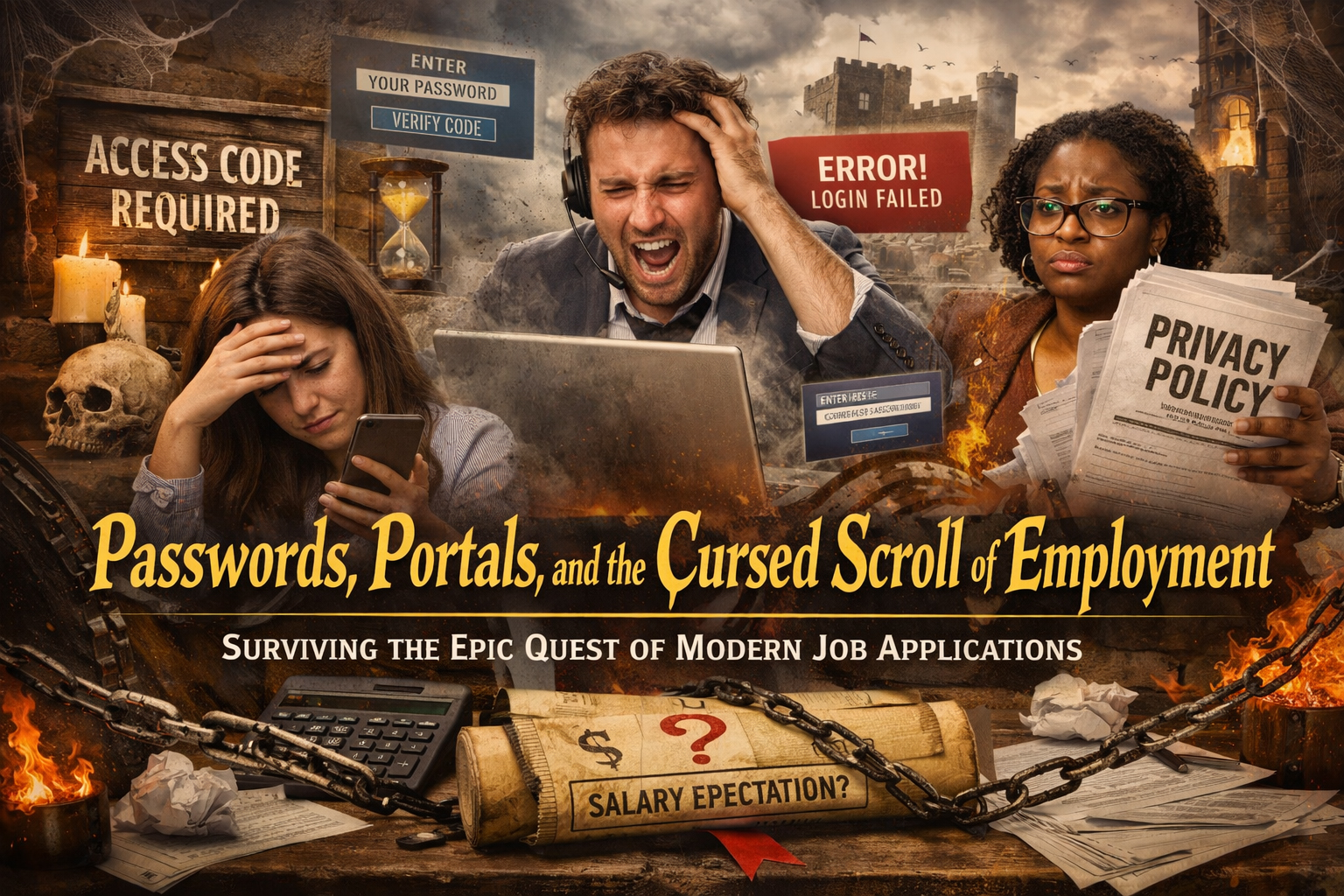
Why Applying for a Job Now Feels Less Like Professional Advancement and More Like Surviving a Bureaucratic Escape Room Designed by a Committee of Sleep-Deprived Goblins
There was a time, allegedly, when applying for a job meant you saw an opening, sent a resume, maybe wrote a cover letter nobody read with their full heart, and then waited to hear back from another human being who at least had the decency to reject you in one language, one format, and one timeline. That era is gone. It has been buried beneath login screens, authentication rituals, privacy disclosures, duplicated data entry, email verification loops, and digital hiring systems that appear to have been engineered by people who believe hope is a vulnerability and passwords are a personality test.
The modern job application is not a process. It is a pilgrimage. It is not a professional exchange. It is a sequence of increasingly personal insults delivered by a portal with the emotional warmth of a parking citation. Somewhere along the way, the people designing these systems stopped asking, “How can we make it easier for qualified candidates to express interest in joining our organization?” and started asking, “How can we make this feel like someone is trying to unlock a family crypt during a thunderstorm while an underfunded chatbot watches from a balcony?”
And that is how otherwise intelligent, capable, taxpaying adults now find themselves seated at dining room tables at 10:47 p.m., squinting at their inbox like amateur archaeologists, looking for a second access code that may or may not have been sent, may or may not be valid, and may or may not have already expired because the system that generated it believes urgency is the same thing as efficiency. We have turned employment into an obstacle course where the first qualification is not experience, judgment, or leadership, but the ability to survive an administrative maze that feels like it was built by a locksmith going through a divorce.
The language around all of this remains my favorite part, because the cruelty is always wrapped in such polished nonsense. “Quick apply.” “Seamless onboarding.” “Candidate experience.” “We value your time.” There is something almost poetic about being told a process is simple moments before you are redirected through three tabs, two identity checks, a legal novella, an account creation page that rejects your password for insufficient hieroglyphic diversity, and a portal that insists your resume be uploaded before demanding you manually type every single thing already listed on that same resume into twenty-seven separate fields like a medieval scribe being punished for literacy.
That is the joke at the center of modern hiring. Companies say they want top talent, then construct an entrance sequence that feels like trying to gain admittance to a secret society whose main qualification is emotional endurance. A candidate can have fifteen years of experience, excellent references, a strong track record, and actual measurable accomplishments, but before any of that matters, they must first prove they can locate a one-time code hidden in a junk folder between a Bed Bath bankruptcy email and a coupon for patio furniture they never wanted. We no longer recruit adults. We summon them through torment.
And still people do it, because rent continues to require money, groceries continue to behave like luxury imports, and a suspicious number of employers continue to act as though being considered for a paycheck is itself a spiritual honor. So people sit down, open laptops, stretch their wrists, whisper a small prayer over their browser history, and enter the cathedral of modern employment, where the incense smells like stress, the hymns are sung by autofill failures, and the first sacrament is resetting a password you did not know you had.
This is the article for those people. For the tired, the qualified, the over-credentialed, the spiritually winded. For everyone who has ever clicked “Apply Now” and accidentally begun a side quest. For everyone who has ever stared into Taleo and felt it staring back. For everyone who has ever thought, with complete sincerity, that successfully submitting an application should count as a leadership competency, a verified skill, and possibly an act of minor sainthood.
Quick Apply, or How the Lie Begins
Every tragedy needs an opening scene, and in modern job hunting that scene is almost always a deceptively cheerful button that says “Quick Apply.” It sits there on the screen with the confidence of a used car salesman and the moral structure of a casino app, promising speed, ease, and momentum. It says, in effect, “Come closer, weary traveler, this will only take a moment.” And what it means is, “We are about to hand you over to a secondary system built in 2006 by people who hated joy, and from there your evening will unravel like a cursed scarf.”
The phrase “Quick Apply” is one of the great surviving works of fiction in the employment world. It belongs in libraries. It belongs in museums. It belongs displayed in a glass case beside other famous lies such as “This meeting will be brief,” “We’re like family here,” and “The recruiter will definitely get back to you by Friday.” Nothing about quick apply is quick. It is merely the elegant foyer to a larger house of suffering. It is the host at the door of the restaurant telling you your table is almost ready while the kitchen is actively on fire.
You click because you are hopeful, or practical, or both. You have seen the title, maybe the salary range, maybe the blessed phrase “remote,” which now lands on the nervous system like a rescue helicopter. You think, perhaps foolishly but understandably, that you are making a smart use of your time. You have a polished resume. You have experience. You have endured enough workplace absurdity to qualify as both employee and war correspondent. Surely this part, the very first part, can proceed like a civilized exchange between adults.
And then you are redirected.
Not to the company site in a clean, modern, dignified fashion. No. You are launched into one of those legacy systems that feel less like software and more like a digital ruin. The page loads with the visual energy of a tax form discovered in a basement flood. The fonts are hostile. The margins are suspicious. The branding is either absent or somehow more threatening than if it were absent. Immediately you are asked for an access code, which is already a bad sign because nobody asking you to simply express professional interest should need to sound like a vault manager.
Then comes the password reset, because naturally you must already have an account, even though you have no memory of ever creating one and in fact suspect the system has simply assigned you an identity based on your suffering. You request the reset email. It does not arrive. You check your inbox. Nothing. You check spam. Nothing. You refresh with the desperate determination of someone awaiting medical results. Finally it appears, except now the link has expired because apparently the system assumes applicants sit motionless in front of their devices like gargoyles waiting for administrative permission to proceed.
You reset the password. You log in. The system rejects it. You try again. It says your account is locked. You unlock it via another email. This one requires a code. Not the original code, which by now has entered folklore. A new code. A second, more advanced code, as though the first one was merely the opening puzzle and now you have reached the chamber where employment is guarded by enchanted bureaucracy.
By this point, something changes inside a person. This is no longer about the job. This is about honor. This is about finishing what was started. This is about refusing to let a portal with the visual design of a haunted county records office defeat you in your own home. The application has become personal. You are no longer an applicant. You are a contestant on a game show called Who Wants to Access Their Own Future, and the grand prize is being allowed to manually re-enter your work history one textbox at a time while your coffee goes cold.
That is the true genius of these systems. They shift the emotional center of the experience. What began as interest in a role becomes a survival narrative. You start out thinking about team culture, compensation, and whether the work aligns with your career goals. Twenty minutes later you are whispering things like, “I know what you’re doing,” to a browser tab. Your standards have narrowed. You no longer want clarity, fairness, or mutual respect. You want the page to stop reloading. You want the submit button to become corporeal. You want to emerge from the experience with your dignity loosely attached and your laptop not thrown through a window.
And when you finally get in, there is always a privacy statement waiting like a smug priest at the entrance, prepared to explain at enormous length how your data will be handled, categorized, retained, transferred, analyzed, and almost certainly used to train some internal process no one will ever describe plainly. These documents are never short. They are never humane. They are always written as if the company is preparing to adopt your identity into a legal trust. There are tables. There are sections. There are clauses so long they should be ventilated.
Nothing says “we’re excited to meet qualified candidates” quite like handing a stressed stranger twelve paragraphs of liability theater before they can even finish typing their address. There is a certain majestic lack of self-awareness in asking exhausted job seekers to process a legal spreadsheet at the exact moment they are just trying to figure out whether they need to include the month they left a job in 2013. It is all so wildly disproportionate. You came here to apply for a remote operations role, and somehow you are now reading a digital treaty that makes buying a house feel informal.
Quick apply, in the end, is not an action. It is bait. It is the polite smile on the carnival worker before he straps you into a ride called Administrative Vertigo. The moment you click it, you are no longer in the labor market. You are in the maze.
Taleo and the Museum of Digital Misery
There are old buildings in Europe with less historical damage than some of these hiring platforms. Taleo in particular does not feel like software so much as a preserved site of workplace trauma. It has the atmosphere of an exhibit you would visit on a school field trip if the curriculum included emotional endurance and low-grade resentment. You do not use Taleo. You enter it. You survive it. You leave with stories.
Everything about it carries the aura of a system that once seemed advanced to a conference room full of executives in 2009 and has been punishing humanity ever since. It is one of those portals that manages to feel both overbuilt and underdeveloped at the same time, like a castle whose architect hated both guests and doors. It demands structure without providing guidance. It requests information while actively resisting your attempts to give it. It has the unsettling energy of a machine that does not want to help you accomplish a task so much as observe what happens to your blood pressure when your session times out for no clear reason.
And that is what makes the experience so darkly funny. The application itself is often not even complicated. The job may be normal. The qualifications may be reasonable. The hiring manager may be perfectly decent. Somewhere beyond the moat, beyond the locked gate, beyond the flaming banner that says Account Authentication Failed, there may actually be a nice team doing useful work and holding mostly manageable meetings. But the route to them is guarded by an interface that behaves like a wizard cursed by budget cuts.
You upload your resume. It parses it badly. Naturally. It always does. A sentence you wrote clearly becomes a professional mystery. Your title is split in half. Your dates are wrong. Your achievements are turned into fragments that make you sound either unemployed or involved in maritime law. Then the system, having mangled your document with all the confidence of a man assembling furniture blindfolded, asks you to correct everything manually. This is the administrative equivalent of someone dropping your groceries in the parking lot and then handing you a clipboard.
And here is where the insult becomes almost artistic. The portal already has the information. You have provided it. It is visible. It exists in digital form, right there, on the page. Yet the system insists that trust is impossible, and that you must now type it all again, carefully, field by field, as if reproducing sacred text before an indifferent tribunal. Employer name. Start date. End date. Responsibilities. Education. Certifications. Voluntary disclosures. Source of application. Resume upload again, perhaps. Maybe a profile creation step for flavor. At no point does anyone step in and say what every sane person is thinking, which is, “If your system cannot read the document, perhaps your system is the one who should feel embarrassed.”
This is where the mood shifts from irritation to philosophy. Because once you have typed the same information in three formats for a company that has not yet spoken to you, the natural question arises: what exactly are we doing here? We are told hiring is about finding the best fit, attracting talent, creating opportunity, and building teams. Yet the actual first step feels like a stress experiment conducted by a compliance committee trapped in 2008. If the company wants to assess your patience, they should say that openly. List it in the qualifications. “Must have seven years of experience, strong communication skills, and the ability to remain composed while our portal behaves like a possum trapped in a fax machine.”
And still, people press on. Because adults are resilient in grotesque ways. We have learned to normalize experiences that should trigger intervention. We have accepted that applying for a job now means budgeting time not just for professional materials, but for technical failure, duplicate effort, and intermittent ego collapse. We say things like, “The application was actually pretty easy once I got in,” the way people who survive storms talk about finally reaching the basement. That sentence alone should have ended several industries.
The saddest and funniest part is how much talent is lost right here, at the digital gate. Not because people are unqualified, but because they are human. They have children to feed, dishes in the sink, messages to return, backs that hurt, dogs that need walking, lives that do not allow unlimited hours for decorative inconvenience. A person can be brilliant, experienced, ethical, and excellent at the actual job, yet still abandon an application because the portal asked for a second verification code and then accused them of using the wrong browser like a disappointed uncle.
Companies almost never calculate the cost of this attrition honestly. They will say they struggle to find candidates. They will host strategy meetings about pipeline quality. They will commission think pieces on labor shortages and employer branding while their application process continues to resemble a cursed side quest in a game nobody wanted to play. Somewhere, right now, an organization is lamenting that top candidates are hard to attract while their website is asking those same candidates to create a username containing one uppercase letter, one lowercase letter, one number, one symbol, one ancient rune, and the emotional memory of their first professional disappointment.
Taleo is not merely a system. It is a worldview. It reflects a managerial philosophy that values process over people, control over clarity, and documentation over dignity. It assumes that what applicants most need at the start of a relationship is friction. It says, before you have even spoken to anyone, “Prove yourself to the machine.” And the machine, in return, promises only this: should you endure enough nonsense to complete the ceremony, it may allow you the privilege of being ignored in three to ten business weeks.
That is not a hiring process. That is a trial by portal.
The Salary Box, the Breaking Point, and the Rise of the Exhausted Professional
After the access codes, after the password resets, after the privacy statement written like a hostile peace treaty, after the resume upload and manual re-entry and inexplicable dropdown menus that refuse to include your actual field, there comes a moment of startling emotional clarity. A quiet, sacred moment. The salary question appears.
And suddenly the whole performance drops away.
Because there is something about surviving a ridiculous application portal that burns off the last remaining layer of fake humility. By the time a candidate reaches the compensation section, they are no longer in the mood to play the old game where adults pretend money is vulgar and every opportunity should be received with trembling gratitude. No. After forty minutes in the labyrinth, after proving not only competence but digital endurance, forensic inbox skills, and the emotional control required not to scream at a login page, a person begins to answer as God intended: directly.
This is one of the few developments in modern work culture that I deeply respect. The rise of the exhausted professional. The person who has seen enough, clicked enough, been ghosted enough, uploaded enough resumes into enough cursed systems, that they now speak with the steady calm of someone who knows exactly how much nonsense they can absorb before billing for it. There is a special dignity in entering a salary expectation cleanly, somewhere in the middle of the posted range, without apology, without performance, without the old little tap dance of trying not to seem too interested in paying your bills.
At a certain age, the fantasy collapses. You stop auditioning for the role of grateful peasant. You stop pretending compensation is some delicate social secret that must be approached like a skittish deer in the woods. You have groceries. You have responsibilities. You may have lower back pain, elevated standards, a suspicious relationship with ibuprofen, and enough life experience to recognize when a company is hoping enthusiasm will subsidize labor. So you type the number like a grown adult and keep moving.
There is real comedy in that contrast. The company may have just forced you through a digital reenactment of The Da Vinci Code, complete with hidden messages, authentication puzzles, and legal scrolls, yet the second you state a reasonable salary within their own published range, someone somewhere will clutch pearls as though you have stormed the gates demanding tribute. No, beloved. The tribute was the application. The tribute was my evening. The tribute was me creating a fourth password variation because your system would not accept the third one despite the third one already satisfying every known requirement of civilized society.
The salary field exposes the emotional imbalance at the heart of hiring. Employers want confidence, but only the decorative kind. They want initiative, but preferably not financial clarity. They want candidates who know their worth, unless that knowledge appears in numerical form. They want people who can advocate, lead, and negotiate, but in a gentle, flattering way that still leaves room for the company to feel like the hero. Meanwhile the applicant has just endured a technological mud run and emerged with their hair singed and their patience medically altered. That person is not about to type, “Open to anything.” That person has seen the underworld and has receipts.
And honestly, the bluntness feels healthy. There is liberation in no longer pretending that the job search is some innocent mutual exchange of dreams and aspirations. It is work. It is compensation. It is labor meeting budget in a heavily lit room while everybody tries to behave. Once that truth is accepted, some of the theater loses power. You no longer feel compelled to undersell yourself in order to appear eager. You have been through too much. A portal already called your session invalid twice and made you verify you were human like a suspicious nightclub bouncer. You are not about to demean your own market value for the emotional comfort of strangers.
This is why I think the people who survive these applications deserve more credit than they get. By the time they click submit, they have demonstrated far more than interest in a role. They have shown patience under stress. They have shown troubleshooting ability. They have shown the kind of resilience corporations put on leadership slides next to mountain imagery. They have shown they can continue working through confusion, ambiguity, system failure, and unnecessary resistance without setting fire to office equipment. If a company truly wanted evidence of composure, they would not need four rounds of interviews. They would simply ask, “Did you complete our application on the first try?” If yes, promote immediately. That person can handle anything short of a building flood.
The phrase “submitted successfully” should come with benefits. It should trigger a small parade. It should unlock a certification badge that can be added to LinkedIn. “Demonstrated competencies include patience, persistence, systems navigation, conflict de-escalation, and advanced profanity containment.” In a rational society, finishing an online application without losing faith in mankind would count toward continuing education credits.
Instead, we act like it is normal. We act like this level of friction is administrative weather. We accept it as part of being professional, as though adulthood naturally includes spending an hour proving to a remote employer that you exist and can remember which special character you used in the password you created six minutes ago. It is one of the most extraordinary examples of collective surrender in modern working life. Everyone knows it is absurd. Everyone jokes about it. Everyone hates it. And yet the portals continue, drifting through the labor market like ancient curses nobody has found the budget to remove.
Still, there is power in naming the absurdity. There is power in refusing to pretend that disrespect becomes acceptable when digitized. There is power in being the kind of applicant who reaches the salary box after all of that nonsense and answers not with fear, but with clean, adult certainty. Not because you are arrogant. Because you are tired. Because your time matters. Because if the opening ritual already feels like a hostage negotiation with a spam folder, the least you can do is tell the truth about what it would cost to continue.
Final Thoughts: Submitted Successfully, Spiritually Altered
The modern job application has become one of the purest expressions of contemporary corporate contradiction. Organizations say they want authenticity, then require performance. They say they want innovation, then trap people in software preserved from the Bush administration. They say they want high-quality candidates, then build entrances that feel like punishing side quests in a kingdom ruled by compliance goblins. And somehow, through all of it, the burden of grace remains with the applicant, who is expected to stay polished, enthusiastic, flexible, technically fluent, emotionally stable, salary-aware but not too salary-aware, and grateful for the privilege of navigating a portal that behaves like it has personal issues.
That is what makes this whole thing so funny and so bleak at the same time. The process often dehumanizes people before the first conversation even begins, then acts surprised when candidates show up tired, guarded, or highly allergic to nonsense. Of course they do. They have already had a relationship with your system, and it was not a healthy one. By the time an interview invitation arrives, they are not just evaluating the role. They are recovering from the prequel.
And maybe that is the clearest sign that something has gone off the rails. When applying for a job feels emotionally adjacent to disputing a bank charge, something is wrong. When the first demonstration of professional competence is locating a verification code in a spam folder, something is wrong. When legal disclosures arrive with enough formatting to look like a trade agreement and the actual human contact remains vague, distant, or imaginary, something is wrong. We have mistaken friction for seriousness. We have confused inconvenience with rigor. We have treated a candidate’s time as infinitely elastic while speaking endlessly about respect, values, and culture.
The truth is that every broken application process says something long before a recruiter ever does. It tells candidates what kind of organization this might be. It tells them whether clarity matters. Whether the internal systems were built around people or around liability. Whether someone at the company has ever sat down, tried to complete their own application from scratch, and emerged from the experience humbled enough to demand reform. Because if leadership had to go through the same maze under the same conditions, I suspect a shocking number of portals would be dragged into the street by noon and replaced by a form that simply says, “Tell us who you are, what you’ve done, and why you’re interested.”
Imagine that. A sane process. A process where the first interaction does not feel like defending your identity before a suspicious machine. A process where technology serves the relationship instead of sabotaging it. A process where respect appears not in branding language, but in design. Where “quick apply” means quick. Where resume upload means resume upload. Where a person applying for a job is treated like a future colleague instead of a mildly inconvenient data package in need of classification.
Until then, we are left with the current arrangement: millions of qualified adults moving through digital gauntlets with the stoic expression of people who have accepted that absurdity is now part of workforce participation. They click, reset, verify, re-enter, scroll, accept, continue, and submit. They survive the cursed scroll. They cross the drawbridge. They answer the salary question like grown people with rent and spinal opinions. They close the laptop and sit in silence for a moment, not because the task was difficult in any meaningful intellectual sense, but because being administratively disrespected for an hour has a way of making the soul need a beverage.
So yes, at this point, “submitted application successfully” should count as something more than a confirmation message. It should count as evidence. Evidence of patience. Evidence of resilience. Evidence of a person’s ability to function under arbitrary pressure while maintaining enough self-control not to mail a strongly worded letter to a software vendor. It should count as a certification. A character reference. A spiritual rite. A small but real proof that the applicant can endure modern work exactly because modern work has already begun trying to break them before day one.
And maybe that is the final joke. The companies think they are screening for talent. Meanwhile the candidates are being forged into legends.
Not polished. Not naive. Not infinitely patient.
Just qualified, exhausted, and one access code away from folklore.






https://shorturl.fm/seYDP