
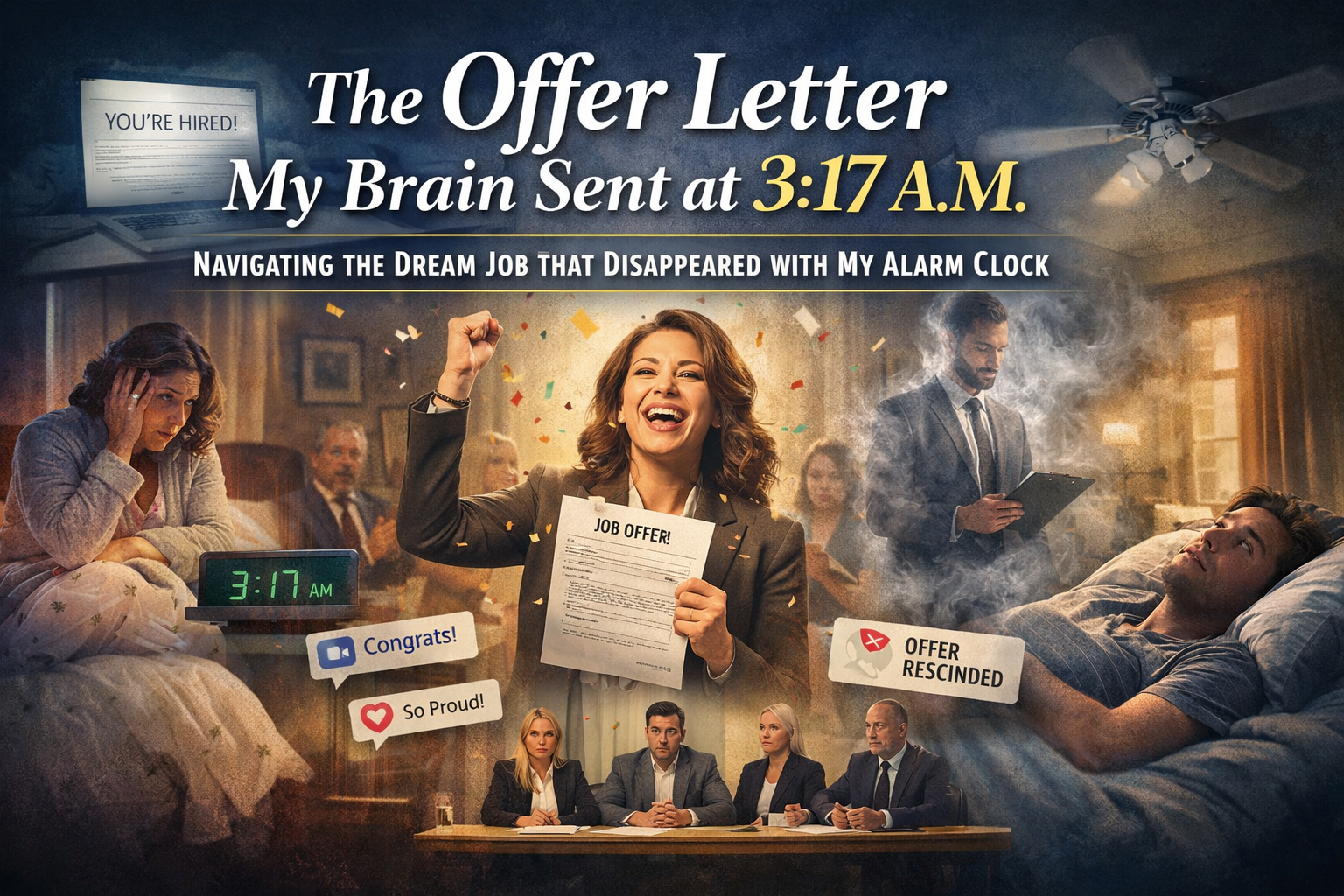
There are few betrayals in modern life more elegant, more emotionally unnecessary, and more on brand for this era than dreaming that you finally got the job only to wake up and discover that your subconscious has become just another member of Talent Acquisition. Not a trustworthy member, either. Not one of the rare and mythical recruiters who calls when they say they will, gives honest feedback, and understands that the person on the other end of the process is a human being and not just a résumé wearing business casual trauma. No, this was the other kind. The kind that rolls in with enthusiasm, paints a picture of a better future, uses phrases like great fit and exciting next steps, lets your nervous system unpack its bags, and then vanishes into thin air just as your hope starts stretching its legs.
Because this was not just a dream. This was a fully staffed corporate performance staged in the lawless theater of sleep. My brain did not casually suggest that maybe life might improve. It produced a complete recruitment event. There was structure. There was pacing. There was emotional architecture. This was not some lazy nighttime hallucination where you are suddenly late to algebra class without pants. No. This was prestige television. My subconscious wrote a screenplay, cast the hiring team, approved the compensation package, warmed the tone of the offer letter, and handed me the exact sort of moment job seekers are taught to imagine while everyone around them keeps saying helpful nonsense like, “Something better is coming,” which is a beautiful phrase if you are a decorative pillow and less comforting if your checking account is making the sound of a distant emergency siren.
And what hurts, truly, is that dream me believed it immediately because dream me, like regular me, has been marinating in this job market long enough to know the shape of longing. Dream-me knew what it felt like to want a title that made sense, money that covered bills without requiring interpretive finance, benefits that did not sound like punishment, and the soft spiritual release of no longer having to explain to strangers why years of experience should not be treated like suspicious behavior. Dream-me saw the email, read the wording, absorbed the respect in it, and said, finally, civilization. Finally, a company that does not conduct hiring like it is assembling a hostage exchange under fluorescent lighting.
For one glorious imaginary moment, I had crossed the desert. I had made it out of the valley of panel interviews and into the promised land of direct deposit. I was already emotionally redecorating my future. I could see the announcement post. I could hear the congratulations. I could practically taste the seasoned blend of gratitude, professionalism, and tasteful vengeance that would radiate from every sentence. It would say thank you to those who supported me, of course, because I am not an animal, but it would also carry that subtle perfume of survival that says to every recruiter who ever ghosted me, every hiring manager who called me overqualified because they feared follow-up questions, and every interviewer who opened with “Tell me about yourself” like they were the first person to ever think of that: you fumbled a legend.
Then morning arrived like an underqualified HR generalist with bad news and a calendar conflict.
There was no offer.
There was no company.
There was no salary.
There was no health plan, no clean title, no miraculous escape, no professionally worded affirmation from people with a budget and a future. There was just me, awake, staring at a ceiling fan that suddenly seemed to be rotating with the exact indifference of a hiring manager who says, “We’ll be in touch soon,” and then is never seen again outside of a conference keynote about empathy. It was all fake. My own brain had built the bridge, walked me across it, and then lit it on fire before coffee.
Which, honestly, feels about right for the current labor market. We have reached such a ridiculous point in the cultural experience of job hunting that even sleep is no longer a sanctuary. Rest used to be where the body repaired itself. Now it is apparently where the mind runs unpaid simulations of success just to keep morale barely above sea level. I am no longer simply unemployed or in transition or exploring opportunities or any of the polished phrases people use when they do not want to scream in front of acquaintances. I am being professionally catfished by my REM cycle. My subconscious has learned from the market. It knows that to truly mirror the applicant experience, it cannot just ignore me. It must first make me feel chosen.
The Night My Brain Became a Recruiter
The first thing you need to understand is that the dream did not feel absurd. That is what makes it sinister. If I had dreamed that I accepted a role as Senior Vice President of Moonlight Logistics on a pirate ship run by three raccoons and a former middle manager from Omaha, I would have woken up amused, maybe even impressed. But no. My brain knew exactly how to hurt me. It offered realism. It gave me plausibility. It built a world so emotionally accurate that I stepped into it without hesitation because it looked exactly like the thing I have been chasing in real life: dignity with dental.
The offer letter itself, as my subconscious presented it, was magnificent. The tone was warm without sounding artificial, which is rare enough in corporate writing to qualify as a spiritual event. The title made sense, which already puts this fictional employer ahead of half the economy. The salary was high enough to inspire tears but not so high that the dream would collapse under its own fantasy. It was believable. It was the kind of number that says someone looked at my background, assessed my value, and decided not to insult both of us. In the dream, this was not a company trying to get director-level leadership for the price of a stressed assistant manager and a granola bar. This was a civilized offer from people who had apparently read my resume without developing an allergic reaction to experience.
And because the dream was written by a version of my mind that understands the hunger of prolonged uncertainty, it did not stop at compensation. No, it layered in emotional detail. There was respect. There was clarity. There was momentum. It implied an adult workplace with stable infrastructure and functioning communication, which at this point is such a breathtaking idea that it belongs in speculative fiction. The benefits sounded humane. The wording sounded intentional. Nobody in the dream requested a seventh interview with a stakeholder who had not read my background but wanted to “dig in a bit.” Nobody asked me to complete a personality test so they could conclude that I have too much initiative or not enough enthusiasm for being underpaid. Nobody circled back after three weeks to let me know they had gone internal. Dream-employer simply arrived, extended the hand, and said, in essence, we see you, we value you, let’s begin.
Naturally, I transformed instantly.
I love how quickly the human body responds to hope, even counterfeit hope. In the dream, my spine straightened like it had received private equity funding. My face said, “This person has options.” My internal monologue put on a blazer. The atmosphere around me changed. Suddenly every prior rejection seemed like part of a noble and necessary character arc instead of what it actually was, which is a series of deeply irritating interactions with organizations that could not recognize a good decision if it sent a calendar invite. I became the kind of person who says, “Everything happens for a reason,” because in dreams, apparently, I am intolerable.
I began planning the aftermath with the confidence of someone who had finally survived the gauntlet. There would be the gracious text messages to friends who had endured my updates and occasional breakdowns. There would be the deliciously restrained public announcement, carefully calibrated to sound humble while quietly serving notice to every recruiter who ever treated me like a maybe in a pile of mediocrity. There would be that private little smile reserved for survivors, the one that says I would like to thank perseverance, prayer, caffeine, and the collapse of every company that passed on me.
But the most dangerous part of the dream was not the joy. It was the relief. That deep, unclenching relief that comes from believing you no longer have to audition your worth. The relief of thinking the search is over. The relief of imagining mornings not ruled by alerts, customized cover letters, keyword gymnastics, and the humiliating ritual of pretending that uploading a resume and then manually entering every line of it into a broken portal is a reasonable use of human life. My brain gave me release. It let me taste the end of vigilance. And then, with the cold professionalism of an enterprise platform update, it revoked access.
Waking Up to a Rescinded Fantasy
There is no graceful way to wake up from hope. Nobody tells you that. People talk a lot about disappointment as if it is one clean emotion, one neat little bruise you press and then carry on from with character and hydration. But disappointment that arrives after relief is different. It is not a bruise. It is whiplash in a dress shirt. It is your body waking up one emotional address behind where reality actually lives.
So when I opened my eyes and realized there was no offer, my first reaction was not simple sadness. It was administrative confusion. I felt like I needed to check my inbox because surely there had been some clerical delay between dreamland and the actual server. Surely the offer was still loading. Surely the universe would not go through the trouble of staging such a meticulous emotional onboarding only to yank the whole package before dawn. But there I was, face to face with morning, and morning had nothing for me except unpaid realism and a ceiling fan spinning like it was being compensated to remain detached.
And I need everyone to appreciate the cruelty of this moment. A normal bad dream ends with a sense of relief. You wake up and say, thank God, I was being chased by wolves in a shopping mall but it was not real. Wonderful. The psyche resets. But in this case the math was reversed. The dream was the good part. Consciousness was the rejection email. Sleep had become the final round. Waking up was the automated note thanking me for my time and informing me that after careful consideration, reality had decided to pursue other candidates.
You start bargaining with nonsense when that happens. Maybe it is a sign. Maybe it means an offer is coming. Maybe God accidentally let me preview next quarter. Maybe the dream was prophetic and I should remain calm, hydrated, and spiritually aligned. This is how the job market damages the mind. It takes ordinary human longing and turns it into superstition. You begin reading omens into spam folders and weather patterns. You assign meaning to missed calls, LinkedIn views, and the exact wording of recruiter emails the way ancient people studied bird movement before war. At no point does this feel healthy, but when you have been in the maze long enough, you start accepting emotional nonsense as a coping mechanism.
And let us also discuss the embarrassing intimacy of being betrayed by your own brain. External rejection is one thing. I can make that into satire. I can turn a bad interviewer into a character. I can give a ghosting recruiter the energy of a haunted Victorian orphanage and move on. But internal rejection is harder to style. What exactly am I supposed to say here? That my subconscious built a false future with excellent benefits and then slammed the door because dream-budget approvals fell through? That even my inner self now speaks fluent corporate deceit? That my own mind has started saying, “We were impressed by your background, but unfortunately we have decided to move forward with wakefulness at this time”?
The market has become so invasive that it colonizes rest. The language of hiring has seeped into the nervous system. Evaluation, anticipation, performance, disappointment, repeat. Even in sleep the brain is apparently unable to just show me a beach or an old school hallway or that one weird dream where you somehow own an alpaca and nobody explains why. No, now it must replicate the exact psychological cycle of job pursuit because that is the groove life has worn into the spirit. It says, here, let us practice hope again, and then let us punish you for believing.
The truly hilarious part, if we are committed to surviving this through mockery, is that dream-me still behaved exactly like real applicant-me. I accepted the offer emotionally before the paperwork existed in physical space. I trusted the tone. I bought into the possibility. I started building an internal future based on one glorious message because job seekers are not weak, despite what smug people online imply. We are hungry. There is a difference. Hunger makes even a dream feel nourishing for a second. Hunger makes a fake offer feel like rescue.
And so I lay there in the morning, not only disappointed but offended. Offended by the craftsmanship of the lie. My subconscious did not have to go that hard. It could have given me a vague good feeling and left it at that. Instead it built a fully branded deliverable. It made me believe in a stable employer while unconscious, which frankly might be the most unrealistic part of the entire fantasy.
The Emotional Economy of False Hope
There is something darkly fascinating about how quickly the mind can construct a whole new identity around the possibility of being chosen. The dream only lasted a moment, but in that moment I was no longer just a person in process. I was a person selected. The difference is enormous. It changes posture, voice, appetite, memory. The chosen version of you moves through the world like gravity is finally being cooperative. The unchosen version of you keeps refreshing an inbox and pretending not to take it personally when another organization decides that what they really needed was a unicorn with twelve years of experience in software released last Tuesday.
That is why dreams like this hit so hard. They expose how much of the search is not logistical but existential. We pretend the job hunt is administrative. We frame it as process. Networking. Positioning. Strategy. Tailoring. Market conditions. And all of that is true in the same way that saying a house fire involves heat is true. But underneath the mechanics is something much more destabilizing: the repeated request to be seen and the repeated experience of being filtered, delayed, misunderstood, or ignored. Over time, that does not just tire you out. It rearranges your internal weather.
So when my subconscious offered me a version of life in which I was finally recognized correctly, it was not just feeding me employment fantasy. It was giving me back a coherent self for five minutes. The person in the dream did not need to pitch her own usefulness like a contestant on a business-themed dating show. She did not need to smile through vague panel questions from people who were clearly threatened by competence wrapped in eye contact. She did not need to act honored that a company with the internal structure of wet cardboard had invited her to prove, yet again, that she deserves health insurance. She was simply welcomed.
Do you know how intoxicating that is after a long enough search? To imagine not negotiating for basic recognition? To imagine a workplace that does not confuse dysfunction with standards or treat clear communication like an exotic luxury item? That is why people write those dramatic new-job posts where they sound like they have just crossed the Red Sea in loafers. Because in a way they have. The modern job market does not merely test patience. It slowly convinces people that wanting clarity, timeliness, fairness, and enough money to live indoors is somehow excessive. It turns ordinary dignity into a wish list.
And the irony is that job seekers become experts in emotional regulation not because they are naturally serene but because collapse is impractical. You learn to manage your hope with the delicacy of someone transporting nitroglycerin across a rope bridge. You do not let yourself get too excited after a good interview because you have been here before. You do not believe praise until it clears legal review. You do not trust momentum because momentum has ghosted you before. You become so skilled at protecting yourself that even joy feels like a trapdoor. Then one night your own sleeping brain says, let me handle this, and proceeds to betray you with the confidence of a venture-backed startup.
Still, there is something almost poetic in the absurdity. Of course I dreamed the perfect offer. Of course it was thoughtful and warm and sane and respectful. Fantasy always knows exactly what reality is withholding. My dream did not invent random luxury. It assembled basic decency with just enough compensation to stop the bleeding. That is the tragedy and the comedy of it. My wildest unconscious fantasy was not yachts, private islands, and being carried through a marble office by grateful shareholders. It was a reasonable title, humane pay, and not having to endure a fourth-round interview with Brad from Operations who asks, “Where do you see yourself in five years?” while his own department is held together by shared documents and panic.
That should tell us everything.
Final Thoughts: Ghosted by Sleep, Still Somehow Available
So where does that leave me, other than annoyed at my own neurological theater department? It leaves me in the same place a lot of people are right now: half resilient, half exhausted, fully overqualified for this level of nonsense, and somehow still expected to present as upbeat, flexible, and passionately interested in opportunities that list twenty-seven responsibilities and a salary range that looks like a prank. It leaves me seasoned, alert, emotionally dented in strategic places, and now apparently vulnerable to nocturnal deception.
But I will say this for the experience: it was clarifying. The dream did not reveal weakness. It revealed desire. Beneath all the sarcasm, beneath every joke about ghosting and ring lights and panel interviews conducted by people who seem offended that I know how calendars work, there is still a very human wish alive in me. The wish to be chosen without games. The wish to contribute somewhere sane. The wish to wake up and not have my future hanging from the emotional stability of strangers who say “exciting role” when they mean “three jobs in a trench coat.” The dream hurt because it touched something real. It reminded me that even after all the absurdity, I have not fully calcified. Hope is still in there, pacing, armed, refusing to die quietly.
And maybe that is what makes the whole thing both ridiculous and weirdly noble. To keep going in this market requires a kind of deranged courage. You have to keep submitting yourself for review in a system that often behaves like a badly managed talent show judged by people who do not understand the act. You have to keep translating your life into keywords. You have to keep acting like “please upload your resume” followed by “now manually enter everything already on your resume” is not an insult handcrafted by bored demons. You have to keep believing that somewhere, eventually, there will be a room where your experience lands as reassurance instead of threat.
That room was not in my inbox this morning.
It was not waiting behind a notification.
It was not attached as a PDF with warm language and a reasonable compensation package.
It existed, for one slippery hour, only in the cinematic fraudulence of sleep.
And still, I cannot even fully hate the dream, because for a moment it let me remember what relief feels like. It let me inhabit the version of myself that is no longer explaining, auditioning, defending, and circling back. It let me see the face of peace, even if peace turned out to be a temp worker in the HR department of my unconscious mind.
So yes, in my actual waking life, I remain available. I remain skilled, proven, mildly unhinged by the process, and entirely too familiar with the taste of almost. I remain the kind of candidate who can build, lead, adapt, repair, communicate, and survive. I remain emotionally pre-owned but still in excellent working condition. And now, apparently, I also remain one of the few professionals in America capable of being ghosted by sleep itself.
That has to count for something.
Because if my brain is willing to stage an entire fake recruitment cycle just to keep my expectations agile, then clearly I am operating at a level of professional endurance that deserves recognition, or at minimum, a beverage and a tax break. Somewhere, someday, an actual offer will arrive. A real one. A waking one. One that does not evaporate in morning light like a corporate hallucination wrapped in decent benefits. And when it does, I would like it noted for the record that I have already practiced receiving it. I have already rehearsed the relief, the gratitude, the barely contained revenge glow, the private little resurrection of self.
I just did not realize the first company to offer me the role would be my own fraudulent subconscious.
And honestly, based on the market, that still makes it one of the more responsive employers I have encountered.






https://shorturl.fm/udCoh