
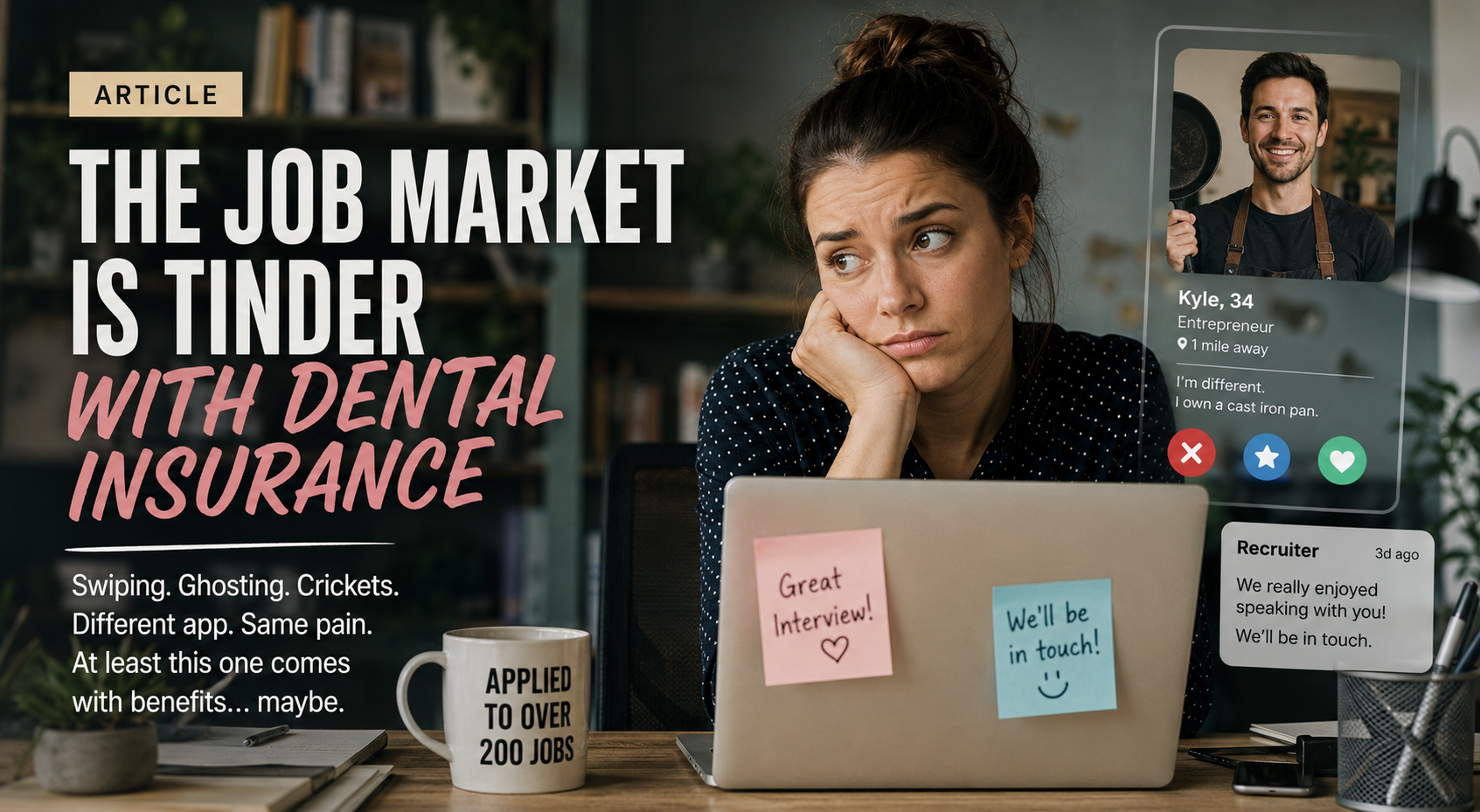
The job market has become Tinder with dental insurance, and at this point I am waiting for Indeed to add a “last active 3 hours ago” feature so candidates can know exactly which recruiter is online ignoring them. Because right now, candidates are out here refreshing inboxes like emotionally exhausted raccoons digging through spam folders, hoping for closure from a company that promised to “circle back” and then disappeared into a conference room with no windows.
Someone messaged me and said she has applied to over 200 jobs. Not 20. Not 40. Over 200. She has rewritten her resume so many times it probably needs its own therapist. She has gone through interviews she thought went great, smiled through tiny Zoom squares, answered every “tell me about a time” question like she was auditioning for a corporate survival documentary, and then got ghosted so many times she lost count. Then she said, “I am starting to think recruiters and dating apps are using the same playbook.”
And honestly, she did not just crack the code. She kicked the door open, pointed at the whiteboard, and exposed the entire HR-Hinge industrial complex. Because recruiting and dating apps are basically the same now. Both start with you polishing your profile like your entire future depends on one stranger having enough caffeine to care. Both make you describe yourself in a way that sounds confident but not desperate, experienced but not old, flexible but not financially panicked. Both involve someone looking at your entire life for six seconds before deciding whether you deserve a conversation.
And both begin with the same lazy question: “Tell me about yourself.” Sir, my resume is right there. My LinkedIn is right there. My work history is right there. My skills are right there. My emotional damage is standing by the door with a clipboard and a name tag that says, “Available immediately.” But no. You still have to smile into a webcam and summarize your entire existence like you are auditioning for health insurance.
So you say the professional version of the truth. “I am a results-driven leader with a strong background in operations, strategy, and pretending not to spiral when a company says they will circle back and then vanishes into the witness protection program.” And the worst part is, you deliver it with a smile, because apparently being unemployed now requires the emotional control of a hostage negotiator and the branding skills of a beverage startup.
Swipe Right on a Job Posting and Pray It Has Benefits
Applying for jobs now feels exactly like swiping on a dating app, except instead of looking for love, you are looking for rent money, stability, and maybe a dental plan that covers more than one sad cleaning and a coupon for toothpaste. You see the job posting and think, okay, this one looks decent. The title makes sense. The salary range is actually listed, which in this market feels like emotional vulnerability. The company website has smiling employees standing near a whiteboard pretending they just invented teamwork, and the careers page says things like “collaborative culture,” “growth mindset,” and “we move fast,” which is corporate language for “you will answer emails while chewing lunch.”
But you apply anyway, because hope is a dangerous drug and LinkedIn keeps handing it out in job alerts. You upload the resume. Then the system says, “Great, now manually enter everything from the resume.” That is the first red flag. That is the job market version of matching with someone who says, “I hate drama,” then immediately tells you about six enemies, three custody battles, and a roommate named Blade. But you keep going because you need work. You need income. You need health insurance. Your refrigerator is making a noise that sounds like it knows your credit score.
So you fill out the application. Work history. Education. Skills. References. Cover letter. Optional demographic questions. Mandatory optional questions. A personality assessment that asks whether you agree or strongly agree that stealing office supplies is bad, like you are applying to manage payroll at a pirate ship. Then finally, after all that, you hit submit. And then nothing. No sound. No confirmation from the heavens. No little animated recruiter saying, “Your resume has entered the sacred portal.” Just silence, the kind of silence that makes you wonder if your application got received or if Workday fed it directly into a furnace.
Then, three days later, a recruiter reaches out. “Hi! Your background is very impressive.” That sentence is dangerous because when you are job hunting, “your background is impressive” hits like someone saying, “You’re different from everyone else on this app.” Suddenly you are sitting up straighter. You start believing again. You start picturing the future together. Maybe this company is different. Maybe this role is real. Maybe “growth opportunity” does not mean doing the work of three departments while the printer screams like it saw the budget.
You imagine yourself logging into the new laptop, getting introduced to the team, and joining Slack channels named #wins, #culture, and #random, where nothing random has ever happened except Janet from Accounting posting a banana bread recipe during a layoff rumor. You start thinking about stability. A paycheck. A manager who does not say “quick sync” like it is a medical emergency. A place where you can finally stop refreshing your inbox like a raccoon pawing through a dumpster looking for closure. That is where they get you. Hope. The job market does not run on opportunity anymore. It runs on hope, caffeine, and candidates trying not to read too much into the phrase “we’ll be in touch.”
The Screening Call Is Just a First Date With Corporate Lipstick
Then comes the recruiter call. The recruiter is cheerful. You are cheerful. Everybody is cheerful in that fake professional way where both people know this is less of a conversation and more of a personality inspection with Wi-Fi. They ask, “What attracted you to this role?” The honest answer is, “The salary range and my electric bill.” But you cannot say that, so you say, “I was really drawn to the opportunity to contribute to a growing team.” Which is corporate for, “This job posting did not mention mandatory weekends, and I saw dental, so here we are.”
Then they ask you to walk them through your resume. Walk you through my resume? Absolutely. Let us take a guided museum tour through the document you already have open in front of you. Here is the leadership exhibit. Over here you will see operations experience. Down this hallway is the section where I saved money, increased performance, fixed chaos, trained teams, and aged emotionally. Please do not touch the glass. That is my burnout. But you perform anyway, because the job market has trained people to smile while explaining things already written in twelve-point font.
You explain your background. You hit the numbers. You use the right words. Strategy. Execution. Culture. Accountability. Cross-functional collaboration. Stakeholder alignment. All the corporate seasoning. The recruiter nods and says, “This sounds great.” That phrase should come with a warning label because in recruiting, “this sounds great” can mean “you are moving forward,” or it can mean “I will now place your resume into a digital cave and let it echo until the end of time.”
Then they schedule the hiring manager interview, and now you are really invested. This is no longer a casual swipe. This is the second date. You have moved from “maybe” to “I could see myself emotionally depending on this email thread.” The hiring manager joins the call. They smile. They say your experience is impressive. They say they are excited. They say the team is growing. They say they need someone who can “hit the ground running,” which means the ground is probably on fire and running is not optional.
You answer everything well. You talk about leadership. You talk about problem-solving. You talk about handling conflict. You explain a time you dealt with pressure without saying, “Every day since 2020.” The call ends. They say, “We really enjoyed speaking with you.” The company says, “We love your energy.” Love my energy where, Brad? Because three days later, you disappear like Kyle from Hinge who said he was “different” because he owns a cast iron pan and listens to podcasts about discipline.
Now you are replaying the interview in your head like game film. Was it the salary question? Was it when I asked about expectations? Was it when I asked why the role was open and everyone on Zoom suddenly looked like they heard a noise in the basement? Was my lighting weird? Did I say “excited” too many times? Did I accidentally look too experienced? Did I smile like a leader or like someone trying to survive a hostage video with benefits? Nobody tells you. That is the worst part. They do not reject you. They do not update you. They do not close the loop. They just disappear, leaving you to analyze your own facial expressions like a detective with LinkedIn Premium and anxiety.
Dating apps ghost you after dinner. Recruiters ghost you after asking for your availability, salary range, resume, LinkedIn, references, blood type, and a 45-minute conversation about your passion for operational excellence. At least on a dating app, you know the person probably got distracted, met someone else, or decided to “work on themselves,” which somehow always happens after they ask what you are looking for. In recruiting, they ghost you with corporate language still hanging in the air. “We are excited.” “You are strong.” “Next steps should move quickly.” Famous last words from a company that is about to disappear like it was never legally registered.
Meet the Whole Family, Then Get Left at the Corporate Altar
Modern hiring does not stop at one or two interviews anymore. That would be too simple. Too humane. Too close to respecting candidates as actual people with lives, bills, and laundry sitting in the dryer since Tuesday. Now they make you meet the whole family. First recruiter. Then hiring manager. Then senior manager. Then director. Then Finance. Then Operations. Then HR again, but this time with a different tone. Then one random VP joins from an airport lounge wearing one AirPod and giving the energy of a man who has never read your resume but is fully prepared to judge your leadership philosophy between boarding announcements.
And then Melissa joins. Nobody knows who Melissa is. Melissa says, “I’m just here to listen.” That is never good. Nobody who is “just here to listen” is ever just here to listen. Melissa is there to inspect the vibes. Melissa is checking if you are a culture fit. Melissa is studying your bookshelf, your facial expressions, your tone, your confidence, your answer length, and whether you said “team player” with enough spiritual commitment. Melissa has no official role in the process, but somehow Melissa’s eyebrow movement can decide whether you get dental.
You answer the same questions again. “Tell us about a time you handled conflict.” “Tell us about a time you worked under pressure.” “Tell us about a time you influenced without authority.” At some point, you want to say, “Right now. I am influencing myself not to scream into this webcam while six strangers ask me the same question in different fonts.” But you stay professional because candidates are expected to perform calm at a level usually reserved for bomb squads and kindergarten teachers during glitter week.
You smile. You give examples. You send thank-you emails. You follow up politely. You do everything right. Then silence. No email. No update. No rejection. No “we went in another direction.” No “we paused the role.” No “the hiring manager has been out.” No “Melissa did not like your aura.” Nothing. Just a corporate disappearing act performed with the confidence of a company that still has “people first” written on its careers page in bold letters.
And then, because the universe has a sense of humor and apparently no HR policy, you see the same job reposted two days later. Nothing hurts quite like being rejected from a role and then seeing that role back online looking single and available. Oh really? I thought you moved forward with another candidate. Apparently the other candidate was the same job description wearing a new blazer. Now the posting says “urgent need.” Urgent for who? Because I was right here. I had availability. I had experience. I had references ready. I had my little interview shirt steamed and everything.
But no. The company said, “We decided to continue our search.” Continue your search? You are not climbing Mount Everest. You are hiring an operations manager. And that is what makes the process feel insane. Companies act like they are searching for a unicorn who knows Excel, leadership, analytics, emotional intelligence, six software platforms, light plumbing, advanced hostage negotiation, and can start Monday for below market rate. Then when they find an actual qualified person, they say, “We’re still evaluating.” Evaluating what? Whether I can survive another panel interview with someone named Chad asking me where I see myself in five years?
Hopefully employed, Chad. Hopefully employed.
Final Thoughts: Candidates Are Not Bitter. They Are Exhausted.
After 200 applications, people are tired. Not lazy. Not entitled. Not unwilling to work. Tired. Tired of customizing resumes for jobs that may not even exist. Tired of writing cover letters that disappear into software named something friendly like Workday while behaving like a haunted vending machine. Tired of being told they are impressive, strong, talented, experienced, and “definitely someone we want to keep in mind,” which is corporate for “we are putting you in a folder we will never open again.”
People can handle rejection. What they cannot handle is confusion dressed up as professionalism. They cannot handle being interviewed five times, complimented seven times, asked for references, told the team is excited, and then abandoned like a shopping cart with one bad wheel. The emotional whiplash is exhausting. One minute you are being told you are exactly what they are looking for, and the next minute you are staring at your inbox wondering if the entire hiring team got trapped inside a strategy meeting and now communicates only through reposted job ads.
The excuses are the same as dating apps too. Dating app says, “Sorry, I’ve been busy.” Recruiter says, “Sorry, we are aligning internally.” Dating app says, “You’re great, but I’m not ready.” Recruiter says, “You’re a strong candidate, but we paused the role.” Dating app says, “I hope we can stay friends.” Recruiter says, “Please join our talent community.” Talent community? That is not a community. That is a digital storage unit where resumes go to question their choices.
At least Tinder shows when someone is online ignoring you. Recruiting lets you refresh your inbox until your phone starts judging you personally. And the worst part is candidates still have to stay graceful. You cannot say, “Hey, why did you waste my time?” You have to say, “Just checking in on next steps.” You cannot say, “Did I get rejected or did everyone in your company fall into a conference room and lose access to Outlook?” You have to say, “I hope your week is going well.” You cannot say, “You reposted the job two days after ghosting me, and now I am emotionally standing outside your LinkedIn window holding a boombox.” You have to say, “I remain very interested in the opportunity.”
That is the exhausting part. The process keeps asking candidates to be polished while treating them like disposable tabs. Be passionate. Be flexible. Be authentic. Be professional. Be available. Be patient. Be excited. Be realistic. Be ready to start immediately. Be willing to wait indefinitely. Be yourself, but not too much. Have experience, but not too much. Ask questions, but not hard ones. Follow up, but do not seem desperate. Care deeply, but do not act hurt when they disappear.
That is not a hiring process. That is emotional dodgeball with a benefits portal. Candidates do not need fireworks. They do not need a parade. They do not need a singing telegram from HR riding into their inbox on a corporate pony. They need communication. Yes. No. Maybe. Still deciding. The role is paused. The hiring manager is traveling. Melissa is still processing your vibe. Anything. Because after 200 applications, ghosting does not feel like a small thing anymore. It feels like a system that forgot real people are on the other side of the inbox.
People are not asking for much. They are asking for basic respect. They are asking companies that post “people first” to remember candidates are people before they become employees. They are asking recruiters to stop treating silence like a process step. They are asking hiring teams to understand that behind every application is a person trying to keep their life together while being judged by software, strangers, panel interviews, and Melissa’s mysterious listening role.
The only difference is Tinder might break your heart.
Recruiting makes you upload it as a PDF first.