I used to roll my eyes at the phrase “the hidden job market” the same way you roll your eyes at someone who says they “don’t really watch TV” while quoting five seasons of The Office like it’s Scripture.
Because for a long time, my career didn’t require mystery. It didn’t require breadcrumb trails, secret handshakes, or a ceremonial candle-lit networking circle where everyone chants “referral” into a Stanley tumbler. Work showed up like a well-trained dog. Recruiters reached out. Opportunities floated in with the casual confidence of someone who knows they’ll be responded to within 24 hours. I barely looked at LinkedIn. Not because I was above it — but because I didn’t need it. LinkedIn was a parking lot. I had a vehicle. I didn’t loiter.
And then the market shifted.
The outreach stopped. The pings dried up. The “Hey! Loved your background!” messages turned into the modern corporate equivalent of tumbleweeds rolling through an abandoned western town. Suddenly, I was staring at a platform I’d been treating like a dusty bulletin board and realizing: oh no. This is where the people are. This is where the conversations are. This is where the vibes are being traded for opportunities like currency.
That’s when I started tinkering. Not in a “I’m going to become an influencer” way — more in a “let me poke this system with a stick and see what moves” way. Because the “hidden job market” sounded like something invented by someone who sells courses and wears a headset mic at brunch.
But then it happened to me.
And nothing is more annoying than discovering the thing you mocked is real.
The Hidden Job Market Is Not Hidden — You Are
Here’s the first lie we tell ourselves when job searching gets weird: that there must be some secret vault of roles we can’t access because we didn’t shake the right hand, attend the right dinner, or be born into the ancient bloodline of “People Who Get Referred.”
In reality, the hidden job market isn’t a locked room. It’s a conversation you’re not in yet.
Jobs don’t appear out of thin air. People talk. Teams vent. Leaders panic quietly. Someone says, “We need a person who can do this,” and before a job posting ever materializes, the hiring manager is already scanning their mental Rolodex of humans they trust. Not resumes. Humans.
So if you’ve been treating LinkedIn like a static museum exhibit titled My Career: Now With Keywords, you’re not doing anything wrong — you’re just playing the old game in a new arena.
Because visibility is not vanity. Visibility is access.
Not access to attention. Access to memory. You want to be the person who pops into someone’s brain when a problem arises. Not in a desperate, “PLEASE THINK OF ME” way. In a natural way. Like, “Oh — I know someone who’s literally been building that in public.”
And that’s the pivot nobody explains: the hidden job market is basically the “people they already trust” market.
Which means your job isn’t to apply harder. Your job is to become easier to remember.
The Resume Parking Lot vs. The Real Person Neighborhood
At some point I realized I was showing up online like a cardboard cutout of a professional.
You know the type. Very clean. Very qualified. Very… emotionally sterile. A profile built like a corporate hallway: polished, quiet, and slightly haunted.
So I stopped treating LinkedIn like a place to store my achievements and started treating it like a place to exist.
Not overshare. Not perform. Not pretend I wake up at 4:30 AM to do “gratitude journaling” and “high-performance breathing.”
Just… exist as someone who builds things and cares about things.
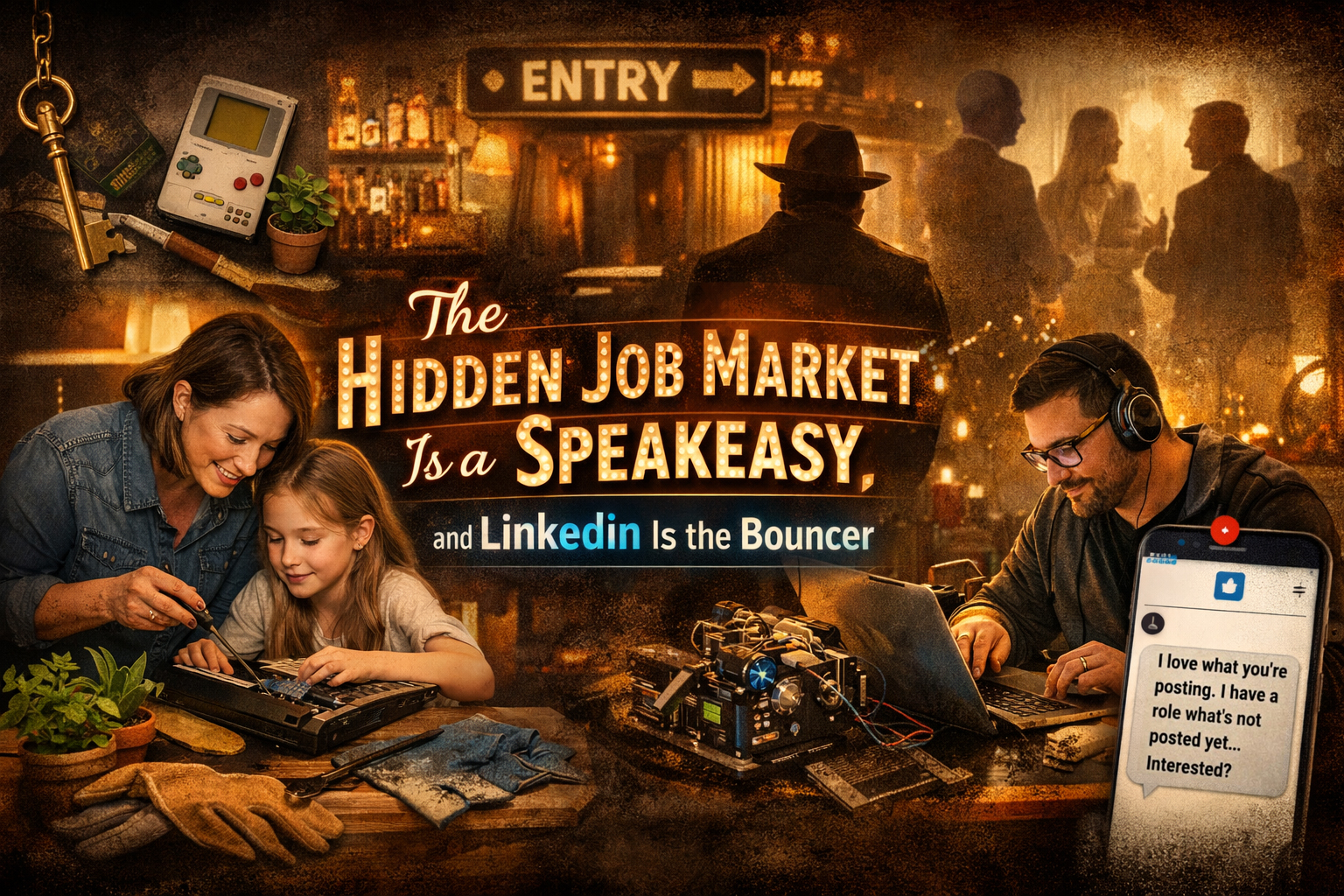
I posted about what I actually enjoy: fixing a GameBoy, teaching my daughter how to repair a laptop, experimenting with AI projects, messing around in the garden, doing the kind of hands-on tinkering that reminds you you’re a person and not a floating job title.
And here’s what’s wild: those posts weren’t “career content.” They were trust content.
Because when people see you consistently building, learning, solving problems, and thinking out loud, they stop wondering if you can do the work. They start assuming you can.
That’s the key difference between a resume and a presence.
A resume says: “Here is what I did.”
A presence says: “Here is how I think.”
And hiring managers don’t just hire experience. They hire the way your brain shows up to problems.
So the conversations started. The connections felt real. People weren’t just liking posts — they were messaging. Asking questions. Sharing their own projects. Introducing me to other humans. Suddenly, LinkedIn stopped being a parking lot and started being a neighborhood.
And neighborhoods are where work gets passed around like: “Oh, you should talk to this person.”
When the DMs Change, the Game Changes
There’s a specific message that marks the moment you realize you’ve crossed into the “hidden job market” territory.
It’s not a recruiter blast.
It’s not an automated “We saw your profile and thought you’d be perfect for this role that pays $14/hour and requires ten years of Kubernetes.”
It’s a human message. A specific message. The kind that starts with:
“I love what you’re posting.”
And then comes the line that hits like a plot twist:
“We have a role we haven’t posted yet.”
That’s when you realize job postings are often the final step, not the first one.
Because by the time a role is public, it’s usually already being shaped. Already being discussed. Already being angled toward someone in someone’s orbit. Sometimes there’s an internal candidate. Sometimes there’s a “we’re supposed to post it” candidate. Sometimes there’s a “we don’t know who yet, but we’re hunting” situation.
And that’s where the hidden job market actually lives: in those early conversations.
Directors, VPs, CEOs — people who don’t have time to sift through 800 applicants — will absolutely slide into your DMs when you’ve made it easy for them to trust you. When your work, your curiosity, and your consistency have been on display long enough that they feel like they already know you.
You become the low-risk, high-confidence option.
Not because you begged.
Because you showed up.
Final Thoughts: The Cliffhanger Is the Point
Removing your banner is honestly the most poetic part of this whole thing.
Because it’s the modern version of a season finale: you didn’t vanish — you just made the room lean in.
The hidden job market doesn’t reward perfect profiles. It rewards momentum, humanity, and proof of life.
So if you’re searching right now, yes — apply. Of course apply. But also build a trail. Give people something to recognize. Let them see how you think. Let them see what you care about. Let them see the projects and the curiosity and the little “I can’t stop tinkering” energy that makes you valuable long before you ever walk into an interview.
Resumes get screened.
People get remembered.
And if your project worked — if it actually shifted who started finding you — then the cliffhanger isn’t just drama.
It’s strategy.
Because now everyone’s watching for what you post next.