It started, as most cultural revolutions do, with a lie. A simple, harmless phrase uttered in jest: “Netflix and Chill.” At first, it sounded innocent enough—like an invitation to relax, unwind, and watch a documentary about people who actually have their lives together. But somewhere between buffering screens and existential dread, the phrase evolved into something else entirely: a coded message for casual connection, emotional avoidance, and digital-era affection.
In the early 2010s, before the pandemic taught us how to professionally isolate, “Netflix and Chill” was a flirtatious inside joke. You said it with a smirk. It was cheeky. A playful excuse to come over and “watch a movie,” even though everyone knew the only thing playing was your overconfidence. But as time went on, it became less of a date and more of a lifestyle. A coping mechanism wrapped in an HDMI cable.
Now, it’s not just a phrase—it’s an identity. The phrase has become shorthand for how an entire generation manages burnout, loneliness, and the overwhelming pressure of existing in a world that demands productivity but offers no emotional Wi-Fi. We don’t “go out” anymore. We “stream.” We don’t “date.” We “buffer.”
Netflix was supposed to be the escape, not the ecosystem. But look around: our attention spans are hanging by a thread, our relationships are built on shared playlists, and our best emotional support friend is a show we’ve rewatched nine times because we’re too tired to start something new. Somewhere along the line, we stopped chilling with people—and started chilling from ourselves.
And as it turns out, Netflix didn’t just change entertainment. It reprogrammed how we relate to comfort, love, and even our own sense of purpose. So grab your remote, your overpriced blanket, and the snack you swore you wouldn’t eat in bed—because it’s time to unpack the gospel according to the red “N.”
The Algorithm of Desire
Netflix knows your soul better than your therapist—and charges less for it. It doesn’t just recommend shows. It reads your mood, your schedule, your loneliness, your 2 a.m. curiosity, and your 4 a.m. regrets. Its algorithm doesn’t sleep; it studies you. The platform has turned binge-watching into emotional anthropology.
Once upon a time, you had to decide what to watch. You’d walk through Blockbuster, physically commit to a DVD, and live with your choices. Now, Netflix hands you a curated emotional buffet. Feeling heartbroken? Love Is Blind. Feeling lost? The Midnight Gospel. Feeling like society is collapsing and it’s your fault? Black Mirror. It’s all there, neatly packaged and served up with a “Next Episode in 5 seconds” prompt—because heaven forbid you pause long enough to think.
The irony is that the algorithm that claims to “know you” only knows your avoidance patterns. It doesn’t know why you need to escape—only that you do. It doesn’t understand the ache behind your rewatches, the loneliness hidden behind your “Top Picks.” Netflix doesn’t ask questions; it offers distractions.
Dating has become a reflection of this same algorithmic logic. Swipe, scroll, match, skip. We treat people the same way Netflix treats shows—test the pilot, lose interest by episode two, and replace them with something new when the emotional storyline gets too complex. The modern love language isn’t poetry—it’s password sharing. “Can I use your login?” is now the 21st-century equivalent of “Will you be mine?”
And just like the algorithm, we’ve learned to predict outcomes before giving stories a chance. We ghost instead of growing, skip instead of listening, scroll instead of connecting. Love, once an adventure, has become a user interface.
The Blanket of Emotional Avoidance
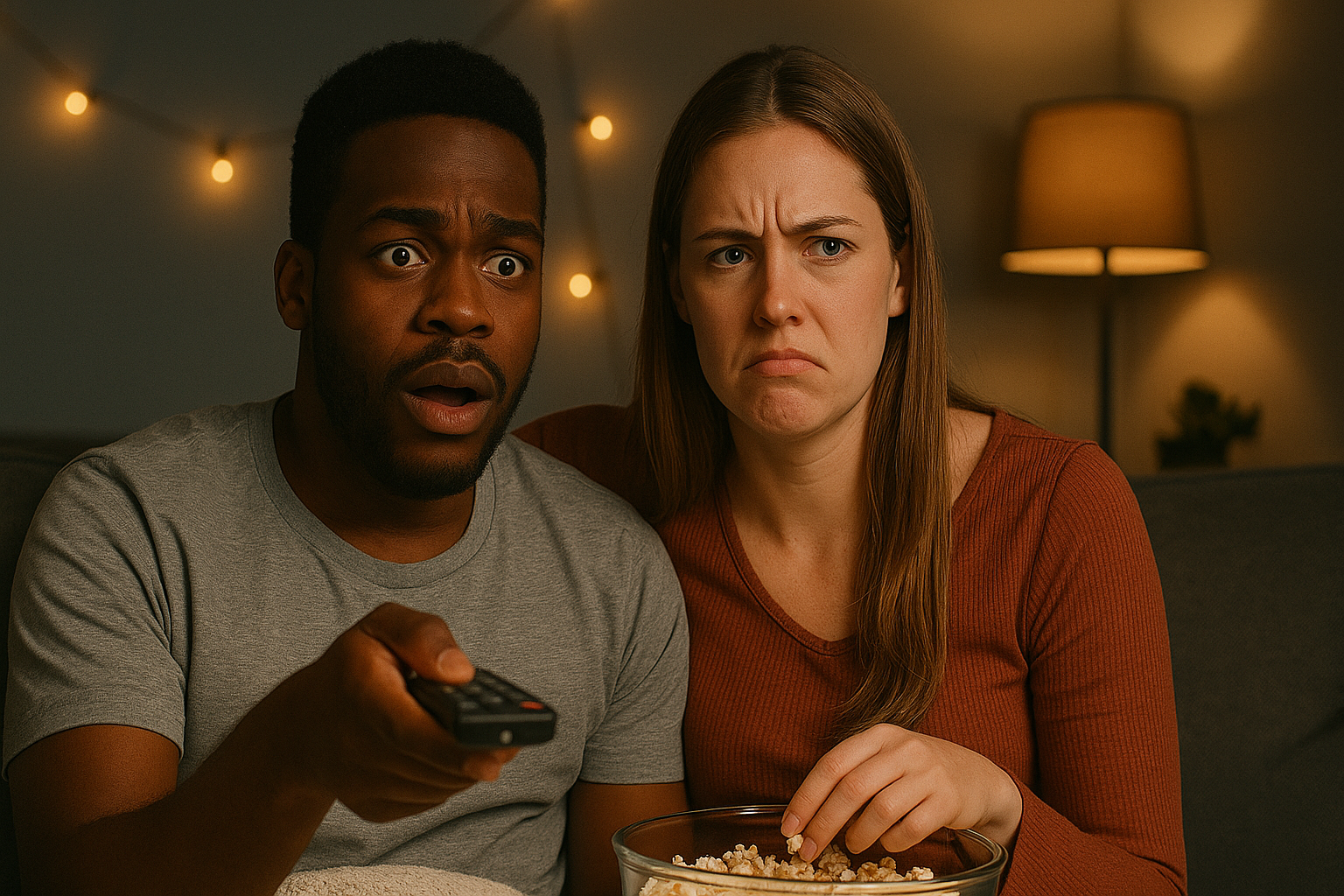
“Netflix and Chill” sounds cozy. A soft blanket, dim lighting, two people existing in peaceful harmony—until you realize both are silently checking their phones, pretending not to feel lonely next to each other. The modern relationship aesthetic is comfort without connection.
It’s 9 p.m. You’re in bed, snacks on standby, half-paying attention to The Office for the 14th time. You’re not watching—you’re numbing. You tell yourself it’s “self-care,” but deep down, you know it’s closer to self-avoidance. The hum of the TV becomes white noise that drowns out the hum of your anxiety.
The truth is, Netflix doesn’t want you to chill—it wants you to stay. That’s the dark genius behind it. Every “auto-play next episode” button is a tiny psychological trapdoor. The screen asks, “Are you still watching?” as if it’s genuinely concerned, when really it’s judging you for your lack of willpower. It’s the closest thing we have to emotional accountability.
We used to spend evenings reflecting, journaling, or—God forbid—talking to people. Now we measure our evenings in “episodes consumed.” Netflix has turned avoidance into an art form. It’s easier to rewatch Friends than to make new ones. Easier to fall in love with fictional characters than to risk getting ghosted by real ones.
And maybe that’s the secret—maybe we’re not addicted to Netflix itself. Maybe we’re addicted to not feeling. “Netflix and Chill” isn’t about relaxation; it’s about sedation. It’s the modern pacifier for overthinking adults who never learned how to unplug without guilt.
We don’t “chill” to recharge—we “chill” to disappear for a while. Under that blanket, surrounded by crumbs and LED light, we’re safe from reality. And in this economy, who can blame us?
Love in the Time of Buffering
We live in a world where both Wi-Fi and emotional connection drop without warning. You can’t even tell if the relationship is lagging or if your router just gave up. Every “you froze for a second” during a call feels metaphorically accurate.
We’ve built love on shared subscriptions and synchronized streaming sessions. People no longer talk about compatibility; they talk about watchlists. “We have great chemistry” now means “We both cried during BoJack Horseman.” Our dating apps should come with genre filters. “Seeking partner who enjoys existential comedies, dark sarcasm, and emotional availability between 8–10 p.m. CST.”
When relationships end, there’s no closure—just revoked access. Nothing stings quite like the “Profile Locked” screen after a breakup. You don’t get a goodbye text; you get a login error.
But the real tragedy is that we’ve mistaken convenience for connection. Netflix made us believe that intimacy should be effortless. Just hit play. Just chill. Just exist next to each other and call it love. But connection—real connection—doesn’t auto-play. It requires awkward conversations, vulnerability, and patience longer than a 40-minute runtime.
We’ve been buffering for years, waiting for the moment our hearts catch up to our bandwidth. But love doesn’t stream. It stumbles. It freezes. It lags. And when it’s real, you don’t just refresh the page—you stay and fix the signal.
Final Thoughts: When the Credits Roll, Stay Awake
“Netflix and Chill” started as a joke, but somewhere between the punchline and the pop-up ad, it became a mirror. We wanted escape and got sedation. We wanted connection and got co-dependence with our screens. We traded real conversations for shared silence and called it comfort.
But maybe, buried under the irony, there’s still something pure about it. Maybe the desire to “chill” was never about laziness—it was about wanting rest in a world that never stops shouting. Maybe what we really crave isn’t distraction but peace.
So the next time someone texts you, “Netflix and Chill?”—say yes. But mean it differently. Don’t scroll. Don’t numb. Don’t hide. Watch something, laugh, talk, exist—really exist—with someone. Put the phone down. Let the credits roll. Sit in the silence afterward.
Because one day, you’ll realize the best episodes were never the ones you streamed—they were the moments you stayed awake for.
😂0😍0😢0😡0👍0👎0






Thank you for your sharing. I am worried that I lack creative ideas. It is your article that makes me full of hope. Thank you. But, I have a question, can you help me? https://www.binance.com/register?ref=IHJUI7TF
I don’t think the title of your article matches the content lol. Just kidding, mainly because I had some doubts after reading the article. https://www.binance.com/el/register?ref=DB40ITMB
Thank you for your sharing. I am worried that I lack creative ideas. It is your article that makes me full of hope. Thank you. But, I have a question, can you help me?