
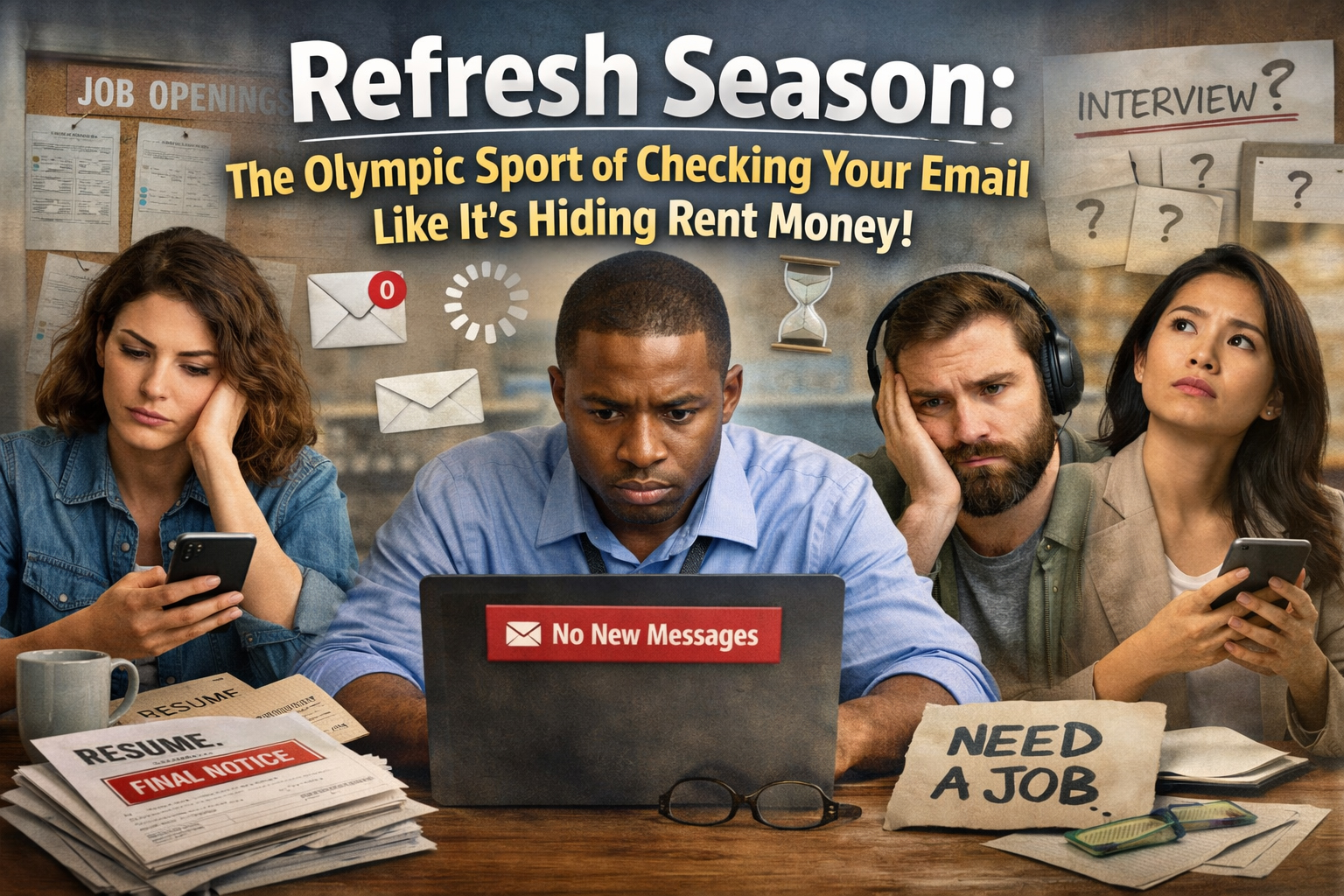
There’s a special kind of emotional cardio that only job seekers know, and it’s not running, Pilates, or that one YouTube instructor who smiles like pain is a personality trait. It’s refreshing your email like it owes you money, like it borrowed your last good week of confidence and now it’s ducking you behind a “Do Not Reply” address.
And it’s never just email, either. It’s email plus LinkedIn messages plus the job portal that requires a separate password and a sacrificial offering every time you try to log in, plus the calendar invite that ended three weeks ago but still lives in your brain like a haunted Times Square billboard that says, “We’ll be in touch soon!”
You try to act normal. You do. You tell yourself you’re going to be healthy about it. You’ll check in the morning, then you’ll go live your life like a balanced adult who eats lunch without simultaneously scanning the top right corner of their phone for notifications like a WWII radar operator.
But then your nervous system, freshly certified in Catastrophe Management, starts doing what it does best: narrating silence.
Because the waiting isn’t passive. It’s active. It’s loud. It’s you rereading your own follow-up email five times to make sure you didn’t accidentally sound like a person who needs money, which is apparently a scandal now. It’s trying to decode tone through punctuation.
“Thanks so much!”
Did that look desperate?
Should I have done “Thanks so much.” with a period so I seem stable?
Did the exclamation mark scream “I have feelings,” which we all know is frowned upon in professional settings unless you’re celebrating a quarterly revenue number?
Meanwhile, the entire job-search ecosystem is built like a theme park run by ghosts. You submit an application into a portal that looks like it was designed in 2009 by someone who hates fonts. You receive an auto-reply that promises someone will “review your qualifications.” Then you wait. Then you follow up. Then you wait more. Then you stare into the void and wonder if the void has a spam filter or if your application is just hanging out in a digital junk drawer with 400 other dreams and a broken stapler.
And yes, we all understand recruiting is complicated. Reqs are heavy. Budgets shift. Hiring managers get distracted by shiny objects and internal politics and an urgent meeting about creating a meeting schedule for future meetings. Nobody is pretending it’s simple.
But silence, in the middle of all this, is not neutral. Silence is a psychological endurance test with bad lighting and no water station.
So welcome to the modern job hunt: the only place where being qualified is important, but being acknowledged is apparently optional.
Inbox CrossFit and Other Unpaid Workouts
Job seekers are in the best shape of their lives, emotionally speaking. Not because anyone asked for it, but because the job search turns your nervous system into a full-time athlete training for the Olympic event known as “Waiting While Pretending You’re Fine.”
Event rules include:
You refresh your inbox before you’ve even blinked properly.
You refresh it again after brushing your teeth, because maybe the email arrived during toothpaste.
You refresh it again after pouring coffee, because coffee is a catalyst for miracles.
You refresh it again after opening a different app and returning, because changing apps is basically shaking the universe awake.
Then you do the portal check. The portal check is a ritual. It’s where you log into a site that says “Application Status: Under Review” as if it’s a literary work-in-progress, as if your entire career is simply being gently edited by a thoughtful committee of invisible librarians.
Under review can mean anything. Under review can mean “We haven’t looked at it.” Under review can mean “We looked at it and panicked.” Under review can mean “We hired Chad last Tuesday and forgot the portal exists.” Under review can mean “The role has been paused, canceled, resurrected, and turned into an internship, but we didn’t want to upset the system.”
Meanwhile, your brain goes full detective. You start analyzing the last conversation like it’s a true-crime documentary narrated by your insecurities.
When I said “I’m excited about the opportunity,” did I sound too eager?
When I said “I can start in two weeks,” did I sound too available?
When I laughed politely at the hiring manager’s joke about “wearing multiple hats,” did I accidentally signal that I own hats and therefore have a hat budget, which means I don’t need this job?
You begin to live inside micro-moments. You remember the interviewer’s expression when you mentioned a skill. You replay it like sports footage.
Was that a nod of approval?
Was that a nod of boredom?
Was that a nod because their cat walked by?
This is the part nobody admits: the silence turns you into someone who has opinions about the meaning of a “Thanks!” versus a “Thanks.” versus a “Thanks!!” as if punctuation is a personality test and the hiring decision depends on whether you used the correct number of exclamation points to signal competence without joy.
You know what would end this madness?
A two-sentence email.
That’s it.
Not an essay. Not a thesis. Not “We have decided to pursue other candidates with slightly stronger synergy and more alignment with our values of synergy.” Just an update.
Because right now, the job seeker experience is like ordering food and being told, “Your order is being prepared,” and then three weeks later, the restaurant has closed permanently, the building is a Spirit Halloween, and you’re still checking the tracking page like maybe the fries are in transit.
Ghosted, But Make It Corporate
Let’s talk about corporate ghosting, because normal ghosting at least has the decency to be personal.
Normal ghosting is one person avoiding another person. Corporate ghosting is an entire organization, with a mission statement and an HR department, collectively deciding that the best way to handle another human being is to pretend they faded out of existence like a Snapchat message.
You can go three rounds deep. You can present. You can do the case study. You can meet the team. You can make them laugh. You can answer the behavioral questions. You can do the whole song and dance and interpretive performance art of “Tell me about a time you overcame adversity,” while trying not to say, “Right now, I’m overcoming adversity. In this interview. With you.”
Then the last meeting ends and you’re told, “We’ll be in touch soon.”
Soon is doing a lot of heavy lifting here.
Soon becomes a week. Then two. Then three. Then your follow-up email becomes a tiny paper boat floating down the river of unread inboxes.
And what makes it extra wild is that the system is full of automated communication. It’s not like technology doesn’t exist.
You get automated reminders.
Automated confirmations.
Automated “we received your application.”
Automated “please rate your experience.”
Automated newsletters that say “We’re hiring!” while you’re actively being ignored by the hiring process.
So the silence is not an accident. It’s a choice. A structural choice. A cultural choice. A decision that says, “We have the tools to communicate, but we will be using them only for things that benefit us.”
That’s why it hits so hard. Because job seekers aren’t asking for perfection. They’re not asking recruiters to write a personalized sonnet about why Chad’s leadership style better matches the team’s energy.
They just want closure.
A “no.”
A “role paused.”
A “position filled.”
A “we’re still deciding, but we haven’t forgotten you.”
Anything that acknowledges the fact that the candidate is a human being with bills, a calendar, and a nervous system that is one more unanswered email away from applying to become a lighthouse keeper.
Silence doesn’t just delay information. It creates meaning where none exists.
When you don’t hear back, your brain doesn’t go, “Ah, they must be busy.”
Your brain goes, “I have failed as a person.”
Because silence is a blank screen, and job seekers will project every fear they’ve ever had onto it like it’s an IMAX theater sponsored by self-doubt.
And yes, recruiters are under pressure. Absolutely. Hiring managers are slow. Systems are clunky. Priorities shift. It happens.
But if an organization can send fourteen emails reminding you to complete your “culture survey,” it can send one email saying, “We’re moving forward without you.”
The truth is, ghosting is not neutral. It’s a process failure with emotional consequences.
Which is a fancy way of saying: it’s rude, and we all know it.
The Myth of “No News Is Good News” and Other Lies We Tell Job Seekers
“No news is good news” is one of those phrases we say because we want to be comforting, but it’s actually just a little bit of emotional gaslighting served in a friendly tone.
Because in the job hunt, no news is not good news. No news is no news. No news is limbo. No news is a waiting room with fluorescent lighting and a looping playlist of motivational advice that makes you want to chew through your own résumé.
No news is the space where people lose momentum.
You stop applying because you think you’re close.
You stop interviewing because you’re emotionally invested.
You stop planning because you’re waiting for a decision that might never come.
And the longer the silence goes on, the more it costs the candidate. Not just emotionally. Practically.
People delay decisions. They delay bills. They delay moving. They delay childcare plans. They delay life.
And in that silence, the job seeker becomes a professional overthinker.
They replay everything.
They start editing themselves retroactively.
They start believing they shouldn’t have asked that question, shouldn’t have mentioned that salary range, shouldn’t have been honest about wanting flexibility, shouldn’t have looked “too confident,” shouldn’t have looked “not confident enough,” shouldn’t have breathed audibly.
The silence turns job seeking into a personal referendum.
Then, on top of that, society loves to treat job seekers like they’re doing something wrong if it’s taking too long.
“Have you tried networking?”
“Have you tried tailoring your resume?”
“Have you tried waking up at 5am and believing harder?”
Yes, Janet. I have tried believing harder. My belief has been in a committed relationship with disappointment for months. We have matching sweatshirts.
Here’s the part that makes candidates feel insane: employers will insist they want “communication skills,” “professionalism,” and “respect,” while participating in a process that often includes zero communication, minimal professionalism, and the kind of respect usually reserved for unread terms and conditions.
And then, occasionally, the employer will resurface like nothing happened.
“Hi! Sorry for the delay. Are you still interested?”
Still interested?
Ma’am, I have aged. I have evolved. I have gone through seasonal depression and come out the other side with a new skincare routine. I have applied to seventeen other roles and developed a small but meaningful distrust of calendar invites. I am no longer the same person you met in Round Two.
But sure. Yes. I’m still interested. Because the job market has turned us all into polite little survivors who respond with gratitude even when we’re being emotionally drop-kicked by the process.
The fix isn’t complicated. It’s not even expensive.
It’s communication that treats candidates like people.
It’s a standard update cadence.
It’s a clear timeline.
It’s closing the loop.
It’s saying no like an adult.
Final Thoughts: Close the Loop Before People Lose Themselves in It
This isn’t a pitchfork post. It’s not “recruiters are villains” or “companies are evil.” It’s just the observation that we’ve normalized a process that quietly harms people and then acts surprised when job seekers are anxious, bitter, exhausted, and unable to “bring their best selves” to a fifth interview on week nine of silence.
Job seekers aren’t asking for poetry. They’re asking for acknowledgment.
Because the job hunt is already vulnerable. It’s already hard. It’s already full of rejection, uncertainty, and the weird emotional whiplash of being told you’re “amazing” in a call and then being treated like you never existed afterward.
Silence takes something stressful and makes it personal.
So if you’re hiring, recruiting, managing, leading, or even just touching the process with your corporate fingertips, here’s the revolutionary idea:
Send the email.
Close the loop.
Say no.
Say pause.
Say anything that recognizes there’s a human on the other side of the screen.
Because hiring works better when people are treated like people, not unread messages left on “seen” by an algorithm with commitment issues.