
There are few places on earth where you can witness the human relationship with patience in its purest, least edited form, where nobody is performing wellness for an audience or pretending they “love the pause,” and where the truth comes out with the blunt confidence of someone who has never once been coached to soften their language for corporate harmony.
Not therapy, because therapy at least comes with context, vocabulary, and the occasional breakthrough that makes you feel like you didn’t waste your entire week ruminating about one email.
Not a meditation retreat, because retreats are curated patience, the kind you purchase and schedule and brag about later, like patience is something you can download if you sit quietly enough and the incense is expensive.
Not even the DMV, because the DMV is where patience goes to retire, because everyone there has already accepted they are not leaving quickly and has moved into a shared emotional state of communal surrender.
No, the truest laboratory for patience is a children’s ministry classroom on a Sunday morning, where you walk in thinking you are a calm, helpful assistant in a gentle environment filled with tiny chairs and earnest lesson plans, and you leave realizing you were actually hired as a part-time negotiator for a group of small humans who have never been gaslit by a productivity podcast, never pretended they were “fine” for the sake of politeness, and have no interest in making waiting sound noble just because adults can’t handle the honesty of how much it annoys them.
These kids do not romanticize waiting.
They do not dress it up as “trusting the process” or “embracing the journey” or “letting the universe unfold,” like time is a kindly mentor who will eventually reward you for being calm.
They look you dead in the face and say, with the conviction of someone who has been personally betrayed by the concept of time itself, that patience means waiting, but not for a long time, and preferably only until the snacks arrive, because anything longer than that is clearly a design flaw in the universe.
And honestly, that clarity is refreshing, because adults are no better, we just upgrade the vocabulary and lower the volume so we can pretend we are emotionally mature while doing the same frantic thing in business casual.
Adults say, “I’m being patient,” while reloading an email thread like it’s a slot machine that might suddenly pay out in validation, clarity, and health insurance, and we act like this is resilience instead of a quiet spiral with a strong Wi-Fi connection.
We say, “I’m trusting the timing,” while checking our phone so often it stops feeling like a device and starts feeling like an extension of our nervous system, a tiny rectangular mood ring that decides whether we get to be calm today.
We say, “I’m staying positive,” while privately drafting a resignation letter to hope itself, because the optimism has started to feel less like a choice and more like an exhausting customer service role you didn’t apply for.
And nowhere does that hypocrisy get louder than the job hunt, where patience isn’t just a virtue you practice in theory, it’s the entire business model, the default expectation, the unpaid labor, and the invisible price of admission for being considered “professional.”
The job hunt is a spiritual endurance sport disguised as a process.
It is a long hallway of closed doors, upbeat automated messages, and timelines that keep shifting like a mirage, and it asks you to be calm while you are judged, confident while you are ignored, grateful while you are strung along, and stable while you stand on a floor made of uncertainty that politely pretends it isn’t moving.
It asks you to wait.
And it does not provide snacks.
So yes, today’s lesson was about patience.
This was a bold choice.
And it turns out the children weren’t the only ones who needed it.
The Holy Art of Waiting Without Becoming a Villain
Patience is always marketed as gentle, like it’s a soft word with warm lighting and a soothing voiceover, the kind of trait you put on a personality list next to “team player” and “self-starter,” as if patience is something you naturally have if you buy the right planner and drink enough water.
But real patience is not gentle.
Real patience is you sitting in your own life, watching the clock perform acrobatics, trying to behave like a stable adult while your brain runs emergency drills every time your phone vibrates, because uncertainty has a way of making even the most rational person start acting like a conspiracy theorist with a calendar.
Real patience is emotional restraint in a world that keeps giving you reasons to escalate, and the escalation is always available, always tempting, always right there in the form of an email you could send, a follow-up you could “just check in” with, or a late-night LinkedIn post you could write that starts as professional insight and ends as a public confession that you are one more non-response away from moving into the woods and becoming a folk legend.
Children understand this instinctively, because they do not pretend patience is fun, they do not frame it as personal growth, they do not say “this is teaching me something,” they just admit it’s boring, which is correct, because waiting is fundamentally the experience of wanting a different reality than the one currently available and being forced to sit inside the gap without turning into a gremlin.
That’s the whole pain of it.
In the job hunt, waiting is not a pause between actions, it’s the environment, the weather, the air you breathe, the background noise of your day, because you apply and you wait, you interview and you wait, you follow up and you wait, you “circle back” and you wait, you do a take-home project that quietly consumes your weekend and your remaining optimism, and then you wait again, like you just donated a piece of your life to a void that might reply in three to five business decades.
And while you wait, everyone around you offers advice that sounds inspirational until you realize it is mostly a strategy to keep you from screaming in public.
“Be patient.”
“Trust the process.”
“Good things take time.”
“Everything happens for a reason.”
Thank you, I will staple these phrases to my forehead and use them as insulation while I refresh my inbox for the fiftieth time today like I’m trying to summon a hiring manager through sheer persistence.
The hardest part is not the waiting itself, because humans can do hard things, especially when they have to.
The hardest part is the silence inside the waiting, because silence creates space, and space creates imagination, and imagination is where you start building stories that are not necessarily true but feel emotionally accurate when your nervous system is bored and terrified at the same time.
They didn’t like me.
They found someone better.
My answer was wrong.
My resume is cursed.
My career peaked in a past life.
I am being punished for something I said in 2014.
And now, suddenly, patience isn’t a calm virtue, it’s a daily negotiation between you and the version of you who wants to send a follow-up email that is technically professional but spiritually unhinged, the kind that says “Hello, hope you’re well” while radiating the energy of someone counting down to their villain origin story.
Because here’s the truth nobody puts on motivational banners: patience isn’t doing nothing, patience is choosing not to detonate while you wait, which is less like inner peace and more like emotional hostage negotiation with yourself.
It is restraint with a pulse.
It is staying human while the process treats you like a file.
It is the deeply unglamorous work of keeping your spirit intact while life moves slower than your need for answers.
Children Ask the Questions Adults Swallow
When a child raises their hand and asks, sincerely, “What if God is taking too long?” the room changes, because that is not a child question, that is a human question, the kind that lives inside everyone who has tried to do the right thing and still ended up staring at a closed door, wondering if they misheard the instructions or if the world is just casually late with the part where it makes sense.
Children don’t hide this.
Adults do.
Adults learn to package that question into something more socially acceptable, like “What’s your hiring timeline?” or “When can I expect next steps?” or “Just checking in,” and we deliver it with a smile that says “I’m chill,” while our insides say “I am one unanswered email away from entering a new dimension.”
But beneath the polite language is the same ache: what if this is taking too long, what if I have waited enough, what if my patience is not being rewarded but simply being required.
This is why the job hunt feels spiritually exhausting, because it turns your life into a series of suspended endings, and you keep reaching moments that should resolve into clarity, only to watch them dissolve into “we’ll be in touch” like you’re stuck in a story where the plot refuses to commit.
And the worst part is how your mind tries to act like waiting is neutral.
Waiting is not neutral.
Waiting is an emotional posture, a constant low-level tension between hope and self-protection, because you try to stay optimistic without becoming naive, and you try to stay realistic without becoming bitter, and you try to keep applying without feeling like you’re throwing your best self into a machine that does not know your name.
Children don’t have that filter, so they say what adults swallow.
“Does patience still count if I’m mad inside?”
Yes, sweetheart, that is literally the point, because patience is not the absence of emotion, it’s emotion with boundaries, it’s frustration that doesn’t get to drive the car.
“Is patience over yet?”
No, and the reason you hate that answer is the same reason adults hate it, because patience does not end because you asked, and that’s the part that makes waiting feel like a test you didn’t consent to.
“What if I waited yesterday? Do I have to wait again today?”
And there it is, the job hunt in one sentence: I waited before, why am I still waiting now, why is my effort not buying me certainty, why does the universe keep charging me for patience like it’s a monthly subscription.
Adults learn the painful answer: yes, sometimes you have to wait again today, because waiting is not always a one-time toll, sometimes it’s the recurring theme, and it keeps showing up like a song you didn’t add to your playlist but somehow know all the words to.
You wait for someone to respond.
You wait for someone to notice.
You wait for the right role.
You wait for your energy to come back after another rejection.
You wait for your confidence to stop feeling like a costume.
You wait for the part where all of this starts making sense.
And in that waiting, you start learning things about yourself that you didn’t ask to learn, like what you do when you don’t have control, how quickly you start bargaining, whether your self-worth is stable or tied to external validation, how your body holds uncertainty, how your mind spirals, how your heart tries to protect you by preparing for disappointment.
This is why the children were better at the lesson than we give them credit for, because they weren’t pretending patience was elegant, they were naming what it costs, and that honesty is exactly what adults lose when we start treating patience like a performance instead of a survival skill.
The Job Hunt Is a Waiting Room With Better Lighting and Worse Music
The job hunt is full of rituals designed to keep you compliant, not necessarily out of cruelty, but out of structure, because the system is built for employers to move at their pace while candidates absorb the emotional consequences, and then we all pretend this is normal because everyone is too tired to rewrite the entire process from scratch.
You are expected to be patient.
You are expected to be grateful for updates.
You are expected to keep showing enthusiasm even when the process stretches longer than a full season of a television show where nothing happens until the finale, and even then the finale ends with “we’ve decided to move forward with other candidates,” which is just a polite way of saying the story is over and you are not invited to the sequel.
You are expected to act like you are not waiting, even though waiting is all you are doing, and you’re supposed to do it with poise, like you’re not secretly tracking time in your head the way kids track time when snacks are involved.
You send your application into the void and you wait for the ATS to decide whether your experience counts as experience.
You finally get an interview and you wait for the calendar invite, then you wait for the meeting, then you wait for the follow-up, then you wait for the next round, then you wait for the next next round, then you wait for the decision that will be delivered with the emotional sensitivity of an automated email written by someone who has never had to stare at their inbox like it owes them rent.
And during this time, life does not pause.
Bills do not pause.
Your energy does not pause.
Your self-doubt does not pause.
You still have to be a person while your future sits in someone else’s inbox, which is what makes the job hunt so uniquely draining, because the waiting isn’t passive, it’s loaded, it’s personal, it’s tied to survival, identity, and dignity, and you are asked to carry that quietly while still showing up to your life like you’re not being slowly worn down by the absence of answers.
This is where patience becomes emotional labor, because you’re not just waiting, you’re managing yourself while you wait, balancing optimism and realism, trying not to take silence personally, trying not to attach your worth to a timeline you cannot see, trying not to become someone who measures their value by the speed of other people’s replies.
And then the job hunt adds its favorite twist: waiting while being evaluated.
You are not just waiting for a response, you are waiting to be chosen, which means every day of silence can start to feel like rejection in slow motion, and the longer it goes, the more your brain starts craving any outcome, even a bad one, just so you can stop hovering in limbo like a cursor blinking in an empty document.
This is why patience is so hard in the job hunt, because the people who tell you to be patient are rarely the ones paying the cost of your waiting, and that makes patience feel less like virtue and more like the price of admission for being considered worthy of stability.
The kids were right.
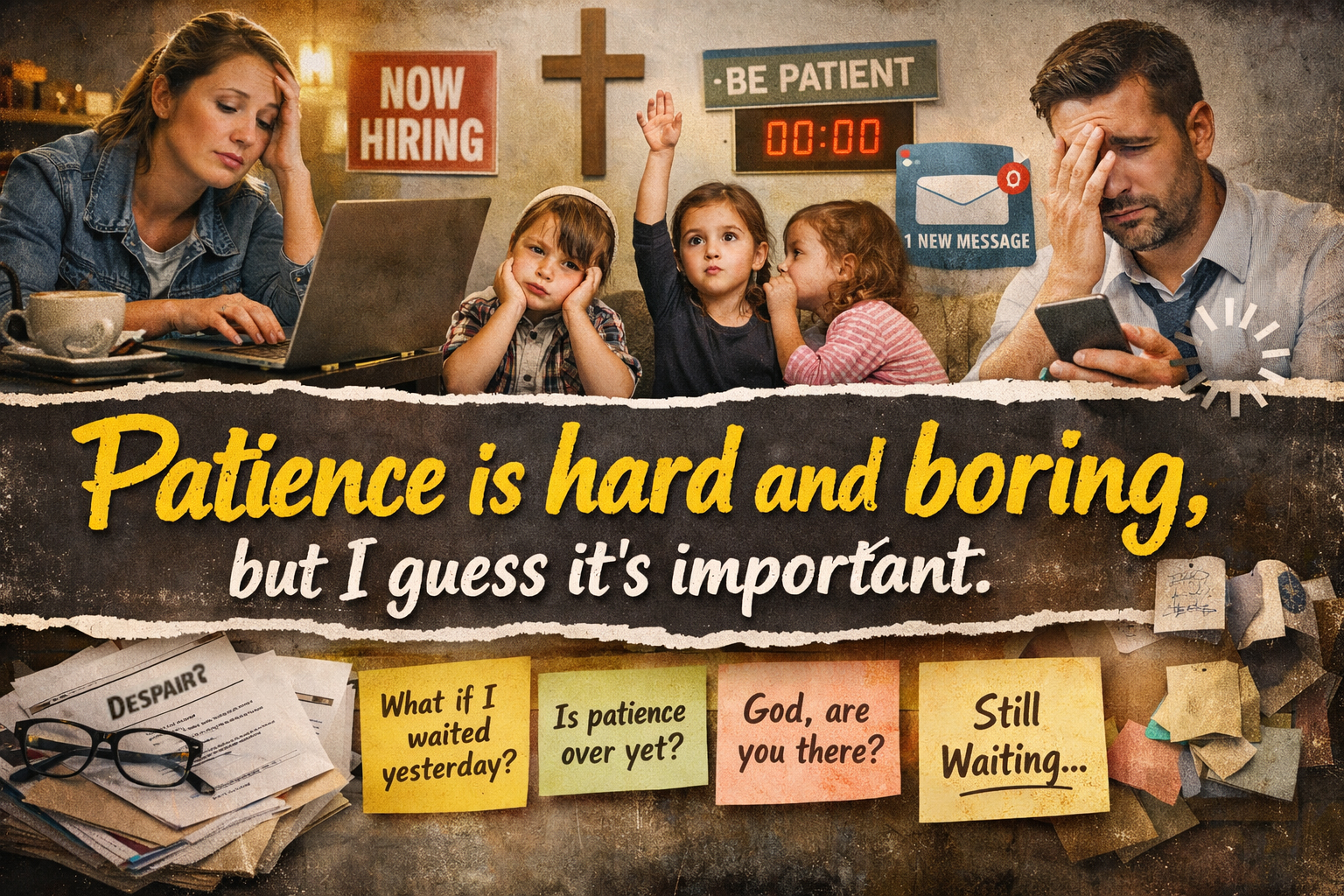
Patience is hard and boring.
But I’d add something they haven’t learned yet: patience is also deeply unfair, not morally unfair in a grand philosophical sense, but emotionally unfair in the everyday way that life sometimes is, where the timeline does not respect your effort and the silence does not care how hard you tried.
And that is why patience, when practiced in real life, is not something you float through.
It is something you survive with.
Final Thoughts: Put It on a Banner, Then Let It Be True
I keep thinking about that child who said patience means waiting, but not for a long time, because there’s something painfully human inside that sentence, something that exposes the wish we all carry, that waiting should be brief and reasonable and proportional to our effort, that if we do our part the world will do its part quickly, that the timeline will respect us, that the answer will show up on schedule because we were good and polite and did everything “right.”
But life does not run on our sense of fairness.
Life runs on its own mysterious calendar, and sometimes it leaves you in the waiting room long enough to start questioning whether the appointment was real, whether the promise was real, whether you made it up to cope, whether you’re foolish for hoping at all.
That’s where patience stops being inspirational and starts being intimate, because patience is not about time, it’s about what you do with yourself in the absence of answers, and who you become when you don’t get immediate feedback, and whether you can stay connected to your worth when the external world is quiet and you’re alone with your thoughts.
In the job hunt, patience is you continuing to apply even after a rejection knocks the wind out of you and makes your confidence feel like it’s been gently unplugged.
It’s you showing up to another interview even when you’re tired of being charming on command, tired of telling your story like it’s a pitch deck, tired of performing enthusiasm for a role you haven’t even been allowed to fully understand yet.
It’s you refusing to interpret silence as a verdict on your value, refusing to let a timeline you don’t control convince you that you are less capable, less worthy, less employable, less anything.
And here’s the part people don’t say enough because it ruins the aesthetic: patience does not mean you are fine.
Patience can include anger.
Patience can include sadness.
Patience can include exhaustion.
Patience can include the private moment where you admit you are scared, because you are human and you do not know what happens next and you are tired of pretending you do.
Patience is not the absence of emotion.
Patience is choosing not to abandon yourself in the middle of it, even when you want to, even when you’re tempted to rewrite your story into something cruel, even when you feel like the waiting has become a commentary on your worth.
That’s the real lesson those kids were circling around without even trying, because they weren’t pretending patience was elegant, they were acknowledging it was difficult and dull and sometimes unbearable, and still, somehow, important.
Which is exactly how adults should talk about it too.
Not as a virtue we perform, but as a reality we navigate.
Not as a pretty concept, but as a daily choice: not to scream, not to quit, not to collapse dramatically onto the floor, even when you want to.
And yes, sometimes you will sprint the moment the bell rings, because some days patience leaves the building immediately, and you need a break, a cry, a walk, a snack, a friend, a reset, a reminder that waiting does not mean failing.
Because patience is not the end goal.
Patience is what you practice while you move toward what you want, even when the world moves slower than your hope, even when the answers arrive late, even when the silence is loud, even when you’re staring at the metaphorical iPad of your life charging and willing it to hit one hundred percent so you can finally press play.
So fine.
Put it on a banner.
Patience is hard and boring, but I guess it’s important.
And if you’re in the job hunt right now, waiting for an email, a call, a decision, a sign, a shred of clarity that proves you didn’t imagine your own effort, let that banner be a little more specific, because you deserve language that actually matches what you’re living:
Patience counts even when you’re mad inside, even when you’re tired, even when you’ve waited before and you’re being asked to wait again, even when you want to whisper scream, even when you’re trying to hold yourself together with polite phrases and sheer willpower.
Patience is not you being perfect.
Patience is you still being here.
And some Sundays, that is the most honest kind of faith there is.






Afunentrar, yeah? Pretty standard stuff, easy enough to sign up and get going. Could be a good option if you need somewhere quick. afunentrar