
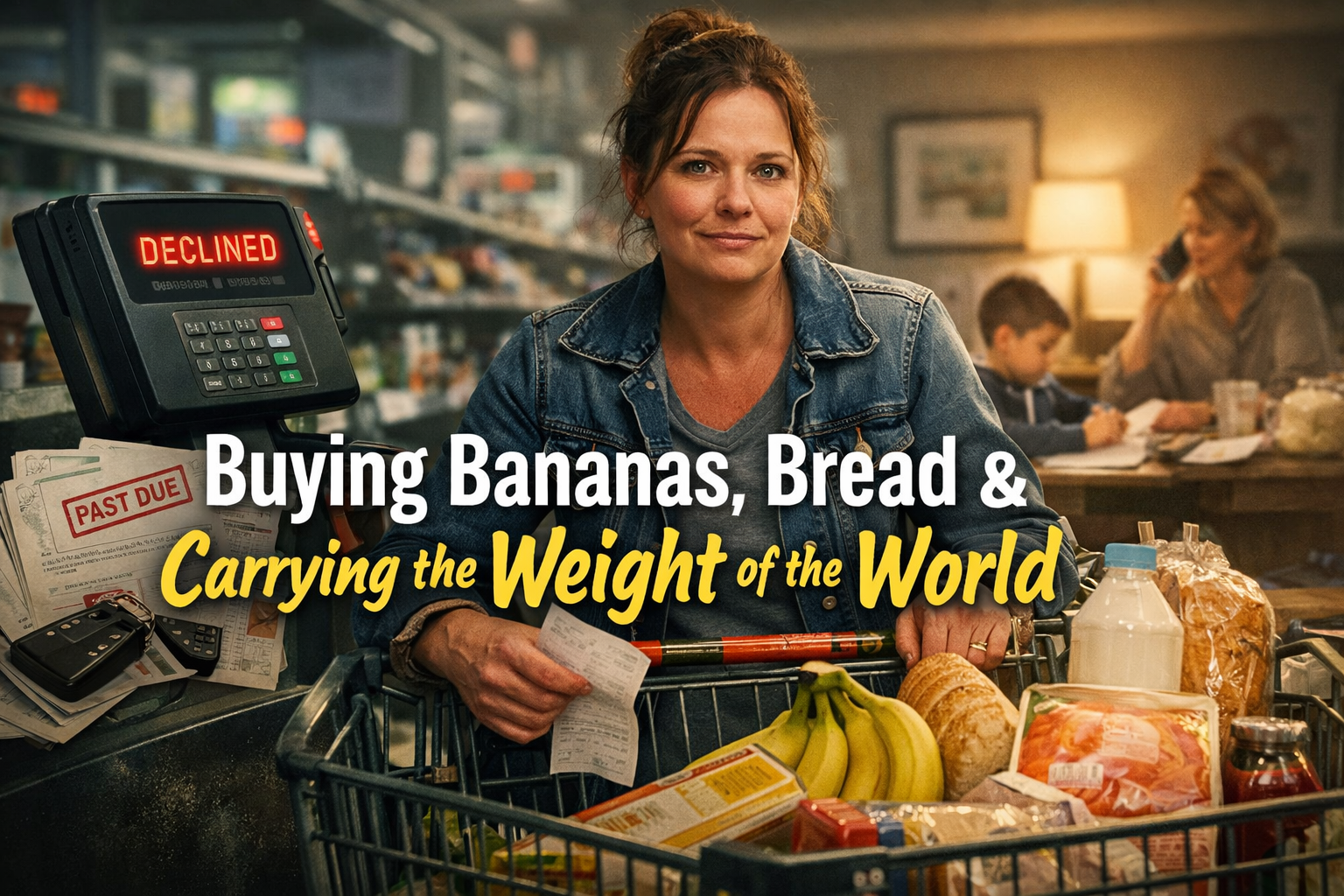
There are some people who make a grand entrance into your life with fireworks, dramatic timing, and a soundtrack that suggests destiny has been collaborating with a lighting department. And then there are the people who meet you beside a malfunctioning card reader at a grocery store, holding a birthday card they may or may not be able to justify, while the fluorescent lights hum overhead like a government office trying its best, and somehow, without fanfare, they tell you more about courage in five minutes than most executives learn after three keynote speeches, two breakout sessions, and a trust exercise involving blindfolds, beanbags, and a white man named Brent explaining vulnerability in a quarter-zip.
The modern world has a bad habit of misunderstanding what strength looks like. It thinks strength arrives in polished speeches, in triumphant LinkedIn posts written from airport lounges, in leadership books with navy blue covers and one-word titles like Grit, Rise, or Synergy but Sadder. It thinks resilience is best expressed by a vice president standing on a hotel stage with a clicker in one hand and a wireless mic in the other, telling a room full of exhausted employees that pressure is a privilege, right before everyone is handed a stale blueberry muffin and sent back to their teams to absorb another round of unpaid emotional labor. We have been sold this glossy little lie that heroism is always visible, always theatrical, always accompanied by applause and perhaps a tasteful piano score.
But real strength is almost never presented that way. Real strength usually looks inconvenienced. It looks under-rested. It looks like someone doing mental math in the cereal aisle while pretending they are just comparing fiber content. It looks like a woman in practical shoes quietly deciding whether she can stretch this week’s groceries far enough to include a birthday card without accidentally declaring war on the checking account. It looks like someone who has not had the luxury of a collapse because the people around her still need lunches packed, rides coordinated, passwords remembered, forms signed, fees paid, and the emotional weather in the home managed with the precision of a battlefield medic and the charm of a cruise director.
That is what struck me about her. Not just what she said, but how she said it. She didn’t deliver her life like a tragedy. She delivered it like a status update. Matter-of-fact. Dry. Efficient. As if being the only provider in a household was simply one more recurring subscription she had forgotten to cancel. And maybe that is what made it land so hard, because there was no campaign around it, no branding, no panel discussion titled Women, Resilience, and the Quiet Excellence of Not Completely Losing It in Public. There was just a woman buying discounted chicken and bananas, joking that even the payment terminal got nervous when it saw her coming, and behind the joke was the kind of truth that does not knock politely. It just walks straight in, takes off its coat, and sits down in your chest.
What she described, in that calm and almost breezy tone people use when the alternative would be screaming into the frozen foods section, was not merely responsibility. Responsibility sounds so neat, so manageable, so color-coded. What she was carrying was the whole circus tent, including the elephants, the clowns, the ticket booth, and that one deeply concerning trapeze act everyone is just agreeing not to discuss. Every bill in her life had apparently formed a union and elected her as their sole point of contact. The mortgage knew her by name. The utilities were on a first-name basis. The gas tank had become a recurring character in the family drama. School expenses appeared with the timing of horror villains, always just when everyone had relaxed enough to believe maybe, perhaps, for one shimmering foolish second, this month might behave itself.
And yet the thing she said that stayed with me most was not about the money. It was the sentence underneath all of it, the sentence millions of people have quietly built their lives around like a condemned property no one is legally allowed to inhabit and yet somehow still calls home. “Once I get ahead, I’ll breathe.” There it was, the national anthem of the overburdened. Not a plan, exactly. More of a prayer in business casual. A promise whispered to the self like a bedtime story for adults who haven’t slept properly in six years. Once I get ahead, I’ll breathe. Once this bill is paid, once this season passes, once the car stops making that noise, once the birthday is over, once the school year settles, once the hours pick up, once the emergency stops breeding in the dark like a family of raccoons wearing tiny utility belts and carrying invoices.
And the terrible joke, of course, is that life almost never “gets ahead” in the dramatic movie-montage way we imagine. There is no swelling soundtrack. No magical clearance sale on suffering. No regional manager from heaven walking in with a clipboard and announcing that due to your exceptional perseverance, your burdens have been reduced by thirty percent and your nervous system will now be upgraded to deluxe. No, life just changes costumes. One crisis clocks out and another clocks in wearing a slightly different hat, maybe carrying a permission slip, maybe a pharmacy receipt, maybe a text message that begins with “Hey, just wanted to let you know,” which as we all know is one of the most chilling sentence starters in the English language.
And still, she was funny. Not cute funny. Not polished funny. Not “this will kill at brunch” funny. She was exhausted funny, which is a very specific genre of brilliance. The kind of wit forged in relentless heat. The kind of humor people develop because despair is expensive and they are already over budget. She had the sharp little one-liners of someone who has stared directly into the administrative abyss and decided that if it was going to swallow her, it was at least going to have to work for it. There is something holy, honestly, about that kind of humor. The ability to stand in line under unflattering lighting, holding a cart full of compromises, and still make a stranger laugh while your own life is balancing on a spreadsheet made entirely of hope and coupons.
So this article is for her, and for every person like her, especially the women who have become the invisible infrastructure of entire households, entire family systems, entire emotional economies. The ones who are somehow expected to be practical and nurturing, tired and cheerful, broke and strategic, frightened and calming, all at once, as if human beings were designed to function as an ATM, a therapist, a scheduler, a chef, a chauffeur, a crisis manager, and a source of gentle encouragement without once needing to sit down on the kitchen floor and ask the ceiling what exactly its plan is.
Because the truth is, some of the strongest people in this country are not giving TED Talks about resilience. They are pricing yogurt. They are answering “Mom?” from three different directions. They are on hold with insurance. They are moving money around like tiny financial magicians, creating dinner from fragments, routine from chaos, stability from fumes. They do not call themselves heroes because heroes sound expensive and they still need to see whether the coupon for paper towels applies to the larger pack. But if heroism means carrying impossible weight without letting the people you love feel the full force of it, then the grocery store is full of heroes, and most of them are too tired to make eye contact.
The Checkout Line Is the New Confessional
There was a time, perhaps centuries ago, when people confessed their deepest truths in candlelit chapels, to clergy, in whispers, or by dramatically staring out rain-covered windows while string music played in the background. Now we do it at self-checkout while scanning avocados and fighting a machine that keeps accusing us of unexpected items in the bagging area, which feels less like retail and more like being emotionally audited by a suspicious toaster. Somehow this has become the modern confessional booth, the place where ordinary people leak little flashes of the truth because the guard is down, the cart is full, and the sheer absurdity of paying nine dollars for a sandwich ingredient has eroded the final layer of social pretense.
That is part of why her honesty landed so hard. Grocery stores are where dignity and arithmetic wrestle in public. You are not just shopping; you are negotiating with reality. Every item is a tiny referendum on your life. Name brand or generic. Fresh fruit or what is on sale. Birthday card or gas. The kind of bread you want or the bread that is available to a person who has turned budgeting into a martial art. And when someone is the only provider, this isn’t shopping in the casual, cheerful, suburban sense where people toss artisan crackers into the cart because they suddenly identify as the sort of household that serves goat cheese. This is strategy. This is logistics. This is the Pentagon, if the Pentagon were run by one tired woman in sneakers trying to remember whether there is enough detergent left to make it to Thursday.
What I keep thinking about is how many women like her have become expert in the kind of executive functioning that corporations spend millions trying to train into management teams who still cannot schedule a meeting without ruining three calendars and someone’s will to live. They track inventory, forecast demand, manage morale, respond to emergencies, coordinate transportation, prioritize competing needs, negotiate with vendors, oversee maintenance, and deliver round-the-clock support under conditions that would make most senior leadership teams cry directly into their catered wraps. Yet for some reason society continues to describe this as “she’s holding it down,” which sounds far too casual, like she is lightly pressing a hand on a tablecloth in the breeze, and not single-handedly preventing the entire tent from launching into the sky.
Imagine for a moment if we described corporate work the way we describe the labor of women holding families together. Imagine a CEO saying, “Yeah, I’m just helping out a little around the company right now,” while privately funding the entire payroll, troubleshooting every outage, soothing every anxious stakeholder, and remembering Kevin’s allergy to shellfish before the retreat menu gets finalized. There would be books. There would be podcasts. There would be a glowing profile in a business magazine titled The Quiet Titan Redefining Leadership Through Presence. But when a woman does the equivalent in a household, often while employed, underpaid, overscheduled, and one loose expense away from a stress eye twitch that could qualify as Morse code, society nods as if this is merely what Tuesdays are for.
And maybe that is part of the insult, the normalizing of impossible labor. The way we have collectively decided that if a woman is competent enough to continue functioning under absurd pressure, then clearly the pressure must not be that absurd. As if the absence of visible collapse is evidence that everything is manageable. As if because she remembered the coupons, signed the forms, smiled at the cashier, and got everyone home alive, her burden must be reasonable. It is the same twisted logic that makes people look at a calm woman and assume she is fine, when in reality calm is often just the last setting left before the whole appliance starts smoking.
The grocery line is full of these women. They are everywhere once you know how to see them. They are the ones calculating totals before the cashier announces them. The ones who say “put that back, baby” in a voice so gentle you almost miss the heartbreak. The ones laughing with strangers because laughter is cheaper than therapy and less paperwork than a nervous breakdown. They are not trying to inspire anyone. They are trying to get through Wednesday. Yet somehow, in the middle of that quiet endurance, they reveal a level of courage more honest than anything framed on an office wall beneath the word Excellence.
There is also something almost criminal about how little room the world gives these women to be complicated. They are allowed to be strong, but only if the strength is convenient. They are allowed to be tired, but only in a charming, relatable way, not in the deeply existential, “I have become one with the hum of the refrigerator and the budget app now controls my blood pressure” kind of way. They are encouraged to persevere, but rarely relieved. Admired, maybe, in passing, but not supported at scale. And support matters. Praise is lovely, but praise does not lower the rent, fix the alternator, buy the inhaler, pay the deductible, or magically turn a family-sized package of chicken into a retirement plan.
So yes, the checkout line is the new confessional, but it is also a witness stand. It reveals who is carrying what, who is laughing through pain, who is one unexpected charge away from staring into the middle distance like a war veteran of customer service and parenthood. And the next time you find yourself beside someone in line, listening to that strange blend of humor and fatigue that only comes from living too close to the edge for too long, remember that you may be in the presence of someone doing Olympic-level emotional and financial labor with no medals, no sponsorships, and no one from Human Resources checking in to ask whether the workload feels sustainable.
The Myth of “Once Things Settle Down”
“Once things settle down” is one of the most dangerous phrases in modern adult life, because it sounds responsible while functioning as a beautifully decorated trap. It is what we tell ourselves when we cannot bear the truth that this may actually be it, this may be the rhythm, the pressure, the cycle, the endless relay race of duties passing the baton from one crisis to the next while we stand there pretending there will soon be a peaceful little gap in which to finally become the person we keep postponing.
Once things settle down, I’ll rest. Once things settle down, I’ll make that appointment. Once things settle down, I’ll replace the shoes with the soles that now seem to be held together by memory and resentment. Once things settle down, I’ll read the book, take the class, go to the dentist, sit on a porch, have a feeling, remember what music I like, exhale long enough to see whether I still have an inner life or whether it was quietly repossessed sometime around utility bill number eighty-seven.
But things do not settle down. That is the scam. Adulthood, especially for the people carrying too much, is less a tranquil progression and more a customer service queue operated by raccoons with clipboards. You think you have resolved one issue and another appears from behind a potted plant holding a form and demanding a signature. The car insurance renews at an offensively spiritual number. The child needs money for something that was absolutely not mentioned in the syllabus. A birthday appears. A prescription changes. The school sends an email at 9:42 p.m. requiring an item no normal household has ever casually kept on hand. The refrigerator makes a noise that sounds too expensive to investigate. Nothing settles down. It merely rotates.
And the people most likely to live inside that postponement are usually the ones least permitted to name it. They have become so essential to the functioning of everyone else’s life that even their fantasy of rest must be scheduled around logistics. They cannot dream in grand, cinematic ways anymore because their dreams have been broken into practical units. Not “I want a new life,” but “I would like one whole week where no one needs a form signed, a fee paid, a ride arranged, or an emotional climate reset.” Not “I want luxury,” but “I would love for my nervous system to stop behaving like a smoke detector someone forgot to remove the battery from.” Not “I crave extravagance,” but “I would like to buy the good laundry detergent without feeling like I have betrayed the republic.”
What that woman in the store said was heartbreaking precisely because it was so common. Once I get ahead, I’ll breathe. There are millions of people walking around with that sentence stitched invisibly into their chest. And the tragedy is not just that they are exhausted. It is that they have started treating oxygen like a reward rather than a right. Breathing is something they think they must earn through flawless endurance, through one more sacrifice, one more month, one more strategic act of self-erasure in service of stability. As though there is some invisible committee watching from above, waiting to grant them permission to become fully human again once they have demonstrated sufficient grit in the face of recurring nonsense.
The world loves this arrangement, naturally. Systems thrive on people who normalize deprivation. Employers adore workers who turn survival into an identity. Institutions flourish when the most responsible people quietly absorb the most dysfunction. Families, communities, and organizations all have a way of silently arranging themselves around the person least likely to say no, then congratulating that person for being dependable while continuing to hand them the emotional equivalent of wet cement. It is one of the great unspoken thefts of adult life: the reliable become load-bearing, and the moment they prove they can carry more, more arrives wearing a smile.
And this is where the humor comes in, because if you do not laugh, you will start writing increasingly aggressive emails to the electric company that end with “best regards” but carry the spiritual tone of a medieval curse. Humor is not denial. It is often the last surviving form of sovereignty. It is the soul’s way of refusing to become entirely mechanical. When that woman joked about the card machine being nervous around her, she was not minimizing her struggle. She was reminding the universe that it could take a lot from her, but it was not getting her timing. It was not getting her punchlines. There is defiance in that. There is artistry in making wit out of weariness. Some people compose symphonies; some people stand in front of a frozen payment terminal and improvise one-liners because otherwise the whole produce section might get a firsthand look at their nervous system leaving their body.
I think a lot about what it costs to live in constant postponement. Not just financially, though certainly that too. I mean psychologically. Spiritually. What does it do to a person to keep moving their own humanity to the bottom of the pile? To treat rest like a luxury item? To become so fluent in necessity that desire itself starts to feel irresponsible? There are people who have forgotten how to ask themselves what they want because every internal conversation has been rerouted through the switchboard of what is required. They do not get to be whimsical. They do not get to be inefficient. Their whole lives have been converted into a practical language of getting through.
And still they are told to practice self-care, which is very funny in the bleakest possible way. Nothing says societal misunderstanding quite like telling an overburdened single provider to “pour into yourself” as if she is a decorative fountain in a wellness brochure and not a human person one tire blowout away from having to choose between groceries and pretending everything is fine. Candles are lovely, but candles are not a structural solution. Bath bombs are not fiscal policy. A lavender-scented suggestion from someone who has never had to decide between a copay and a field trip fee is not relief. It is aromatherapy for the apocalypse.
So perhaps the first honest thing we can say is this: a lot of people are not failing to rest because they have poor boundaries. They are failing to rest because the math does not permit it. The obligations do not permit it. The systems around them are held together by their unpaid overperformance. And until we are willing to say that out loud, we will continue offering inspirational nonsense to people who do not need another quote about blooming where they are planted. They need fewer things trying to eat them alive.
Women Who Carry Whole Worlds and Still Remember the Coupons
It is impossible to overstate how much of civilization is quietly being held together by women who have not had a full uninterrupted thought since 2017 but can still locate a missing shoe, remember a dentist appointment, thaw the chicken, answer a school email, diffuse a family tension, compare unit prices, and somehow make it all look less catastrophic than it really is. If extraterrestrials were studying our planet seriously, they would not be interviewing the men on podcasts explaining disruption. They would be standing near a laundry basket watching a tired woman reorganize six competing disasters before 8:15 a.m. and concluding, correctly, that she is the dominant life form.
These women are remarkable not because they wanted to be symbols, but because the world keeps handing them impossible combinations and they continue, through equal parts necessity, love, exhaustion, and dark humor, to create functioning reality from fragments. They are part bookkeeper, part medic, part logistics specialist, part morale officer, part hostage negotiator, and part amateur economist, all while being expected to answer questions like “What’s for dinner?” in a tone that does not suggest they are considering faking their own disappearance and starting over in a town where no one has ever heard the phrase “just one more thing.”
And yet the public language around this kind of woman is absurdly insufficient. We call her strong, which is true but incomplete. We call her dependable, which sounds like she is an appliance that has been getting excellent reviews. We say she is doing her best, which is accurate but somehow too gentle, too pastel, too emotionally scented, as though she is scrapbooking through difficulty rather than body-checking chaos into submission on a daily basis. There should be bigger words. More precise words. Words that account for the sheer muscularity of sustaining a family under pressure while often disappearing in plain sight beneath the title of “mom,” “wife,” “daughter,” “worker,” or the all-purpose and deeply underfunded category of “the one who handles it.”
Because that is what happens to a lot of women. They become “the one who handles it.” Which sounds almost flattering until you realize it is often code for “the one we unconsciously assign the overflow to because she has demonstrated she will somehow keep functioning even when the load is insulting.” She handles the paperwork. She handles the schedule. She handles the birthdays, the emergencies, the dishes, the awkward conversations, the practical adjustments, the emotional debris, the little invisible failures of everyone else’s planning. She becomes the containment unit for the chaos other people create, inherit, or simply fail to notice. And because she is skilled, she becomes expected. That is the trapdoor beneath competence. Do something well enough and suddenly it is no longer seen as effort. It becomes atmosphere.
What breaks my heart is how often these women are funniest when they are closest to the edge. Not because their pain is funny, but because humor becomes a pressure valve, a kind of elegant rebellion against total depletion. Their jokes come out fast and dry and perfect, often while they are carrying more than anyone in the room fully understands. They will say something devastatingly funny about bills, exhaustion, scheduling, or the absurdity of modern life, and everyone will laugh, because of course it is funny, but also because none of us quite know what to do with the fact that the joke came wrapped around real sacrifice. Exhausted women have some of the best material on earth because they are living at the intersection of responsibility and nonsense, and that is where comedy breeds like mold in a rental bathroom.
There is also a particular loneliness in being the capable one. When you are the person people rely on, they often stop checking whether you are okay. Not because they are cruel, necessarily, but because your consistency creates an illusion of endlessness. You become a utility. A service. A stable feature in everyone else’s emotional weather. People start approaching you the way they approach Wi-Fi or electricity: with mild irritation when you are unavailable and almost no astonishment when you keep working despite the storm. They forget that behind all that competence is a human body, a human mind, a human spirit that may be one delayed paycheck away from sitting in the car for ten extra minutes in a parking lot just to experience silence without anyone needing anything.
And this is why the woman in the grocery store felt so unforgettable. She wasn’t trying to be profound. She was just being honest in the accidental, unscripted way truth sometimes slips out when no one is posing for it. She had that exhausted dignity so many women carry, the kind that doesn’t demand attention because attention itself would be another thing to manage. She wasn’t asking for anyone to call her inspiring. She wasn’t building a personal brand around resilience. She was just buying groceries and continuing to hold up a life that clearly asked too much of her, and somehow she still had the presence to joke, to smile, to move through the world with enough grace that a stranger could see both the strain and the astonishing force required to keep going.
So yes, some people wear capes. And some people wear tired eyes, discount-store sneakers, and an expression that says they have personally argued with three institutions before noon. Some people save cities in movies. Some save households on Thursdays. Some people are celebrated in public. Some people remember the coupons, stretch the dinner, absorb the panic, tuck away the receipt like one more battle report, and do not even get to sit down until long after everyone else is asleep.
If heroism means making life possible for others while carrying fear privately, then these women are heroes. If courage means continuing without certainty, then these women are courageous. If leadership means creating stability under pressure, then half the leadership books in America need to apologize directly to the woman in the grocery line and ask whether she would like to teach the master class, though naturally she would not have time because she still has to get home, unload the bags, answer two questions, solve three small crises, and probably check whether the bank account survived the trip.
Final Thoughts: Some Miracles Come with Receipts
I keep coming back to that image of her tucking away the receipt. Not dramatically. Not symbolically. Just automatically, the way people do when every dollar has to remain traceable and every purchase is part transaction, part testimony. But there was something almost sacred in it, because that little strip of paper was more than proof of purchase. It was evidence of effort. Evidence that she had once again entered the arena of ordinary survival and come out with dinner, household supplies, and her sense of humor still technically operational.
Some miracles do not look miraculous while they are happening. They look like routine. They look like repetition. They look like someone driving the same roads, paying the same bills, making the same substitutions, telling themselves the same hopeful lie about breathing later. They look so ordinary, in fact, that the world often misses them completely. But keeping a home afloat when the math does not love you back is a miracle. Feeding people when prices are climbing like they have a personal grudge against happiness is a miracle. Turning anxiety into normalcy for the sake of the people you love is a miracle, even if it is done while wearing yesterday’s fatigue and holding a store-brand loaf of bread.
And perhaps that is the part we most need to say aloud: ordinary struggle does not mean small struggle. Just because the burden is common does not mean it is light. Just because millions are living this way does not make it acceptable, sustainable, or somehow less worthy of tenderness. There are people walking around right now performing quiet acts of devotion so constant that they have been mistaken for personality traits. She’s just strong. He’s just dependable. She’s just good under pressure. No. They are adapting to relentless demands with a grace that would be celebrated properly if the world were not so busy mistaking survival for normalcy.
That woman in the grocery store probably went home and continued her day the way so many people do, without ceremony. Groceries unpacked. Dinner considered. Something wiped down. Something paid. Something postponed. Maybe someone in the house asked for something before she even put her purse down. Maybe no one fully understood how much math had gone into the cart, how many invisible choices had already been made before the first item reached the conveyor belt. Maybe they never will. That is another quiet cruelty of this kind of labor: much of it is only visible when it fails.
But I saw her, if only for a moment. And I think a lot of us have seen some version of her. Maybe in our mothers, our sisters, our friends, our coworkers, ourselves. Maybe in the woman smiling through a grocery run. Maybe in the one answering emails at midnight after everyone else is asleep. Maybe in the one making jokes because humor is the only part of her day still fully under her control. Maybe in the one who keeps saying she will breathe once she gets ahead, while life keeps moving the finish line and sending another fee in a different font.
So let this be said with the seriousness it deserves and the humor it has probably earned: the world is standing on the backs of women who are one minor inconvenience away from laughing so hard they cry and crying so hard they accidentally reorganize the pantry. Civilization, frankly, is being maintained by people with overdrawn patience, practical shoes, and a breathtaking ability to turn love into logistics. Not glamorous logistics, either. Real logistics. Coupons. Carpooling. Utility calls. School forms. Store brands. Tiny substitutions. Quiet sacrifices. The kind of daily, repetitive excellence that no one claps for because by the time anyone notices it, the moment has already moved on to the next task.
So if you are that woman, or have been that woman, or love that woman, know this: you are not failing because you are tired. You are tired because you have been succeeding at something brutally hard for far too long with far too little relief. The answer is not more inspirational slogans. It is not another lecture about mindset from someone whose groceries have never had to double as a moral test. It is recognition, yes, but also support, softness, rest, backup, practical help, and the kind of respect that does not just admire endurance but asks how to reduce the need for it.
Until then, I suppose many of the holiest people among us will continue doing what they have always done. They will swipe the card. They will make the joke. They will tuck away the receipt like a field report from another skirmish in the endless campaign of keeping life running. They will go home and turn love into dinner again. And the rest of us, if we are paying attention, ought to stop calling that “just getting by.”
We should call it what it is.
A miracle with coupons.






https://shorturl.fm/38lkI