
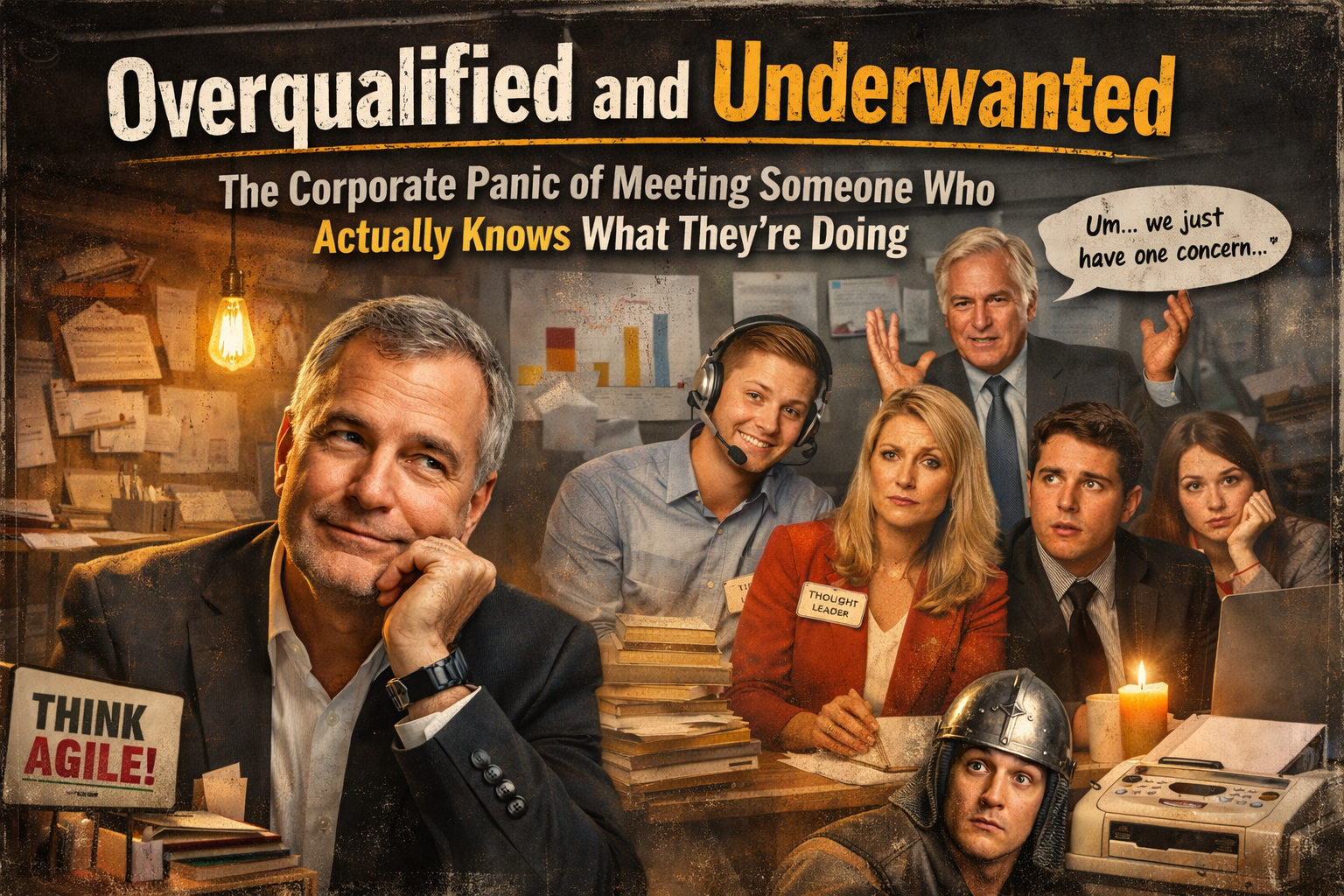
There is a very specific kind of sentence that arrives in the modern hiring process wearing a nice blazer, speaking in a careful tone, and pretending it is there to help, when in reality it has come to quietly push your confidence down a flight of stairs. It usually begins with praise, because corporate America loves nothing more than softening a punch with a compliment, and it sounds something like this: “You were incredibly impressive, the team really enjoyed meeting you, we were excited by your background, and we can absolutely see the value you would bring here.” That is the verbal appetizer. Then comes the entrée of nonsense. “Our only concern is that you may have too much experience.”
Too much experience.
What a remarkable phrase. What a dazzling, polished, deeply unserious thing to say out loud in a business setting where entire companies allegedly exist to solve problems. Imagine applying that logic anywhere else in adult life. A pilot steps into the cockpit and someone from talent acquisition leans over and whispers, “I don’t know, Brenda, he has landed too many planes. We were hoping for somebody with a little less familiarity with gravity.” Or a firefighter shows up and the town council says, “Frankly, we worry she has responded to too many emergencies. This role really calls for someone more eager, more moldable, perhaps someone who still thinks smoke is mostly symbolic.”
But in hiring, somehow, this gets treated like wisdom. It gets delivered with a face full of concern, like they are protecting the candidate from a mismatch rather than protecting themselves from the horrifying possibility that someone competent might join the building and start asking the kind of calm, devastating questions that make weak leadership break out in a cold rash. Because that is what “too much experience” usually means. It does not mean the candidate lacks fit. It means the candidate might possess perspective. They might recognize confusion disguised as strategy. They might hear the phrase “we’re still building the plane while flying it” and, instead of nodding like a LinkedIn pilgrim, ask why everyone on board is applauding obvious negligence. They might notice that the systems do not connect, the goals do not align, the managers contradict one another, and Kevin’s quarterly presentation has been surviving for three years on clip art and emotional bluffing.
And this is where the whole theater gets especially insulting for seasoned professionals, because the very people making these judgments are often standing on foundations so flimsy they would not survive one hard gust of accountability. The candidate has survived recessions, mergers, layoffs, software migrations, budget freezes, impossible bosses, undercaffeinated crises, overcaffeinated leadership retreats, and all the strange humiliations that come with being the adult in rooms full of people who confuse enthusiasm with expertise. Meanwhile, the panel across from them is nodding in coordinated concern like a startup choir, worried that somebody with actual scar tissue might be a dangerous presence in a department currently being held together by personality assessments, Slack emojis, and one operations manager who cries in her car.
That is the quiet comedy of the modern job market. Companies claim they want leadership, maturity, resilience, and strategic thinking, but what they often mean is that they want those qualities in brochure form. Decorative leadership. Framed wisdom. Competence that looks beautiful in a mission statement and never once interrupts a bad decision in real time. They want someone experienced enough to fix things, but not experienced enough to notice who broke them. They want insight without friction. Authority without challenge. An adult, but preferably one who has agreed in advance not to sound too adult.
So let us talk honestly about this ridiculous little pageant, because all across the professional world, people with real experience are being told they are somehow suspicious for having accumulated too much proof that they can do the work. And that is not merely frustrating. It is hilarious in the bleak, fluorescent way only corporate dysfunction can be. It is not a hiring process anymore. It is a haunted escape room where every clue says the same thing: they do not fear incompetence nearly as much as they fear being seen by someone who can identify it immediately.
The Compliment Before the Ambush
The first thing to understand about modern hiring is that rejection rarely arrives honestly. It arrives dressed as concern. Corporate language has evolved to make almost every insult sound like a mindfulness exercise, which is why companies can look directly at a highly accomplished candidate and essentially say, “You seem threateningly capable,” while somehow making it sound like a wellness based decision. The sentence “you have too much experience” is not feedback. It is a smoke bomb. It is the verbal equivalent of somebody pulling a fire alarm right before the audit starts.
The process leading up to that sentence is always part of the joke. Nobody gets told they are overqualified in the first five minutes. No, no. That would be efficient, and efficiency is not what we do here. First, the candidate is marched through multiple interviews like a very tired pageant contestant. They talk to HR, who asks them what animal best represents their leadership style, because apparently success in business hinges on whether you identify as an eagle, a wolf, or a deeply burnt-out raccoon holding a resume in its tiny little hands. Then they meet the hiring manager, who says he is looking for a strategic thought partner but later reveals he mostly needs someone who will fix six years of operational neglect without making anyone feel judged for causing it. Then comes the panel, where several cheerful strangers ask the same question in slightly different outfits. Then comes the assessment, because no modern company can simply observe a person behaving intelligently; it must first subject them to a digital quiz designed by a consultant who believes human personality can be accurately measured through reaction choices about staplers.
The candidate plays along, because what else are they supposed to do. They smile. They tell stories. They translate years of actual hardship into tidy examples about leadership under pressure. They explain how they solved messy problems, coached difficult teams, managed stakeholder chaos, rescued underperforming functions, and remained composed while entire departments behaved like raccoons fighting in an HVAC vent. They do everything right. They bring exactly the substance companies claim to want. And then, once everyone has had a chance to admire how useful this person could be, the mood shifts.
Suddenly, the people interviewing them begin to experience a very specific corporate dizziness. They start imagining what it might feel like to manage someone who has seen nonsense before. Someone who will not be dazzled by jargon. Someone who might hear, “We’re looking for a ninja who can wear a lot of hats in a fast-paced environment,” and calmly translate it into, “So the role is understaffed, underdefined, and emotionally predatory.” Someone who might join a meeting, listen quietly for eleven minutes, and then ask one devastatingly reasonable question that exposes the fact that nobody in leadership has the same definition of success. This is when admiration becomes anxiety. Not because the candidate cannot do the job, but because they clearly can, and competence is deeply destabilizing in an environment built on presentation.
So the compliment changes shape. It becomes selective. “We loved your background.” “We were impressed by your expertise.” “You are clearly very accomplished.” Notice how all of those phrases are pastels. Soft tones. Decorative cushions laid gently around the hard truth, which is that the room has realized this person is not just qualified. They are experienced enough to detect fraud in its natural habitat. And suddenly the strength that made the candidate attractive now feels risky to people who have survived this long by never being measured against genuine steadiness.
That is why “too much experience” lands with such absurdity. It is a compliment weaponized into a warning. It says, “You are probably right about a great many things, and that makes us uncomfortable.” It says, “We prefer a candidate we can shape, not one who has already learned how often organizations lie to themselves.” It says, “You have seen enough chaos to know ours is not charming.” This is not selection. It is self-defense by committee.
Decorative Wisdom and the Fear of the Functional Adult
One of the strangest features of modern corporate life is how aggressively it celebrates wisdom in theory while panicking at the sight of it in person. Every company claims to love experience. They put it in the job description with almost religious sincerity. They want a seasoned leader. A strategic thinker. A mature operator. A calm hand. A collaborative problem-solver. They say they want someone who can lead through ambiguity, build processes, mentor teams, drive outcomes, and communicate across levels. In other words, they say they want a grown adult.
But then a grown adult shows up.
And now the room changes temperature.
Because the truth is, many workplaces do not actually want maturity. They want the aesthetic of maturity. They want someone who sounds reassuring in interviews and on company websites, but who will not create too much turbulence once hired. They want wisdom as wallpaper. Leadership as branding. Judgment as a decorative item you can reference in a town hall. What they do not want is the operational version of adulthood, which is the person who notices that the department has no clear ownership model, the deadlines are fictional, the reporting line makes no sense, and half the team has built its professional identity around saying “great point” in meetings while contributing nothing measurable.
This is especially threatening in offices where the management structure has been assembled through a combination of panic promotions, vague charisma, and historical accidents. You know the places. The director is there because she once stayed late during a reorganization and nobody corrected the misunderstanding. The senior manager is there because he speaks confidently in bullets and knows how to say “cross-functional alignment” without blinking. The recruiter believes culture fit is a scientific discipline. The vice president keeps using phrases like “high-level visioning session” because the details tend to collapse when touched. Everyone is performing business. Some of them are quite good at the performance. But performance has one natural predator, and it is competence.
An experienced candidate threatens this ecosystem simply by existing. Not because they are arrogant. Usually the opposite. Truly seasoned professionals are often calmer than everyone else in the room, because life has already beaten the drama out of them. They are not there to grandstand. They are there because they know how work happens. They know what strong teams feel like. They know the difference between healthy ambiguity and managerial neglect. They know that “we’re all wearing a lot of hats” often means someone cheap made a staffing decision and then gave it motivational branding. They know that a department held together by vibes eventually becomes a legal matter.
And that knowledge is disruptive.
Not disruptive in the fun, TED Talk way. Not the polished innovation kind. Disruptive in the terrifying way a light is disruptive to a room that has adjusted to darkness. Because once a functional adult walks in, the rest of the room risks becoming visible to itself. Suddenly, someone might notice that the onboarding plan is just three Google Docs and a prayer. Someone might ask why every problem is urgent but none of them are owned. Someone might question why the team keeps changing priorities every eight days like a teenager changing majors. Someone might gently suggest that the endless talk about agility has become an excuse for never finishing anything.
This is why younger or less seasoned panels sometimes react so strangely to experienced candidates. It is not always age, and it is not always insecurity in the cartoonish sense. It is often something subtler and sadder. They have built careers inside environments where performative confidence was rewarded, where fluency in corporate language could compensate for thin substance, where being agreeable mattered more than being right, and where the people who held things together did so quietly while others collected credit. Then into that ecosystem walks someone who has actually carried responsibility. Someone who has had to explain bad numbers to executives, deal with payroll disasters, clean up broken operations, manage difficult customers, soothe frightened teams, and make decisions that mattered after the inspirational posters went home.
That person does not need to posture. They do not need to say “I’m a thought leader.” They do not need to post a filtered paragraph about resilience under a photo of themselves near a plant wall. Their experience sits differently. Heavier. Quieter. More real. And in rooms built on image, reality can feel weirdly rude.
So companies end up choosing comfort over capability. They select candidates who feel easier to absorb, easier to influence, easier to place inside a shaky system without forcing that system to confront itself. Then, months later, leadership wonders why execution remains inconsistent, accountability remains foggy, and the team keeps hosting meetings about problems that should have died in February. They do not connect it to the candidate they rejected for being too experienced, because that would require one final act of honesty, and by that point honesty has usually been pushed to the edge of the org chart and left without calendar access.
Haunted Workplaces in Business Casual
There should really be a more accurate phrase than “overqualified,” because what is often being described is not excess qualification at all. It is atmospheric incompatibility. The candidate is not too experienced for the role. The workplace is too spiritually fragile for the candidate. That is a very different problem. The person could do the job. The office simply senses, somewhere in its haunted little bones, that hiring this individual would end the era of stylish confusion that has kept everyone employed and unexplained for years.
A haunted workplace is not necessarily loud. In fact, many of them are very polished. Clean branding. Beautiful slide decks. Wellness language everywhere. Core values on the walls. A head of people who speaks in warm, curated paragraphs about authenticity while employees exchange thousand yard stares in the kitchen. The haunting lives underneath. It lives in the strange pause after simple questions. It lives in titles that do not match responsibilities. It lives in priorities that shift according to the mood of whoever returned from leadership offsite with a new favorite phrase. It lives in the peculiar fact that nobody can explain why a process exists, only that it does, and touching it may alert Kevin.
These workplaces are often maintained through collective emotional choreography. Everyone knows roughly where the weak beams are, so they learn to step around them. Nobody says directly that the strategy is thin, the team is confused, or the manager is mostly an email with shoes. Instead, people adapt. They normalize nonsense. They speak in euphemisms. They call dysfunction “complexity,” indecision “thoughtfulness,” chaos “pace,” and exhaustion “commitment.” This is how a department becomes haunted: not by one catastrophe, but by years of adults agreeing not to name what they can plainly see.
Then an experienced candidate interviews, and the workplace senses a threat.
Not because the candidate is mean. Not because they intend to clean house like some cinematic consultant with a tragic backstory. But because experienced people carry an invisible map of patterns. They know the smell of avoidable disaster. They can hear process rot in a sentence. They can detect when a leader is narrating instead of managing. They understand that the sentence “we need someone who can come in and build structure” often translates to “everything is on fire and no one wants to admit who brought the matches.” They have lived too much life inside too many companies to be charmed by decorative urgency and espresso powered confusion.
This is where the interview feedback becomes comedy. “We worried you might not feel challenged enough.” That one is beautiful, because it assumes the experienced candidate has been spending their life seeking novelty rather than peace. As though after twenty years of professional warfare, what they are desperate for is not stability, competence, and health insurance, but one more whimsical opportunity to untangle a reporting structure designed by ferrets. Or, “We were concerned you might get bored.” Bored. My God. Do you know what seasoned professionals dream of? Boredom. Clean, orderly, respectful boredom. A calendar that makes sense. A manager who answers directly. A process with an owner. A meeting that ends because the topic is finished instead of because everyone’s suffering has reached legal limits.
But haunted workplaces do not understand that kind of maturity. They confuse steadiness with restlessness, confidence with threat, and wisdom with noncompliance. They imagine the experienced candidate arriving and immediately judging everyone, when in reality that candidate would probably just like to do the work, help the team, improve the systems, and maybe, if the gods are merciful, make it through one quarter without hearing the phrase “quick sync” seven hundred times. The office projects its own anxiety onto the candidate. It assumes competence comes with accusation, because incompetence is often secretly accusatory toward itself.
So they pass. They choose someone lighter, safer, less likely to notice the ghosts. And the workplace continues, drifting elegantly through quarters, maintaining the same unstable rituals, wondering why every strategy execution turns into group therapy with spreadsheets. Meanwhile, the rejected candidate is left to process the absurdity of being told that surviving more of life somehow made them less employable, which is like being denied entry to a ship because you know too much about swimming.
Final Thoughts: When Competence Becomes the Scariest Thing in the Room
There is a cruel little irony at the heart of all this. The people most likely to steady a shaky workplace are often the very ones it rejects. Not because they lack humility, not because they lack adaptability, not because they would not fit, but because they remind the organization of everything it has been avoiding. Competence does that. Real competence is not flashy. It does not need a ring light, a thought leadership caption, or a five part personal brand series on resilience. It just sits there, calm and deeply inconvenient, refusing to pretend confusion is strategy or that a vague mission statement can substitute for operational truth.
That is why so many seasoned professionals leave interviews feeling as though they were not rejected by a company so much as expelled by a group hallucination. They did everything right. They prepared, connected, answered thoughtfully, showed range, demonstrated wisdom, conveyed steadiness, and somehow still got told that their greatest professional strength had become a liability. That kind of feedback can mess with your head if you let it, because it is designed to sound plausible while being fundamentally unserious. It borrows the language of fit to mask the reality of fear.
And the fear is simple. A lot of organizations do not mind dysfunction nearly as much as they mind exposure. They can tolerate waste, confusion, duplication, weak leadership, contradictory goals, and years of expensive drift as long as everyone involved agrees to treat it like weather. What they cannot tolerate is the arrival of one grown adult who quietly recognizes that none of this is normal. One person who knows where the lifeboats are. One person who can read a balance sheet, manage a conflict, build a process, coach a team, and detect nonsense before it becomes a quarterly surprise. One person who hears “we’re very excited about your background” and understands that the sentence only matters if the people saying it are brave enough to hire what they claim to admire.
So if you have been told you are too experienced, overqualified, too senior, too much, too steady, too direct, too seasoned, too something for a role you know you could have done with one hand on the keyboard and the other hand stopping the building from sliding into a ravine, do not automatically treat that as a verdict on your value. Sometimes it is not a rejection of your talent at all. Sometimes it is a confession from the company, though they would never phrase it that way. Sometimes they are telling you, in the softest and most corporate language possible, that they are not equipped for someone who can see clearly.
And honestly, that may be the most useful information you get from the entire process.
Because yes, rejection stings. It always will. It is maddening to be measured by panels that confuse freshness with depth and energy with judgment. It is exhausting to watch experienced professionals be treated like suspicious artifacts from a time when work was allowed to mean something concrete. It is infuriating to hear maturity praised in public and penalized in practice. But there is also a strange comfort in recognizing the pattern for what it is. Not every “no” is evidence of a flaw in the candidate. Some of them are proof that the room was not prepared for reality.
And reality, unfortunately for many modern offices, does not care how pretty the slideshow is.
It still knows when the numbers are wrong. It still knows when the process is broken. It still knows when leadership is hiding behind vocabulary. And it still knows the difference between a healthy workplace and a haunted one wearing business casual and calling itself agile.






https://shorturl.fm/LQ091