
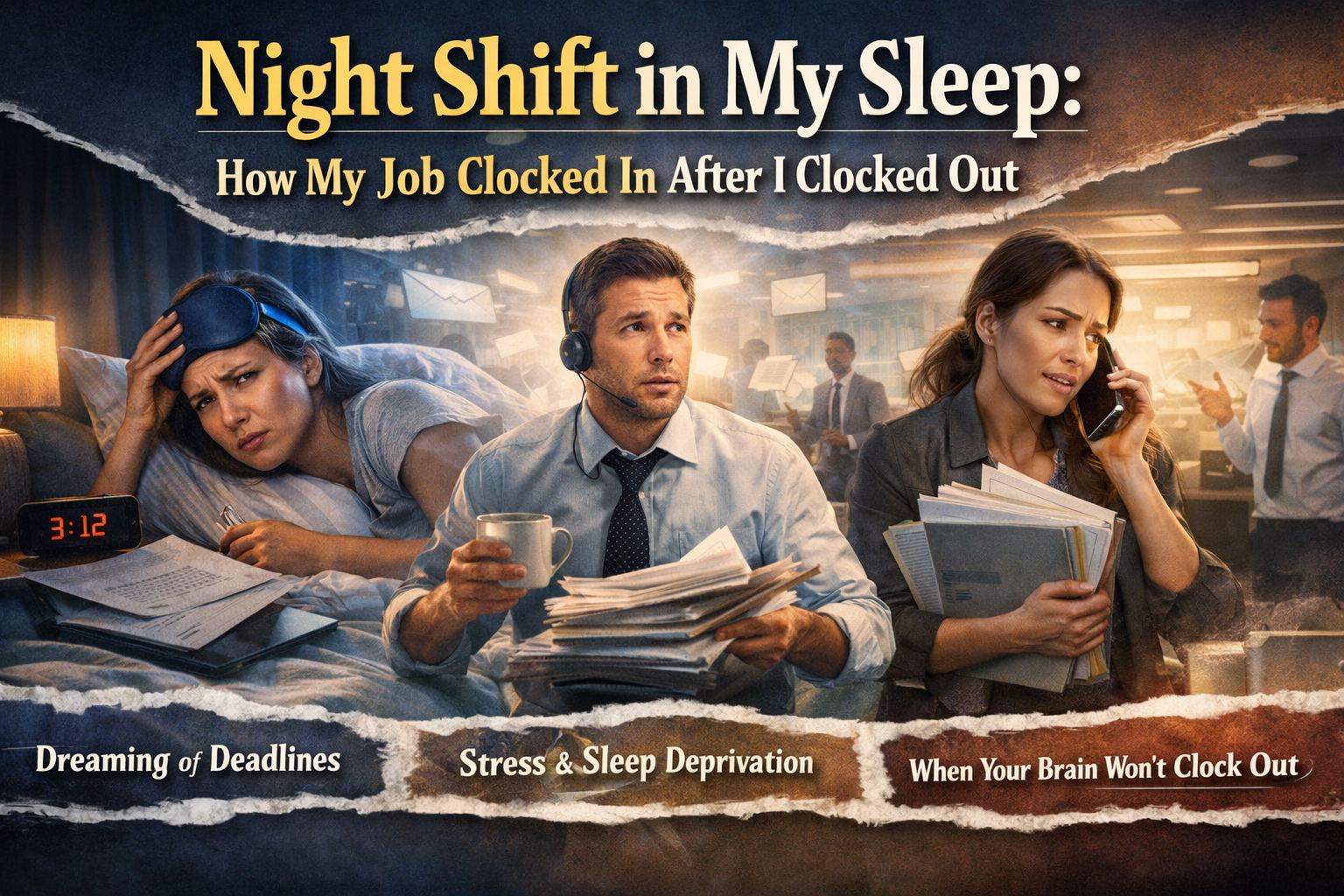
There’s a particular kind of betrayal that only happens at bedtime, when you do everything right—brush your teeth like a responsible adult, set your alarm like a person who still believes in hope, put your phone face down like you’re auditioning for the role of “someone with boundaries”—and then you slide under the covers expecting rest, peace, maybe even one of those soft, cinematic dreams where you’re walking through a field of wildflowers with a vague sense of purpose and excellent hair.
Instead, your brain pulls up a rolling chair, clears its throat, and opens a laptop.
Because apparently I don’t sleep. I just change locations.
Every night, without fail, I go to bed and my job comes with me, like an unpaid intern that refuses to go home, like a coworker who thinks “quick question” is a valid time zone, like a corporate poltergeist that lives in my nervous system and rattles the chains of my calendar invites the moment my eyelids close. I don’t drift off into dreams; I get assigned to a new shift in a completely imaginary office where nothing makes sense, everything is urgent, and the Wi-Fi is always just bad enough to ruin my confidence.
It’s not even the fun kind of work dream, either, where you’re the CEO of something glamorous and everyone claps when you enter the room. No. It’s the dream version of your job, which is somehow more stressful than the real one because the rules are vague and the consequences are dramatic and your boss is a symbolic representation of “performance expectations” wearing a polo shirt.
And the worst part is how normal it feels while it’s happening.
In the dream, I don’t think, “Why am I answering emails in a hallway that looks like my high school cafeteria?” I just accept it the way adults accept everything else that’s unreasonable: with a sigh, a tight jaw, and the deep internal understanding that the meeting will start whether I’m emotionally prepared or not.
By the time I wake up, I’m exhausted, like I’ve worked a full day in a parallel universe where the only currency is anxiety and the only break room snack is the sensation of being behind.
So yes. Every time I go to bed, I dream about my job.
And if I’m being honest, I’m starting to suspect my subconscious has a manager.
The Dream Office Where Nothing Works and Everything Matters
Dream-me always shows up for work the same way: already late, already sweating, already carrying the emotional weight of five unanswered emails and the faint feeling that I forgot something important even though I don’t know what it is, and no one will explain it to me because apparently we “covered that” in a meeting I wasn’t invited to.
The dream office is never my actual workplace, because that would be too easy. It’s always some strange hybrid location: half corporate conference center, half abandoned mall, half airport terminal, and somehow still containing the exact same energy as a Monday morning where everyone’s pretending they had a restful weekend while their eyes quietly confess they did not.
In this place, the layout changes constantly. I walk toward my desk and it turns into a staircase. I open a door and it’s a supply closet full of printers that are all jammed with paper they refuse to release, like they’re hoarding it out of spite. The elevator stops on a floor that doesn’t exist. The hallway stretches into infinity like the world’s least inspiring treadmill.
And I’m still expected to perform.
Someone asks me for a report and I’m like, “Absolutely,” because dream-me has excellent customer service instincts and absolutely no self-preservation. Then I try to pull up the report and the computer is running on a system that looks like it was designed by an alien who once overheard the phrase “spreadsheet” and decided to improvise.
I click “File” and it opens a menu called “Emotional Consequences.”
I click “Send” and it asks, “Are you sure you deserve to be confident?”
I click “Refresh” and a coworker appears behind me and says, “Hey, quick question,” which is the dream equivalent of a jump scare.
In my sleep, I am constantly trying to do my job, but the tools don’t work, the instructions are unclear, and the vibe is always, always, always that I should have figured it out already. The most unrealistic part is that dream-me doesn’t even question this. Dream-me just accepts that competence is a scavenger hunt and the clues are hidden inside my sense of worth.
And the pressure is intense, not because anything is actually happening, but because dream logic has the audacity to attach life-or-death stakes to the smallest tasks. If I can’t find the right attachment, the company collapses. If I can’t remember my login password, the economy suffers. If I don’t respond to the email fast enough, everyone will finally discover what I’ve feared all along: that I am one minor inconvenience away from being exposed as a professional adult held together by caffeine and calendar reminders.
Then I wake up and realize none of it happened.
But my body doesn’t know that.
My body is already in “let’s survive the day” mode, heart racing like I just sprinted through a burning building with a laptop and a sense of responsibility. My brain feels like it spent the night lifting weights made of expectations. My shoulders are up near my ears like they were trying to escape.
And it hits me, right there in the morning light, that I didn’t rest.
I just did overtime in my imagination.
The Anxiety Version of Me Is a Full-Time Employee
There’s a version of me that exists exclusively in my sleep, and I need you to understand that this version of me is deeply committed to the job.
This version doesn’t ask for clarification. This version doesn’t say, “That deadline isn’t realistic.” This version doesn’t take breaks. This version takes every minor workplace inconvenience and turns it into an epic emotional saga, like my subconscious is writing a prestige drama called The Inbox and it’s currently in season seven.
Dream-me is always trying to prove something.
Dream-me is always trying to keep up.
Dream-me is always trying to be helpful, which is how you know dream-me is operating under the ancient professional curse that says: if you just work hard enough, maybe you’ll feel safe.
Except safety isn’t what those dreams deliver.
Those dreams deliver pressure, and that weird tight feeling in your chest that says, “You’re behind,” even when nothing is happening. They deliver scenarios where I’m presenting something I didn’t prepare, to a room full of people who look vaguely familiar and somehow disappointed in me, even though they are literally fictional.
They deliver moments where I’m running late to a meeting and my legs won’t move fast enough, and I’m trying to apologize but no sound comes out, and the longer I struggle the more I feel the old panic rise—because it’s never just about being late. It’s about the fear that everyone will decide I’m not reliable. It’s about the fear that one mistake is enough to erase every good thing I’ve done. It’s about the fear that I’ll be judged for being human in a system that only rewards machine-like output.
And that’s the thing about job dreams.
They don’t come from your job.
They come from what your job has taught you to believe about yourself.
They come from that subtle daily conditioning where you’re praised for being available, rewarded for being responsive, respected for being busy, and quietly penalized for needing rest. They come from the world where productivity is treated like a personality trait, and “I’m tired” is considered an inconvenient detail rather than a valid human state.
So of course my subconscious dreams about work.
My subconscious has learned that work is where the evaluation happens.
Work is where the proving happens.
Work is where the survival happens.
Even if, logically, I know I’m more than my output, my nervous system is still out here acting like my worth is a performance review.
Sometimes the dreams get so emotionally real that I wake up already feeling like I’ve failed. Nothing has happened. No email was sent. No meeting took place. No one actually said, “We need to talk,” in the tone that turns your spine into a frozen statue.
But my brain did.
And my brain is persuasive.
So I lie there in the morning, staring at the ceiling, trying to talk myself down like a gentle therapist to my own overachieving spirit: You’re safe. You’re home. You’re not behind. That was a dream. Nobody is about to ask you for a last-minute deck.
And then I roll over, pick up my phone, and see an actual email.
Which feels like the universe saying, “Welcome back to the franchise.”
What It Means When You Can’t Even Rest Without Being ‘On’
The saddest part of dreaming about work isn’t the dreams themselves. The sad part is what they reveal.
They reveal how hard it is to shut down.
They reveal how deeply “being on” has seeped into the marrow of modern adulthood, where even rest is not fully rest, but a brief, fragile window where your body tries to recover while your mind keeps running the same loops it runs all day: Did I do enough? Did I say the wrong thing? Am I forgetting something? What if they’re mad? What if I’m not doing as well as I think? What if I’m one mistake away from everything falling apart?
It’s exhausting to be a person who cares.
And for many of us, caring is not optional. Caring is who we are. We care about doing a good job, being dependable, providing, building something stable, being respected, being secure. We care because we’ve seen what happens when you don’t have stability. We care because we’ve experienced the consequences of being misunderstood. We care because we’ve learned that sometimes, the only way to feel safe is to be useful.
And usefulness is a trap when it becomes your only identity.
So the dreams show up like a nightly reminder: you haven’t been able to fully put it down. Not because you’re weak, but because you’ve been trained. Trained to hold it. Trained to respond quickly. Trained to anticipate needs. Trained to keep moving. Trained to feel guilty when you stop.
The dreams are my brain’s way of saying, “Hey. We’re still running.”
Not because I want to be, but because I’ve been in motion for so long that stillness feels unfamiliar.
And the emotional part—the part that hits in the quiet moments—is realizing how many of us are living like this. How many people are lying down at night with a body that aches for rest and a mind that won’t unclench, because somewhere along the line we started believing that peace had to be earned.
So we go to bed and we keep working.
We keep proving.
We keep trying to get ahead of a fear that doesn’t have an end date.
And we wake up tired, not just from the tasks, but from the constant invisible labor of carrying the job inside us.
Final Thoughts: You Deserve Sleep That Doesn’t Feel Like a Shift
If you dream about your job every time you go to bed, you’re not broken. You’re not dramatic. You’re not “too sensitive.”
You’re probably just tired in a way that sleep alone can’t fix, because the exhaustion isn’t only physical—it’s psychological, emotional, and deeply human. It’s the exhaustion of having your brain on high alert all day, then expecting it to power down like a phone on airplane mode just because the lights are off.
Some nights, your mind is going to replay the stress because it hasn’t had a safe place to release it. Some nights, your brain is going to run simulations because it thinks preparedness equals protection. Some nights, you’re going to dream about emails and meetings and being late and being evaluated because modern work has trained your nervous system to treat ordinary life like a constant audition.
But here’s what I’m trying to remember, and maybe you need it too:
Rest is not a reward for perfect performance.
Rest is a right.
You deserve a bed that doesn’t turn into a conference room. You deserve dreams that don’t come with deadlines. You deserve to be a whole person, not a productivity machine that keeps running even when you’re asleep.
And if tonight, your job tries to clock in inside your head again, I hope some small part of you can look at it and say, with calm authority: “We’re closed.”
Because you are allowed to power down.
Even if your inbox is still out there somewhere, screaming into the void like it always does.
Tomorrow can have you back.
Tonight belongs to you.