
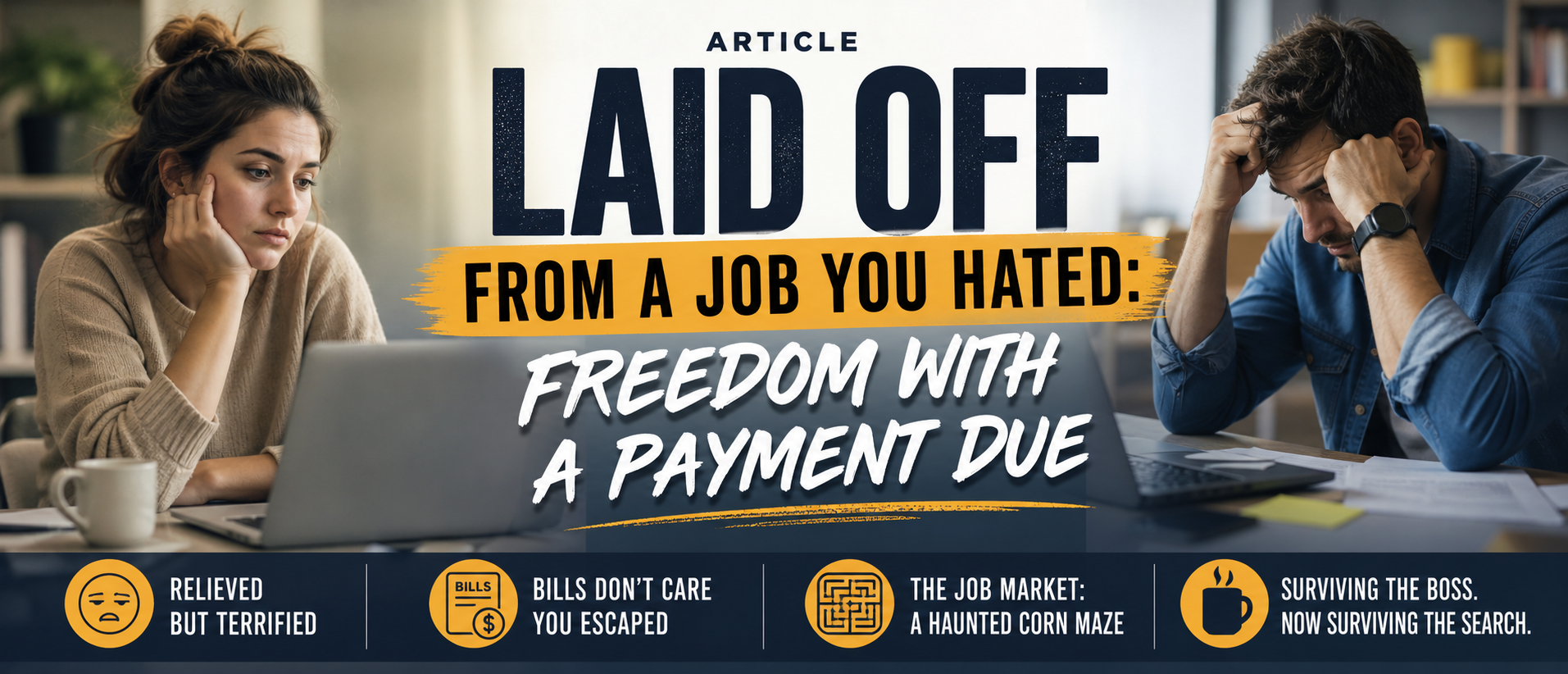
There is a very specific emotional confusion that happens when you get laid off from a job you already hated, because society wants you to pick one clean feeling, put it in a nice little emotional folder, label it something inspirational, and move forward like a LinkedIn thought leader standing near a window with soft lighting and a suspicious amount of confidence.
But real life does not work like that.
Real life says you can hate the job, hate the boss, hate the meetings, hate the fake urgency, hate the “just circling back” emails, hate the leadership updates where nothing is updated except your blood pressure, and still feel like someone kicked the air out of your chest when the layoff notice arrives dressed in corporate funeral language.
That is the part people do not always understand.
Getting laid off from a toxic job is not automatically a celebration. It is not a clean exit. It is not always the cinematic moment where you walk out of the building, toss your badge into the sunset, and suddenly birds begin singing while your nervous system applies for vacation. Sometimes it is freedom arriving with a bill attached. Sometimes it is relief sitting next to panic in the same waiting room, both of them filling out paperwork incorrectly.
One part of you is thinking, “Thank God, I am finally out of there.”
The other part of you is staring at your bank account like it just invited you to a final round interview with no salary range.
Because yes, the toxic meetings are gone. The boss who managed people like a printer jam with dental insurance is gone. The pointless status updates are gone. The calendar invites with titles like “Quick Sync” that somehow lasted fifty-eight minutes and damaged three generations of morale are gone.
But so is the paycheck.
So is the insurance.
So is the little comfort of knowing that, twice a month, direct deposit would quietly enter your account like a responsible adult and mind its business.
And now, instead of dealing with a boss who treats every Teams message like a federal investigation, you are dealing with the modern job market, which is somehow worse because at least your boss responded when they wanted to ruin your afternoon.
The job market does not respond.
The job market posts a role, collects 847 applications, reposts the same role three weeks later, tells you your resume was impressive, ghosts you, then sends an automated rejection at 2:13 in the morning like a haunted fax machine with access to your self-esteem.
So yes, being laid off from a job you hated is complicated.
It is grief and relief wearing the same jacket.
It is escape and uncertainty sharing a password manager.
It is standing outside a burning building, grateful to be alive, then realizing your car keys, wallet, health insurance, and emotional stability were apparently still inside.
The Job Was Terrible, But the Paycheck Was Paying
Let us be honest about something most people are too polished to admit on LinkedIn: sometimes the job was awful, but the paycheck was dependable, and dependable money has a way of making terrible environments feel survivable for longer than they should.
You may not have loved the company. You may not have believed in the mission. You may not have felt “aligned with leadership priorities,” mostly because leadership priorities seemed to change every Tuesday after someone with a better title read half an article on transformation. But the paycheck arrived, and that paycheck had one very important leadership quality.
It showed up.
Unlike the manager.
Unlike HR after the “anonymous” engagement survey.
Unlike the recruiter who said, “We will definitely keep in touch,” then vanished into the mist like a Victorian ghost with a LinkedIn Premium account.
That paycheck showed up, and when you are trying to pay rent, buy groceries, keep insurance active, make car payments, handle family responsibilities, and maintain the basic illusion that adulthood is under control, a paycheck can become the emotional support animal of financial survival.
This is why layoffs from bad jobs are so weird.
Because when people hear you hated the role, they sometimes assume you should be celebrating. They say things like, “Maybe it was a blessing,” which may be true eventually, but in the moment, blessings usually do not come with COBRA paperwork and a resume rewrite.
You can know a workplace was draining you and still feel afraid without it.
You can know your boss was toxic and still miss the security of having income.
You can hate the office politics and still feel stunned when your name appears on the wrong spreadsheet.
That is not hypocrisy. That is being human.
The workplace may have been a circus, but it was a circus that paid you every other Friday. The boss may have had the emotional intelligence of a conference room chair, but your bills did not care. Your bills were not sitting around saying, “Actually, this layoff may be good for your personal growth.” Your bills were wearing reading glasses, reviewing the situation, and asking when the next direct deposit planned to arrive.
And that is where the emotional package gets heavy.
You feel free, but not safe.
You feel relieved, but not settled.
You feel grateful to be gone, but angry about how it happened.
Because companies love to use soft language when they do hard things.
They say, “We made the difficult decision.”
No, Brad, you made a spreadsheet decision and then handed regular people the emotional receipt.
They say, “Your role has been impacted.”
Impacted is what happens when a shopping cart taps your bumper. Losing your job is not “impacted.” Losing your job is your whole life suddenly being asked to improvise in front of a panel that did not read your resume.
They say, “We encourage you to explore external opportunities.”
That phrase makes unemployment sound like a luxury retreat where candidates sip cucumber water while exploring new career landscapes. In reality, it means you are now applying to jobs that require ten years of experience in a software platform invented during breakfast.
And then, after the layoff, you are expected to perform optimism.
You must update your resume.
You must refresh your LinkedIn.
You must message people you have not spoken to since the Obama administration and say, “Hope you are well,” which is professional language for, “Please help, the economy has placed me in a decorative basket.”
You must tell recruiters you are excited about new opportunities, even though part of you wants to say, “I am mostly excited about not having panic nausea during calendar invites anymore, but I am also deeply interested in continuing to afford electricity.”
That is the truth.
And it deserves to be said without dressing it up in corporate confetti.
The Job Market Is Not a Market, It Is an Escape Room Designed by Someone Who Hates People
Once the toxic job is gone, you imagine for maybe twelve beautiful seconds that life will become lighter.
You wake up without dread.
You do not have to attend the 8:30 meeting where fourteen people discuss a dashboard nobody trusts.
You do not have to decode passive-aggressive emails from a boss who writes “Thanks” like a threat.
You do not have to pretend the company values transparency while leadership speaks exclusively in riddles, acronyms, and phrases copied from a consulting deck that smells like airport carpet.
For one brief moment, you feel like yourself again.
Then you apply for a job.
And immediately, the job market grabs you by the collar and says, “Welcome back. Please create an account.”
That is always the first insult.
You are emotionally vulnerable, financially stressed, freshly launched from corporate captivity, and the portal says, “Before we reject you, please make a password containing one uppercase letter, one lowercase letter, one number, one symbol, one hieroglyph, and the blood oath of a former supervisor.”
Then you upload your resume.
Then the portal says, “Great. Now manually enter everything we just asked you to upload.”
This is where the healing journey takes a sharp left turn into madness.
Because modern job hunting is not just looking for work. It is a full psychological obstacle course disguised as opportunity. It is a haunted corn maze with a login screen, a broken chatbot, and a recruiter named Madison who sends one enthusiastic message before dissolving into fog.
You apply to roles that say “remote,” but three paragraphs later explain that remote means remote from the truth, because the job actually requires you to be in-office four days a week, live within fourteen minutes of headquarters, and occasionally attend “culture moments,” which is corporate for pizza under fluorescent lighting.
You apply to roles that say “entry level,” but require eight years of experience, five certifications, executive presence, advanced Excel, emotional resilience, and the ability to remain passionate while being paid like the company found your salary in a couch cushion.
You apply to roles that say “fast-paced environment,” which usually means the company has no process, no training, no boundaries, and one overworked manager named Cheryl who knows where everything is because everyone else quit.
And then there are the interviews.
The interviews have become their own strange theater production.
First, there is the recruiter screen, where someone asks why you are interested in the company after you have already explained that you are unemployed and enjoy shelter.
Then there is the hiring manager interview, where they ask you to walk through your resume even though your resume is literally the document that got you invited.
Then there is the panel interview, where four people join late, apologize vaguely, and ask questions from a shared document last updated during the Bronze Age.
Then there is the assessment.
Then the case study.
Then the culture interview.
Then the final final interview.
Then the final final final interview, where someone with a mysterious title asks, “What motivates you?”
A paycheck, Derek.
A paycheck and the sincere hope that my next manager does not use Slack like a weaponized mood ring.
And still, after all of that, they may ghost you.
Not reject you.
Not update you.
Not send a kind note.
Just vanish.
You are left checking your email like a detective in a low-budget crime drama, trying to determine whether the company is still considering you, forgot you exist, hired internally, paused the role, canceled the budget, or was never hiring in the first place because the job posting was apparently decorative.
This is why people who were laid off from toxic jobs often feel emotionally scrambled.
They escaped one bad system only to enter another one with more passwords.
At least the toxic job had a desk.
The job market gives you silence and a login error.
You Are Not Failing, You Are Recovering While Competing in a Broken Game
The hardest part after a layoff is not always the resume.
It is not always the applications.
It is not always the interviews, although those do deserve their own support group, preferably one with snacks and a licensed therapist who specializes in the phrase, “We went with another candidate.”
The hardest part is trying to rebuild confidence after being treated like a line item.
Because layoffs do something strange to your mind.
Even when you know it was not personal, it feels personal.
Even when you know the company cut thousands of people, your brain still tries to hold a private trial and ask what you could have done differently.
Could I have worked harder?
Could I have been more visible?
Could I have played the politics better?
Could I have smiled more in meetings where leadership announced chaos using the tone of a weather update?
Could I have survived if I had become one of those people who comments “Great leadership!” under every executive post while half the department is being packed into cardboard boxes?
That thinking is exhausting, and most of the time, it is unfair.
Because the truth is, many people did everything right.
They showed up.
They worked hard.
They answered the emails.
They attended the meetings.
They survived the boss.
They carried the workload.
They kept the team moving while leadership invented new priorities like a toddler with a whiteboard.
And then they were cut anyway.
That does not mean they failed.
It means the company made a decision, and regular people got handed the consequences.
The cruel part is that after being laid off, you are expected to immediately become marketable, cheerful, strategic, resilient, grateful, polished, and available for interviews at 10:00 a.m. on Tuesday with a panel that may or may not show up on time.
There is very little room to be human.
You are supposed to say, “I am excited for my next chapter.”
But maybe you are not excited yet.
Maybe you are tired.
Maybe you are angry.
Maybe you are relieved.
Maybe you are still trying to understand how you can be so grateful to be out of a toxic workplace and still feel like you are carrying a bag of bricks through a wind tunnel.
That is okay.
You do not have to turn your layoff into inspirational content before you have even caught your breath.
You do not have to pretend the job was amazing just because losing it hurt.
You do not have to defend a workplace that drained you just because it paid you.
And you do not have to feel guilty for missing the stability of something that was bad for your peace.
That is a real thing.
A job can be unhealthy and still provide structure.
A boss can be awful and still be attached to income.
A company can be toxic and still be the place where your benefits lived.
Leaving, losing, escaping, and grieving can all happen at the same time.
So if you were laid off from a job you hated, please understand this clearly: your mixed emotions are not a character flaw. They are evidence that you are a person, not a press release.
You are allowed to be relieved.
You are allowed to be scared.
You are allowed to laugh one minute and stare into the refrigerator like it contains career guidance the next.
You are allowed to make jokes, update your resume, cry in the car, apply to three jobs, forget a password, question society, eat cereal for dinner, and then wake up the next morning and try again.
That is not weakness.
That is survival with Wi-Fi.
Final Thoughts: The Exit Sign Had Terrible Timing, But It Was Still an Exit
Getting laid off from a job you hated is one of the strangest emotional experiences adulthood can offer, and adulthood already includes taxes, dental insurance, printer errors, and being asked to create a new password for an account you do not remember creating.
It is strange because the job may have been bad for you, but losing it still shakes the ground.
It is strange because you may not miss the company, but you miss feeling financially safe.
It is strange because you may feel rescued and rejected at the same time.
And it is strange because the world often wants simple stories.
People want you to say, “It was a blessing.”
Maybe it was.
But blessings can still arrive looking like a layoff email written by a committee of emotionally unavailable staplers.
People want you to say, “Everything happens for a reason.”
Maybe it does.
But while the reason is still loading, the electric bill is not sitting quietly in the corner practicing patience.
So here is the truth for anyone living in that awkward middle space between relief and panic.
You are not wrong for being glad it is over.
You are not wrong for being scared about what comes next.
You are not wrong for hating the job and grieving the loss.
You are not wrong for feeling like the toxic workplace took too much from you, then somehow made you responsible for rebuilding afterward.
You survived the boss with the leadership style of a printer jam.
You survived the fake urgency.
You survived the meetings that could have been emails, the emails that could have been silence, and the leadership updates that required a translator, a therapist, and possibly a priest.
Now you are surviving the search.
And yes, the job market is weird right now. It is slow, crowded, automated, ghost-heavy, and full of postings that look like opportunities until you realize they have been reposted more times than a motivational quote from a regional vice president.
But you are still here.
You are still trying.
You are still applying, laughing, rebuilding, venting, hoping, and somehow keeping enough emotional range to joke about raccoon communes while refreshing your inbox.
That matters.
Being laid off from a toxic place does not mean you failed.
Sometimes the building was on fire, and the layoff was the exit sign with terrible timing.
You did not lose your value because a company lost its nerve, budget, direction, or basic understanding of human consequences.
You are not a spreadsheet casualty with a LinkedIn profile.
You are a person rebuilding after impact.
And one day, when the right door opens, when the next role finally makes sense, when the boss is not a human printer jam and the company does not describe chaos as “transformation,” you may look back and realize that the layoff did not save you in a clean, gentle, cinematic way.
It shoved you out.
It scared you.
It interrupted your life.
But it also ended a chapter that was already draining you.
And until the next chapter arrives, keep going.
Keep laughing when you can.
Keep resting when you need to.
Keep applying without letting rejection become your identity.
And please, for the love of all things holy, save your passwords somewhere safe, because this haunted corn maze has portals, and every portal thinks your resume needs to be uploaded twice.