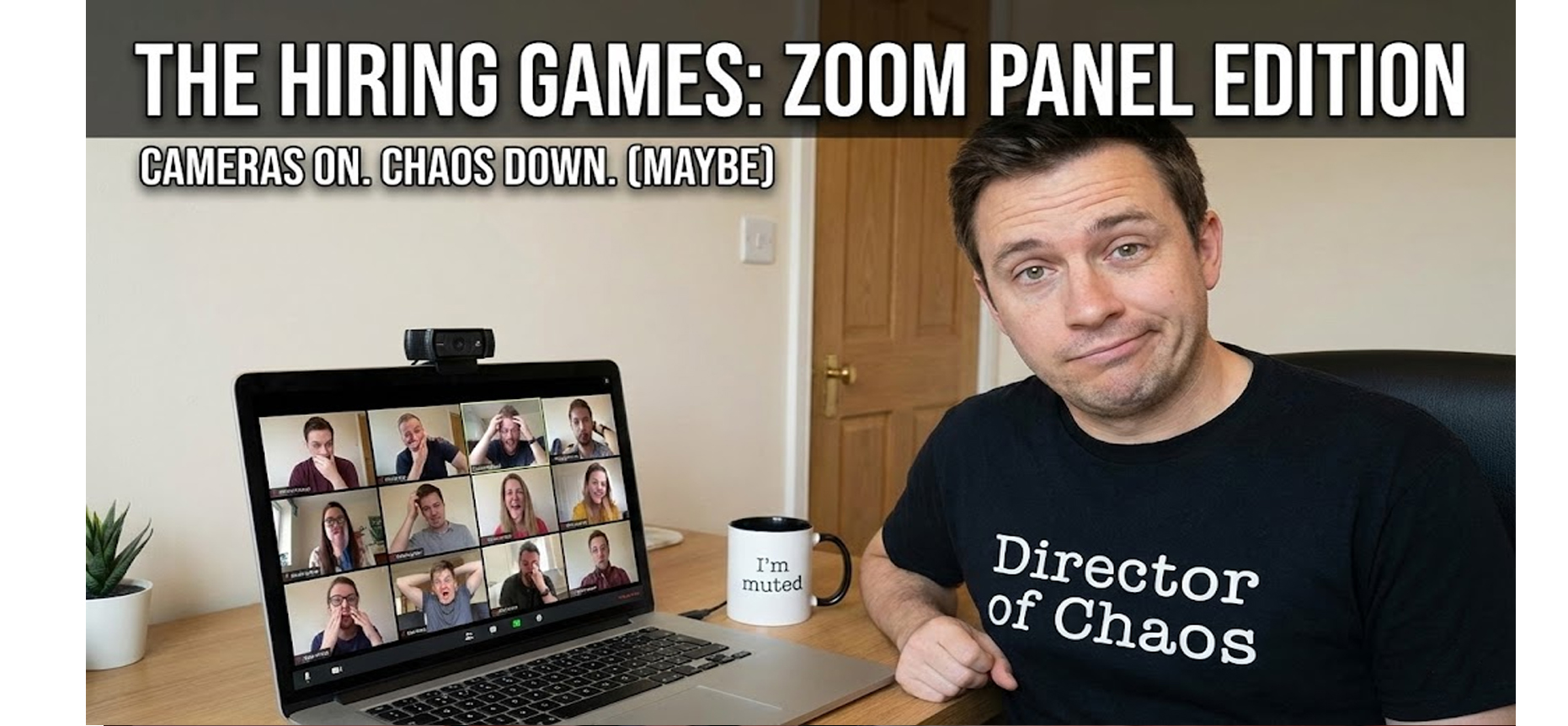
There are two kinds of people in the modern job market: the ones still trying to believe interviews are “conversations,” and the ones who have already accepted that a Zoom panel is basically a corporate escape room where the clues are vague, the doors are locked, and every smiling participant is quietly holding a rubric like it’s a sacred text.
So when someone asked me today, “You always talk about the hiring games… what would you do if you were the hiring manager on a Zoom panel?” I felt something shift inside me, like a man who has spent years warning the village about the haunted house and has now been handed the keys, the flashlight, and a budget code.
Because yes, I have opinions. I have notes. I have lived through enough interviews to know the difference between a company that’s trying to hire a human being and a company that’s trying to summon a mythical creature that can do five jobs, fix the culture, smile through ambiguity, and still sound “energetic” on a Tuesday afternoon while their Wi-Fi is actively sabotaging them.
We have normalized some truly unhinged interview behavior. Cameras off panels. Silence as a personality. Questions written by people who have never met a human but have heard rumors they can be “leveraged.” Follow-ups that feel less like curiosity and more like a prosecutor sharpening a pencil. And the grand finale: the ghosting, the “we went with someone else” weeks later, the rejection email that arrives like an obituary for an opportunity you were told was “moving quickly.”
So yes. If I ran the hiring games, the haunted house would still exist—because work is still work, and companies are still complicated—but the point would no longer be to scare the candidates into proving they can survive the darkness. The point would be to turn the lights on and say, calmly and clearly, “Here’s the house. Here’s what’s broken. Here’s what we’re fixing. Here’s what we actually need. And here’s what we can offer in return.”
Because I’m not interested in testing your ability to perform confidence while being evaluated by five rectangles and one disembodied voice. I’m interested in whether this makes sense for both of us.
Here’s exactly how it would go.
Cameras On, Names Real, Vibes Not Allowed to Run the Meeting
First rule: the cameras would be on. Yes, all of them. I know that sounds extreme, like I’m proposing we bring back flip phones or tell the truth in job descriptions, but stay with me.
If you are asking someone to show up with eye contact, warmth, clarity, and presence, you do not get to evaluate them as a floating initial in a black square named “iPad (2).” You do not get to sit in darkness like a hiring Dracula, whispering, “Tell me about your strengths,” while the candidate performs emotional labor into the void.
We would do something radical: we would look like people. Everyone introduces themselves. Everyone says what they actually do. Not the title. Not the LinkedIn headline. The real thing. “I run this team.” “I’m the person you’ll work with daily.” “I’m the one who will ask you for updates and then immediately forget I asked.” Honesty. Connection. Humanity. The basics.
And because I am now the hiring manager, I would set ground rules that would make the average panel interviewer sweat:
- We are not multitasking.
- We are not reading Slack while pretending to listen.
- We are not doing that aggressive nodding that says, “I hear you,” while your eyes are clearly watching an email load.
- We are not playing “gotcha” with follow-up questions like this is a courtroom drama and you’re trying to trap someone in a minor contradiction from 2019.
If something is unclear, we ask for clarity out loud like adults. If someone needs a second, we let them take it. If the Wi-Fi hiccups, we don’t act like the candidate’s integrity just buffered.
Because interviews should not be endurance tests. They should not be rituals. They should not feel like you’re being assessed by a committee of owls who will not speak until you prove you can hunt your own career.
They should feel like: We’re both trying to make a good decision. Imagine that.
Real Questions That Sound Like Humans Wrote Them
Second rule: the questions would be real. Human questions. Questions that don’t require an interpretive dance, a PowerPoint, and the full emotional arc of a Pixar movie.
I would not ask, “Tell me about a time you demonstrated leadership in ambiguity while influencing cross-functional stakeholders under pressure,” because that sentence is not a question, it’s a hostage note written by a corporate thesaurus.
I would ask things like:
What kind of work drains you, even if you’re good at it?
What kind of work makes time disappear?
When you walk into a messy process, what’s the first thing you notice?
How do you like to receive feedback when something goes sideways?
What do you need from a manager to do your best work and what do you not need?
And then I would actually listen to the answers, which in 2025 is already considered an innovation.
I would also stop pretending everyone needs to deliver their personality through the STAR method like they’re presenting evidence to the National Resume Tribunal. If your story makes sense, it makes sense. If you need to talk through something, talk through it. If you don’t remember the exact number you increased efficiency by, I’m not going to slam the gavel and shout, “So you admit you didn’t actually improve anything.”
Because here’s what we’ve forgotten: interviews aren’t supposed to be about who can perform the cleanest narrative under pressure. They’re supposed to be about who can do the work, communicate, learn, adapt, and not turn into a chaos sprinkler when something breaks.
Also and this is important, I would stop treating confidence like the only proof of competence.
Some of the best people are thoughtful, measured, and not interested in playing verbal speed chess for sport. Some of the loudest people are just loud. Some candidates are nervous because they want it, because they care, because they’ve been through the grinder and they’re trying not to show how tired they are.
I’m not hiring the person who can sound perfect in a spotlight. I’m hiring the person who can do the job when the spotlight is off and the work is messy and nobody is clapping.
So yes. Real questions. Real listening. Less theater. More truth.
The Honest Job Preview (Because Surprise Misery Is Not a Retention Strategy)
Third rule: I would explain the job honestly.
Not the highlight reel. Not the “we’re a fast-paced environment” fairy tale that means, “We are understaffed and allergic to planning.”
The real job.
What’s broken. What’s messy. What’s unclear. What we’re still building. What success actually looks like in the first 30, 60, 90 days. What support exists and what doesn’t yet. What the team is great at and where they struggle. What decisions are already made and what the new hire can influence.
Because I do not believe in selling someone a dream and then acting shocked when they quit after realizing the dream was actually a burning dumpster with a mission statement taped to the side.
I would also respect time. Start on time. End on time. No “just one more question” that turns into a bonus round called Tell Us About a Time You Managed Up While Managing Down While Also Being the Culture.
And when the interview was done, the next steps would be clear. The timeline would be real. Not “we’ll circle back” which is corporate for “we will now disappear into the fog.”
If someone didn’t move forward, they would hear back. A real response. Not silence. Not vibes. Not a LinkedIn auto-closure three months later like an abandoned shopping cart notification for your dignity.
And if I couldn’t give detailed feedback for legal or process reasons, I would still treat them like a person and say so. I would not hide behind ambiguity like it’s a business model.
Because people can handle “no.” What they can’t handle is being treated like they never existed.
Final Thoughts: It’s Not an Audition for Worthiness
If I ran the hiring games, interviews would stop being auditions for worthiness and start being what they should have been all along: conversations about fit, clarity, expectations, and mutual respect.
Not everyone is wrong for a role because they aren’t chosen. Sometimes the role is wrong. Sometimes the timing is wrong. Sometimes the team doesn’t actually know what it needs yet, so they keep interviewing candidates like they’re trying to recognize a face from a dream they can’t describe.
And sometimes the system is wrong. The process. The panel. The “cameras off” culture. The ghosting. The performative mystery. The way we’ve turned hiring into a high stakes game show and then act surprised when candidates leave the experience feeling smaller, exhausted, and slightly feral.
If I were the hiring manager on a Zoom panel, fewer people would walk away feeling like they failed a secret test they were never told they were taking.
More people would leave clearer.
And honestly? Even the people who didn’t get the job would still feel respected, which is so rare right now it’s basically considered a perk.
So yes. Cameras on. Questions human. Honesty upfront. Time respected. Communication real.
And if anyone on the panel starts turning it back into a ritual sacrifice disguised as a conversation, I will gently remind them:
This is a Zoom call, not the Hunger Games.
We can all be normal for forty five minutes.