
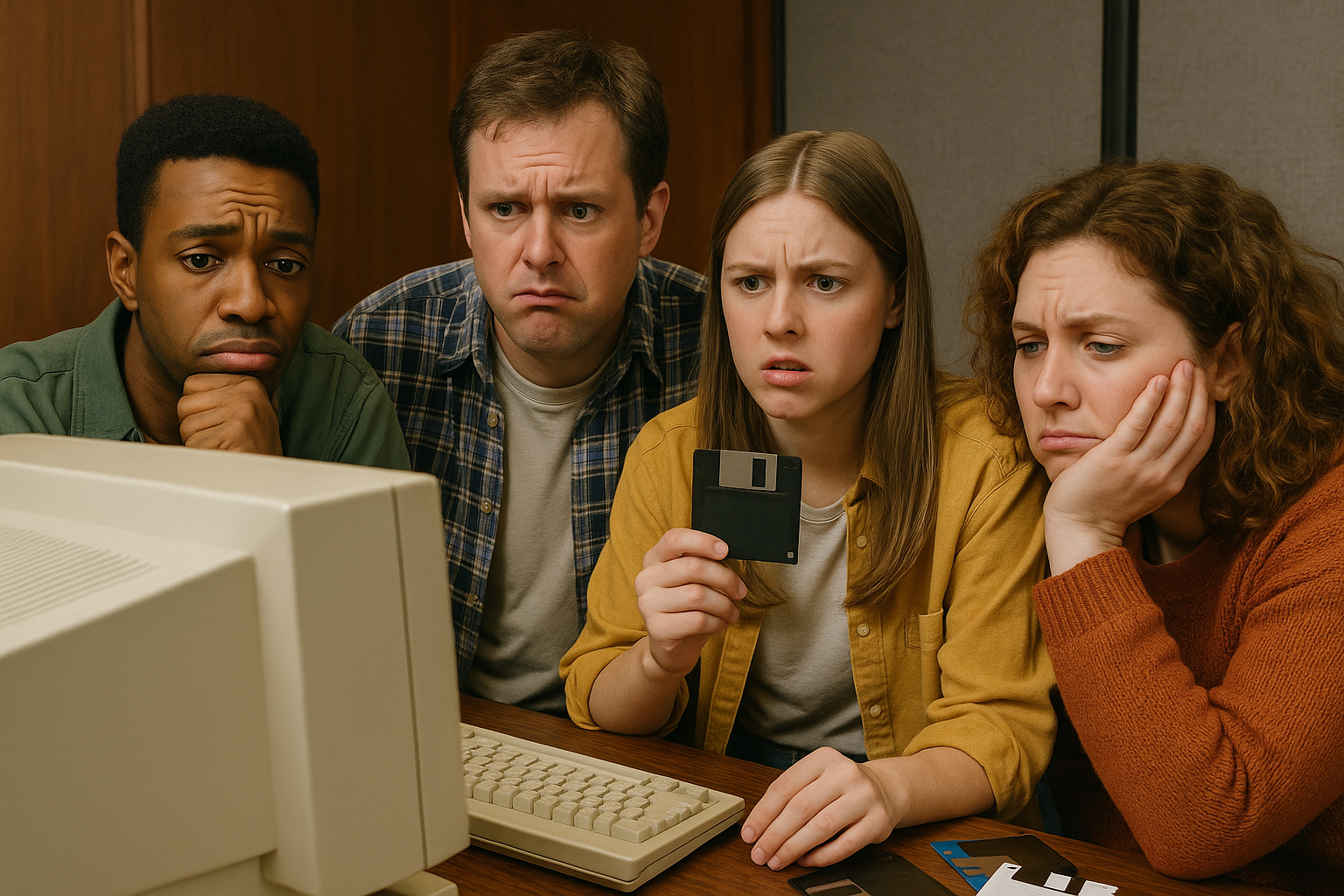
There was a time when owning a computer meant you were either a visionary… or someone who just enjoyed emotional suffering. The year was 1995. Gas was cheap, Blockbuster was thriving, and the height of technological achievement was making ClipArt dance inside Microsoft Word. You didn’t need AI, you didn’t need cloud storage, and you definitely didn’t need Wi-Fi—because you didn’t have it. What you had was a box the size of a microwave, a screen that buzzed like it had seen things it shouldn’t have, and an operating system that promised the future: Windows 95.
Booting up Windows 95 was a sacred ritual. You’d press that power button, and the room would fill with sounds that could summon angels—or demons. Fans whirring. Hard drive spinning. That mechanical clunk that made you wonder if your computer was breaking or just finding itself spiritually. The Windows 95 logo would flicker on like a divine revelation, and then came the chime. That ethereal, four-second sound that whispered, Welcome to the future, kid… now please wait another 20 minutes for your desktop to appear.
And wait you did. Patience wasn’t optional; it was survival. Every minute of loading was a meditation on mortality. You’d sip your Tang, glance at your floppy disks, and wonder if your descendants would live long enough to see Microsoft Paint open. Back then, everything was slow, but that was okay—because for the first time in human history, we were part of the machine. We weren’t just using computers. We were raising them like confused, emotional children that occasionally forgot who they were.
Windows 95 didn’t just introduce us to technology—it introduced us to emotional resilience. It was the first system to teach an entire generation that hope and despair can share the same screen. It didn’t matter if you were doing homework, building a spreadsheet, or playing Solitaire: at any given moment, your computer could just stop. Freeze. Collapse. Existentially implode. And yet, we kept coming back for more.
It was clunky. It was slow. It was full of bugs. And somehow, it was perfect. Because deep down, Windows 95 didn’t just mirror technology—it mirrored life itself. Every startup was a new beginning, every crash a lesson in humility, and every blue screen a spiritual awakening disguised as an error code.
The Age of Patience, Panic, and the Hourglass of Doom
You could tell a lot about a person by how they reacted to the Windows 95 hourglass. That little pixelated symbol of waiting—spinning endlessly, tauntingly—was the true test of human character. Were you calm? Were you furious? Did you stare at it like it held answers to your existence? Because if you used Windows 95, you did wait. You waited for programs to open, for files to save, for printers to respond, and for the sweet release of Ctrl + Alt + Del.
Let’s talk about installation. Installing a program in Windows 95 was like a trust fall with a stranger who may or may not catch you. You’d insert floppy disks—sometimes ten, sometimes twenty—and pray to every technological deity that Disk 7 wouldn’t be corrupted. If it was, your entire life’s work was over. No backups. No recovery. Just sadness and a loud buzzing sound from your computer that screamed, You brought this on yourself.
And the graphics! Oh, those glorious 256 colors. People today complain about lag on their 4K monitors, but back then, we thought pixelated skies were beautiful. You didn’t see a mountain—you saw seven shades of blue, arranged with optimism and denial. It was art. The mouse pointer moved like it was dragging a piano behind it, and every click carried emotional weight.
Windows 95 was a boot camp for frustration. You learned not to double-click too fast, or too slow, or too confidently. You learned that “Not Responding” was not a bug—it was a way of life. You learned to defragment your hard drive like it was a spiritual cleansing. Watching those little colored blocks move around was hypnotic. You didn’t know what was happening, but it felt productive. It was our generation’s version of meditation—except instead of inner peace, you got mild migraines and the faint smell of burning circuits.
Every glitch was personal. Every crash was betrayal. But you didn’t give up. You restarted. You pressed “Retry” again and again because hope is the most dangerous driver of all—and Windows 95 taught us to keep hoping, no matter how many times the screen flickered into oblivion.
The Great Internet Awakening (and the Soundtrack of Suffering)
Before the world had Wi-Fi, it had The Sound. That unholy symphony of dial-up Internet—the screeches, the beeps, the digital screams that said, I’m trying my best. The first time you heard it, you thought your computer was being exorcised. But once the connection succeeded, oh, the joy. You were online. You were free. You were also grounded, because your mom picked up the phone and disconnected the Internet again.
Internet Explorer came bundled with Windows 95, and it was both a miracle and a curse. It took seven minutes to load a page, but we didn’t care. We were explorers—digital pioneers entering the new world of GeoCities and AOL chat rooms. You didn’t just “surf” the web; you crawled across it with broken knees and a floppy disk full of hope.
Pop-ups were the mosquitoes of the digital swamp. “You’ve won!” they said. “Click here!” they screamed. Every click led you deeper into the abyss. Spyware wasn’t a threat—it was a roommate. It lived in your system, ate your RAM, and whispered insecurities to your processor. Yet somehow, we loved it all. Because the Internet back then wasn’t about speed or convenience—it was about discovery. It was about mystery. It was about connecting with strangers who were also waiting for their images to load, pixel by pixel, one eternal minute at a time.
Email felt revolutionary. You could send a message around the world in under an hour! And sure, sometimes it got lost, or bounced, or crashed your inbox entirely—but that was part of the charm. Every “You’ve Got Mail” was a serotonin rush, every chain email a moral test. Forward it or risk seven years of bad luck. Windows 95 turned us into believers in both technology and superstition.
We were connected, but also isolated. We sat in our bedrooms, bathed in the glow of cathode rays, learning HTML by accident and trusting strangers with our souls. Windows 95 wasn’t just an operating system—it was the portal through which humanity collectively entered the digital age… and immediately regretted it.
The Blue Screen of Death and Other Spiritual Lessons
Nothing in life prepares you for the sudden, chilling sight of the Blue Screen of Death. It didn’t knock. It didn’t warn you. It just appeared—like an angel of malfunction—declaring, “Your system has encountered a fatal error.” Fatal. Not “temporary,” not “minor.” Fatal. Windows 95 didn’t just crash your computer; it diagnosed it with terminal illness on the spot.
And the codes. Those long, cryptic hieroglyphics—0x0000007B—they made you feel like you were reading the Dead Sea Scrolls of despair. You’d stare, confused, powerless, whispering, “What did I do?” And the truth was: nothing. You did nothing. Windows 95 simply decided that today was not your day.
But the Blue Screen had a strange kind of beauty to it. It was humbling. It reminded you that control was an illusion. It was Windows’ way of saying, “You are not the main character here.” You’d restart, hoping it would fix itself, and when it didn’t, you’d restart again. And again. And sometimes—by sheer miracle—it would work. Like resurrection through reboot.
Windows 95 turned every user into a philosopher. You learned about failure, recovery, and the delicate art of pretending to understand error messages. You learned that saving your work every five minutes was not paranoia—it was wisdom. And you learned that sometimes, when everything freezes, the only thing you can do is walk away, make a sandwich, and let life figure itself out.
And yet, for all its flaws, for all its crashes, Windows 95 felt alive. It had personality. It had moods. It was unpredictable, yes—but it was yours. When it worked, it was magic. When it failed, it was tragedy. But either way, you were part of something bigger: the messy, magnificent birth of the digital age.
Final Thought: Ctrl + Alt + Del for the Soul
Today, our computers boot in seconds. They talk, they predict, they even write poetry. But none of them have soul. Windows 95 was a chaotic, beautiful mess that made us laugh, cry, and occasionally throw the monitor out the window. It didn’t coddle you—it tested you. It made you earn every victory, every saved file, every successfully printed document. It made you grateful for progress.
Because life is a lot like Windows 95. It’s full of bugs and random crashes, filled with pop-ups you didn’t ask for, and moments when you have to hit Ctrl + Alt + Del just to keep going. But somehow, we endure. We reboot. We learn. And every once in a while, against all odds, everything loads perfectly—and for one shining moment, it all works.
That’s the legacy of Windows 95. It wasn’t perfect. It wasn’t easy. But it was real. And maybe, just maybe, that’s what we’re all still trying to run—our own little operating system of hope, humor, and human error.
😂0😍0😢0😡0👍0👎0






Hi, this is a comment.
To get started with moderating, editing, and deleting comments, please visit the Comments screen in the dashboard.
Commenter avatars come from Gravatar.