
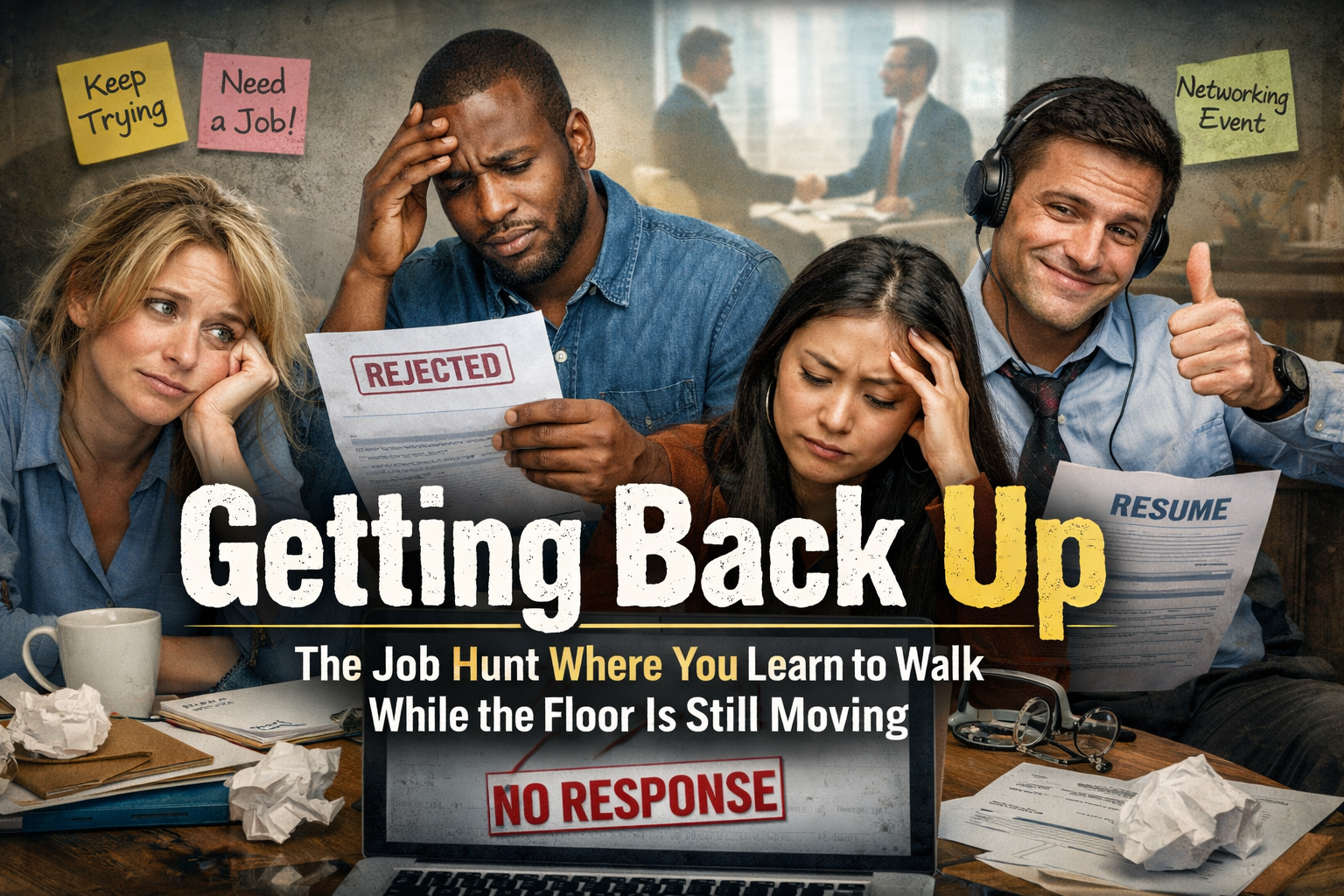
There’s a specific kind of exhaustion that doesn’t come from doing nothing, but from doing everything and still feeling like you’re standing perfectly still. You wake up, you check your email like it’s a weather report that might finally announce sunshine, you refresh LinkedIn like the refresh button owes you money, and you tell yourself, with the confidence of a motivational speaker who definitely cries in their car, that today is the day you’re going to get back up and do it again. Because you have bills. Because you have pride. Because you have people who ask “Any updates?” with the casual cruelty of someone checking the status of a pizza delivery, not the status of your entire identity.
Job hunting is a weird emotional bootcamp, because it asks you to be brave and polished at the same time. You’re supposed to be resilient, but also upbeat. You’re supposed to be honest, but also “strategic.” You’re supposed to be human, but not too human. You’re supposed to explain a gap without sounding like you ever sat down. You’re supposed to want the job, but not need the job, even though you absolutely need the job, and the whole thing is like trying to play it cool while your soul is doing wind sprints.
And still—somehow—you get up.
Not always in a cinematic way. Not with a triumphant soundtrack. Sometimes you get up in sweatpants that have accepted defeat, with dry shampoo as your primary coping mechanism and a coffee that tastes like “fine, let’s do this.” Sometimes getting back up doesn’t look like confidence. It looks like opening your laptop and whispering, “Please don’t let me spiral today,” and then doing the next right thing anyway.
Because here’s the part no one posts about: you don’t just get rejected from jobs. You get rejected from versions of your future you were starting to believe in. You get ghosted by companies you told your friends about. You get asked to “tell me about yourself” on a day when you’re still trying to remember what you’re worth. It’s not just professional. It’s personal. It’s emotional. It’s a slow, repetitive lesson in standing up even when you’re embarrassed that you fell in the first place.
But standing up again is still standing up.
The Fall Isn’t the Worst Part—It’s the Pause
The fall is obvious. The pause is what takes you out.
The pause is when the adrenaline fades and you’re left alone with your thoughts, your browser tabs, and the strange silence that follows big life changes. The pause is when you stop moving long enough to feel how much it hurt. The pause is when your confidence starts playing tricks on you—when you reread your own resume like it belongs to someone else, when you wonder if your skills are suddenly imaginary, when you start treating your past achievements like they were lucky accidents instead of evidence.
And that’s when job hunting gets sneaky. Because the world still expects “forward.” Your friends still expect “hopeful.” Your family still expects “optimistic.” Your bills still expect “paid.” But inside the pause, you’re trying to do something much harder than apply for jobs—you’re trying to reassemble yourself into someone who can walk into an interview without flinching when they ask why you’re available.
The pause also comes with a parade of unsolicited advice from people who have not been humbled by an ATS system recently. You’ll hear things like, “Just stay positive,” as if positivity is a coupon code you forgot to enter. You’ll hear, “Everything happens for a reason,” which is a beautiful sentiment until it’s delivered like a shrug. You’ll hear, “Have you tried networking?” in the same tone someone asks, “Have you tried turning it off and back on?”
But the pause is where a lot of people give up—not because they’re weak, but because they’re tired. Because it’s exhausting to keep showing up to a system that often doesn’t acknowledge you as a person. It’s exhausting to be patient in a process designed to be indifferent. It’s exhausting to keep believing in yourself when the scoreboard is quiet.
So when you get back up, you’re not just recovering your momentum. You’re recovering your story. You’re deciding that you are not defined by a “no,” a “we went with someone else,” or the email that begins with “Thank you for your interest” and ends with you staring at the wall like you just watched a season finale you didn’t consent to.
Getting back up starts here: not with confidence, but with permission. Permission to be disappointed. Permission to be angry. Permission to be tired. And permission to still take the next step anyway.
Confidence Isn’t a Feeling—It’s a Repetition
Some people talk about confidence like it’s a permanent personality trait, like you either have it or you don’t, like it’s sitting in your chest fully assembled, humming quietly like a well-funded generator. Job hunting teaches you a harsher truth: confidence is usually something you do while you’re afraid.
Confidence, in the job hunt, is not waking up excited. It’s waking up discouraged and still updating your application tracker. It’s writing a cover letter even though you’re pretty sure no one will read it, because you’ve decided your effort matters even when the outcome isn’t guaranteed. It’s going into an interview after three rejections and remembering that the last three companies were not the final judges of your life.
And the wild part is how repetitive it becomes. You apply. You wait. You follow up. You get ghosted. You apply again. You tailor the resume. You learn a new keyword. You rewrite the summary. You practice your answers. You try to sound confident without sounding like you’re reading lines off a teleprompter built from trauma.
There’s also the emotional gymnastics of selling yourself while you’re still healing. You’re supposed to be “excited about new opportunities,” but your nervous system is still replaying that one call, that one meeting, that one moment where you realized the rug was moving. You’re supposed to speak about your strengths with certainty, even though the job hunt has a way of making you question the obvious, like your accomplishments were only valid in the last job and have expired like yogurt.
So you build confidence the only way it actually gets built: through repetition. Through showing up again and again until your brain starts to accept the truth you keep practicing—that you are capable, even when you feel shaky. That you have value, even when the inbox is quiet. That you are not “behind,” you are just in a chapter that doesn’t photograph well.
And yes, you will have days where getting back up looks like you open your laptop, stare at the screen, and decide your big win is sending one email instead of twenty. That still counts. Because job hunting isn’t a sprint. It’s a long, weird, emotional marathon where some miles are made of courage and some miles are made of pure spite.
If confidence is a muscle, job hunting is the gym where the equipment is always slightly broken and the instructor keeps yelling “be authentic” while simultaneously demanding you use corporate-approved buzzwords. You don’t build confidence by feeling ready. You build it by doing the thing even when you don’t.
The Comeback Is Quiet, Until It Isn’t
Nobody really warns you that the comeback rarely arrives as one big moment. It comes in small, almost unremarkable ways—the kind you could miss if you’re only looking for fireworks.
It’s the morning you realize you didn’t dread checking your email quite as much. It’s the day you write a better resume bullet and you can actually feel the difference. It’s the first time you answer “Tell me about a challenge” without your voice going tight, because you’ve stopped interpreting every question as an accusation. It’s the moment you stop apologizing for being in transition, because you finally accept that transitions are not failures—they’re movement.
The comeback is also the way you start protecting your heart. You stop attaching your self-worth to every application like it’s a lottery ticket for validation. You start pacing yourself. You start treating your energy like a resource instead of a bottomless well you can keep scooping from until you collapse. You get better at separating what’s yours from what isn’t—your effort is yours, your preparation is yours, your persistence is yours, but the hiring timeline, the internal chaos, the budget freeze, the “we’re exploring options,” and the recruiter who disappears like a magic trick? Not yours.
And slowly, the job hunt stops being a constant emergency and becomes something else: a process you can survive. A thing you can navigate. A season that doesn’t get to define your entire identity.
Then—one day—it happens. An email lands with a different tone. A call comes in that doesn’t feel like an interrogation. An interview flows. A hiring manager says something that sounds like a human sentence. An offer appears. And suddenly the comeback is loud, not because the world changes overnight, but because your body finally unclenches enough to hear yourself breathe again.
But even if you’re not there yet, even if you’re still in the middle of the quiet part, the getting back up part matters. Because every time you get back up, you’re proving something important: you can be knocked down and still choose yourself. You can be tired and still continue. You can be disappointed and still not surrender your future.
That’s not just resilience. That’s courage wearing regular clothes.
Final Thoughts: You’re Not Behind—You’re Healing While Moving
If you’re in the “getting back up” phase, let this be your reminder that you don’t have to be inspirational to be in motion. You don’t have to feel confident to be capable. You don’t have to have a perfect plan to take a real step.
The job hunt will try to convince you that silence means you’re failing. It doesn’t. Sometimes it just means the system is slow, noisy, and messy. Sometimes it means you’re early. Sometimes it means you’re being redirected to something that fits you better than the thing you were trying to force.
And yes, it’s unfair that you have to be strong for longer than you wanted. It’s unfair that you have to keep pitching yourself like a product when you’re a person. It’s unfair that you have to keep smiling while waiting for someone to decide whether you get stability.
But you’re still here. You’re still getting up. You’re still trying. And that counts for more than most people will ever understand.
So if today all you can do is stand, then stand. If all you can do is take one step, take one step. If all you can do is open the laptop and not quit, that is still a win. Because getting back up isn’t one heroic moment.
It’s a practice.
And you’re practicing it.