There’s a point in every job search where the metaphor stops being funny and becomes documentary footage.
Not because you ran out of hope. Not because you “don’t want it bad enough.” But because the process itself starts to feel less like a journey and more like nature content where the narrator keeps whispering, “This is truly brutal,” while you, a perfectly harmless creature with bills and a LinkedIn profile picture you took in 2019, drift through open water and get politely eaten in installments.
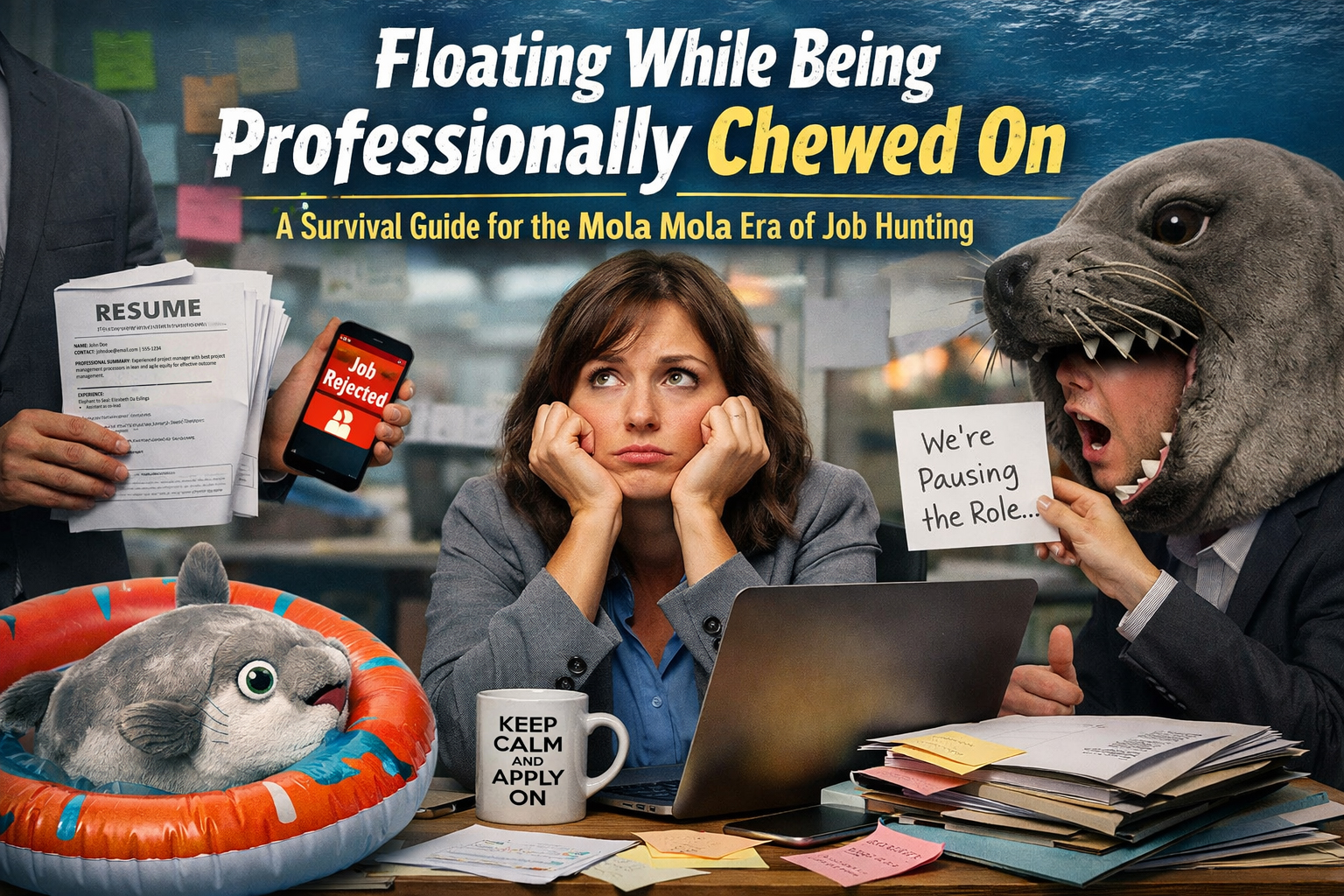
And yes, I’m talking about the mola mola, the ocean sunfish. The absolute icon of “I am doing my best with the body and circumstances I was given.” The fish isn’t built for speed. It isn’t built for aggression. It isn’t built for corporate hoop jumping or emotional parkour. It is built for existing. Quietly. Slowly. Earnestly. Just trying to float through life without being selected for a “quick chat” with a seal that has opinions about your transferable skills.
And that’s what modern job hunting does: it turns your dignity into a slow-release snack.
Because you can do everything “right.” You can tailor your resume like you’re writing a breakup letter to every adjective you’ve ever used. You can craft a cover letter so specific it sounds like you’ve been living inside the company’s mission statement with a sleeping bag and a reusable water bottle. You can practice STAR stories until your own memories feel like they were written by HR. You can show up early, smile warmly, ask thoughtful questions, and say the words “excited to learn” like you’re auditioning for the role of Pleasant Human #4.
And still… nibble.
“Great conversation!”
“Loved your experience!”
“We’re moving forward with candidates who more closely align!”
“We’ve decided to pause the role!”
“We’re restructuring the team!”
“We’re looking for someone with deeper experience in a tool that did not exist when we scheduled this interview!”
Nibble nibble nibble.
No single bite is dramatic enough to call a lawyer. But collectively? You start to feel like the entire ocean is chewing you with polite email templates.
And then people offer you motivational advice the way someone might offer a bandaid to a mola mola actively being eaten alive.
“Stay positive!”
“Everything happens for a reason!”
“It only takes one yes!”
“Have you tried networking?”
Which is basically telling the fish, “Have you tried floating more strategically while being consumed?”
So here we are. Floating. Applying. Enduring. Refreshing LinkedIn like it’s a weather app for emotional damage. Attempting to remain professional while the market takes tiny bites out of our confidence and then compliments us on our resilience like resilience isn’t just the ability to keep showing up while being slowly turned into a lesson for someone else’s leadership blog.
Welcome to the mola era. Let’s talk about it.
The Ocean of Opportunity (Also Known as the Same Job Posted for the Sixth Time)
The first stage of the job search is optimism with a faint undertone of delusion, which is honestly the healthiest thing about it.
You open your laptop with purpose. You tell yourself, “Today is the day.” You refresh job boards like you’re about to discover a hidden island made entirely of fair salaries and managers who don’t say things like “we’re like a family here” while actively ghosting candidates. You see a listing that looks promising. You click. You scroll. You nod.
And then you hit the requirements section and the listing starts asking for things that feel less like qualifications and more like a prophecy.
They want eight years of experience in a software platform that launched four years ago. They want an entry-level candidate with executive presence, advanced conflict resolution skills, expert knowledge of three industries, and the emotional stability of a monk who has never read a Slack message marked “URGENT” at 4:58 p.m. on a Friday.
They want you to be collaborative but autonomous, confident but humble, innovative but consistent, fast but thorough, strategic but tactical, data driven but “people first,” and also somehow available for an interview on Tuesday at 11 a.m. with 30 minutes notice.
And the salary. The salary is always the funniest part.
It’s written in that cheery tone like they’re offering you an adventure. “Competitive pay!” Which means they will compete with your rent and win. The range is either suspiciously vague or aggressively confident for a number that suggests they believe groceries are still nine dollars a week and healthcare is something you pick up at the front desk like a mint.
But you apply anyway. Because you’re a professional mola. You endure.
You tailor your resume like you’re trying to impress an algorithm that was trained on corporate vibes and despair. You adjust keywords. You swap “led” for “spearheaded” and “managed” for “orchestrated” and “made it through the week” for “demonstrated resilience in dynamic environments.”
You upload the resume.
Then the system asks you to retype the resume.
Then the system asks you to create an account.
Then the system emails you to verify the account.
Then the system makes you answer questions that feel like therapy prompts written by a spreadsheet.
“Describe a time you demonstrated leadership.”
“Describe a time you overcame adversity.”
“Describe a time you improved a process.”
“Describe a time you were basically a superhero but in a humble way.”
And you do it. Because you want to work. Because you have bills. Because your bank account has started giving you motivational speeches.
Then you hit submit and you feel that little spark of hope, that tiny buoyant moment where you imagine an inbox notification that says, “We saw you. We liked you. We are normal.”
And then the ocean goes quiet.
And you drift.
And somewhere, in the distance, you hear the soft splash of a role being reposted. Again. With the exact same description. Like the company is casting for a mythical creature and you were bold enough to apply as a human.
The Interview Tank (Where Everyone Smiles While Testing Your Ability to Swim Through Hoops)
Eventually, if you survive the silence long enough, you get the email.
“Would you be available for a quick chat?”
And quick chat is never quick. Quick chat is a doorway. Quick chat is a trapdoor. Quick chat is the moment the seal notices you floating and thinks, “This one seems polite.”
You schedule the call. You prepare like you’re going to war, except the war is against your own nervous system.
You research the company. You research the interviewer. You memorize the mission statement. You learn the CEO’s leadership philosophy. You discover the company’s values are “Integrity, Innovation, and Synergy,” which is corporate for “we like words that sound good on wall decals.”
You practice answers.
You practice your voice.
You practice smiling on camera without looking like you’re about to blink “help me” in Morse code.
The interview begins and they ask you to “walk me through your background,” which is a cruel request because it requires you to summarize your entire life into a story that sounds intentional.
You do it anyway.
They nod politely. They ask about your experience. You answer with thoughtful clarity.
Then they ask the fun question: “Why do you want to work here?”
Which is always interesting because the honest answer is, “I have exchange needs, and I enjoy eating,” but the socially acceptable answer is, “I’m passionate about your mission,” even if their mission is “making shareholders feel warm and safe.”
So you say the lines. You deliver the performance. You become the most palatable version of yourself. Not too eager. Not too desperate. Not too bold. Not too quiet. Not too human.
And then they hit you with the greatest classic of them all: “Tell me about a time you dealt with conflict.”
Which is code for, “Tell me about a time someone acted like a seal and you floated politely anyway.”
You describe a situation. You mention collaboration. You highlight communication. You frame it as growth. You resist the urge to say, “I survived three reorganizations and a manager who used ‘circle back’ as a personality trait.”
They smile. They thank you. They say they’ll be in touch.
“In touch” is another one of those phrases that sounds comforting until you realize it can mean anything from “tomorrow” to “never” to “we’ll keep your information on file until the sun burns out.”
Then comes the multi-round phase, where you meet more people, answer the same questions, and pretend that repeating your origin story five times in a row is normal and not the corporate version of making you run laps to prove you’re grateful.
Round two: more questions, same energy.
Round three: panel interview, where six people stare at you in tiny rectangles like you’re on trial for wanting employment.
Round four: “culture fit,” which is where they try to determine if you can laugh at their jokes while quietly accepting late meetings.
At some point, someone will say, “We’re looking for someone who can hit the ground running.”
Which is a wild thing to demand from someone you haven’t even hired yet. Like, yes, absolutely, I will begin sprinting immediately. I will also juggle. I will also bring my own laptop. I will also arrive pre-trained in your internal systems through the power of imagination and fear.
And then, after you’ve performed excellence like a trained professional mola, they disappear.
Not loudly. Not dramatically. Just… quietly.
And that’s the part that breaks people. Not rejection. Not “no.” A clean “no” is merciful. A clean “no” is closure.
The silence is the chewing.
The Professional Chewing Phase (Aka Polite Emails That Remove One Tiny Piece of Your Soul)
The job search doesn’t usually crush you with one big moment.
It wears you down with tiny, repeated, ambiguous bites.
You get a message: “Great talking with you!”
You feel hope for six minutes.
Then you get another message: “We’re moving forward with candidates who more closely align.”
Align with what? The job? The team? The salary you refused to accept? The fact that they wanted a unicorn but posted “horse” in the description?
No explanation. No feedback. No actionable information. Just a kind sentence and a closed door.
Or you get the classic: “We’ve decided to pause the role.”
Paused. Like a Netflix show. Like hiring is a hobby they pick up when the weather is nice. Like your time and preparation were a fun little side quest for them while they explored their options.
Or the role stays open but they’re “realigning.” Or “restructuring.” Or “recalibrating.” Which is corporate for, “We’re not sure what we want but we’re very sure we want to keep you waiting.”
And if you’re really lucky, they’ll ask you for a reference check, which is the job market equivalent of a seal complimenting your flavor, only to wander off and chew on someone else anyway.
This is where the stamina comes in.
Because people love to call job searching a hustle, but hustle implies control, like if you move fast enough, grind hard enough, network cleverly enough, the universe will reward you.
But this isn’t a vending machine.
This is open water.
You can do everything right and still get chewed on, because the system rewards speed, noise, confidence, and the ability to sell yourself in neat little packages. Meanwhile thoughtful candidates who actually know how to do the job are floating calmly, trying to communicate in a language the algorithm doesn’t speak.
And then the world tells you to stay positive.
Which is rich.
Because positivity is easy when your effort produces outcomes. Positivity is easy when the process has feedback loops. Positivity is easy when your applications are seen by humans, and not filtered by a digital bouncer with a clipboard and unresolved trauma.
But in this market, positivity often becomes performance. A mandatory facial expression worn over fatigue.
And the irony is that the people saying “stay positive” are often the same ones who, if they were forced to apply for jobs right now, would immediately walk into the ocean fully clothed and whisper, “I understand the mola now.”
So if you feel worn down, you’re not weak. You’re not lazy. You’re not unqualified.
You’re experiencing death by a thousand professional nibbles.
And you’re still here.
That matters.
Final Thoughts: Float On (And Please Stop Apologizing for Being Tired)
If you’re in the middle of this right now, if you’re doing the whole routine of applying, tailoring, interviewing, waiting, refreshing, repeating, please hear this clearly:
You’re not failing because you’re tired. You’re tired because the system is exhausting.
You’re not behind. You’re being evaluated by a process that rewards performance over substance and speed over sanity.
You are not “too sensitive” because the silence hurts. The silence is designed to be painless for them, not for you. It’s a convenience for companies. It’s a cost for candidates.
So yes, you may be floating. You may be drifting. You may be doing your best not to get chewed on by polite feedback that contains zero useful information.
But floating is not quitting.
Floating is surviving.
Floating is you refusing to sink, even when the ocean keeps acting like your worth is negotiable.
And honestly? Anyone still showing up, still applying, still taking interviews, still believing there’s something better on the other side of this deserves a standing ovation, a long nap, and a salary that reflects the emotional cardio they’ve been doing.
Until then: float on. Avoid seals where possible.
And remember, just because you’re being chewed on doesn’t mean you’re not valuable. It just means you’re in a market that confuses endurance with weakness, and mistakes loud confidence for competence.
The mola doesn’t stop existing just because something tried to eat it.
Neither do you.






Thank you.