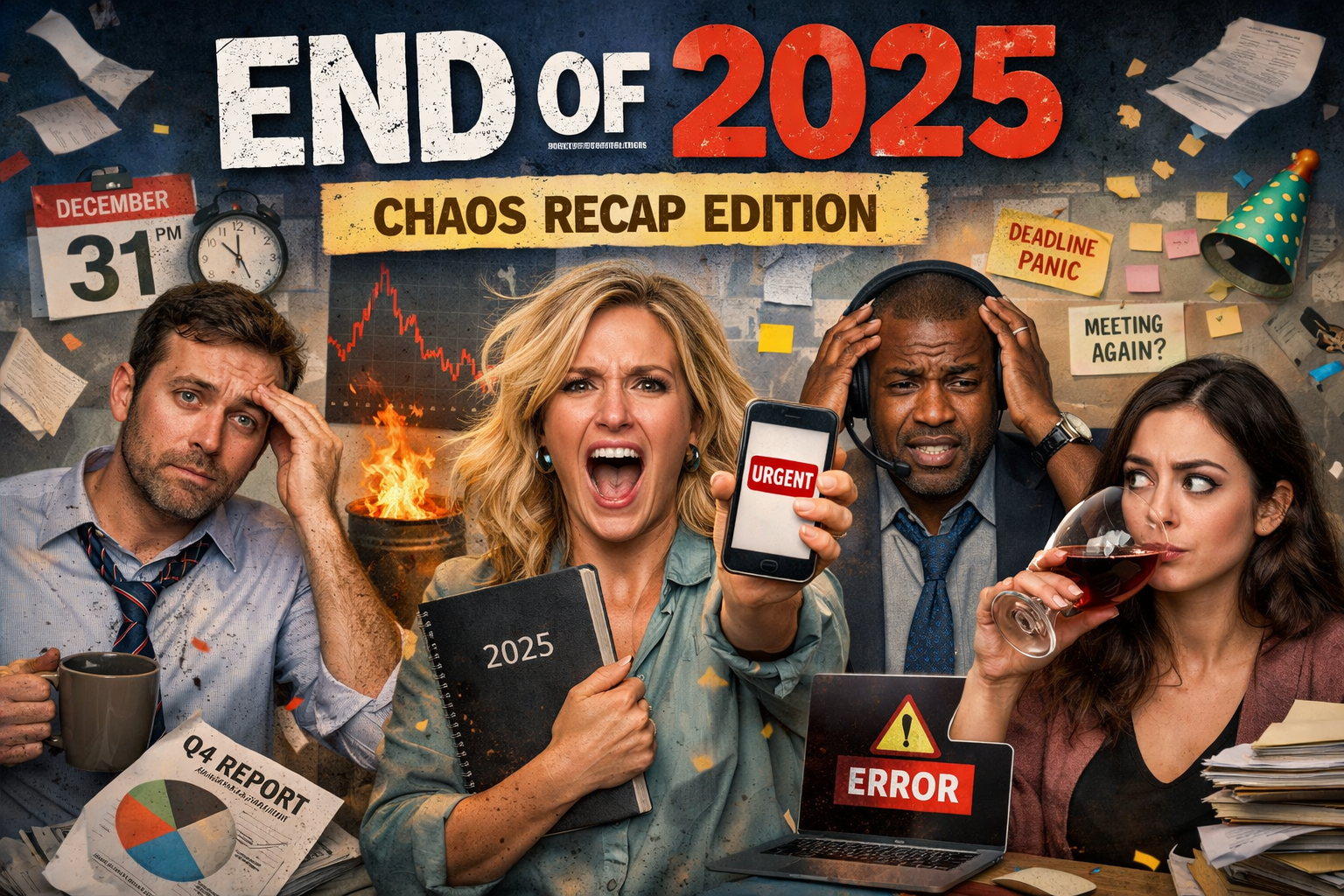
There’s a very specific kind of vibe that shows up at the end of a year, and it’s not peace, or closure, or “rest,” despite what the vision-board industrial complex is trying to sell you with its beige fonts and suspiciously calm women holding mugs while staring out rainy windows. No, the last week of 2025 arrives the way a corporate calendar invite arrives: aggressively, without context, and with a subject line like “Quick Sync: Year-End Alignment” that makes your stomach drop even though you are technically at home, in sweatpants, holding a plate of leftover cookies like a fragile emotional support device.
And suddenly, everyone becomes a philosopher.
People you haven’t heard from since February emerge from the LinkedIn fog to announce, with the solemn authority of someone about to read from an ancient scroll, that “2025 taught me resilience” and “this year was about boundaries” and “if it doesn’t align with your purpose, it’s a no.” Meanwhile your purpose is currently hiding under a blanket, whispering, “Please stop emailing me,” because you cannot align with anything right now except the couch and the nearest power outlet.
The recap posts start multiplying like unpaid interns.
Your phone becomes a nonstop parade of year-end summaries: streaming apps telling you that you listened to the same sad song 47 times in one week, your bank app politely informing you that your “top category was: feelings,” and your email inbox blasting you with messages like “LAST CHANCE: Use your benefits before midnight!” as if your dental plan is going to burst into flames if you don’t schedule a cleaning in the next twelve minutes.
And in the middle of all that, you’re supposed to reflect.
Not casually. Not like a normal person. You’re supposed to do it publicly, with a carousel post, a soft smile, and a caption that implies you have gracefully overcome every obstacle with poise, while secretly you are still thinking about that one meeting in April where someone said, “Let’s circle back,” and your soul left your body and filed a forwarding address.
So yes. Let’s recap 2025.
Not the highlight reel. Not the “gratitude and growth” version.
The real one.
The version where we all tried our best, got humbled by the calendar, and learned, once again, that time is fake and consequences are immediate.
January Was a Delusion and We All Signed the Contract
January 2025 started the way every January starts: with a collective lie.
We told ourselves this year would be different because we bought a planner with thick paper, we reorganized one drawer, we drank water one time like it was a spiritual rebirth, and we decided we were going to be the kind of person who doesn’t check email from bed. For roughly seven days, this went great, mostly because nobody was emailing yet and half the world was still pretending they were “easing back in.”
Then reality clocked in.
Suddenly, the “fresh start” energy was replaced with the immediate realization that everything you avoided in December didn’t disappear, it simply waited politely in the corner like a debt collector with a calendar. Projects reactivated. Slack pings reappeared. The phrase “Q1 priorities” returned like a seasonal virus, and you remembered that most goals are not goals, they are just the emotional consequences of having a job.
We made ambitious lists anyway.
We said things like, “This year I’m going to focus on what matters,” as if what matters won’t immediately email you with a subject line like URGENT and a body that contains exactly zero information. We declared we would “protect our peace,” and then we volunteered for three committees because we are still, fundamentally, learning boundaries the way most people learn accounting: through painful trial and public embarrassment.
January was not a month.
January was a motivational speech delivered by a person who has never seen your inbox.
And by the time February arrived, half of us were already negotiating with ourselves like, “Okay, the spirit of the goal still counts,” and the other half were still trying to find the charger for the new habits we bought.
The Middle of the Year Was a Group Project with No Leader
Somewhere around March through September—time becomes a blur, and that’s not a metaphor, that’s an actual symptom of being alive in 2025—the year shifted into its true form: a long, chaotic group project where everyone is confused, nobody has the rubric, and one person keeps saying, “Let’s take this offline,” like that sentence has ever fixed anything.
This was the season of sudden pivots.
Plans changed weekly. Processes got “optimized” until they no longer resembled anything functional. People quit, joined, got promoted, got reorganized, got “reassigned,” got “transitioned,” got “sunset,” got “realigned,” got “rightsized,” and at least one person got asked to do two jobs “temporarily,” which is corporate language for, “Congratulations, you have been adopted by chaos.”
And everyone was tired in a way that felt extremely personal.
Not just “I need a nap.” More like “I don’t remember what I like anymore and I flinch when Outlook opens.” There was a special kind of exhaustion that came from being constantly reachable, constantly improv-ing, constantly pretending you were fine while your nervous system ran on a subscription plan you did not authorize.
This was also the year of the performance of productivity.
We attended meetings about meetings. We sent follow-ups about follow-ups. We created trackers to track the tracking. We were asked to “be more strategic” by people who couldn’t define strategy without using the phrase “north star.” We wrote status updates so detailed they could be used as legal documents, and then watched as nobody read them because nobody reads anything anymore, including the thing they asked you for, including the policy they wrote, including the email they sent.
And still, somehow, you got through it.
Not because you were magically inspired.
Because you adapted.
Because you learned which fires were real and which ones were just someone else’s anxiety in a trench coat.
Because you discovered that half of adulthood is staying calm while you quietly Google, “Is this normal?” and the other half is making jokes so you don’t scream in a company-wide chat.
The Final Quarter Was a Sprint with a Broken Shoelace
Then came Q4, the part of the year where corporations behave like a person who suddenly remembers they have a final exam tomorrow and decides the solution is to drink three energy drinks and aggressively highlight a textbook they never opened.
Everything became urgent.
Budgets had to be used. Goals had to be hit. Metrics had to be “closed.” People started speaking in deadlines the way ancient prophets spoke in omens: “We need this done before year-end,” they said, as if midnight on December 31 is a magical portal where incomplete work gets incinerated and your performance review is carved into stone tablets by HR.
The holiday season arrived, and with it, the yearly confusion about what “slow week” means.
Some people disappeared entirely, leaving behind vague auto-replies like “Out of office with limited access,” which we all know is the corporate version of witness protection. Other people stayed online and acted like it was a normal Tuesday, sending 8:17 p.m. messages that began with “Quick question,” and ended with you staring at the screen, wondering if “quick” is a psychological experiment designed to test your ability to remain employable.
Then the reflections started.
You saw posts about growth and gratitude from people who spent the year publicly melting down in comment sections. You saw “I learned to let go” from someone who absolutely did not let go of anything, including a minor typo you made in June. You saw “I’m proud of what I built” from leaders who built exactly one thing: a culture of unnecessary urgency.
And still—still—there were moments that landed.
There were quiet wins that didn’t get announcements.
There were days you didn’t give up.
There were mornings you showed up when you didn’t feel like yourself.
There were boundaries you set, even if they were imperfect and shaky and mostly enforced through strategic silence.
There was the simple fact that you are here at the end of 2025, which means you survived an entire year of modern life, and that is not nothing.
That is a full accomplishment, even if you did it with caffeine, sarcasm, and the emotional stability of a toddler holding a juice box.
Final Thoughts
So yes, 2025 was chaos.
It was messy and loud and weirdly fast, like the year was speeding and we all forgot our seatbelts. It was filled with curveballs, reroutes, and “surprise” challenges that were only surprising because we keep expecting life to be reasonable, even though life has never once been certified in reasonability.
But if we’re going to do a recap, let’s do it honestly.
You made it through a year that asked a lot.
You learned things you didn’t ask to learn.
You adjusted to changes you didn’t vote for.
You carried responsibilities that didn’t come with extra pay, extra help, or extra patience from the people who assigned them.
And you still found a way to laugh, even if it was a slightly unhinged laugh, the kind that shows up when you close your laptop and stare into the middle distance like you’ve seen things.
End of 2025 isn’t just a finish line.
It’s a receipt.
A proof of purchase for everything you endured.
So if you’re closing out the year feeling behind, or tired, or weirdly emotional, or like you should have done more—consider this your reminder that surviving the chaos counts, and sometimes the biggest flex is simply reaching December 29 with your personality still intact and your email signature not updated to “Regards, this is a simulation.”
Now go into 2026 with whatever you have left.
Hope, grit, spite, a planner, a drink, a nap, a new boundary, a slightly stronger “no,” a slightly softer “yes,” and the deep, unwavering knowledge that if the world tries to throw more chaos at you next year, you already have experience.
You are, unfortunately, a seasoned professional.