
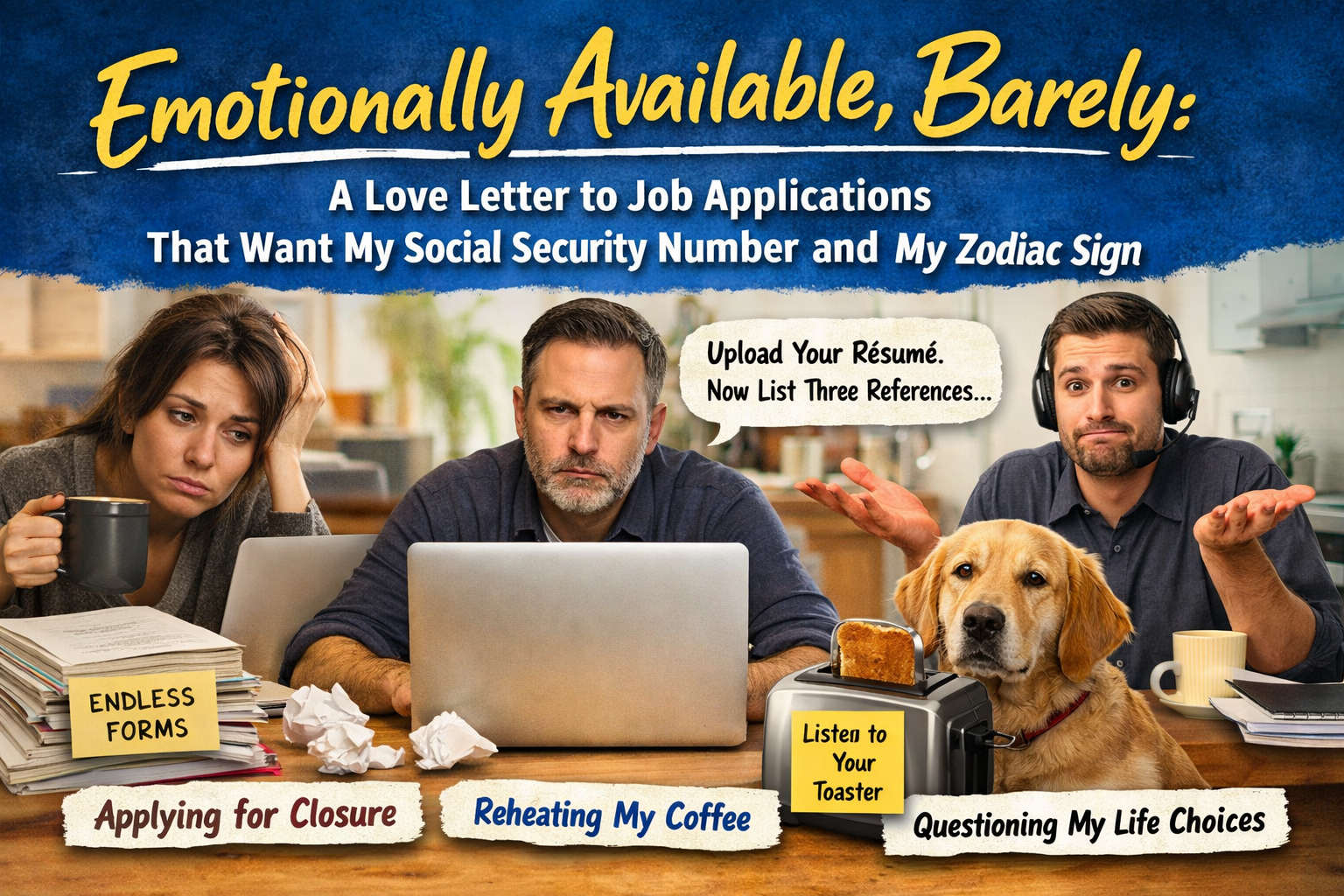
There’s a special kind of optimism that lives inside people who click “Apply Now” in the year 2026, because that simple button is never a button, it’s a trapdoor disguised as opportunity, a brightly colored hyperlink that drops you into a labyrinth of mandatory fields, suspicious questions, and the emotional ambience of a DMV that also teaches improv.
You start confident, too. You have your résumé open. You have your cover letter saved as “FINAL_final_REALLYFINAL_THISONE.docx.” You’ve even dressed up your LinkedIn headline like it’s going to court. You are ready to be perceived as a competent adult.
Then the portal hits you with: “Describe yourself in three words.”
And you realize this isn’t a job application. This is a psychological endurance sport.
Because what do they want here? Honest? Polished? Human? Brand-safe? A TED Talk in miniature? You can’t put “tired” because they’ll call it negative, you can’t put “ambitious” because they’ll call it cliché, and you can’t put “emotionally available” because that implies you have feelings and we all know feelings are only allowed if they can be tracked in a KPI dashboard.
So you give them the truth, the version that has survived recruiters, algorithms, and auto-rejection emails that arrive faster than Amazon Prime.
“Emotionally. Available. Barely.”
Congratulations. You have now entered the interview process as a person instead of a file.
That’s your first mistake.
Because the portal, like an ancient bureaucratic deity that feeds on hope, does not want a person. It wants data. It wants you to prove you exist by typing your entire life into 47 boxes that were designed by someone who hates punctuation and thinks “Work History” should feel like confessing to a crime.
And after enough questions, you begin to understand something important: you are no longer applying for a job.
You are applying for closure, caffeine, and a reason to believe in HR again.
The Three Word Trap and Other Ways to Accidentally Reveal Your Soul
“Describe yourself in three words.”
A question so small, so innocent, so deceptively simple, it might as well be printed on a clown car that’s driving toward your nervous system at full speed.
Because you know what they’re really asking, right?
They’re asking: Can you market your entire existence like a product without sounding like a product?
They’re asking: Can you be unique in three words, but not too unique, because unique is risky and risky is inconvenient?
They’re asking: Can you do personality in a format that fits inside a corporate textbox that is, for reasons unknown, only 100 characters long?
They don’t want three words. They want a prophecy.
So you stare at the screen and your brain begins offering options like a broken vending machine.
“Hardworking. Dedicated. Reliable.”
Those are the three words of someone who has never been hurt.
“Driven. Results-focused. Strategic.”
Those are the three words of someone who owns multiple blazers and cries in Excel.
“Collaborative. Passionate. Resilient.”
Those are the three words of someone who has been through at least one layoff and is still trying to be polite about it.
But you, dear applicant, have been forged in the heat of ghosting, rejection, and auto-generated emails that begin with “Thank you for your interest” and end with “We will be pursuing other candidates” before your coffee even finishes brewing.
So you answer like a person who has lived.
“Emotionally. Available. Barely.”
And suddenly the application becomes intimate. It becomes honest. It becomes the first time you’ve told the truth without a filter since you started job searching.
And that is when the portal, offended by authenticity, tries to regain control.
It asks for a fun fact.
A fun fact.
As if you are a dolphin in captivity and this is the part where you do tricks for a fish.
So you offer what you have.
“I’ve been ghosted by more recruiters than people I’ve dated.”
That’s not just a fun fact. That’s a timeline. That’s an era. That’s a documentary series with eight episodes and a reunion special.
But the portal doesn’t laugh. The portal doesn’t care. The portal is incapable of joy.
The portal simply loads the next question like it’s wiping away your humanity with a dry paper towel.
And now you understand the rules.
This isn’t about knowing yourself.
This is about surviving a system that treats self-awareness like a liability.
“Why Do You Want to Work Here?” Because My Toaster Says I Need Stability
Then it comes. The question that has ended more sincerity than any other phrase in corporate America.
“Why do you want to work here?”
This question is fascinating because it is rarely asked by companies who have also asked themselves, “Why would someone want to work here?”
But okay. Sure. Let’s play.
You want to answer honestly. You want to say:
“Because I need health insurance and the rent is not impressed by my potential.”
You want to say:
“Because I’ve been in the job market long enough to know stability is a luxury item.”
You want to say:
“Because I have skills and bills, and they are currently in a heated negotiation.”
But you can’t.
Because the question is not designed for truth. It is designed for performance.
It is designed for you to flatter them in the language of corporate romance.
So you sit there, trying to write something tasteful and professional, while your spirit quietly files for bankruptcy.
And then, out of nowhere, your toaster speaks.
Not literally, but spiritually.
Because everything in your kitchen has watched you reheat coffee three times while staring into the middle distance, wondering if your résumé is haunted.
So you type what your entire household has been thinking.
“Because my toaster said I can’t keep living like this.”
And honestly? That’s the most accurate career objective you’ve ever written.
Because job searching is not just applying for roles. It’s negotiating with your own dignity.
It’s clicking through salary ranges that feel like dares. It’s reading job descriptions that ask for ten years of experience in software that was invented during the pandemic. It’s being told you’re “overqualified” by someone whose entire authority comes from a company-branded lanyard.
And still, you try.
You try because you are a responsible adult who is attempting to rebuild a life in a market that behaves like a carnival game.
So you go back and write something “proper.”
You say you admire their mission. You say you’re excited about their culture. You say you want to contribute and grow.
You say all of this while knowing that if they truly cared about culture, they wouldn’t ask you to upload a résumé and then retype it like the portal is suspicious of PDFs.
But you say it anyway.
Because hope is weird like that.
Hope is what makes you compliment a company that hasn’t even emailed you back.
Hope is what makes you act like you’re lucky to be considered by a system that has already replaced you with an automated rejection template titled “Candidate_Disposition_FINAL.”
Upload Your Resume. Now Rewrite Your Entire Life in 47 Boxes.
And now we arrive at the part of the application that feels like a prank that escalated into a lifestyle.
“Upload your résumé.”
You do it. You drag and drop. You watch the little loading bar. You feel accomplished for half a second.
Then the portal smiles the smile of a villain who has read your mind.
“Now retype your entire résumé into 47 different boxes.”
What is the point of the résumé upload, you ask?
There is no point.
The résumé upload is a ceremonial offering. The boxes are the true ritual.
The boxes demand details.
They demand every job title, every date, every supervisor, every duty, every accomplishment, every measurable outcome, every measurable outcome’s measurable outcome, and possibly the name of the teacher who once said you had “a lot of potential.”
And while you’re typing, you begin to realize the portal is not collecting information.
It is collecting obedience.
It wants to see if you will comply with nonsense without questioning it.
It wants to see if you will perform patience, even as your soul is being manually entered into a dropdown menu.
And the dropdown menus, let’s talk about those, because they are always wrong.
Your job title is never listed. Your industry is never accurate. Your degree is never represented in a way that makes you look competent.
You select the closest option, knowing it’s a lie, and then you wonder if you’re disqualified because your career doesn’t fit neatly into the portal’s limited imagination.
Then the references.
Ah, the references.
“List three references who still like you.”
Which is bold, because job searching already requires you to call people you haven’t spoken to since the Before Times and ask them to vouch for your character like you’re trying to adopt a child.
“Hi! Long time! Hope you’re well! Quick question: would you be willing to confirm I’m employable and not emotionally unhinged?”
And somehow, we all do it.
Because we are not applying for jobs anymore.
We are applying for permission to be stable.
And after you hit submit, after you watch the confirmation page flash across the screen like a mirage, you wait.
You wait for a response.
You wait for an email.
You wait for any sign that a human being saw your name and did not immediately hand it to an algorithm with commitment issues.
But nothing comes.
Of course not.
So you do what every mature, emotionally regulated adult does in this moment.
You close the tab. You reheat your coffee. You stare at your dog like he’s your therapist and your attorney.
And you whisper, “I’m too qualified for this chaos.”
And your dog agrees, because your dog has never once asked you to upload your résumé and then retype it, and that makes him the most emotionally intelligent manager you’ve ever worked for.
Final Thoughts: Resilience, Sarcasm, and the Toaster That Never Ghosts
Here’s what nobody tells you: job searching is a full-time job with no pay, no benefits, and a performance review conducted entirely by silence.
It is a strange modern ritual where you are asked to shrink your story into bullet points, inflate your personality into “culture fit,” and somehow remain grateful while being ignored.
And yet, you finished the application.
That matters.
Not because the company deserves you. Not because the portal was fair. Not because HR will suddenly remember you’re a person.
It matters because you did the thing anyway, even when it was ridiculous, even when it was insulting, even when it felt like you were filling out paperwork for a job you were never going to hear back about.
That’s resilience.
That’s endurance.
That’s you, walking through the corporate fog with a reheated coffee and a sense of humor sharp enough to cut through the nonsense.
You may not have the job.
But you’ve got sarcasm, survival instincts, and a Cuisinart toaster that never ghosts you.
And honestly?
In this economy, that is a win.