
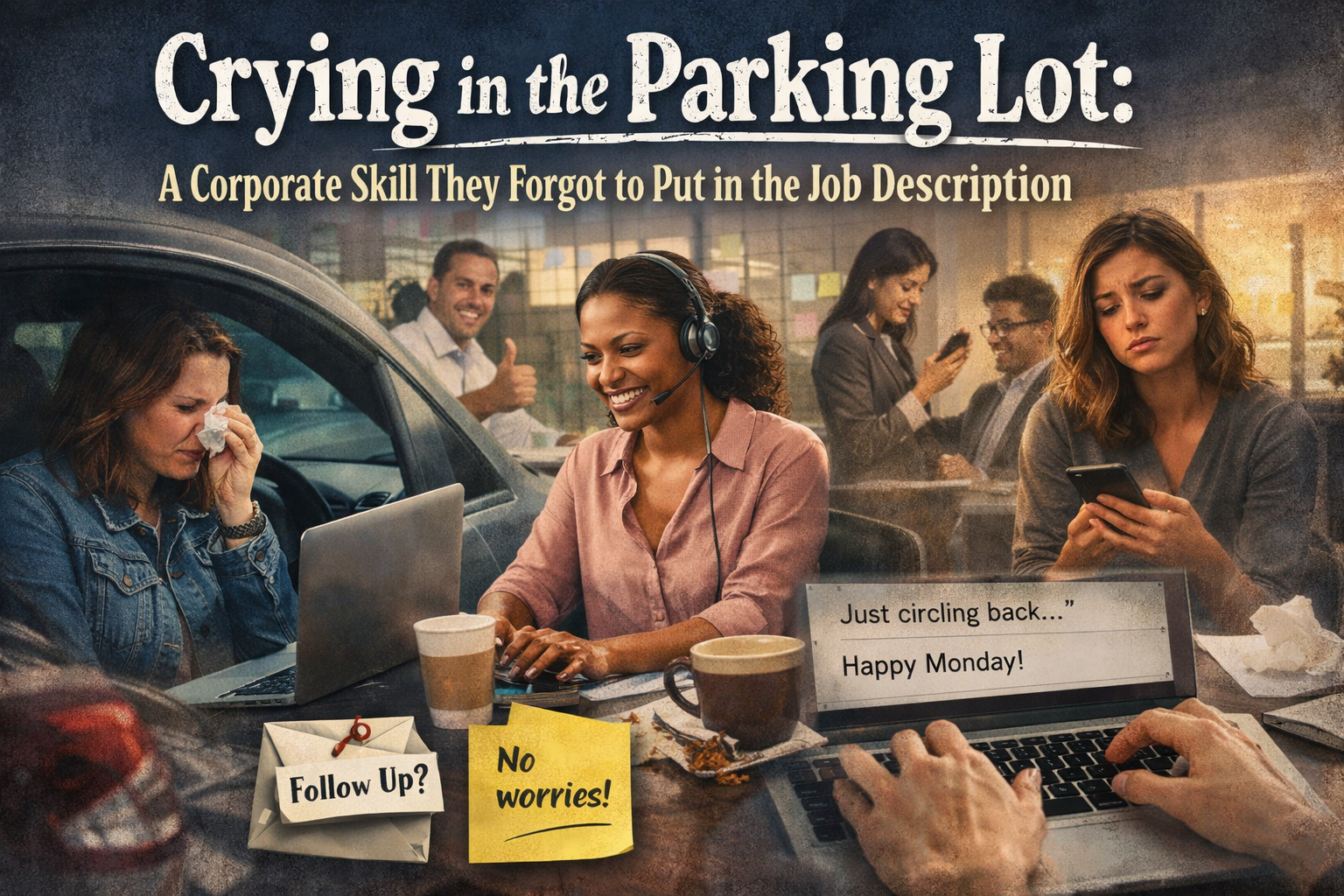
There’s a special corporate superpower no one puts on a resume, not because it isn’t impressive, but because if you write it down in plain English it sounds like something a court-appointed therapist would highlight with a yellow marker and slide across the desk with a long, silent stare.
It’s the ability to cry in a parking lot, take three shaky breaths that feel like they’re being manually downloaded through dial-up, open your laptop, and type “Happy Monday!” like you didn’t just have a full-body emotional event in the driver’s seat of a 2016 Honda Civic while the radio calmly played an ad for a mortgage you will never qualify for because your job is currently sponsored by vibes and a prayer.
And if you’re reading that and nodding like, “Yes. That’s accurate,” congratulations. You have been raised by corporate culture. Not hired. Not trained. Raised.
Because corporate life doesn’t just teach you skills. It teaches you how to edit your humanity into something that can be forwarded without causing concern. It teaches you how to be “resilient” in the same way a folding chair is resilient: technically still standing, but visibly one meeting away from collapse. It teaches you how to turn genuine feelings into respectable euphemisms. “I’m struggling” becomes “I’m navigating a transition.” “This is hurtful” becomes “I wanted to flag a potential misalignment.” “I have been emotionally haunted by this conversation for three days” becomes “Just circling back.”
You learn Corporate Neutral the way people learn a second language: through immersion, repetition, and fear.
And you start doing things that are objectively wild. Like rewriting an email twelve times so it doesn’t sound like you have a pulse. Like adding “grateful” to prove you’re not bitter, then deleting “grateful” because now it sounds like you’ve joined a gratitude cult, then adding “excited for what’s next” even though what’s next is currently a mystery sponsored by anxiety, insomnia, and the LinkedIn feed.
We laugh at it because if we don’t laugh, we’ll remember that we used to apologize for existing while being extremely competent.
So yes. This is a funny article. But it’s also a documentary. Welcome.
The Parking Lot Is Your Office Now
The corporate parking lot is a sacred place. It’s where you hold private meetings with yourself. It’s where your nervous system clocks in early. It’s where you rehearse being fine before you go perform Fine™ in a building that smells like burnt coffee and policy violations.
It starts innocently. You sit in your car for a minute before work because you’re “just gathering your thoughts.” Next thing you know, you’ve been in the parking lot for twenty-seven minutes conducting a full emotional inventory like you’re at a warehouse counting trauma by barcode.
You have the whole routine down, too.
You cry. But not like a movie cry. Not glamorous. Not a single tear sliding down your cheek while you stare meaningfully into the distance. No. This is parking lot crying: quick, messy, functional. The kind of crying where you’re also checking the time because you have a 9:00 a.m. “quick sync” and you need to stop looking like you’ve been swimming.
You become a professional at the reset. Tissue. Deep breath. Sunglasses if necessary. Water bottle. Pep talk. Then the most important step: opening your laptop and typing words that are completely unrelated to the human experience you just had.
“Happy Monday!”
“Hope everyone had a great weekend!”
“So excited to tackle this week!”
You are not excited. You are awake. That’s what you are.
And the funniest part is the way corporate culture rewards this like it’s normal.
If you show up puffy-eyed but on time, you get labeled “dedicated.”
If you show up visibly exhausted but still smiling, you get labeled “positive.”
If you show up after swallowing your entire emotional life like a vitamin, you get labeled “professional.”
And if you don’t?
If you say, “Actually, I’m not okay,” suddenly everybody remembers HR exists. Suddenly you’re “a concern.” Suddenly someone says, “We just want to make sure you have the support you need,” which is corporate for, “Please cry more quietly next time.”
So you adapt. Because you’re smart. Because you’re capable. Because you’re trying to survive a system that treats feelings like a software bug.
Eventually, your car becomes the only place you can be honest without someone scheduling a follow-up meeting about your tone.
The parking lot is your confession booth. Your decompression chamber. Your emotional loading dock.
And it is insane that so many of us have been doing this long enough to call it “normal.”
Fluent in Corporate Neutral, With a Minor in Self-Erasure
Corporate Neutral is the language you learn when you realize honesty is rarely rewarded, but composure is always appreciated.
It’s not that you become fake. It’s that you become edited.
You start adjusting yourself the way people adjust the brightness on their phone screen. Too much emotion? Dim it down. Too much truth? Slide it toward “strategic.” Too much vulnerability? Turn on Night Mode and hope no one notices you’re blinking back tears.
And the email drafts. My God, the email drafts.
You don’t write emails anymore. You negotiate with them. You approach them like bomb disposal.
You type a sentence.
You stare at it.
You whisper, “That feels too honest.”
You delete it.
You rewrite it with softer edges until it sounds like a polite ghost wrote it.
You remove “honestly” because “honestly” implies you were lying before.
You remove “unfortunately” because it sounds like you’re blaming someone.
You add “thank you” because you want to be perceived as a person who can be trusted around sharp objects.
You add “appreciate your time” because time is the corporate love language.
You delete an exclamation point because it looks unhinged.
You add an exclamation point because now you sound cold.
You reread it twelve times like you’re trying to catch a mistake that will ruin your reputation and also your entire bloodline.
Then you hit send and immediately feel the deep spiritual regret of someone who just handed their dignity to the internet.
Corporate Neutral doesn’t just change how you write. It changes how you think.
You stop saying “I need help” and start saying “Would you be open to partnering on this?”
You stop saying “This is unfair” and start saying “I’m seeking clarity.”
You stop saying “I’m burned out” and start saying “I’ve been in a high-output season.”
A high-output season. As if your exhaustion is a festive time of year. As if burnout is a limited-edition flavor at Starbucks.
And the worst part? You get good at it.
You get so good at it that people start complimenting you for how “calm” you are. They say it like calm is your personality, not your coping mechanism.
You become the kind of person who can be falling apart and still respond to Slack with, “Absolutely! Happy to help.”
Happy. To help. While actively unraveling.
That’s not professionalism. That’s performance art.
And you deserve an award for it. But instead you get more work.
“Just Circling Back” Is a Threat With Business Casual Energy
Let’s talk about follow-ups, because follow-ups are where the corporate nervous system goes to die.
Follow-ups are those messages you send after you’ve been ignored for long enough that your brain starts building conspiracy theories. Not because you’re dramatic, but because your mind hates an open loop.
You send the message because you want closure.
You want clarity.
You want proof that the conversation happened and you didn’t hallucinate an entire professional relationship out of stress and caffeine.
So you type something gentle. Something polite. Something that signals, “I am normal, stable, and not thinking about this constantly.”
“Just checking in!”
“Wanted to follow up!”
“Circling back on this!”
Circling back is my favorite corporate phrase because it makes you sound like a friendly bird when really you are a vulture hovering over your own dignity.
And the tone you have to use is absurd.
You can’t sound annoyed, even though you are.
You can’t sound desperate, even though you are.
You can’t sound emotional, even though you are.
You must sound like someone who casually remembered this email exists, while your heart is doing parkour.
And when they don’t respond?
When they leave you on silence?
Silence teaches lessons nobody asked for.
It teaches you how much emotional labor you were doing for people who offered none back.
It teaches you how often you extended grace like it was a subscription service.
It teaches you that a lot of professionalism is just endurance with better lighting.
Because silence in corporate life isn’t neutral. Silence is a message.
Sometimes it’s “I forgot.”
Sometimes it’s “I’m overwhelmed.”
Sometimes it’s “I don’t value this enough to answer.”
Sometimes it’s “I don’t want to deal with this so I’m letting time do my conflict avoidance for me.”
And no matter the reason, you’re the one left carrying it.
You’re the one rereading your last message, wondering if you sounded weird.
You’re the one trying to decode punctuation like it’s a hostage note.
You’re the one practicing a level of emotional restraint that would qualify you for Olympic trials.
Eventually, something changes.
You stop sending the extra follow-up.
You stop auditioning for approval.
You stop trying to earn closure from people who have already shown you who they are.
And when you do that, it can feel like bitterness at first, because corporate culture trained you to believe that self-respect is the same thing as being difficult.
But it isn’t.
Sometimes maturity looks like closing the laptop and choosing peace over one more professionally traumatic email draft.
Final Thoughts: You’re Not Weak. You’re Overqualified for Endurance.
If this made you laugh in a way that felt suspiciously personal, here’s what I want you to know: you’re not dramatic. You’re not fragile. You’re not “too much.”
You’re just a human being who learned how to survive environments that rewarded silence and punished honesty.
You learned how to minimize yourself to remain palatable. Easy to work with. Low maintenance. Flexible. Resilient. The kind of person who can be emotionally devastated and still say, “No worries at all!”
And listen. That is a skill. A horrifying skill, but a skill.
But you don’t have to keep using it as your default setting.
You don’t have to keep proving how “strong” you are by suffering quietly.
You don’t have to keep polishing pain into professionalism.
You don’t have to keep thanking systems that broke you for the opportunity.
Because that’s wild, actually.
So if lately you’ve been choosing real over polished, peace over chasing, honesty over Corporate Neutral, and silence over one more “just checking in,” that’s not you giving up.
That’s you graduating.
And honestly? Anyone who can cry in a parking lot and still show up deserves way more credit than they ever got.