There was a time, not that long ago when job interviews were theatrical in their own right, but at least everyone showed up in person for the performance. You’d wake up early, iron a shirt you secretly hated, rehearse your “greatest weakness” in the mirror, and pray the bus wouldn’t make you smell like regret. You shook hands that were too firm, sat in chairs that squeaked in betrayal, and made small talk about traffic or weather because that was the ancient currency of professionalism.
You could see the nervous energy in the room, the recruiter pretending to skim your resume while silently judging your tie, and you pretending to be “a people person” despite wishing you were home under a blanket of existential dread. Everything was visible: the sweat, the awkward pauses, the desperate smiles. There was no hiding behind bandwidth issues or strategically “accidental” mute buttons.
Then came the great digital migration, that global moment when offices became living rooms, and “Can you hear me now?” replaced “Good morning.” Cameras became windows into people’s chaos, cats performing stunts, toddlers staging coups, Wi-Fi connections collapsing under the pressure of capitalism. The once sacred ritual of the job interview was reduced to pixels, lag, and the occasional accidental unmute.
At first, everyone tried to maintain appearances. Bookshelves were curated. Backgrounds were blurred. People pretended their homes smelled like productivity instead of leftover takeout. There was an art to it, professional lighting, rehearsed smiles, strategically placed plants meant to whisper, “I have emotional stability.” But then fatigue set in. The longer we lived in this virtual circus, the more we collectively gave up.
Now, in 2025, we’ve entered the era of the Camera Off Renaissance, where faces are optional, engagement is theatrical, and everyone silently agrees that pretending to care is the new form of professionalism. This is the story of how corporate America traded handshakes for hover-over initials and discovered that maybe, just maybe, we were all happier not being perceived at all.
The Great Camera-Off Justification
Every digital generation develops its own excuses, and ours will be remembered for the majestic creativity of the “camera off” justification. It’s the professional equivalent of “my dog ate my homework,” except now it’s, “my camera’s acting up,” or “I’m having some lighting issues,” or the timeless, “I’d love to turn it on, but my bandwidth can’t handle it.”
Let’s be honest, your Wi-Fi can handle four streaming services, your Spotify playlist, and your roommate’s video game marathon. What it can’t handle is your self-esteem when you see your reflection at 9:00 a.m. under harsh laptop lighting.
There’s an entire symphony of facial expressions behind that black square, the panic of being asked a question you didn’t prepare for, the smug satisfaction when you nail a rehearsed answer, the relief when you realize no one can see your resting “hire me or I’ll cry” face.
Recruiters, of course, play along. They, too, are battling their own on-camera fatigue. No one wants to perform corporate enthusiasm while sitting two feet away from a pile of laundry. So both parties engage in a silent truce. “Camera off?” “Of course, no problem!” It’s not just accepted, it’s expected.
The truth is, the camera-off movement isn’t laziness; it’s rebellion. It’s the modern worker’s declaration that they refuse to turn their personal space into a stage. You’re not disengaged, you’re establishing emotional boundaries between your self-worth and your internet speed. You’re conserving your face for better days.
And so the game continues: one side pretending their webcam is broken, the other pretending to care about engagement. Somewhere, in the silent void of muted microphones, both sides whisper: thank God.
The Theater of the Floating Initials
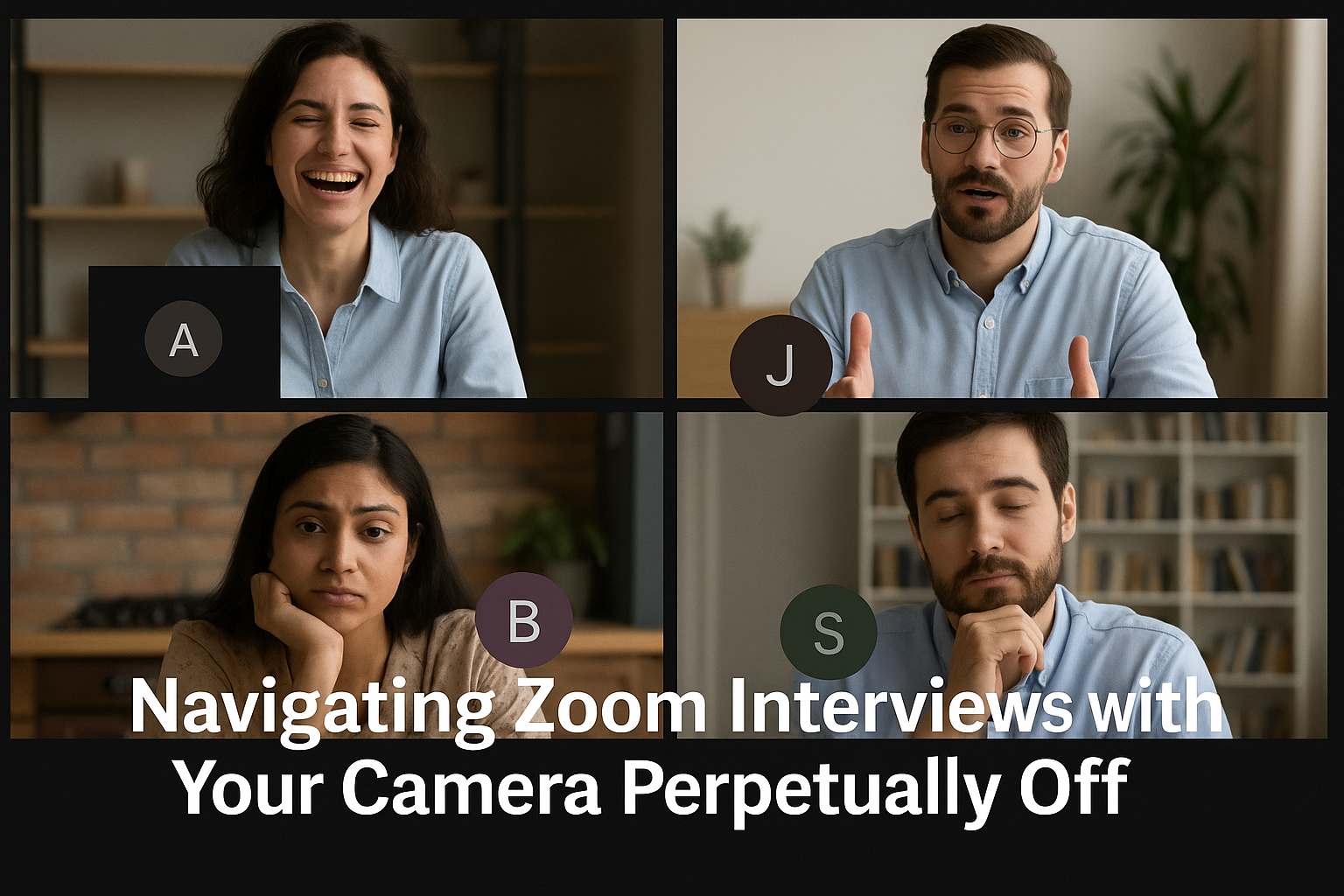
If Dante had written The Divine Comedy today, one of the circles of modern professional hell would absolutely be the Zoom gallery view: a dark constellation of initials floating in silence. It’s haunting, poetic, and deeply depressing, like a séance for productivity.
Each letter represents a mystery. Who is “K”? Are they even there? Is “T” paying attention or microwaving something mid call? Nobody knows. You start talking to your screen, pitching yourself passionately to a wall of vowels and consonants, and the only response is digital stillness, the kind that feels personal.
Recruiters narrate slide decks like lonely audiobook narrators, pausing for questions that never come. Candidates, meanwhile, nod at nothing, terrified that unmuting might expose them eating cereal or whispering “I hate this” under their breath. Every thirty seconds, someone’s dog interrupts. Every sixty seconds, someone says, “Oh sorry, you go ahead.” It’s the symphony of modern work, the sound of humans trying to communicate without eye contact or serotonin.
And yet, there’s a strange freedom in this detachment. The floating initials have become our armor. They protect us from judgment, bad lighting, and the intrusive thought that maybe, just maybe, we’re all slowly becoming customer service AIs.
It’s performance art, really — a minimalist masterpiece titled “Human Connection (2025 Remix).” It’s about pretending to be engaged while secretly Googling “Is it unprofessional to eat during a virtual interview?” or “How long should I fake nod after a recruiter stops talking?”
Behind every black square lies a reality: people are tired. They’re overexposed, overworked, and over-Zoomed. The floating initials represent not apathy, but survival, a digital shield for our collective burnout.
The Post-Interview Debrief Nobody Asked For
When the meeting finally ends, everyone leaves like survivors of a social experiment gone wrong. The recruiter clicks “End Call for All,” then sits in silence, unsure if anyone they just spoke to was real. The candidate stares at their reflection in the darkened screen, unsure if they just interviewed for a job or a simulation.
Five minutes later, the post interview autopilot begins. The recruiter sends a templated “Thanks for your time!” email that radiates the emotional warmth of a parking ticket. The candidate, still caffeinated and delusional, writes a polite thank you note, desperately pretending to believe in “next steps.” Neither will remember the other’s voice by Friday.
The whole exchange feels like a modern ghost story. No body language, no laughter, no shared awkward silence, just the eerie hum of professionalism without connection. We’ve turned interviews into sterile rituals: smile on command, answer behavioral questions, then vanish into digital dust.
And yet, somewhere deep down, both sides know this isn’t sustainable. Humans need faces, gestures, and moments of imperfection, the eye contact that says I get you, the nervous laugh that says I’m human too. We’ve replaced all that with a mute button. We’ve traded authenticity for convenience.
Still, we keep showing up, camera off, heart cautiously on. Because maybe, just maybe, the next call will be the one where someone turns their camera on, looks like a real person, and says something genuine. Something like, “Sorry, my cat just walked across my keyboard,” or “This is my third interview today, and I’m running purely on caffeine and delusion.”
That’s when it hits you, those are the moments that remind us why we ever turned cameras on in the first place. Not to look perfect. Not to perform. But to prove that even through the lag, the static, and the chaos, we’re still here, still trying, still human.
Final Thought:
One day, historians will study this strange period of human evolution and marvel at our ability to work, connect, and interview through pure exhaustion. They’ll find footage of floating initials, muted voices, and the faint, desperate whisper of “You’re still on mute.”
And they’ll say: these people lived through chaos, and their legacy was simple, they turned their cameras off, but they never truly disconnected.






Thank you for your sharing. I am worried that I lack creative ideas. It is your article that makes me full of hope. Thank you. But, I have a question, can you help me?
Can you be more specific about the content of your article? After reading it, I still have some doubts. Hope you can help me. https://www.binance.info/register?ref=JW3W4Y3A
Thanks for sharing. I read many of your blog posts, cool, your blog is very good.
Your article helped me a lot, is there any more related content? Thanks! https://www.binance.com/register?ref=IXBIAFVY
Your article helped me a lot, is there any more related content? Thanks!